
We may earn a commission when you buy through links on this page, at no extra cost to you. It never decides what we recommend. How we make money
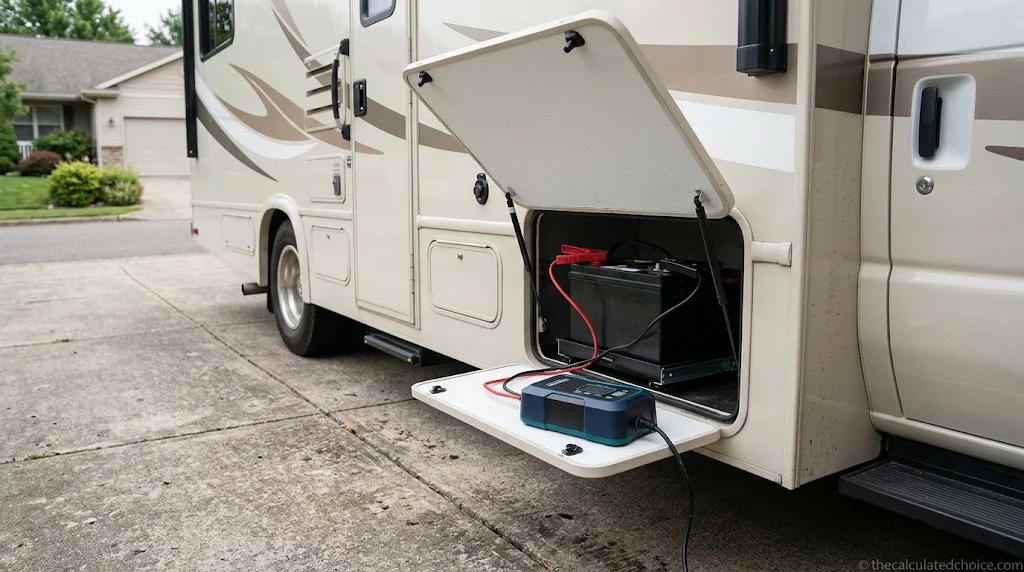
Choosing the best battery maintainer for RVs requires sizing for much larger battery banks and constant parasitic loads than you find in a passenger car. A travel trailer or fifth wheel typically carries one or two 12-volt deep-cycle house batteries (80 Ah to 200+ Ah) or a pair of 6-volt GC2 golf cart batteries wired in series (roughly 200 to 230 Ah), while a Class A, B, or C motorhome adds a separate engine chassis starter battery up front. Even when you flip the main cabin disconnect switch off, hardwired safety gear—like an RV propane and carbon monoxide detector that draws a small current around the clock—plus natural chemical self-discharge steadily drain those banks in storage.
Picking the wrong charger, or relying on an older single-stage RV converter, shortens battery life fast. According to Interstate Batteries’ Marine/RV battery maintenance guide, a flooded RV battery kept at 80°F can self-discharge about 25% of its capacity in three to four months, and regularly draining a deep-cycle battery to 100% depth of discharge instead of 50% cuts its cycle life from about 1,000 cycles to about 250. Overcharging is the other trap: Interstate notes that needing to add water every two to three weeks is a sign your charger or converter is overcharging.
We cross-checked Keepa sales-rank history, buyer review stability, and engineering manuals from NOCO, Victron Energy, and CTEK to find six smart RV battery maintainers—covering portable clamp-on units and sealed IP68 two-bank onboard chargers—that keep both house and chassis batteries healthy in storage.
Quick answer
- Best overall portable for RV house batteriesNOCO GENIUS10 (10A, 6V/12V) — Recharges and maintains deep-cycle RV house banks up to 230Ah (flooded, AGM, gel, and LiFePO4) and includes a 13.6V/10A DC power supply mode.Check price →See review ↓
- Best compact / chassis batteryNOCO GENIUS5 (5A, 6V/12V) — Half the size and output of the GENIUS10, sized for single Group 24/27 trailer batteries or motorhome engine starting batteries up to 120Ah.Check price →
- Best onboard 2-bank (chassis + house)NOCO GEN5X2 (10A total: 5A × 2 banks) — Hardwired IP68 waterproof charger with two independent 5A channels to maintain your motorhome starter battery and house battery at the same time.Check price →
- Best heavy-duty onboard 2-bankNOCO GENPRO10X2 (20A total: 10A × 2 banks) — Doubles output to 10A per bank (up to 230Ah each) with thermal compensation and Repair mode on each bank.Check price →
- Best Bluetooth / lithium RV pick (premium)Victron Blue Smart IP65 12V/10A — UL 1236 listed 7-stage charger with VictronConnect Bluetooth monitoring, a 3A low-current toggle, LiFePO4 under-voltage wake-up, and a 13.2V storage stage.Check price →
- Best for lead-acid / AGM storageCTEK MXS 5.0 40-206 (4.3A, 12V) — Proven 8-step pulse maintainer for 12V lead-acid and AGM batteries up to 160Ah (not compatible with lithium).Check price →
Our picks at a glance
Use this table to compare our six Keepa-verified picks by output amperage, number of charging banks, supported battery chemistries, weather sealing, and warranty coverage.
| Pick & Best For | Output & Banks | Max Capacity & Chemistries | Special RV Modes | IP Rating & Safety Cert | Warranty & Price |
|---|---|---|---|---|---|
| NOCO GENIUS10 Best overall portable | 10A DC × 1 bank (6V / 12V) | Up to 230Ah (maintains all) Wet, Gel, AGM, LiFePO4 | 13.6V Supply Mode, 12V Repair, 0V Force | IP65 Spark-proof | 3 years $$ |
| NOCO GENIUS5 Best compact / chassis | 5A DC × 1 bank (6V / 12V) | Up to 120Ah (maintains all) Wet, Gel, AGM, LiFePO4 | 12V Repair Mode, 1V start / 0V Force | IP65 Spark-proof | 3 years $$ |
| NOCO GEN5X2 Best onboard 2-bank | 10A total: 5A × 2 banks (12V per bank) | Up to 120Ah per bank Wet, Gel, AGM, LiFePO4 | Independent chemistry per bank, 0V Force | IP68 waterproof UL 1236 | 3 years $$$ |
| NOCO GENPRO10X2 Best heavy-duty 2-bank | 20A total: 10A × 2 banks (12V per bank) | Up to 230Ah per bank Wet, Gel, AGM, LiFePO4 | Independent mode + Repair per bank | IP68 waterproof Spark-proof | 3 years $$$ |
| Victron Blue Smart 12V/10A Best Bluetooth / lithium | 10A max / 3A low × 1 bank (12V only) | 30Ah–100Ah recommended Wet, AGM, Gel, LiFePO4 | Bluetooth app, 13.2V storage stage, 12V Supply | IP65 UL 1236, CSA C22.2 | 5 years $$$ |
| CTEK MXS 5.0 (40-206) Best lead-acid / AGM storage | 4.3A DC × 1 bank (12V only) | Charges 110Ah / Maintains 160Ah Wet, AGM, Gel (NO lithium) | 8-step pulse float, AGM & Recond modes | IP65 Splash/dust proof | 5 years $$ |
The 6 best battery maintainers for RVs
Whether you pull your travel trailer batteries into a home garage for off-season storage or want a permanent waterproof dual-bank maintainer bolted inside a motorhome compartment, these six chargers passed our Keepa and manual checks.
NOCO GENIUS10 10A Smart Battery Charger, Maintainer & Desulfator
Best for: Single 100Ah–200Ah 12V deep-cycle RV house banks, dual parallel Group 24/27 batteries, and 6V GC2 golf cart batteries
For most RV owners who want one portable charger strong enough to recover a depleted deep-cycle bank and gentle enough to float-maintain it all off-season, the NOCO GENIUS10 is our top pick. According to NOCO’s GENIUS10 technical specifications, it outputs 10 amps DC across both 6V and 12V batteries and is rated to charge banks up to 230 Ah (while maintaining any size). It supports flooded, gel, AGM, and 12V LiFePO4 lithium profiles, includes a 13.6V/10A DC Supply mode (which keeps your RV’s 12V radio presets and control boards powered while you swap a battery), and carries an IP65 enclosure with a 3-year limited warranty.
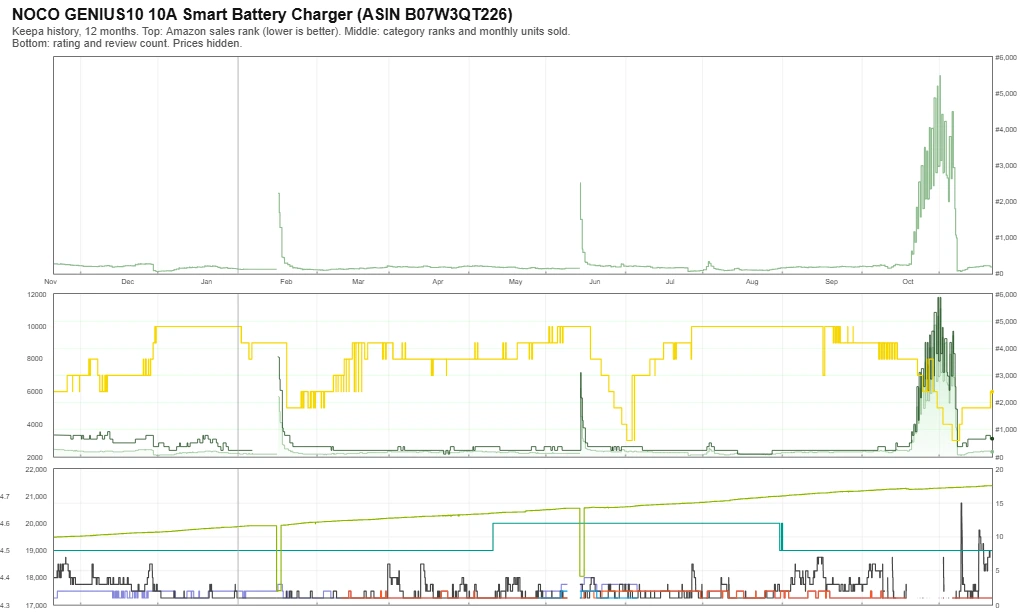
On Keepa, the GENIUS10 holds a 4.3-star rating across more than 21,000 reviews with high, year-round sales velocity among RV, marine, and truck owners.
Fine print: Per NOCO’s spec sheet, the integrated eyelets built inside the GENIUS10’s removable clamps are M10 (3/8-inch) ring terminals, sized for the 3/8-inch threaded studs common on marine and RV deep-cycle batteries. Also note that while the GENIUS10 has a 6V AGM mode alongside 6V standard, its Lithium (LiFePO4), Supply, and Repair modes operate on 12V systems only.
What we like
- 10A output refills a half-drained 100Ah house battery in well under a day, where a 1A unit would take days
- 6V and 12V modes let you charge individual 6V golf cart batteries or maintain a full 12V series/parallel bank up to 230Ah
- Built-in M10 (3/8-inch) ring eyelets fit threaded RV deep-cycle battery studs directly
Watch out for
- Single-bank output cannot maintain an isolated motorhome chassis battery and house bank at the same time
- Uses NOCO’s proprietary X-Connect plug rather than a generic 2-pin SAE connector
Verdict: The best all-around portable RV charger and maintainer for 100Ah to 230Ah house banks across lead-acid, AGM, and lithium. Skip it if you want a permanent dual-bank charger for both a motorhome engine battery and house battery—choose the GEN5X2 or GENPRO10X2 below.
NOCO GENIUS5 5A Smart Battery Charger & Maintainer
Best for: Single Group 24/27 travel trailer batteries or dedicated motorhome chassis starting batteries up to 120Ah
If your travel trailer or pop-up camper runs a single Group 24 (75–85 Ah) or Group 27 (90–105 Ah) battery—or you need a dedicated maintainer for your Class A or Class C motorhome’s engine starting battery—you do not need to pay for a 10-amp unit. According to NOCO’s GENIUS5 specifications, the NOCO GENIUS5 delivers 5 amps DC at 6V and 12V for batteries up to 120 Ah across flooded, gel, AGM, and 12V LiFePO4 chemistries. It packs an onboard thermal sensor (-4°F to 104°F), 1V low-voltage sensing with 0V Force Mode, a 12V Repair desulfation cycle, an IP65 housing with a mounting bracket, and a 3-year limited warranty.
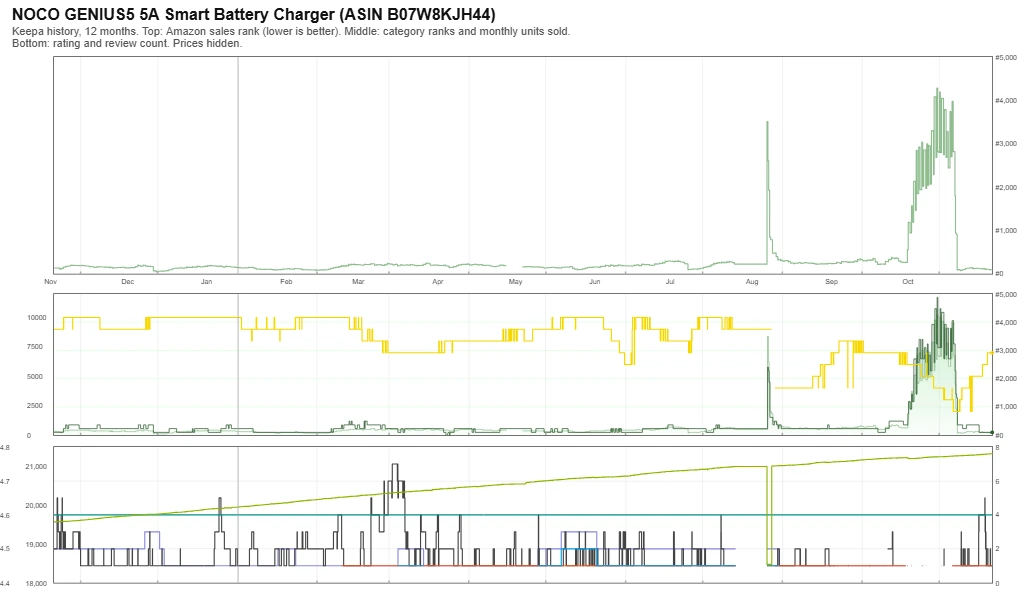
On Keepa, the GENIUS5 holds a 4.6-star rating across more than 21,000 reviews with strong, consistent rank stability.
Fine print: Unlike the GENIUS10 (which uses larger M10 3/8-inch eyelets), the GENIUS5 specification page notes that its removable clamps house smaller M6 (1/4-inch) eyelets. On a marine/RV battery with a 5/16-inch negative stud and a 3/8-inch positive stud, you will need to use the clamp jaws on the larger stud.
What we like
- Right-sized 5A output for single 75Ah–120Ah RV starter and house batteries at a lower price than 10A chargers
- Supports 6V and 12V flooded, AGM, gel, and 12V LiFePO4 batteries with automatic temperature compensation
- Includes a strap-style wall-mounting bracket and 12.4 feet of combined AC and DC cable reach
Watch out for
- Included M6 (1/4-inch) eyelets are too small to slip over 3/8-inch marine/RV wingnut studs without using the clamp jaws
- Does not include the 13.6V DC Supply mode found on the GENIUS10
Verdict: An ideal 5A maintainer for single-battery trailers and motorhome chassis batteries up to 120Ah. Skip it if you have a dual-battery 200Ah house bank or want 3/8-inch ring terminals included in the box.
NOCO GEN5X2 2-Bank 10A (5A/Bank) On-Board Battery Charger
Best for: Motorhomes that need to maintain an AGM/lead-acid engine starter battery and a separate house battery simultaneously
The biggest headache in a Class A, B, or C motorhome is that the onboard RV converter often charges only the house battery when plugged into shore power, leaving the engine chassis battery to die in storage. The NOCO GEN5X2 solves that permanently. It is a hardwired two-bank charger that delivers 5 amps per bank (10A total) to two separate 12V batteries up to 120 Ah each. Because each bank is completely independent, you can set Bank 1 to 12V AGM or Flooded for your motorhome’s starter battery and set Bank 2 to 12V Lithium (LiFePO4) for your upgraded house battery. It is fully potted to an IP68 waterproof rating, certified to UL 1236, and backed by a 3-year limited warranty.
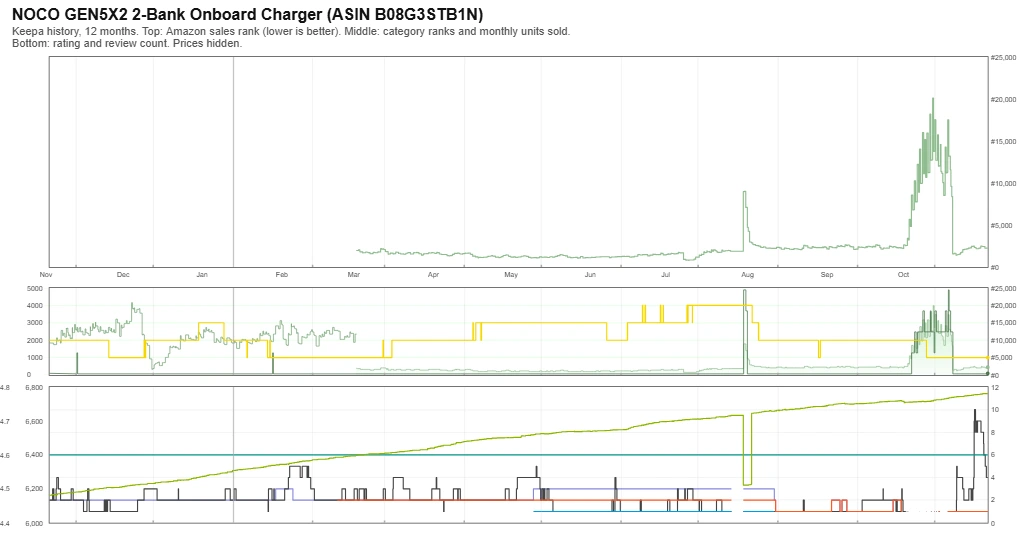
On Keepa, the GEN5X2 holds a 4.6-star rating across more than 6,700 reviews with strong demand from RV and marine owners.
Fine print: Per NOCO’s GEN5X2 specifications, this unit is strictly for 12V batteries only—it cannot charge a single 6V battery on one bank (though you can connect one 12V bank across two 6V GC2 batteries wired in series for 12V). Each bank includes a 72-inch (6-foot) DC lead with fixed 3/8-inch ring eyelets; check that your chassis and house batteries sit within 12 feet of each other before mounting, or budget for extension leads.
What we like
- Two independent 5A banks let you maintain a lead-acid/AGM chassis starter battery and a LiFePO4 house battery from one AC plug
- Fully sealed IP68 waterproof housing survives damp, road-sprayed RV undercarriage battery bays
- UL 1236 safety certified with thermal compensation, 1V start sensor, and 0V Force Mode on both banks
Watch out for
- 12V batteries only, with no 6V mode
- 6-foot DC leads per bank require mounting the charger midway between the engine bay and house battery box
Verdict: The cleanest permanent fix for motorhomes with a separate 12V chassis battery and 12V house battery up to 120Ah each. Skip it if your house bank is larger than 120Ah—step up to the GENPRO10X2 below.
NOCO GENPRO10X2 2-Bank 20A (10A/Bank) On-Board Battery Charger
Best for: Larger RV setups with two 12V banks of up to 230Ah each
When your RV house bank grows past what the GEN5X2 can recharge efficiently, the NOCO GENPRO10X2 is the heavy-duty upgrade. According to NOCO’s GENPRO10X2 spec sheet, it delivers 10 amps per bank (20A total) to two independent 12V banks rated up to 230 Ah each, and each bank can be set to 12V, 12V AGM, 12V Lithium or 12V Repair mode. It is IP68 waterproof and covered by a 3-year limited warranty.
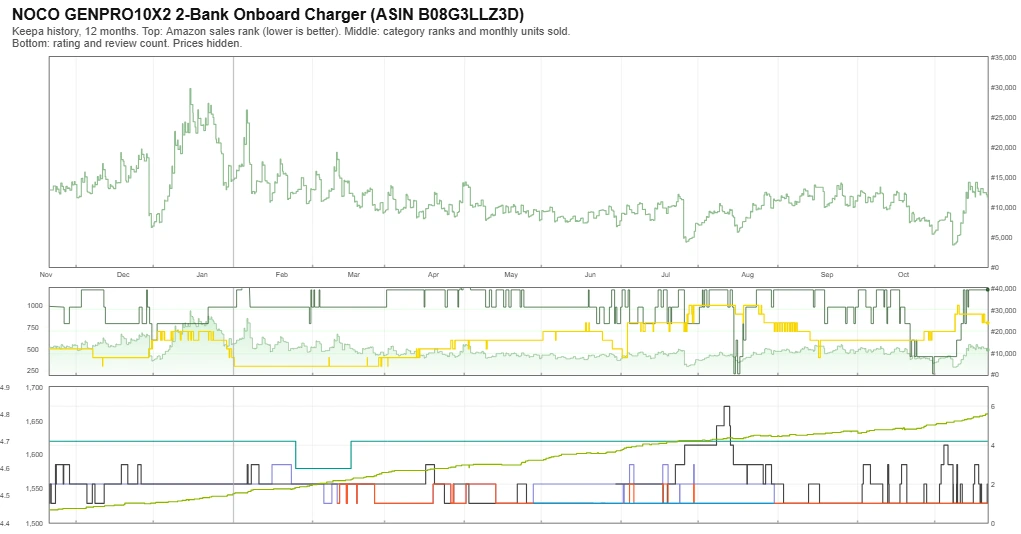
On Keepa, the GENPRO10X2 holds a 4.7-star rating across more than 1,600 reviews with steady sales among larger RV and boat owners.
Fine print: Per NOCO’s published specifications, the GENPRO10X2 weighs 8.74 pounds (3.96 kg) and draws up to 300 watts at full output. Like the GEN5X2, its DC leads are 72 inches (6 feet) long with 3/8-inch eyelets and dual inline 15A mini blade fuses, so measure your compartment layout before drilling mounting holes.
What we like
- Doubles per-bank output to 10A (20A total), handling up to 230Ah per bank
- 12V, AGM, Lithium and Repair modes set independently on each bank
- Includes 12V Repair mode, thermal compensation, and an IP68 sealed enclosure
Watch out for
- Heavier (8.74 lbs) and pricier than the GEN5X2
- Hardwired ring eyelets only—not designed to be moved quickly between garage vehicles
Verdict: Worth the investment if you run dual 100Ah–200Ah RV banks. Skip it if you only maintain a single battery or need portability.
Victron Energy Blue Smart IP65 Charger 12V/10A with Bluetooth
Best for: LiFePO4 and AGM RV owners who want live smartphone voltage/amp telemetry and a dedicated 13.2V storage stage
Victron Energy is the gold-standard name inside custom camper vans, fifth wheels, and marine electrical bays, and the Victron Blue Smart IP65 Charger 12V/10A gives you something no LED-only brick can: live charging graphs on your phone via the free VictronConnect Bluetooth app. According to the official Victron Blue Smart IP65 120V manual, it outputs 10A max (with a one-touch 3A low-current mode for smaller batteries), and is recommended for batteries from roughly 30 Ah to 100 Ah. Better yet, after 24 hours in float (13.8V), its 7-stage algorithm drops voltage further to a dedicated 13.2V Storage stage (13.5V for Li-ion) to minimize gassing and grid corrosion during multi-month RV storage. It is certified to UL 1236 and CSA C22.2 and carries a 5-year limited warranty.
On Keepa, this 12V/10A listing holds a 4.2-star rating with a smaller Amazon review count than mass-market NOCO chargers. Victron is a long-established name in RV and marine electrical systems, so we include it despite the smaller Amazon review base.

Fine print: Per the Victron spec sheet, this is a 12V-only charger (no 6V mode), includes both battery clamps and M8 (5/16-inch) ring terminals on roughly 5-foot DC cables.
What we like
- Dedicated 13.2V lead-acid (13.5V LiFePO4) Storage stage reduces plate corrosion and water loss compared to standard 13.6V–13.8V float chargers
- VictronConnect Bluetooth app shows live voltage, current, charge stage, and charge history from inside your RV or house
- Automatic LiFePO4 BMS under-voltage wake-up, 12V DC power supply mode, UL 1236 listing, and a 5-year warranty
Watch out for
- Smaller Amazon review count (4.2★) and $$$ price tag compared to NOCO
- 12V systems only, and included M8 (5/16-inch) eyelets may need enlarging or a clamp connection on 3/8-inch positive RV studs
Verdict: The best choice for lithium (LiFePO4) and AGM RV owners who want Bluetooth app diagnostics, custom voltage presets, and a true 13.2V/13.5V long-term storage stage. Skip it if you want a simple plug-and-play charger without an app or need 6V capability.
CTEK MXS 5.0 (40-206) Fully Automatic 12V Battery Charger & Maintainer
Best for: Long-term pulse maintenance on 12V flooded, AGM, and gel RV batteries up to 160Ah (not for lithium)
If your RV runs traditional 12V flooded lead-acid or AGM batteries and you want a time-tested European-engineered storage maintainer, the CTEK MXS 5.0 (Part #40-206) is a standout. According to CTEK’s North American specification sheet, it outputs 4.3 amps at 12V and uses an 8-step charging curve: Step 1 pulses voltage to break down light lead sulfate crystals, Steps 2–6 handle soft start, bulk, absorption (with a dedicated 14.7V AGM option and 15.8V Recond option for deeply discharged wet cells), Step 7 holds float, and Step 8 switches to Pulse Maintenance—monitoring the battery from 95% to 100% capacity and sending a pulse only when voltage drops. CTEK rates it to actively charge batteries up to 110 Ah and maintain stored RV banks up to 160 Ah. It carries an IP65 splash- and dust-proof rating and a 5-year limited warranty.
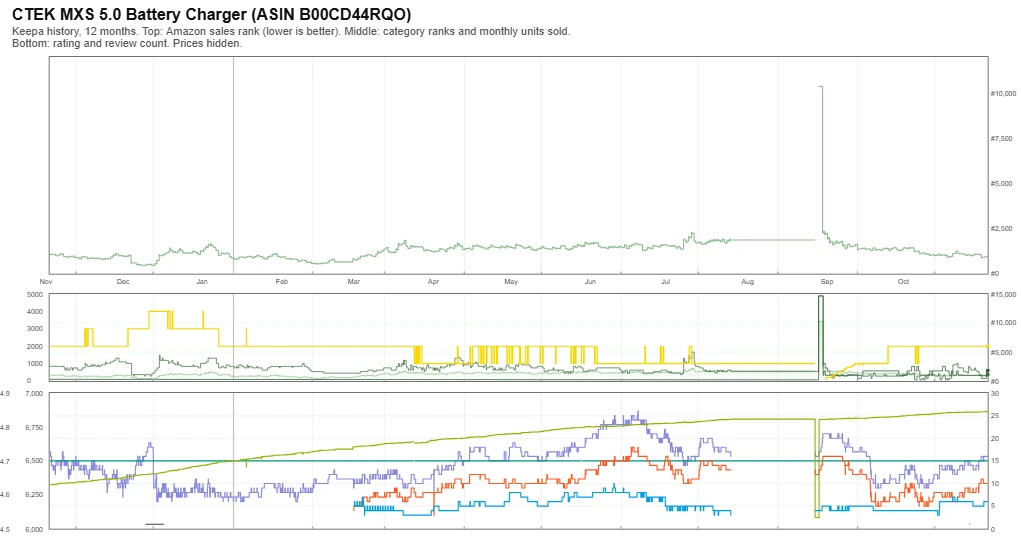
On Keepa, the CTEK MXS 5.0 holds a 4.7-star rating across more than 6,800 reviews with a long, stable sales history.
Fine print: Take note of one critical restriction from CTEK’s official specifications: the MXS 5.0 (40-206) is designed strictly for 12V lead-acid chemistries (Wet, MF, Ca/Ca, AGM, and Gel) and is NOT compatible with lithium (LiFePO4) batteries, because its automatic Step 1 desulfation pulses (up to 15.8V) can trip or damage a lithium battery’s BMS. It also requires a 2.0V minimum start voltage.
What we like
- Step 8 pulse maintenance (95%–100% cycling) prevents electrolyte dry-out during multi-month RV storage up to 160Ah
- Dedicated 14.7V AGM profile and 15.8V Recond mode for stratified flooded deep-cycle batteries
- IP65 weather sealing, built-in temperature sensor, and a 5-year warranty
Watch out for
- Strictly NOT for lithium (LiFePO4) batteries—do not use if you plan to upgrade your RV to lithium
- Requires at least 2.0V to start and does not support 6V batteries
Verdict: An outstanding 5-year-warranty pulse maintainer for 12V flooded and AGM RV batteries up to 160Ah. Skip it completely if your RV has—or will soon upgrade to—lithium (LiFePO4) batteries.
RV battery sizing math: amp-hours, parasitic draw, and charge time
Many RV lead-acid batteries list cold-cranking amps (CCA) and reserve capacity (RC) on the label instead of amp-hours (Ah), so check the battery maker’s spec sheet for the Ah figure. For example, Interstate rates its SRM-24 Group 24 deep-cycle battery at 140 minutes of reserve capacity and its SRM-27 Group 27 at 160 minutes, and retailer spec sheets list them at roughly 81 Ah and 88 Ah. Interstate’s own rule of thumb is approximate Ah = RC × 0.6 (for example, 180 RC × 0.6 ≈ 108 Ah). It also recommends a charger of no more than 20 amps per 100 Ah, noting that a 10A to 20A charger can recharge a 100 Ah battery in roughly 8 to 12 hours.
To estimate recharge time from half empty, take the amp-hours you need to put back, divide by the charger’s amps, then add about 20% for the slower final stage. A 100 Ah battery at 50% needs about 50 Ah back: roughly 12 hours on a 5A charger or 6 hours on a 10A charger. Also match the charger to its rating: NOCO rates the GENIUS5 to charge batteries up to 120 Ah and the GENIUS10 up to 230 Ah, while both will maintain any size.
Use the table below as a rough planning guide. Real times vary with temperature, battery age and how deeply the battery was drained.
| Common RV battery setup | Typical capacity | Sensible charger size | Approx. time from 50% at 5A | Approx. time from 50% at 10A |
|---|---|---|---|---|
| Single Group 24 deep-cycle | About 80 Ah | 4A to 10A | 9 to 10 hours | 5 hours |
| Single Group 27 deep-cycle or 100Ah LiFePO4 | About 90 to 100 Ah | 5A to 10A | 11 to 12 hours | 5 to 6 hours |
| Two 12V batteries in parallel, or two 6V golf cart batteries in series | About 180 to 230 Ah | 10A single bank, or a 2-bank charger | Better to maintain only (above the GENIUS5 charging rating) | 11 to 14 hours |
What to check before buying an RV battery maintainer
1. Why not just leave your RV plugged into 30A/50A shore power?
Many RV owners assume plugging the rig into a driveway outlet maintains the batteries automatically. There are two catches. First, in most motorhomes, the built-in AC-to-DC converter charges only the house bank—your engine starting battery still drains flat. Second, older single-stage or non-temperature-compensated RV converters hold a continuous 13.6V to 13.8V float charge 24/7. If your flooded batteries need distilled water every few weeks, that is a common sign the converter is overcharging them. A dedicated smart maintainer with temperature compensation or a lower 13.2V storage stage (like the Victron Blue Smart IP65) prevents electrolyte boil-off.
2. LiFePO4 lithium compatibility and BMS wake-up
If you have upgraded your RV house bank to 12V lithium iron phosphate (LiFePO4), verify two things before connecting a maintainer: the charger must have a dedicated LiFePO4 mode (without automatic 15.8V desulfation spikes), and it must be able to wake a tripped Battery Management System (BMS). Both NOCO (via its manual Force Mode) and Victron (via automatic dead-battery UVP reset) can wake a sleeping LiFePO4 BMS. By contrast, lead-acid-only chargers with automatic desulfation—like the CTEK MXS 5.0—must never be connected to lithium batteries. (To learn how pulse desulfation works on older lead-acid batteries, see our guide on whether battery desulfator chargers really work.)
3. Inline fusing and ring-terminal stud sizing
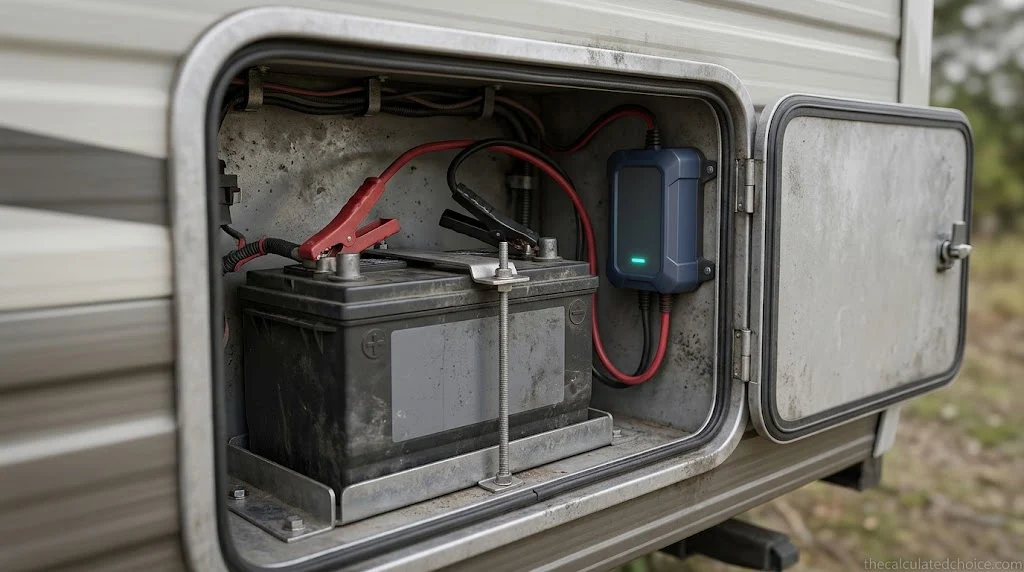
Marine and RV deep-cycle batteries typically use a 3/8-inch (M10) positive threaded stud and a 5/16-inch (M8) negative stud. NOCO’s GENIUS10, GEN5X2, and GENPRO10X2 include 3/8-inch eyelets sized for the 3/8-inch stud, while Victron includes M8 (5/16-inch) eyelets alongside alligator clamps. If you hardwire a charger permanently, put an appropriately rated inline fuse as close as practical to the positive battery post to protect the cable against a short circuit; NOCO’s onboard chargers already include inline fuses on their DC leads.
Popular picks we rejected
We filtered out several charger categories and listings during our Keepa and manual checks that frequently cause headaches for RV owners.
| Charger Category / Listing Type | Why RV Buyers Consider It | Why We Rejected It |
|---|---|---|
| Under-sized 0.75A–1.25A powersport maintainers on 200Ah house banks | Inexpensive ($) and already sitting in the garage | While a 1A unit can float a disconnected battery on a bench, it cannot overcome cabin parasitic draws plus self-discharge if an RV battery drops to 50%, taking 60+ hours to recover a 100Ah bank. |
| Unregulated solar dash/roof trickle panels without a multi-stage controller | Appealing for outdoor unpowered RV storage lots | Cheap unregulated solar panels push raw voltage over 18V in midday sun without a 3-stage PWM/MPPT cutoff, cooking AGM and flooded batteries, while some branded 17W kits showed no active OEM offers on Keepa. |
| Grey-market or mismatched 15A Bluetooth charger ASINs | Higher amperage sounds better for multi-battery banks | Several 15A listings circulated on blogs had invalid or discontinued US Amazon ASINs on Keepa, whereas the UL 1236 listed 12V/10A model has verified US 120V NEMA 1-15P distribution. |
| Unsealed indoor bench chargers mounted inside exterior RV tongue boxes | High amp numbers per dollar | Tongue-mounted travel trailer battery boxes are exposed to road spray and condensation; chargers without IP65 or IP68 sealing corrode internally and fail prematurely. |
How we chose these picks
We did not lab-test these RV maintainers; instead, we evaluated every candidate by cross-referencing Keepa sales and review data against manufacturer technical manuals and RV battery engineering standards.
Sources: NOCO Technical Specs, Victron Blue Smart IP65 Manual, CTEK North America, Interstate Marine/RV Battery Manual
Frequently asked questions
What size battery maintainer do I need for an RV?
Can I maintain two 6V golf cart batteries in my RV with one 12V maintainer?
Does plugging my RV into shore power maintain the chassis battery too?
Should I disconnect my RV battery when using a battery maintainer in storage?
Can I use a standard lead-acid battery maintainer on a lithium (LiFePO4) RV battery?
How often should I check water levels on flooded RV batteries while on a maintainer?

Researched by Shahzad
Amazon seller who researches products using sales-rank history, price tracking and owner reviews before recommending anything. Read our disclosure.