
We may earn a commission when you buy through links on this page, at no extra cost to you. It never decides what we recommend. How we make money
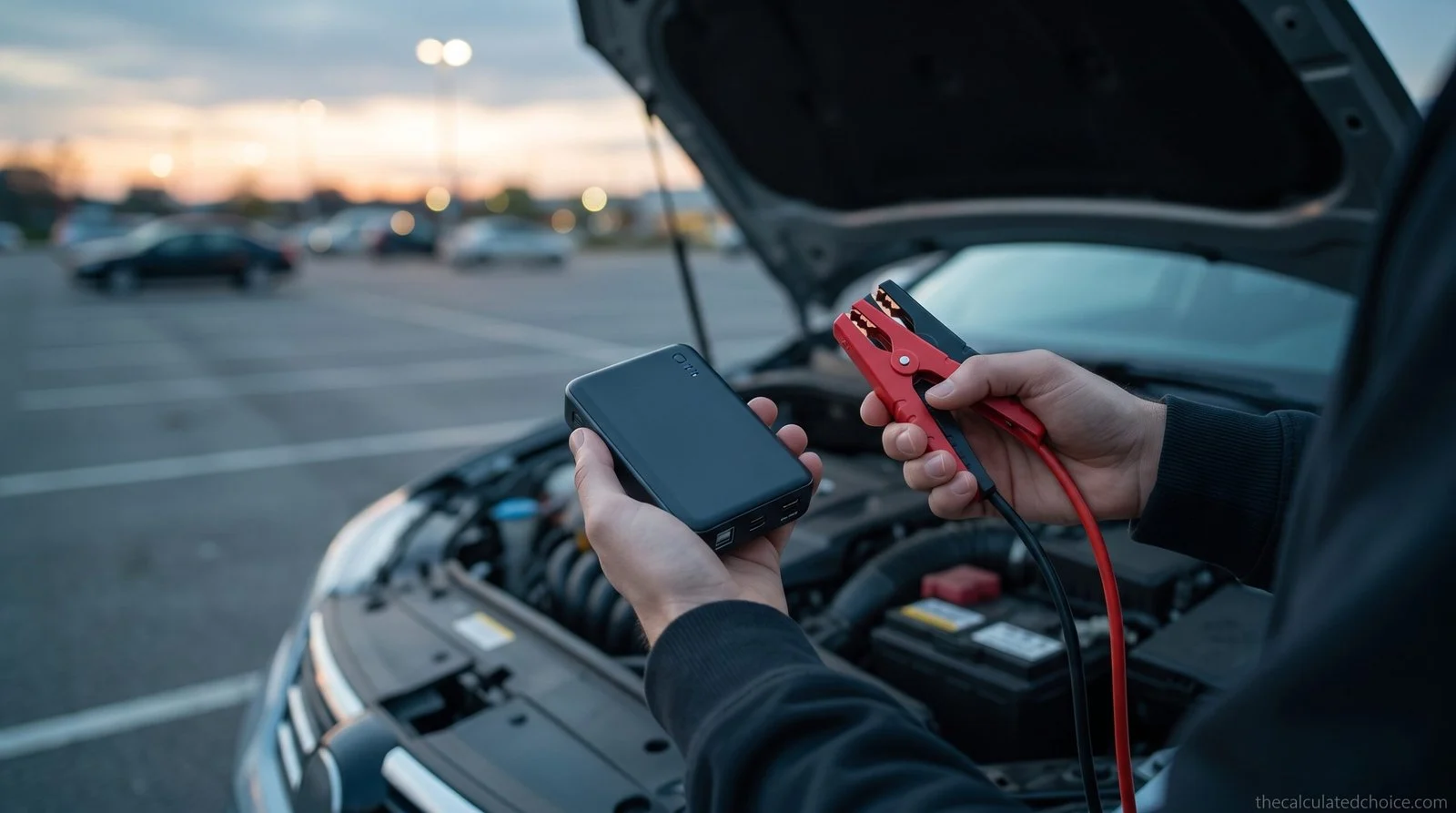
Learning how to choose a jump starter should take ten minutes, not a weekend of comparing numbers that do not mean what they seem to. Most “how to choose” guides you will find are written by jump starter brands, so they tend to push the specs that make their own products look best — usually a huge peak-amp figure. This guide is independent. It walks through the ten things that actually decide whether a jump starter will start your vehicle safely when you need it, in the order that matters.
Quick answer: how to choose a jump starter
- Match the engine rating on the box to your engine size and fuel type (gas or diesel).
- Size up one class if you drive in freezing weather or have an old battery.
- Choose lithium for everyday drivers — smaller, lighter, holds charge well.
- Require safety protections: reverse-polarity, spark-proof clamps and a manual override.
- Prefer UL 2743 certification and a brand with a real warranty and support.
1. Start with your engine size, not the amp number
The single most important spec is the engine rating: the largest engine the manufacturer says the jump starter can start, usually printed as something like “up to 6.0L gas / 3.0L diesel.” That rating is the manufacturer putting its name behind a real-world result. If a listing shows only a giant amp number and never says which engines it can start, treat that as a red flag.
Not sure what size you need? Our jump starter size calculator takes your engine size, fuel type, climate and battery condition, and tells you the minimum class to look for. Driving a V8? See how many amps you need to jump start a V8.
2. Read the right rating: gas vs. diesel
Every quality jump starter lists two engine ratings, and the diesel number is always much lower. A pack rated for a 6.0L gasoline engine might only be rated for a 3.0L diesel. Diesels rely on very high compression instead of spark plugs, so they are far harder to turn over, and many draw extra power for glow plugs in cold weather.
If you drive a diesel, ignore the gasoline rating completely. Full-size diesel pickups with 6.6L and 6.7L engines need a pack whose diesel rating covers that size, which usually means a heavy-duty or commercial-class unit.
3. Choose the battery type: lithium, lead-acid or supercapacitor
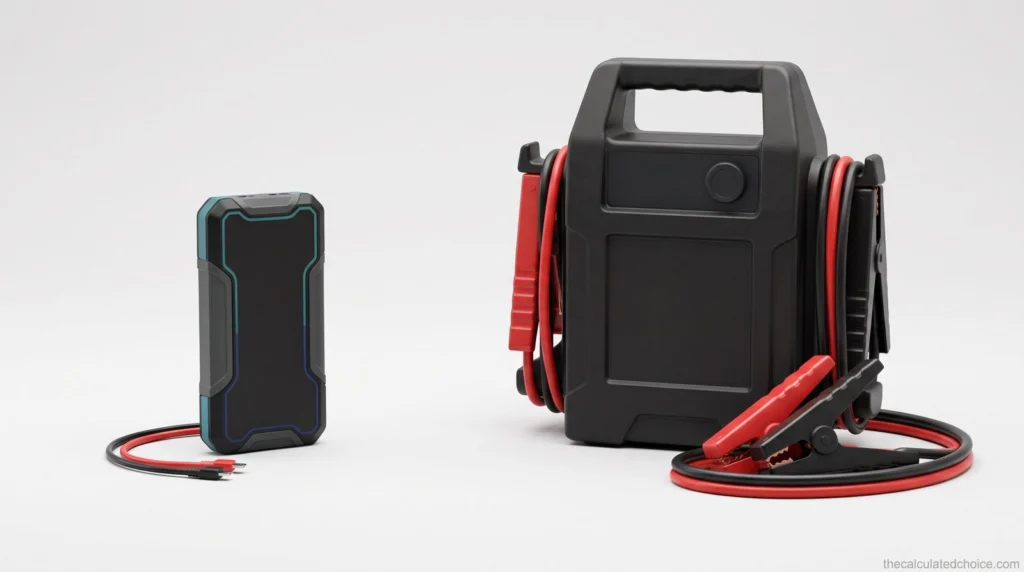
Jump starters store their energy in one of three ways. Each has a place, but for most drivers the choice is simple.
| Type | Best for | Strengths | Trade-offs |
|---|---|---|---|
| Lithium Most drivers | Everyday cars, SUVs, trucks | Small and light, fits in a glovebox or under a seat, holds charge well in storage, often doubles as a power bank | Needs care in extreme heat and cold; quality varies a lot between brands |
| Lead-acid | Workshops, fleets, occasional heavy use | Rugged, lower cost per unit of power, familiar technology | Heavy and bulky; can be damaged if stored flat, so it needs regular topping up |
| Supercapacitor | Drivers who forget to recharge | Can often recharge in minutes from a weak car battery, very long cycle life | Does not store energy for long periods and usually cannot double as a power bank |
Unless you run a workshop or have a specific reason to choose otherwise, a well-made lithium pack is the right starting point. For a detailed same-brand comparison, see lithium vs lead-acid jump starters.
4. Insist on the safety features that matter
A jump starter sends hundreds of amps through clamps you attach by hand, often in the dark and in a hurry. Good protection turns a risky job into a mistake-proof one. Look for all of these:
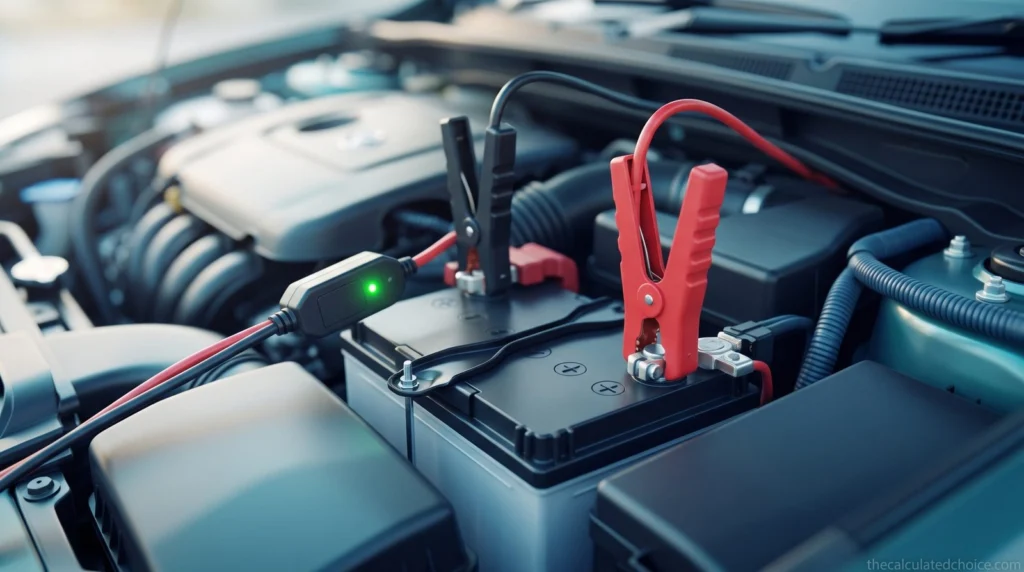
- Reverse-polarity protection: if you connect the clamps backwards, the pack refuses to send power instead of damaging your vehicle’s electronics.
- Spark-proof clamps: power only flows once the clamps are connected correctly, so no sparks jump when they touch a terminal.
- Short-circuit, over-current and over-heat protection: the pack shuts down if something goes wrong rather than overheating.
- Manual override (boost mode): a completely flat battery may be too drained for the pack to detect. An override lets you force power through — used strictly as the manual describes.
- Clear status indicators: lights or a display that confirm a correct connection before you try to start the engine.
5. Look for UL 2743 certification
Certification is one of the few specs a brand cannot simply print on a box without proof. UL 2743 is UL’s safety standard for portable power packs, and it covers devices with a booster function such as car jump starters. It was first published in 2016 and sets requirements for the pack’s construction, charging system, and electrical and mechanical safety.
A listing that states UL 2743 certification — and a brand that can show a certificate or file number when asked — tells you the product was built and tested to a recognized standard, not just assembled to hit a price point.
6. Understand capacity: why Wh beats mAh
Listings love to advertise huge milliamp-hour (mAh) figures, but mAh can mislead because it is usually quoted at the internal cell voltage, not at the 12 volts your car uses. Watt-hours (Wh) are the fairer comparison because they account for voltage.
Convert mAh to Wh yourself
Wh = mAh × cell voltage ÷ 1,000For a typical lithium cell voltage of about 3.7V, a “20,000 mAh” pack stores roughly 20,000 × 3.7 ÷ 1,000 ≈ 74 Wh. If two packs list mAh at different voltages, converting to Wh shows which one really stores more energy.
Capacity affects how many jump attempts you get per charge and how useful the pack is as a power bank. It does not replace the engine rating — a big battery with weak output still will not start a large engine.
7. Plan for cold weather
Winter is when most batteries fail, so this is exactly when your jump starter has to perform. Cold weather hurts twice: the car battery delivers less power, and thickened engine oil makes the engine harder to turn. That is why our calculator moves you up one size class if you regularly start your vehicle below freezing.
- Check the operating temperature range in the specifications, not just the marketing copy.
- Charge indoors. Most lithium batteries should not be charged below freezing. Bring the pack inside to recharge it.
- Avoid extreme heat storage. A dashboard in summer sun is a bad place for any lithium battery; a glovebox, under a seat or the trunk is better.
8. Don’t overlook clamps and cables
The clamps are where the power actually reaches your battery, and cheap ones are a common complaint in owner reviews. Look for solid, well-sprung clamps with good jaw contact, cables thick enough for the pack’s rating, and enough cable length to reach your battery terminals comfortably — especially on trucks where the battery can sit deep in the engine bay.
9. Extra features: worth it or not?
Usually worth it
- USB-C charging (faster, and one less cable to carry)
- Built-in flashlight for night-time breakdowns
- Battery-level display
- Water and dust resistance if you drive off-road
Think twice
- Built-in air compressors add bulk and weight, and dedicated tire inflators are often better
- Very high peak-amp claims with no engine rating
- Bundles of accessories you will never use
Features are nice, but never trade away engine rating, safety protections or build quality to get them.
10. How to spot a trustworthy brand
The best-selling jump starters are not always the most trustworthy. Newer brands can climb the charts quickly with aggressive pricing and big claims. Before you buy, run the brand through the same six checks we use:
Buyer’s checklist
Tick every box before you buy
☐ Engine rating covers my engine size and fuel type
☐ One class larger if I face freezing weather or have an old battery
☐ Lithium battery (unless I have a specific reason for lead-acid)
☐ Reverse-polarity and spark-proof protection
☐ Manual override for very dead batteries
☐ UL 2743 certification stated
☐ Capacity compared in Wh, not only mAh
☐ Solid clamps with enough cable length
☐ Brand passes the six trust checks
☐ I have a plan to recharge it every few months
Common mistakes to avoid
- Buying by the biggest number on the box. Compare engine ratings instead.
- Using the gasoline rating for a diesel engine.
- Buying right at the limit of your engine size and hoping winter is kind.
- Forgetting to recharge it. A flat jump starter is just extra weight in the trunk.
- Ignoring the manual. Connection order and override procedures vary by model.
Want the short answer? See our best jump starter for small cars picks for four-cylinder compacts or our best jump starter for V8 trucks picks for big engines, and read peak amps vs cranking amps before you trust any amp rating on a listing. Once you own one, our guide on how to use a jump starter safely covers the right clamp order, and jump starter vs jumper cables explains when cables still make sense.
Frequently asked questions
What is the most important thing when choosing a jump starter?
Is a lithium or lead-acid jump starter better?
How many amps does a jump starter need for a car?
What does UL 2743 mean on a jump starter?
How often should I charge a jump starter?
Can a jump starter start a completely dead battery?
How we researched this guide
This guide is independent: it is not written or sponsored by a jump starter brand. We compared manufacturer specifications and engine ratings, the published scope of the UL 2743 safety standard, and recurring themes in owner feedback. Where brands disagree on how to measure a spec, we explain the difference instead of repeating marketing claims.
Sources: UL Solutions — Portable Power Pack Testing (UL 2743) · NOCO Boost Plus GB40 specifications · NOCO Boost XL GB50 specifications

Researched by Shahzad
Amazon seller who researches products using sales-rank history, price tracking and owner reviews before recommending anything. Read our disclosure.