

We may earn a commission when you buy through links on this page, at no extra cost to you. It never decides what we recommend. How we make money
A car battery voltage chart turns one number on a meter into an answer: charged, low, or time to look closer. The catch is that most charts online come from solar and deep-cycle battery sellers, mix different battery types without saying so, and stop at the engine-off reading. That is why one site says 12.4 volts is fine and another says charge it now.
This chart is built for US drivers testing a 12-volt car or truck battery. We took the numbers from a battery load tester manual, an AGM battery maker’s technical manual, a lithium starter battery maker’s FAQ and Fluke’s battery testing guide, and put them side by side. You will see what each reading means with the engine off, while cranking and while running, how AGM and lithium batteries read differently, and what to do at each level.
Car battery voltage chart at a glance
- 12.6V or more Fully charged (engine off, rested, standard flooded battery).
- 12.4V About 75% charged. Fine for now, but top it up.
- 12.2V About 50%. Charge it soon.
- 12.0V About 25%. Charge it now.
- 11.8V or less Fully discharged. Charge it, then retest.
- 13.7 to 14.7V Normal with the engine running, per Fluke. That is the alternator charging.
- 9.5V or more The lowest reading while cranking should stay at or above this, per a Clore load tester manual.
Car battery voltage chart: engine off
This is the reading most people mean. The engine is off, everything is switched off, and the battery has rested so surface charge from driving or charging has faded. The numbers below come from the open-circuit voltage chart in Clore Automotive’s 1874 load tester manual for a standard 12-volt flooded lead-acid battery. Fluke’s battery guide gives the same 12.6, 12.4 and 12.2 volt points.
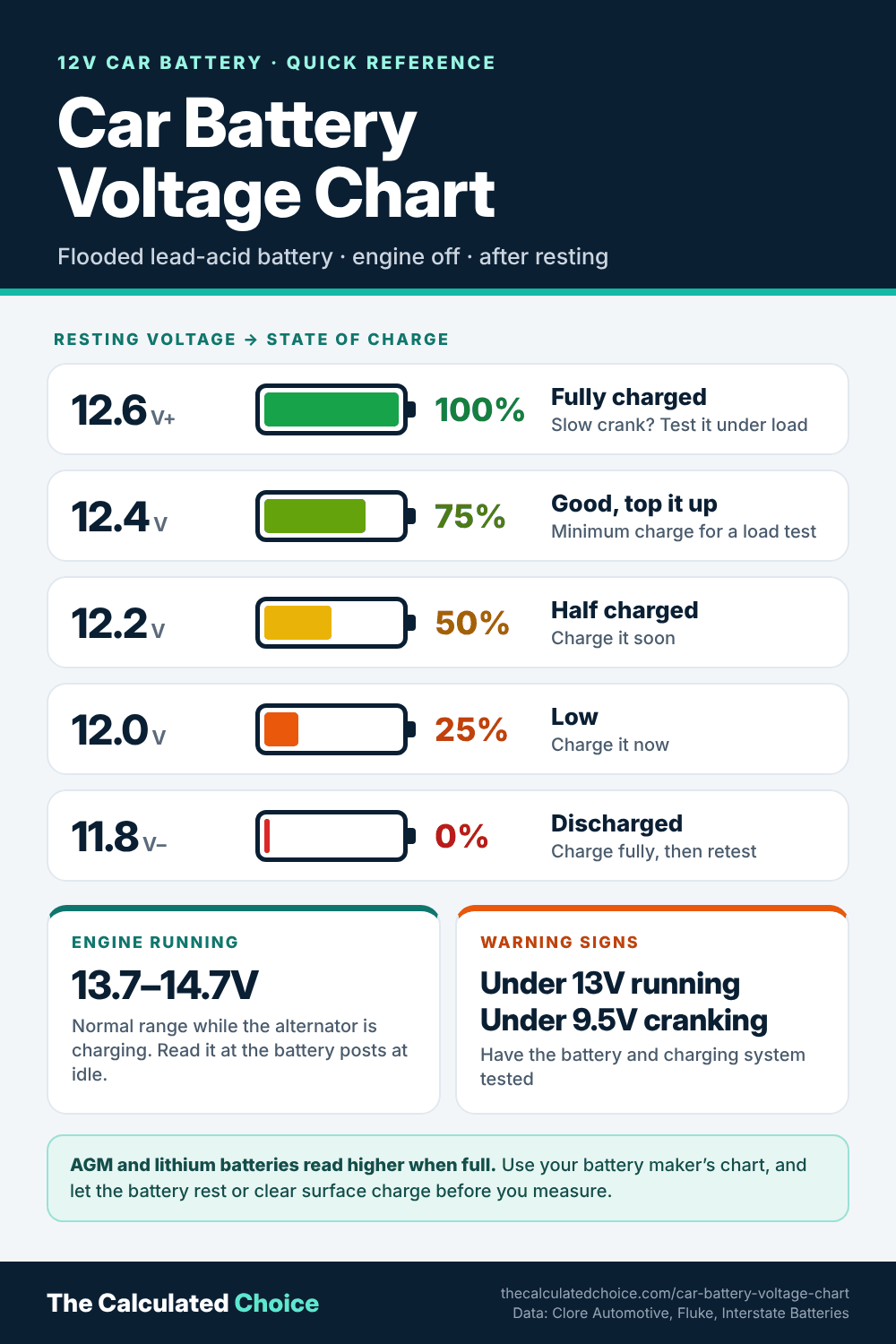
| Resting voltage | State of charge | What it means | What to do |
|---|---|---|---|
| Above 12.8V | Not on the chart | Usually surface charge on a flooded battery | Remove the surface charge, wait, then measure again |
| 12.6V | 100% | Fully charged | Nothing. If it still cranks slowly, test it under load |
| 12.4V | 75% | Charged enough to load test | Top it up with a charger or a longer drive |
| 12.2V | 50% | Half charged | Charge it soon; do not load test until it is charged |
| 12.0V | 25% | Low | Charge it now |
| 11.8V | 0% | Fully discharged | Charge it fully, then retest |
Two rules from the same manual make the chart more useful. A battery must read at least 12.4 volts before a load test means anything, and if a battery still reads below 12.4 volts after a full charge, Clore says to replace it. Measuring right after a drive skews everything upward; our guide on how to test a car battery with a multimeter shows how to clear surface charge first and how accurate your meter needs to be.

AGM and lithium batteries: same reading, different meaning
Here is the part generic charts leave out. AGM and lithium starter batteries rest at higher voltages than flooded batteries, so the same number on your meter can mean very different things. We lined up three makers’ published figures:
| Reading at rest | Flooded (Clore chart) | AGM (ODYSSEY chart) | Lithium starter (Antigravity FAQ) |
|---|---|---|---|
| 13.2V | Surface charge, not a real reading | Above ODYSSEY’s 100% point; let it rest and recheck | Normal voltage |
| 12.9V | Surface charge likely | 100% | Below its normal 13.2V |
| 12.6V | 100% | 75% | Getting close to the recharge point |
| 12.4V | 75% | Between 50% and 75% | Below 12.5V: put it on a charger |
| 12.2V | 50% | 50% | Charge it |
| 12.0V | 25% | Between 25% and 50% | Charge it |
| 11.8V | 0% | Between 0% and 25% | Charge it |
| 11.5V | Below 0% on the chart | 0% | Charge it now; Antigravity warns against resting below 11V |
The middle column comes from Table 4 in the ODYSSEY AGM technical manual, which puts 100% at 12.9 volts and 0% at 11.5 volts. ODYSSEY says to take that reading at least four hours after charging, or 30 minutes after a discharge. AGM brands do not all agree: OPTIMA says a full REDTOP reads about 12.6 to 12.8 volts and a full YELLOWTOP about 13.0 to 13.2 volts. If you have an AGM battery, use your own battery maker’s chart when it publishes one.
The lithium column comes from Antigravity’s lithium starter battery FAQ. It lists a normal voltage of 13.2 volts, says to charge the battery if it drops below about 12.5 volts while sitting, and warns that permanent damage may occur below 11 volts at rest. Antigravity also says not to use lead-acid chargers or battery tenders on its lithium batteries, so check the charger too; our guide on how to choose a car battery charger covers matching a charger to your battery.
Car battery voltage chart while running
With the engine running, the meter shows what the alternator is putting into the battery, not the battery’s own state of charge. Here is how the sources we checked read it:
| Engine-running voltage | What the sources say |
|---|---|
| Below 13.0V | Interstate: you could have a bad alternator or a bad battery |
| 13.0 to 13.7V | Gray zone. Above Interstate’s 13-volt line but below Fluke’s normal range; have the charging system tested |
| 13.7 to 14.7V | Fluke: what a good alternator should produce under normal conditions |
| 14.2 to 14.5V | ODYSSEY: the alternator range it expects at 77°F for its AGM batteries |
| Above 14.7V | Antigravity: the most its lithium starter batteries should see |
| Above 15.0V | ODYSSEY: causes irreversible damage to its batteries; have the charging system checked |
ODYSSEY also notes that charging voltage should run a little higher in the cold and a little lower in the heat, about 18 millivolts per °C away from 77°F for a 12-volt battery. So a reading near the top of the range on a frozen morning is not automatically a problem. Interstate links a rotten-egg smell to overcharging; if you notice it, shut the engine off and have the system checked.
Car battery voltage when starting the engine
Voltage always drops while the starter turns. The question is how far. Clore’s load tester manual uses 9.5 volts as the line for a 12-volt vehicle’s cranking test: below it, something is drawing too much current, whether that is a failing battery, poor battery or starter connections, a failing starter or a battery too small for the vehicle.
If cranking voltage still drops below 9.5 volts after a full charge, see how to clean car battery terminals before you replace the battery or starter.
The same manual’s load test, which pulls half the battery’s CCA rating for 15 seconds, sets the passing voltage by battery temperature. We turned it into a cold-weather starting chart:
| Battery temperature | Minimum voltage at the end of a 15-second load test |
|---|---|
| 70°F | 9.6V |
| 60°F | 9.5V |
| 50°F | 9.4V |
| 40°F | 9.3V |
| 30°F | 9.1V |
| 20°F | 8.9V |
Your multimeter can catch the cranking dip if it has a MIN/MAX mode, which Fluke recommends for exactly this. A plain meter often misses it because the dip lasts only a moment.
What voltage is a dead car battery?
On the flooded chart, 11.8 volts is 0% state of charge. ODYSSEY puts 0% for its AGM batteries at 11.5 volts. Either way, a battery at those levels needs a full charge before you can judge its health; Clore’s manual says not to load test below 12.2 volts.
Very low readings cause a second problem: many smart jump starters cannot detect a battery that is almost completely flat. On NOCO Boost packs, for example, the pack will not activate below about 2 volts without a manual override. Our guide to jump starter error lights explains what each brand does when the battery is too low to detect.
At what voltage should you replace a car battery?
There is no single replacement voltage, because a low reading usually means a discharged battery, not a dead one. Clore’s manual gives a clear order of steps:
- If the resting reading is below 12.4 volts, charge the battery fully.
- Measure again after it rests. If it still reads below 12.4 volts, replace it.
- If it reaches 12.4 volts or more, load test it. If the voltage at the end of the load test falls below the minimum for its temperature, the battery fails.
Fluke and Interstate make the same point from the other side: a good resting voltage on its own does not prove a battery is healthy. Interstate says a battery is at its best for about three years and should be watched closely after that. Not sure the battery is the culprit? Our guide to the signs of a bad car battery pairs each symptom with a quick check. If you test batteries often, our guide to the best car battery tester compares testers that check a battery against its CCA rating, which a voltage chart cannot do.
Why car battery voltage charts don’t agree
If you have compared charts online, you have seen 100% listed anywhere from 12.6 to 12.9 volts and beyond. We found four reasons:
- Battery type. Flooded, AGM and lithium batteries rest at different voltages, as the comparison table above shows, and many charts do not say which one they describe.
- Brand. Even AGM makers differ: ODYSSEY puts 100% at 12.9 volts, while OPTIMA gives about 12.6 to 12.8 volts for REDTOP and 13.0 to 13.2 volts for YELLOWTOP.
- Rest time. ODYSSEY wants four hours after charging, OPTIMA suggests 12 to 24 hours, and Clore lets a battery stand 10 minutes after removing surface charge. A reading taken too soon reads high.
- Deep-cycle charts. Many top-ranking charts come from solar and power-station sellers whose numbers are written for deep-cycle and LiFePO4 house batteries, not for the starting battery under your hood.
Our advice: identify your battery type from its label, use that maker’s chart if one exists, and measure the same way every time. The trend over a few days tells you more than any single reading.
If your car sits for weeks at a time, the chart also tells you when to step in. ODYSSEY recommends a freshening charge once a stored battery falls to 12.2 volts, about 50%. A maintainer avoids that drop entirely; see our picks for the best battery maintainer for winter storage.
Battery voltage: myth vs fact
| Myth | Fact |
|---|---|
| A 12-volt battery should read 12 volts. | On the flooded chart, 12.0V is only about 25% charged. A full one rests near 12.6V. |
| Higher resting voltage always means a healthier battery. | On a flooded battery, a reading above 12.8V usually means surface charge, not extra health. |
| One chart works for every battery. | At 12.4V, a flooded battery is about 75% charged, an ODYSSEY AGM is between 50% and 75%, and an Antigravity lithium starter battery needs charging. |
| Engine-running voltage shows battery health. | It shows the alternator’s output. Fluke’s normal range is 13.7 to 14.7V. |
| If it reads 12.6V, the battery is good. | Voltage shows charge, not capacity. A battery can read full and still fail a load test. |
Frequently asked questions
Is 12.2 volts okay for a car battery?
What is the normal voltage of a car battery when the car is off?
What should car battery voltage be when the car is running?
What voltage indicates a dead car battery?
At what voltage should I replace my car battery?
How low should battery voltage drop when starting a car?
Is 12.4 volts a good battery reading?
How we built this chart
We took the engine-off numbers from the open-circuit voltage chart in Clore Automotive’s 1874 load tester manual and checked them against Fluke’s battery guide. The AGM column comes from the ODYSSEY technical manual, the lithium column from Antigravity’s lithium starter battery FAQ, and the running and cranking lines from Fluke, Interstate Batteries, ODYSSEY and Clore. Where a value falls between two points on a maker’s chart, we say “between” instead of guessing a percentage. The battery-type comparison, the cold-weather starting chart and the myth-vs-fact table are our own work built from those sources. We did not hands-on test any battery for this article, and no brand paid for or reviewed it.
Sources: Clore 1874 load tester manual · ODYSSEY AGM technical manual · Antigravity lithium starter FAQ · Fluke battery voltage guide · OPTIMA voltage guide · Interstate Batteries test guide

Researched by Shahzad
Amazon seller who researches products using sales-rank history, price tracking and owner reviews before recommending anything. Read our disclosure.