
We may earn a commission when you buy through links on this page, at no extra cost to you. It never decides what we recommend. How we make money
Knowing how to get your car unstuck from snow starts with resisting the urge to floor the gas pedal. The first three seconds after your tires lose forward momentum decide whether you drive out in five minutes or spend the afternoon waiting for a flatbed tow truck. Flooring the throttle spins your drive wheels, melts the top millimeter of snow through friction heat, and instantly refreezes the trench into a polished cradle of solid glare ice while burying your chassis deeper toward the pavement.
Worse, aggressive wheel-spinning and rapid gear-slamming can destroy expensive drivetrain components in minutes. Automaker owner’s manuals—including Kia’s official winter driving manual—explicitly warn that prolonged rocking or spinning stationary wheels above 35 mph (56 km/h) can overheat the engine, cause catastrophic automatic transmission or CVT failure, and overheat a spinning tire to the point of blowout. At the same time, idling in deep snow with a plugged tailpipe creates an immediate carbon monoxide hazard inside the cabin (NHTSA).
Whether your sedan is plowed in at the curb or your SUV is high-centered in an unplowed lot, follow this seven-step mechanical recovery sequence to free your vehicle safely without burning up your transmission or tires.
Quick answer
- 1. Straighten the front wheelsAfter clearing the tailpipe and switching on your hazards, turn the wheel fully left and right once to push snow aside, then point the front tires dead straight ahead.
- 2. Dig a sloped ramp at all four tiresShovel a gentle 2-to-3-foot ramp in front of and behind every tire, and chip away any glazed ice ridge under the leading edge of the tread.
- 3. Check for high-centeringLook under the car. If packed snow is pressing on the belly pan, tunnel it out until the car settles back onto its suspension.
- 4. Turn OFF traction control (ESC/TCS)Press your dashboard traction-control button so the computer does not cut engine power or apply the brakes as the wheels begin to creep.
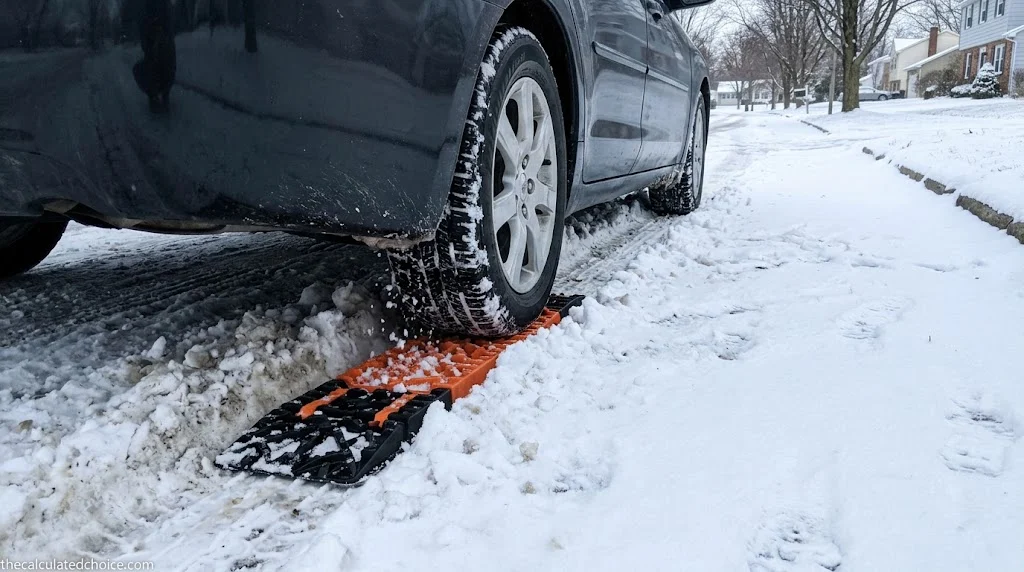
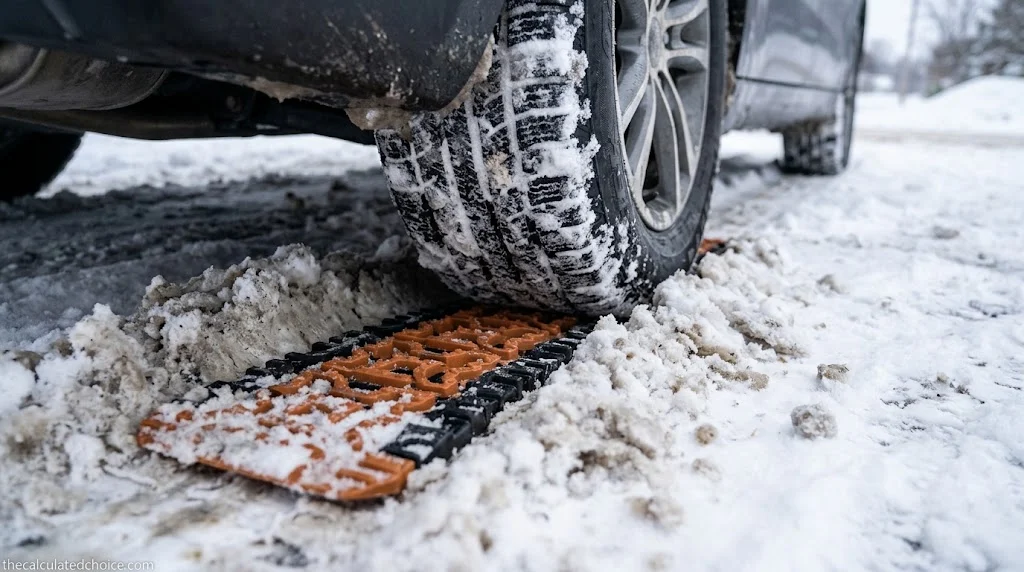
- 5. Add grit or traction boardsWedge coarse sand, non-clumping clay cat litter, or recovery boards tightly under the leading tread edge of the drive wheels.
- 6. Shift into Low or 2nd gearUse L, 2, or Winter mode (2nd gear in a manual) and squeeze the throttle gently. Lift off the moment a tire spins freely.
- 7. Rock gently, only if neededUse controlled pendulum rocking for 3 to 5 attempts at most, stopping fully before each shift between Drive and Reverse. Then dig more or call a tow.
What to do first before touching the gas pedal
Before you shift gears or step outside into a snowbank, run through three 30-second safety checks that prevent carbon monoxide poisoning and roadside collisions:
- Turn on your hazard flashers and check approaching traffic: If you slid off the road or got stuck near an active lane, falling or blowing snow cuts visibility for snowplows and other drivers. Never step out on the traffic side of your vehicle until you confirm the lane is clear.
- Clear the exhaust tailpipe immediately: When a car backs into a snowbank or settles into deep drift snow, snow plugs the rear exhaust pipe. Both NHTSA and the National Weather Service (NWS) warn that a blocked tailpipe forces odorless, lethal carbon monoxide gas back into the cabin within minutes. Dig out a clear 1-foot cavity around the tailpipe before leaving the engine idling.
- Identify which wheels are your drive wheels: Putting traction sand or mats under the rear tires of a front-wheel-drive (FWD) car accomplishes nothing. Check whether your vehicle is front-wheel drive (most sedans and compact crossovers), rear-wheel drive (pickup trucks in 2WD, sports cars, and some cargo vans), or all-wheel / four-wheel drive (AWD/4WD).
How to get your car unstuck from snow: 7 steps
Work through these steps in exact order. Skipping straight to throttle or rocking before clearing the tires and belly pan is the main reason drivers dig themselves into ice ruts.
Step 1: Sweep the steering wheel side-to-side, then point the front tires dead straight
When your front wheels are turned at a sharp angle, the vehicle has to push two wide sidewalls of rubber through packed snow before it can roll an inch. As noted in the Kia Owner’s Manual, start by turning the steering wheel fully right and left once or twice to push loose snow away from the front tire shoulders, then bring the steering wheel back to dead center so the tires point straight down your intended exit path. Only turn the wheel once the car is actively rolling at walking speed.
Step 2: Dig a 2-to-3-foot sloped ramp in front of and behind all four tires
A tire sitting at the bottom of a steep 6-inch snow pothole cannot climb a vertical wall of ice. Using one of our best portable snow shovels for your car, dig away the wall of snow in front of and behind all four tires—not just the two drive wheels. Even unpowered rear wheels on a front-wheel-drive sedan act like wheel chocks if they are wedged against a frozen snowplow berm. Shovel a gradual 15-to-20-degree exit ramp extending 2 to 3 feet along your exit track, and chip away any glazed ice ridge right under the tire’s leading edge.
Step 3: Check for “high-centering” and clear snow from under the belly pan
Kneel beside the car and look underneath the rocker panels. If packed snow is pressed tightly against the plastic engine splash shield, oil pan, subframe, or differentials, your vehicle may be high-centered (also called “beached”). When a car is high-centered, the packed snow mound underneath the floor pan supports the vehicle’s curb weight, lifting the tires slightly so they have almost zero downward vertical load on the ground. No traction mat, snow chain, or 4WD lock can move a vehicle whose weight is resting on its belly pan. Use your shovel to tunnel out the packed snow underneath the center of the chassis until the car visibly settles back down onto its suspension.
Step 4: Turn OFF Traction Control (TCS / ESC) temporarily
Electronic Stability Control (ESC) and Traction Control Systems (TCS) are lifesavers at highway speeds, but they actively prevent you from getting unstuck at 0 mph. When TCS detects a drive wheel slipping in snow, the computer automatically cuts engine fuel/spark and pulses the ABS brakes on the spinning wheel. In deep snow, that intervention bogs the engine down to a stall before the tires can claw through the top layer. Press your dashboard TCS/ESC button (marked with a car icon over wavy lines) to turn traction control off—or enable your vehicle’s dedicated “Deep Snow / Mud” mode—and remember to turn ESC back on as soon as you reach clear pavement (Kia Owner’s Manual).
Step 5: Place abrasive grit or traction boards directly under the leading tread edge
Do not toss sand randomly across the driveway. Wedge your traction material—coarse winter sand, non-clumping clay cat litter, or purpose-built recovery boards—tightly into the pinch point where the rubber tread meets the ice in the direction you plan to move. If you are using rigid traction boards or heavy rubber floor mats in an emergency, make sure nobody is standing behind the drive wheels: a spinning tire can launch a floor mat or board backward like a projectile.
Step 6: Shift into Low or 2nd gear and squeeze the throttle like an eggshell
High wheel torque breaks static friction instantly. Instead of leaving an automatic transmission in normal Drive (D) or launching a manual transmission in 1st gear, shift an automatic into L, 2, or manual-shift M2 (“Winter” mode on many transmissions), or start a manual transmission in 2nd gear. Starting in 2nd gear reduces torque multiplication at the drive axles so the tires roll forward smoothly without breaking loose. Apply the lightest possible pressure to the gas pedal; the moment you hear or feel a tire spin freely, lift off the throttle immediately so you do not polish the snow into ice.
Step 7: Use controlled pendulum rocking (only if steps 1–6 need extra momentum)
If the car moves 6 inches forward and stops against the lip of the snow rut, you can use gentle pendulum rocking to build momentum across the rut:
- Apply light throttle in forward gear until the car climbs as far up the front of the rut as it will go without spinning the tires.
- Take your foot off the gas, press the brake pedal lightly or let the vehicle pause at the peak of its travel, and shift cleanly into Reverse (R)—never slam an automatic transmission from Drive to Reverse while the wheels are still spinning.
- Apply light throttle in Reverse to roll backward up the rear slope of the rut, flattening a slightly longer track each time.
- Limit rocking to 3 to 5 attempts maximum, then stop and dig further or call for a tow. As automaker manuals warn, rocking for more than a few tries superheats automatic transmission fluid and can burn up clutch packs or torque converters (Kia Owner’s Manual).
Traction aids compared: sand, kitty litter, mats, and salt
Drivers keep all kinds of improvised materials in their trunks, but chemical de-icers and mechanical abrasives behave completely differently once temperatures plunge below 15°F. According to the Minnesota Pollution Control Agency (MPCA) Stormwater Manual, ordinary rock salt (sodium chloride) stops working practically below 15°F, whereas abrasives like winter sand work at any temperature because they rely on physical friction rather than melting.
| Traction material | How it works | Lowest working temperature | Pros | Watch out for |
|---|---|---|---|---|
| Coarse winter sand / tube sand | Mechanical abrasive grit + ballast weight over axle | Works at all temperatures (never relies on melting) | Instant grit on glare ice; 50–60 lb bags add rear-axle traction weight in RWD pickups | Can freeze into a solid block inside the bag if moisture leaks in |
| Non-clumping clay cat litter | Mechanical grit that absorbs surface water film | Works at all temperatures | Inexpensive, lightweight, and easy to pour out of a plastic jug around stuck tires | Must be non-clumping clay—clumping bentonite litter turns into slick, greasy mud when wet |
| Polymer recovery / traction boards | Rigid cleated ramp bridged across the snow rut | Works at all temperatures (check polymer cold rating) | Reusable; bridges deep ruts and helps lift tires out of soft drifts | Can shoot backward if a tire spins violently on the cleats; bulkier to store |
| Calcium chloride (CaCl2) pellets | Exothermic chemical ice melter | Down to -20°F practical (-60°F eutectic per MPCA) | Melts through thick glare ice under tires even in sub-zero cold; releases heat on contact | Takes 5–10 minutes to melt ice; corrosive to bare steel and concrete; attracts moisture if bag is unsealed |
| Standard rock salt (Sodium chloride, NaCl) | Endothermic chemical ice melter | Down to 15°F practical (-6°F eutectic per MPCA) | Cheap and widely available for mild freeze-thaw ice | Useless below 15°F; creates a slick brine film on top of cold ice if it cannot melt all the way through |
| Car floor mats or flattened cardboard | Emergency disposable friction pad | Any temperature (single-use) | Always inside the car when you have zero winter supplies | Rubber mats frequently get shredded, stained, or launched across the street by spinning tires |
The physics and math of snow recovery
Two numbers explain why gentle shovel work beats high-RPM wheel spinning every single time: available tire traction force (which drops to zero as soon as your belly pan touches packed snow) and open-differential wheel speed (which doubles the actual spin speed of a single free wheel).
1. Why high-centering kills traction & 2. Open-differential spin speed math
Formula 1 (Maximum Tire Pull Force): F_pull = μ (coefficient of friction) × N (vertical weight resting on drive tires)High-Centering Effect: If a 3,600 lb FWD car (2,100 lb on front axle) settles onto a packed snow mound that supports 1,600 lb of the chassis weight, vertical load N on the front tires drops to 500 lb. On glare ice (μ ≈ 0.10), total pull force drops from 210 lb down to just 50 lb—not enough to climb a 2-inch rut.Formula 2 (Open Differential Single-Wheel Spin Speed): Actual Spinning Tire Speed = 2 × Speedometer Reading (when the opposite tire on the axle is stationary)Example: If your speedometer reads 35 mph (the maximum warning limit in the Kia Owner’s Manual) while one tire is stuck still and the other spins freely on ice, the single spinning tire is actually rotating at 70 mph—generating enough centrifugal force and heat to delaminate the tread or shatter the differential spider gears.Wheel-spin speed limit (35 mph / 56 km/h) verified in the Kia Owner’s Manual.
4 snow recovery myths that wreck transmissions and tires
Bad roadside advice circulates every winter. Avoid these four common mistakes that turn a simple dig-out into a costly repair bill:
Myth 1: “Let half the air out of your tires to get a wider footprint in snow”
Off-roaders air down specialized beadlock or thick-sidewall all-terrain tires in deep sand because they carry portable 12V air compressors to reinflate them before touching pavement. Deflating standard passenger car tires when stuck in roadside snow is dangerous for two reasons. First, passenger winter and all-season tires rely on inflation pressure to keep their microscopic tread sipes open so they can bite into ice; severely underinflating a street tire distorts the contact patch and reduces ice grip. Second, cold winter air has already lowered your tire pressure—Bridgestone notes that tire pressure drops by approximately 1 PSI for every 10°F drop in ambient temperature. If you bleed an extra 15 PSI out of an already cold tire and then drive onto the highway without a compressor in your trunk, severe sidewall flexing can overheat and blow out the tire within miles.
Myth 2: “Spin the tires fast to melt your way down to bare asphalt”
Unless there is less than half an inch of light frost over dry asphalt, spinning your tires never reaches bare pavement. Instead, friction melts a thin film of water between the rubber tread blocks and the packed snow; the moment the tire slows down, that water freezes into a concave mirror of glare ice, while the excavated snow packs underneath the suspension arms until the car is high-centered.
Myth 3: “Slam an automatic transmission between Drive and Reverse without stopping”
Old mechanical advice from the era of cast-iron three-speed transmissions will destroy a modern 8-speed automatic, dual-clutch transmission (DCT), or continuously variable transmission (CVT). Shifting from Drive into Reverse while the drive wheels are still spinning forward at 20 mph forces internal planetary clutch packs or CVT steel belts to absorb massive shock loads, shearing splines and burning transmission fluid in seconds. Always let the wheels come to a brief stop at the top of each pendulum swing before shifting.
Myth 4: “Loop a tow strap around a tie rod, control arm, or bumper cover”
If a passing pickup offers a pull, never hook a recovery strap around a steering tie rod, aluminum lower control arm, sway bar, or plastic bumper fascia. Pulling against steering or suspension links bends your alignment instantly and can snap a ball joint. Attach recovery straps only to a frame-mounted recovery hook, a trailer hitch receiver pin, or the forged steel screw-in tow eye stored with your spare-tire jack kit.
What to buy so you never stay stuck
Getting unstuck in five minutes instead of waiting two hours for a tow truck comes down to having the right mechanical gear inside your cabin and trunk before the storm hits:
- A metal portable snow shovel: Skip brittle plastic scoops that crack at the neck socket. See our Keepa-verified guide to the best portable snow shovels for your car—including the under-seat SOG Entrenching Tool (B0038A05X6) for chopping tire ice, the 3-piece Lifeline 4017 Aluminum Shovel (B07H25P4YR) for everyday trunks, the all-steel Bully Tools 14-Gauge Trunk Shovel (B00IDV2GQY) for solid plow berms, and the 6061-T6 Voilé Telepro Avalanche Shovel (B01LW1Q9X4) for deep drifts.
- A full-reach ice scraper and snow brush: Before you pull back onto traffic after freeing your tires, clear all snow off your roof, hood, lights, and windows using one of our best ice scrapers and snow brushes so roof snow cannot slide over your windshield when you brake.
- Complete winter vehicle prep: Stock your trunk using our checklists for what to keep in your car in winter and the best winter car emergency kit, and verify your battery, tire tread, and antifreeze freeze-point with our complete car winterization checklist.
How we researched this guide
We compiled this recovery protocol by cross-referencing automaker owner’s manual procedures for stuck vehicles with federal winter-driving safety guidelines, state highway chemical de-icing data, and tire manufacturer inflation physics.
Sources: NHTSA, National Weather Service, Kia Owner’s Manual, Minnesota Pollution Control Agency, Bridgestone
Frequently asked questions
Should you turn traction control off when stuck in snow?
What gear should I use to get unstuck from snow?
Does kitty litter actually help get a car unstuck from snow?
Can rocking a car in snow damage an automatic transmission?
Why is my car shaking after getting unstuck from deep snow?
What should you do if you are stranded in a snowstorm and cannot get unstuck?

Researched by Shahzad
Amazon seller who researches products using sales-rank history, price tracking and owner reviews before recommending anything. Read our disclosure.