
We may earn a commission when you buy through links on this page, at no extra cost to you. It never decides what we recommend. How we make money
Knowing how to winterize your car comes down to checking the exact fluids, rubber components, and electrical reserves that fail when ambient temperatures plunge below freezing. Most drivers wait until the first hard frost triggers a low-tire-pressure warning light or a slow-cranking starter, when repair shops are booked solid and roadside tow waits stretch for hours. This checklist is built for everyday commuters, family SUV owners, and DIYers who want concrete pass-or-fail thresholds rather than vague advice to “get a tune-up.”
Getting these specifications wrong carries a steep price. According to the AAA Automotive Research Center, a standard 12-volt car battery loses about 35% of its strength at 32°F and 60% of its power at 0°F, right when thick cold engine oil demands up to twice the normal starting current. Top off your radiator with plain water instead of a 50/50 coolant mix and the fluid can freeze solid, cracking an engine block or radiator core ($$$ in repairs). Run all-season tires worn down to the legal 2/32-inch limit on snow-packed pavement and your stopping distance multiplies because the shallow grooves can no longer pack and release snow.
Quick answer
- Battery reserveLoad-test any 12-volt battery over 3 years old; at 0°F a battery loses about 60% of its cranking strength while the engine requires up to 2x normal starting current.
- Coolant mixtureVerify a 50/50 ethylene glycol and distilled water ratio (-34°F freeze protection), or step up to a 70/30 concentrate mix (-84°F freeze protection) in extreme sub-zero regions.
- Tires and pressureAdd 1 PSI for every 10°F drop in outdoor temperature to match your door-jamb placard, and replace tires before tread wears below 5/32 inch if you drive on snow.
- Oil and washer fluidRun the lowest “W” viscosity grade allowed in your owner’s manual (such as 0W-20 or 5W-30 per SAE J300) and purge summer washer fluid for -25°F to -34°F de-icer fluid.
- Onboard safety gearKeep your fuel tank close to full, secure rubber floor mats with retention clips, and stock a dedicated winter roadside kit in the trunk.
How to winterize your car: the complete checklist at a glance
Most of the inspections on the AAA Winter Car Care Checklist and the NHTSA Winter Weather Driving Guide take less than an hour in a driveway with basic hand tools. Use the table below to separate five-minute visual checks from tasks that require a hydrometer, tread gauge, or shop load tester.
| System / Component | Pass / Fail Winter Spec | Critical Temp Threshold | DIY Cost Band |
|---|---|---|---|
| 12V Battery & Terminals | Load test passes; replace if weak or >3–5 years old; zero terminal corrosion | 32°F (-35% power) / 0°F (-60% power) | $ (tester/brush) to $$ (battery) |
| Tire Tread Depth | 5/32″ minimum for snow (Tire Rack); 3/32″ AAA limit; 2/32″ legal minimum (NHTSA) | Below 32°F (snow and slush packing) | $ (gauge) to $$$ (tires) |
| Tire Rubber Compound | Switch to 3PMSF winter tires if roads stay cold and snow-covered | Below 45°F / 7°C (all-season rubber stiffens) | $$$ (set of 4 winter tires) |
| Tire Inflation Pressure | Match driver door-jamb placard measured cold (parked 3+ hours) | Drops ~1 PSI per 10°F ambient drop | $ (digital gauge / inflator) |
| Antifreeze / Coolant | 50/50 mix (-34°F freeze / 265°F boil) or 70/30 mix (-84°F freeze / 276°F boil) | Below 32°F down to -84°F | $ (hydrometer + 1 gal coolant) |
| Engine Oil Viscosity | 0W or 5W multigrade per owner’s manual (SAE J300 cold-cranking spec) | -30°C (-22°F) for 5W; -35°C (-31°F) for 0W | $$ (synthetic oil + filter) |
| Windshield Washer Fluid | Winter de-icer formula rated to -25°F, -30°F, or -34°F; never plain water | Below 32°F (summer fluid freezes on glass) | $ (1 gal winter de-icer) |
| Serpentine Drive Belt | No underside cracks or fraying; replace at 60,000-mile intervals | All freezing temperatures | $ to $$ |
1. Test the 12-volt battery and charging system
The battery is the first stop when you learn how to winterize your car, because dead batteries are the single largest cause of cold-morning roadside calls because freezing temperatures attack starting systems from two directions at once. Chemical reactions inside a lead-acid battery slow down as electrolyte temperature drops, while thickened engine oil forces the starter motor to draw far more amperage to spin the crankshaft. According to AAA’s Winter Battery Preparation data, a battery loses roughly 35% of its cranking strength at 32°F and 60% at 0°F, while the engine can demand up to twice its normal warm-weather starting current.
Cold-weather battery cranking reserve math
Step 1: Available Cold Power = Warm Rated Amps × (1 − Cold Capacity Loss %)Step 2: Cold Engine Demand = Warm Cranking Amps Needed × Cold Multiplier (up to 2.0 at 0°F)Example: A degraded battery delivering 400 amps at 70°F drops by 35% at 32°F to 260 amps (400 × 0.65), and drops by 60% at 0°F to just 160 amps (400 × 0.40). If your engine needs 220 amps warm, it can demand up to 440 amps at 0°F (220 × 2.0) — leaving a 280-amp deficit and a no-start.A battery that starts your car effortlessly in mild weather can fail overnight when temperatures hit 0°F. AAA Automotive Research Center
Check the date code stamped on your battery case first. AAA notes that automotive batteries last an average of 3 to 5 years, and heavy electronic loads in modern vehicles push real-world lifespan closer to the 3-year mark. If your battery is more than 3 years old, have an auto parts store or repair shop run a conductance or load test on the battery, starter, and alternator before freezing weather arrives. For a quick at-home check first, follow our guide on how to test a car battery with a multimeter, and if it fails, compare options in our best car battery for cold weather guide.
- Clean both battery terminals: As outlined in the AAA Winter Car Care Checklist, inspect the positive and negative cable ends for white or bluish-green sulfate powder. Disconnect the negative (black) clamp first, scrub posts and clamps bright with a wire terminal brush and baking-soda solution, and retighten so the clamps cannot twist by hand. Our step-by-step guide on how to clean car battery terminals covers the full process, and a battery terminal protector spray slows the corrosion from coming back.
- Watch for early electrical warning signs: Headlights that look yellow or dim at idle, interior dome lights that flicker, a weak-sounding horn, or heated seats and phone chargers that cut out all point to declining battery reserve or a weak alternator (AAA Oregon/Idaho). See our full list of signs of a bad car battery.
- Inspect the case and smell: A swollen, cracked, or bloated battery case—or a sharp sulfur (“rotten egg”) odor under the hood—indicates thermal or overcharge damage and requires immediate replacement (AAA Oregon/Idaho).
2. Check tire tread depth, compound, and cold PSI
Every steering input, lane change, and panic stop on slush or black ice passes through four contact patches no larger than your palms. Preparing your tires for freezing temperatures requires checking three separate numbers: remaining tread depth, rubber compound temperature limit, and cold inflation pressure. For the full cold-weather pressure math, see our guide to tire pressure in cold weather.
Why the 2/32-inch legal limit is not safe for snow
Safety agencies and tire testing organizations publish different minimum tread depths depending on road conditions. Federal and state law in most of the United States sets the legal wear-bar limit at 2/32 inch (NHTSA). However, AAA recommends replacing any tire worn below 3/32 inch before cold weather starts. In controlled track testing, Tire Rack goes further: they recommend replacing tires at 4/32 inch for wet roads and at 5/32 inch if you drive on snow-covered roads, noting that snow and slush traction already begins dropping once tread wears to 6/32 inch.
Why does snow require more than double the legal minimum tread depth? As Tire Rack explains, a tire needs deep grooves to pack snow into the tread blocks and eject it as the wheel rotates. Once tread wears down to 5/32 inch, winter wear indicators (“snow platforms” molded into dedicated snow tires) connect adjacent tread blocks, and deep “bites” into snow shrink to shallow “nibbles.” Also check the tire manufacture date on the sidewall; NHTSA notes that some automakers recommend replacing tires every 6 years regardless of remaining tread depth.
The 45°F (7°C) compound rule: all-season vs. winter tires
Tread depth alone cannot save a tire whose rubber compound has turned stiff in the cold. When ambient temperatures consistently drop below 45°F (7°C), standard all-season tread compounds harden and lose pliability on cold dry pavement, wet slush, and ice, whereas dedicated winter tires are formulated to stay flexible (Tire Rack). If you install winter tires, AAA specifies mounting them on all four wheels—never just the two drive wheels—to prevent dangerous oversteer or understeer during emergency braking and cornering.
Ambient temperature drop vs. cold tire pressure math
Step 1: Temperature Drop (°F) = Last Fill Temp (°F) − Current Cold Morning Temp (°F)Step 2: Pressure Loss (PSI) = (Temperature Drop ÷ 10°F) × 1 PSI + (Months Elapsed × 1 PSI)Example: You set your tires to 35 PSI when the garage was 75°F. Two months later, the morning temperature is 15°F (a 60°F drop). Your tires lose about 6 PSI from temperature contraction (60 ÷ 10 × 1) plus ~2 PSI from natural monthly permeation, leaving your tires around 27 PSI — 8 PSI underinflated.Always measure tire pressure “cold” (parked for at least 3 hours) and inflate to the driver’s door-jamb placard, never the maximum PSI molded on the tire sidewall. Bridgestone / NHTSA
3. Test coolant freeze protection and inspect hoses
Engine coolant does far more than prevent overheating; its ethylene glycol concentration keeps water in the engine block, cylinder head, water pump, and heater core from freezing and expanding when your car sits parked overnight in sub-zero air. According to Prestone’s engineering specifications, just 1/16 inch of corrosion scale buildup inside a radiator can cut heat-transfer capability by roughly 40%.
With the engine completely cold, check the coolant level in the translucent overflow tank and test the fluid’s freeze point with an inexpensive floating-ball or dial hydrometer (AAA). Never top off a cooling system with straight water before freezing weather. Compare the two standard manufacturer mix ratios below (Prestone 50/50 & 70/30 Technical Data):
- 50% Antifreeze / 50% Distilled Water (Standard Mix): Protects against freezing down to -34°F (-37°C) and protects against boil-over up to 265°F (129°C) while meeting ASTM D3306 and ASTM D4985 corrosion standards.
- 70% Antifreeze Concentrate / 30% Distilled Water (Extreme Cold Mix): Extends freeze-up protection down to -84°F (-64°C) and boil-over protection up to 276°F (136°C) for drivers in severe northern climates. Do not exceed 70% antifreeze concentrate, as pure ethylene glycol actually freezes at a warmer temperature than a 70/30 water blend and transfers heat less efficiently.
- Squeeze-test radiator and heater hoses: Per AAA’s inspection guidelines, inspect all cooling hoses for crusty seepage around clamps, and squeeze each hose with the engine cold—replace any hose that feels hard and brittle or overly soft and spongy.
4. Verify engine oil winter viscosity (SAE J300)
In multigrade motor oil labels such as 0W-20, 5W-30, or 10W-30, the “W” stands for “Winter”—not weight. Under the Society of Automotive Engineers SAE J300 standard (and Anton Paar’s SAE J300 reference tables), that first number defines two critical sub-zero laboratory tests: the Cold Cranking Simulator (ASTM D5293), which measures whether the starter can spin the crankshaft fast enough to fire the engine, and the Mini Rotary Viscometer (ASTM D4684), which determines the borderline pumping temperature where the oil pump can still draw oil from the pan without cavitating and starving the valvetrain.
| SAE J300 Winter Grade | Max Cold-Cranking Viscosity (ASTM D5293) | Max Borderline Pumping Temp (ASTM D4684, 60,000 cP) | Best Climate Fit (Check Owner’s Manual) |
|---|---|---|---|
| 0W (e.g., 0W-20, 0W-30) | 6,200 cP at -35°C (-31°F) | -40°C (-40°F) | Severe sub-zero climates and modern tight-tolerance engines |
| 5W (e.g., 5W-20, 5W-30) | 6,600 cP at -30°C (-22°F) | -35°C (-31°F) | Most US cold-weather regions down to -22°F |
| 10W (e.g., 10W-30, 10W-40) | 7,000 cP at -25°C (-13°F) | -30°C (-22°F) | Moderate freeze zones; thickens rapidly below -13°F |
| 15W (e.g., 15W-40) | 7,000 cP at -20°C (-4°F) | -25°C (-13°F) | Heavy-duty/mild climates; hard cold starts near 0°F |
Check the viscosity chart in your vehicle owner’s manual before your pre-freeze oil change. Many older vehicles that allow 10W-30 in warm weather specify switching to 5W-30 when ambient temperatures drop below 0°F, while newer engines run 0W-20 year-round. While changing the oil, pull the engine air filter and perform AAA’s 60-watt light bulb check: hold the filter up to a 60-watt bulb, and if light cannot pass through most of the pleats, replace it.
5. Upgrade wipers, washer fluid, and exterior lights
According to NHTSA crash statistics, an estimated 101,390 police-reported crashes happened during snow or sleet in a single recent year. Road salt spray and early darkness can blind a driver within seconds, so visibility gear matters as much as traction. A single highway trip behind salt trucks can empty a washer reservoir.
- Drain or purge summer bug-wash fluid: Plain water and standard 32°F summer bug-wash fluids freeze inside the reservoir, split the plastic washer pump, or turn into an opaque sheet of ice the instant they hit a cold windshield at highway speed. Refill with a dedicated winter de-icer formula rated to -25°F (Rain-X Heavy Duty De-Icer), -30°F (Rain-X Extreme Temperature De-Icer), or -34°F / -37°C (Prestone De-Icer Washer Fluid), then run the front and rear washers for 10 seconds so the low-freeze solution fills the lines and nozzles.
- Install beam-style or booted winter wiper blades: Traditional open-frame metal wiper blades pack with slush at the hinge joints, lifting the rubber squeegee off the glass. AAA recommends winter wiper blades wrapped in a protective rubber boot (or modern one-piece beam blades) that shed ice and maintain even downward pressure.
- Test defrosters and all exterior bulbs: Confirm strong airflow from the front windshield defroster and heat across every grid line of the rear window defogger, then walk around the vehicle to check headlights, brake lights, turn signals, four-way hazard flashers, and reverse lights (NHTSA).
6. Inspect brakes, belts, floor mats, and EV/fuel systems
Finish your mechanical prep by checking the components that handle icy stopping distances, cabin safety, and cold-weather energy drain:
- Serpentine drive belt (60,000-mile rule): Your alternator, water pump, and power steering or air-conditioning compressor depend on the serpentine belt. AAA warns that modern multi-rib EPDM serpentine belts wear down in the grooves without showing obvious surface cracks, and recommends replacing them at 60,000-mile intervals.
- Brakes, ABS, and fluid levels: Have a certified technician inspect brake pad thickness and rotor surfaces if you hear squealing or feel pedal pulsation, and verify that brake, transmission, and power-steering fluids sit at or above minimum marks (AAA). If your car has an antilock brake system (ABS), remember NHTSA’s rule: apply firm, continuous pressure on slick roads rather than pumping the pedal.
- Keep the gas tank close to full (and skip long warm-up idles): NHTSA advises keeping the tank close to full whenever possible, which also gives you heat run-time if a highway closes (NHTSA). According to U.S. Department of Energy and EPA cold-weather testing, gasoline city fuel economy drops roughly 15% at 20°F compared to 77°F (and up to 24% on short 3- to 4-mile trips), while hybrid fuel economy drops 30% to 34%. Instead of idling in the driveway at 0 MPG, most automakers recommend driving off gently after about 30 seconds so the engine and drivetrain warm up under light load.
- Precondition EVs while plugged in: In U.S. Department of Energy data at 20°F, electric vehicles lose about 12% of their driving range without cabin heat, and up to 41% of their range when cabin heat is running (with roughly two-thirds of the extra energy consumed by the cabin heater). Keep your EV plugged in overnight so the thermal management pack warms the battery and cabin from grid power, and use heated seats rather than high cabin heat on the road (FuelEconomy.gov).
Cold-weather symptoms and failure-mode table
If your car acts up on the first freezing morning, use this diagnostic table to pinpoint the mechanical cause before replacing parts blindly.
| Cold-Morning Symptom | Most Likely Cause | Verification Check | Fix |
|---|---|---|---|
| Engine cranks slowly (“uh-uh-uh”) or clicks rapidly | Depleted 12V battery capacity (-35% at 32°F, -60% at 0°F) or corroded terminals | Check terminal tightness and test battery load / resting voltage | Clean terminals; recharge or replace battery if >3–5 years old (AAA) |
| TPMS warning light turns on overnight | Ambient air contraction (~1 PSI loss per 10°F drop) | Measure all 4 tires + spare with a gauge after sitting 3+ hours cold | Inflate to driver door-jamb placard PSI (Bridgestone) |
| Washer jets do not spray, though pump hums | Summer washer fluid frozen in lines or hood nozzles | Check bottle label temperature rating | Thaw in a warm garage, drain reservoir, refill with -25°F to -34°F de-icer (Prestone) |
| Cabin heater blows lukewarm air after 10 minutes | Low coolant level, stuck-open thermostat, or radiator/heater core scale | Check cold overflow tank level and test freeze point (-34°F at 50/50) | Top off with 50/50 coolant or flush system (Prestone) |
| Car slides straight ahead when braking on light snow | Tread worn below 5/32″ or hardened all-season rubber below 45°F | Measure tread depth in center grooves across all 4 tires | Replace tires below 5/32″ for snow or switch to 3PMSF winter tires (Tire Rack) |
What to buy for winter roadside readiness
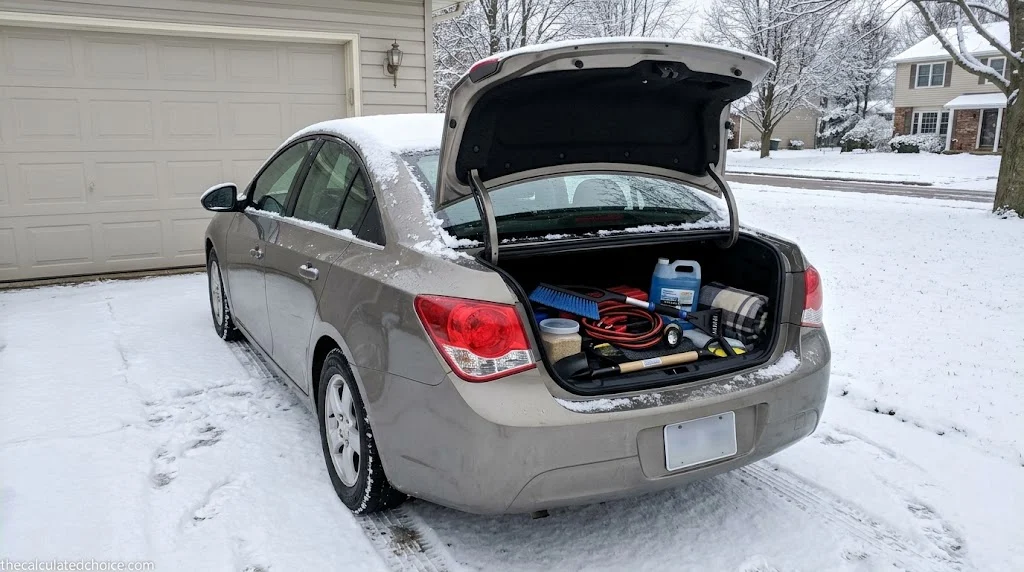
Knowing how to winterize your car lowers the odds of a breakdown, but even a well-maintained vehicle can get trapped behind a jackknifed tractor-trailer, slide into a snowbank, or suffer a dead battery at a trailhead. Both NHTSA and AAA advise stocking every vehicle with cold-weather survival and recovery gear before freezing weather begins.
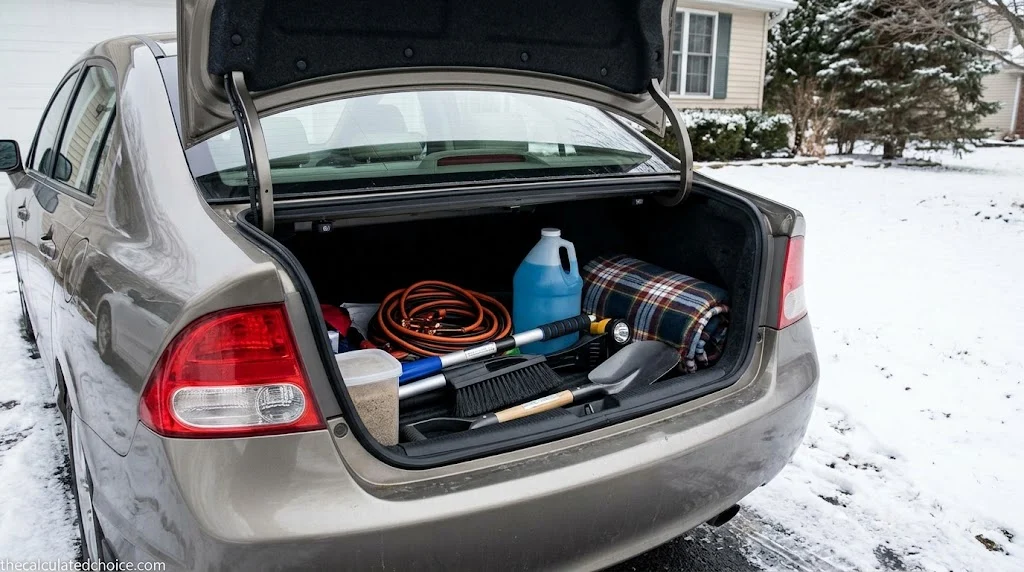
- Build or buy a verified roadside kit: If you want a pre-assembled bag with heavy-gauge jumper cables, a 12V tire inflator, highway flares, or a tow strap, see our Keepa-verified guide to the best winter car emergency kit. If you only need cables, compare our picks for the best jumper cables for cars and trucks.
- Pack your trunk with cold-weather essentials: For a complete item-by-item breakdown of traction grit, folding shovels, blankets, water, and cab supplies, read our companion checklist on what to keep in your car in winter.
Pack a dedicated snow brush and ice scraper sized to your roof width before the first freeze so you are never forced to clear glass with a credit card or gloved hand. Before heavy snow arrives, stow a compact metal snow shovel in the trunk so you can clear frozen snowbanks away from your exhaust pipe and drive wheels. Even winter tires can get high-centered on a packed snowplow berm; review how to get your car unstuck from snow so you know when to turn off traction control.
How we researched this guide
We did not lab-test vehicles; we analyzed federal traffic safety advisories, automotive engineering standards, and fluid/tire manufacturer technical sheets to build a spec-driven checklist on how to winterize your car.
Sources: NHTSA, AAA Exchange, AAA Oregon/Idaho, Tire Rack, Anton Paar (SAE J300), FuelEconomy.gov
Frequently asked questions
When should you winterize your car?
What is the minimum tire tread depth for snow driving?
How long should you warm up your car in cold weather?
What ratio of antifreeze to water is best for freezing weather?
Why does my tire pressure light come on every time it gets cold?
Does cold weather hurt gas mileage and EV range?

Researched by Shahzad
Amazon seller who researches products using sales-rank history, price tracking and owner reviews before recommending anything. Read our disclosure.