
We may earn a commission when you buy through links on this page, at no extra cost to you. It never decides what we recommend. How we make money
Shopping for the best portable power station for car camping is a minefield of inflated coupons, rotating Amazon listings, and misunderstood watt-hour specs. Buy an undersized 250Wh box for a weekend trip with a 12V compressor cooler and a camp coffee maker, and the inverter will trip on your first morning brew—or drain flat before Sunday morning, spoiling your food in the trunk. Buy an overpriced model during a fake-discount cycle, and you can easily overpay by hundreds of dollars for the exact same LiFePO4 battery capacity.
To cut through the noise, we shortlisted eight popular car-camping power stations from BLUETTI, Jackery, EcoFlow, and Anker, verified their electrical manuals and warranty terms, and audited every listing on Keepa for price stability, Buy Box consistency, sales-rank trend, and review integrity. Seven of the eight failed our Keepa audit due to extreme coupon yoyo pricing, missing Buy Boxes, or stockouts—leaving one standout basecamp workhorse that earned a clean pass.
Table of Contents
Quick answer
- Best for basecamp & tailgate gearBLUETTI AC180 (1,152Wh / 1,800W) — The only candidate in our 8-unit audit with a stable 12-month Amazon Buy Box history, pairing a 3,500-cycle LiFePO4 battery with a regulated 12V/10A car port and a 1,800W pure sine wave inverter.
- Minimum size for a 12V car fridgeLook for at least 768Wh to 1,152Wh of capacity with a regulated 12V/10A cigarette-lighter socket to run a 45W portable refrigerator for a full 2-to-3-day weekend without solar.
- Minimum watts for camp cookingElectric kettles, travel coffee makers, and induction plates require 1,000W to 1,800W of continuous AC output; a 300W or 500W station will shut down immediately.
- Why 7 big-name rivals failedPopular models from Jackery, EcoFlow, and Anker failed our Keepa check due to two-year coupon price swings, lost Buy Boxes, or discontinued stock.
Our picks at a glance
We only recommend products that pass both our technical manual audit and our Keepa price-and-stock stability check. Out of eight major candidates checked for this guide, only the BLUETTI AC180 passed.
| Model & Scenario Badge | Capacity & Chemistry | Continuous / Surge AC | 12V Car Port & Solar Input | Weight & Warranty | Price Band |
|---|---|---|---|---|---|
| BLUETTI AC180 Best for heavy-duty basecamp & tailgate appliances | 1,152Wh LiFePO4 (3,500+ cycles to 80%) | 1,800W pure sine wave (2,700W Power Lifting) | Regulated 12V/10A port; 500W max solar (12–60V) | 35.27 lbs; 5-year warranty | $$$ |
Best portable power station for car camping: the Keepa-verified pick
BLUETTI AC180 Portable Power Station
Best for: Running a 12V car fridge all weekend plus high-wattage camp coffee makers, electric skillets, and CPAP machines
The BLUETTI AC180 hits the sweet spot for vehicle-based camping because it combines 1,152Wh of LiFePO4 storage with a full 1,800W pure sine wave inverter across four 120V outlets, a regulated 12V/10A car socket, a 100W USB-C PD port, four USB-A ports, and a 15W top wireless charging pad on the official BLUETTI AC180 specification page. Unlike smaller weekend boxes whose 12V voltage sags as the battery drains—causing 12V portable fridges to throw low-voltage error codes prematurely—the AC180’s 12V/10A car outlet is voltage-regulated, keeping compressor coolers running steadily down to the bottom of the pack. It also includes solar and car charging cables in the box and is backed by a 60-month (5-year) coverage period on the BLUETTI warranty page.
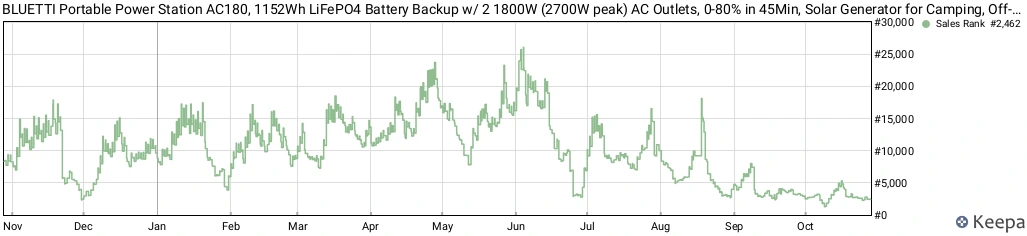
On Keepa, this listing has 3.4 years of tracked sales history with a current sales rank of #2,462 and a 365-day average rank around #10,000, held by Amazon in the Buy Box with a stable 12-month price band ($$$) and a 4.5-star rating across 2,826 reviews. Two Keepa details are worth noting before you buy: earlier in its multi-year history the listing saw wider promotional swings before settling into its steady 12-month band, and the review graph shows an upward step of roughly 500 reviews at once, which we could not tie to a confirmed cause (a variation merge is the most likely explanation).
Fine print: Check three details in the BLUETTI AC180 manual and FAQ before loading your trunk: (1) the AC180 is not natively capacity-expandable—it can only be recharged from B80, B230, or B300 batteries in Power Bank Mode via an optional separately sold adapter cable; (2) when ambient campsite temperatures sit between 86°F and 104°F (30°C–40°C), continuous AC output automatically derates from 1,800W down to 1,500W max; and (3) BLUETTI states the unit must always be stored and transported upright, never laid on its side in a packed cargo bay.
What we like
- Regulated 12V/10A car socket prevents premature low-voltage shutoffs on 12V compressor coolers
- 1,440W Turbo AC charging reaches 80% in 45 minutes (or 45 dB Silent mode at 260W input)
- Includes AC, 12V car, and MC4 solar charging cables in the box (up to 500W solar input)
Watch out for
- At 35.27 lbs (16 kg), it requires a two-handed lift in and out of a high SUV cargo floor
- BLUETTI app connects via Bluetooth only (no Wi-Fi remote check when away from camp)
- Only one USB-C port (100W), whereas several newer rivals include two USB-C ports
Verdict: If you want a single trunk battery that runs a 12V fridge all weekend and still has the 1,800W inverter muscle to run a coffee maker, electric kettle, or microwave without tripping, the BLUETTI AC180 is the most proven, price-stable choice on Amazon. Skip it if you camp solo out of a compact hatchback and want a lightweight 8-to-18-pound battery just for phones, laptops, and tent lights.
Car camping sizing math: Wh and watts
Portable power stations are rated by two numbers that buyers routinely mix up: watt-hours (Wh), which measure the size of the fuel tank, and continuous watts (W), which measure how many appliances can run at the exact same moment. You never get 100% of the sticker watt-hours at the outlets because internal Battery Management System (BMS) reserves and DC-to-AC inverter heat consume part of the stored energy.
In its official AC180 technical FAQ, BLUETTI publishes the exact engineering formula for real-world runtime: 90% Depth of Discharge (DoD), 85% inverter efficiency (η), and approximately 15W of internal self-consumption while the inverter is switched on.
How to calculate real campsite runtime (BLUETTI formula)
Step 1 (Usable Wh formula): Runtime (hrs) = Battery Capacity (Wh) × DoD (0.90) × Efficiency (0.85) ÷ (Appliance Watts + 15W self-consumption).Step 2 (Net usable energy on a 1,152Wh station): 1,152Wh × 0.90 × 0.85 = 881.28Wh of net usable energy after reserve and conversion losses.Example A (60W camp electric blanket overnight): 881.28Wh ÷ (60W + 15W) = 881.28 ÷ 75W = 11.75 hours of continuous heat.Example B (12V compressor fridge drawing 45W when active, cycling 33% of each hour = 15W average draw): On regulated 12V DC (without AC inverter overhead, ~5W DC board draw): (1,152Wh × 0.90) ÷ (15W + 5W) = 1,036.8Wh ÷ 20W = 51.8 hours (over 2 full days without solar or driving recharge).Always plug your 12V camping fridge into the regulated 12V car socket rather than the 120V AC wall outlet—turning off the AC inverter eliminates ~15W of continuous idle drain. Source: BLUETTI AC180 Official Runtime Formula If you would rather power the fridge through a standalone inverter, see what size power inverter you need.
Use the runtime table below to see how common car-camping gear performs across three standard power station capacity tiers using that same 90% DoD / 85% efficiency math. If you only need to run low-wattage electronics while your vehicle engine is idling or driving, see our guide on what a 300W power inverter can run.
| Campsite Appliance | Typical Draw | ~300Wh Station (300W AC) | ~768Wh Station (800W–1,000W AC) | 1,152Wh BLUETTI AC180 (1,800W AC) |
|---|---|---|---|---|
| 12V Compressor Cooler (plugged into 12V DC port, ~15W avg cycling) | 45W active / 15W avg | ~13 hours | ~34 hours | ~51 hours (2+ days) |
| CPAP Machine (heated humidifier & tube off) | 30W continuous | ~4.9 hours (too short) | ~13 hours (1–2 nights) | ~19.5 hours (2+ nights) |
| Heated Electric Blanket (low/medium setting) | 60W continuous | ~2.9 hours | ~7.8 hours (1 night) | ~11.7 hours (full night+) |
| Camp Coffee Maker (10-minute brew cycle) | 800W AC | Will not run (trips 300W inverter) | ~4.5 brew cycles (uses ~135Wh per pot) | ~6.5 brew cycles (13 cups) |
| Electric Kettle or Skillet (15-minute cook) | 1,200W–1,500W AC | Will not run | Will not run on standard 800W–1,000W AC | Runs at full wattage (~30–35 mins total) |
Four manual fine-print checks before you buy
Before spending money on any portable power station for your vehicle, check these four rules buried inside manufacturer manuals:
- Regulated 12V DC output vs. unregulated battery voltage: A 12V compressor fridge has a built-in battery protection circuit that shuts the cooler off if input voltage drops below roughly 10.4V to 11.0V. Choose a station whose spec sheet explicitly specifies a regulated 12V/10A (or 12.6V/10A) car outlet, like the BLUETTI AC180.
- Resistive “Power Lifting / SurgePad” vs. true continuous watts: Marketing pages love to advertise “2,000W to 2,700W” modes on 800W to 1,800W inverters. In the BLUETTI AC180 FAQ and Anker SOLIX C1000 FAQ, makers state that voltage-lowering modes (Power Lifting, X-Boost, SurgePad) work only for simple resistive heating elements (hair dryers, kettles, space heaters) and must never be used for compressor air conditioners, microwaves, or sensitive electronics.
- 12V car recharging speed while driving: Standard cigarette-lighter charging cables pull roughly 96W to 100W (12V at 8A). As shown in Jackery’s car-charging table and the BLUETTI AC180 specs, refilling a 1,000Wh+ battery from 0% to 100% via a 12V dashboard socket takes 12 to 12.5 hours of driving. Two hours of highway driving between campsites restores roughly 180Wh to 200Wh—enough to offset one night of 12V fridge use, not a full recharge.
- Warranty storage rules that void coverage: Read the warranty exclusions carefully. On Jackery’s official service policy, the warranty on the battery cell does not apply unless you fully charge the unit within 7 days of purchase and recharge it at least once every 6 months. BLUETTI and Anker require recharging to 40%–80% every 3 to 6 months during storage.
Popular picks we rejected (and why)
The seven portable power stations below are widely recommended across outdoor blogs and have solid manufacturer spec sheets, but every one of them failed our Keepa price-stability, Buy Box, or stock audit when we checked their Amazon listings.
| Model & ASIN | Key Published Specs | Why We Rejected It (Keepa Findings) |
|---|---|---|
| Jackery Explorer 1000 v2 (B0D7PPG25F) | 1,070Wh LiFePO4, 1,500W AC, 23.8 lbs (Jackery specs) | Keepa shows two years of repeated, extreme high-to-low price swings (more than doubling between promo lows and list highs) in a classic fake-discount pattern. |
| EcoFlow DELTA 2 (B0B9XB57XM) | 1,024Wh LiFePO4, 1,800W AC, 27 lbs (EcoFlow manual) | Lost its active Amazon Buy Box and new-condition price line on Keepa, making availability and seller fulfillment unreliable. |
| Anker SOLIX C1000 (B0C5C89QKZ) | 1,056Wh LiFePO4, 1,800W AC, 28.44 lbs (Anker specs) | Keepa shows sharp price spikes, volatile sales rank, and an abrupt review-count drop from roughly 2,300 down to 1,600 on the listing chart. |
| Anker SOLIX C800 Plus (B0C5CBDX2P) | 768Wh LiFePO4, 1,200W AC, built-in camp lights, 24 lbs (Anker specs) | No active Amazon Buy Box on Keepa, sales rank deteriorated to roughly #300,000, and review volume remains thin (130 reviews). |
| EcoFlow RIVER 2 Pro (B0BVLPGS79) | 768Wh LiFePO4, 800W AC, 17.2–18.2 lbs (EcoFlow specs) | Keepa’s 3.5-year chart shows continuous 2× price swings between promotional lows and inflated list prices. |
| BLUETTI AC70 (B0CLG6FYLQ) | 768Wh LiFePO4, 1,000W AC, 22.5 lbs (BLUETTI specs) | Out of stock on Amazon (price line stopped and sales rank spiked) and marked discontinued/sold out on BLUETTI’s direct US store. |
| Jackery Explorer 300 Plus (B0CFV93GZM) | 288Wh LiFePO4, 300W AC, 8.27 lbs (Jackery manual) | No active Amazon Buy Box, weak sales rank (~#150,000 to #280,000), only 488 reviews, and being phased out by Jackery in favor of newer v2 models. |
How we chose these picks
We did not lab-test these units; we checked Keepa sales-rank and price-tracking history, manufacturer specification sheets, and battery safety standards to separate stable, proven car-camping power stations from listings with inflated coupon cycles or stock gaps.
Sources: BLUETTI AC180 Official Page, BLUETTI Warranty Policy, Jackery Service Policy, UL Solutions (UL 2743)
Bottom line: the best portable power station for car camping is the one that pairs a regulated 12V/10A port with a stable Amazon price history. Right now the BLUETTI AC180 is the only unit that cleared both checks, so it is our pick for the best portable power station for car camping until a rival earns a clean Keepa pass.
Frequently asked questions
What size portable power station do I need for car camping?
How long will a 1,000Wh portable power station run a 12V car fridge?
Why should I plug my camping cooler into the 12V DC port instead of the 120V AC outlet?
Can I recharge a portable power station from my car’s 12V socket while driving?
Is LiFePO4 (LFP) worth the extra weight over standard lithium-ion for car camping?
Can I leave my portable power station inside a freezing car overnight at camp?

Researched by Shahzad
Amazon seller who researches products using sales-rank history, price tracking and owner reviews before recommending anything. Read our disclosure.