
We may earn a commission when you buy through links on this page, at no extra cost to you. It never decides what we recommend. How we make money
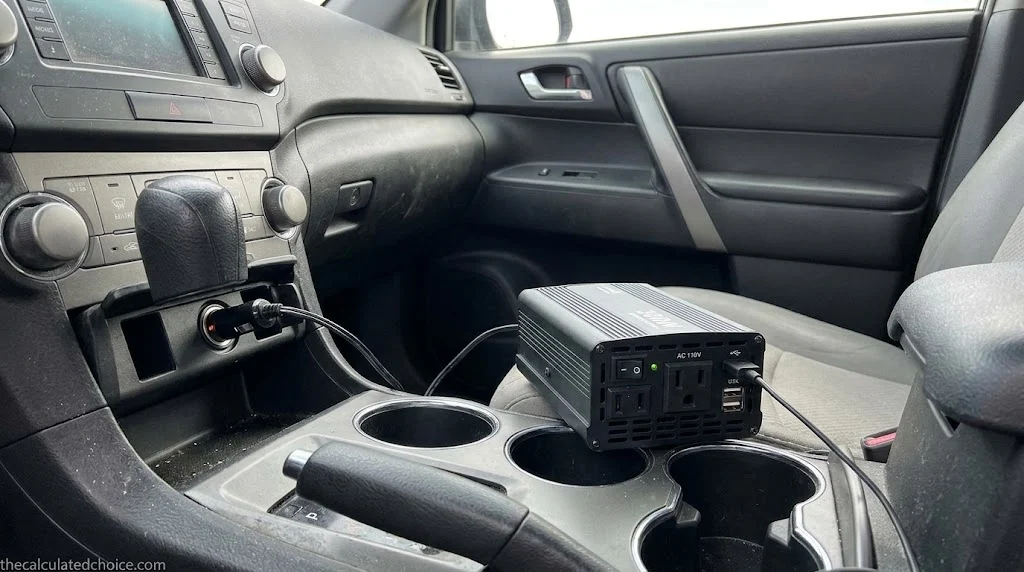
When drivers ask what can a 300W power inverter run, they usually see the 300-watt badge on the box and assume any appliance under 300 watts can plug straight into their dashboard. In practice, a 300W car inverter has two different wattage limits depending on which input cable you attach—and ignoring that rule will blow your car’s dashboard fuse in seconds.
Plug a 300W inverter into a standard 12V cigarette-lighter socket and try to pull 250 watts for a gaming laptop and monitor, and your vehicle’s 15-amp accessory fuse will pop before the screen boots. Worse, plug a CPAP humidifier or cordless tool charger into a budget modified sine wave inverter, and the stepped AC waveform can cause transformer buzz, excess heat, or charger failure.
We checked the engineering manuals, overload cutoff curves, and wiring rules from BESTEK (MRI3011BU), BESTEK Pure Sine Wave (MRZ3011BU), BYGD (A300W), Topbull, and Xantrex (UL 458) to break down every device a 300W inverter can run, why the 150W socket bottleneck exists, and how to calculate vehicle battery drain.
Table of Contents
Quick answer
- 12V socket limit (up to 150W)Plugged into a car’s 12V cigarette-lighter port, a 300W inverter is capped at 120W to 150W—enough for work laptops (60W–100W), phones, tablets, drones, camera batteries, LED lights, and a CPAP without its heated humidifier.
- Battery clamp limit (150W to 300W)To access the full 150W to 300W range (for a 32–43 inch LED TV, gaming console, desktop monitor, or heated CPAP), you must connect directly to your 12V battery terminals with alligator clips.
- Safe continuous ceiling (240W–270W)For loads running longer than 30 minutes, keep total draw at 80% to 90% of rated capacity (240W to 270W) to avoid thermal shutdown.
- What it cannot runA 300W inverter cannot run heating appliances (electric kettles, coffee makers, hair dryers, space heaters, toasters) or high-surge household compressors (microwaves, AC mini-fridges).
- Pure sine vs. modified sineChoose a pure sine wave 300W inverter for CPAP machines, laptops with GaN bricks, power-tool battery chargers, and audio gear.
What can a 300W power inverter run? The master chart
Before plugging in any device, check its AC power brick for running watts (continuous draw) and starting watts (surge draw). Match the load to your connection method—either the 12V dashboard socket (150W max) or direct 12V battery clamps (300W max), per the BESTEK MRZ3011BU manual and BYGD A300W manual. The full math is in what size power inverter you need.
| Device or Appliance | Running Watts | Surge Watts | 12V Socket (≤150W)? | Battery Clamps (≤300W)? | Waveform & Wiring Notes |
|---|---|---|---|---|---|
| Phone / Tablet charger | 18W–45W | None | Yes | Yes | Use built-in USB ports to skip AC conversion loss. |
| Work laptop (MacBook, XPS) | 60W–100W | None | Yes | Yes | Pure sine wave prevents GaN power brick heat. |
| Starlink Mini or Wi-Fi router | 15W–60W | None | Yes | Yes | Runs cleanly off a 12V socket below 70W fan threshold. |
| 12V compressor car fridge | 40W–60W | 120W–180W | Yes (use 12V DC) | Yes | Plug into 12V DC directly to avoid ~15% inverter loss. |
| CPAP (humidifier OFF) | 30W–50W | None | Yes (Pure Sine) | Yes (Pure Sine) | Medical blowers require pure sine wave AC or 12V DC cord. |
| CPAP (heated humidifier ON) | 90W–150W | None | Borderline | Yes (Pure Sine) | Heater plates cycle near 150W; use clamps or a power station. |
| Tool battery charger (18V/20V) | 75W–160W | None | Small only | Yes (Pure Sine) | Rapid chargers fail on modified sine waves; check base label. |
| 32–43″ LED TV + Xbox Series S | 110W–165W | None | No (>150W) | Yes | Needs battery clamps (Xbox Series S uses ~75W + 40W–80W TV). |
| Gaming laptop (RTX brick) | 180W–280W | None | No (blows fuse) | Yes (≤270W) | Requires battery clips; 240W+ bricks blow 15A car fuses. |
| Mini blender or slow cooker | 200W–250W | 350W–500W | No | Yes (short use) | Keep continuous load under Topbull’s 270W ceiling. |
| Household AC mini-fridge | 100W–600W | 800W–2,000W | No | No (surge trips) | Compressor startup surge exceeds 600W–700W peak rating. |
| Coffee maker, kettle, hair dryer | 800W–1,800W | 800W–1,800W | No | No | Heating coils require a 1,500W–1,800W+ power station. |
The 150W cigarette-lighter fuse trap explained
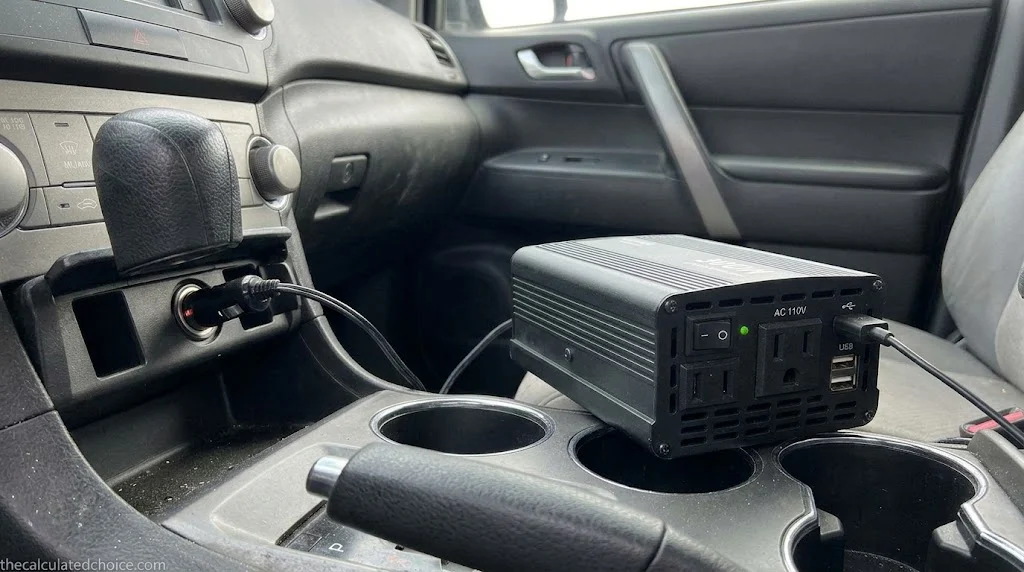
The biggest frustration with 300W car inverters is your vehicle’s dashboard wiring. Every major 300W inverter manual—including the BESTEK MRZ3010BU manual, BESTEK MRZ3011BU manual, and BYGD A300W manual—warns: do not draw more than 150 watts through the 12V cigarette-lighter plug.
Automotive 12V accessory sockets use thin 16–18 AWG wiring protected by a 10-amp or 15-amp blade fuse. Because DC-to-AC conversion is not lossless—the BESTEK MRI3011BU manual rates efficiency at >83% (typically 83% to 90%)—the inverter pulls extra DC watts from your socket to cover conversion heat.
DC amp draw & 12V dashboard fuse math
Step 1 (Formula): DC Amps from 12V Socket = AC Load (Watts) ÷ [DC Voltage (12V) × Efficiency (0.85)].Step 2 (At 150W AC load): 150W ÷ (12V × 0.85) = 150W ÷ 10.2V = 14.7 Amps DC (right at a 15A vehicle accessory fuse limit).Example (At 300W AC load): 300W ÷ (12V × 0.85) = 29.4 Amps DC (nearly double a 15A car fuse, requiring 30A internal fuses and direct battery clamps).Any AC load above 150W pulls over 15 amps from a 12V circuit and blows a standard 15A cigarette-lighter fuse. Sources: BESTEK MRI3011BU Manual, BYGD A300W Manual
Continuous watts vs. peak surge watts
Every 300W inverter lists two ratings: 300W continuous power and 600W to 700W peak surge power (600W peak on the BYGD A300W and 700W peak on the BESTEK MRZ3011BU). Knowing how long an inverter tolerates surge loads prevents unexpected shutoffs:
- The 80%–90% continuous load rule (240W to 270W): Per Topbull’s load guidelines, long-duration loads should stay below 270 watts, and loads above 200W should be capped at 3 hours to prevent transformer overheating.
- Exact overload cutoff timers: On the BESTEK MRI3011BU overload curve, loads of 300W–330W run for ~60 seconds; loads of 330W–360W trip after 20 seconds; and 350W–400W+ triggers immediate overload protection.
- Inductive startup spikes: Appliances with AC compressors or motors pull 3 to 7 times their running wattage at startup. Even if a dorm mini-fridge draws 90W running, its 800W startup spike trips a 300W inverter into fault lock.
Pure sine wave vs. modified sine wave at 300W
In the 300W class, buyers choose between modified sine wave (correction wave, such as the BESTEK MRI3011BU) and pure sine wave (such as the BESTEK MRZ3011BU and MRZ3010BU). Modified sine wave units step voltage in blocky square steps. Five categories of gear require a pure sine wave 300W inverter: For a deeper comparison, see pure sine vs modified sine wave inverter.
- CPAP and BiPAP machines: As noted in the BESTEK Pure Sine Wave manual, medical equipment relies on smooth grid-grade waveforms; modified sine waves overheat CPAP bricks and disrupt humidifier heaters.
- Cordless tool battery chargers: Rapid 18V/20V lithium chargers use voltage-sensing circuits that misread modified sine waves or burn out internal rectifiers.
- Modern laptops and GaN USB-C bricks: Active Power Factor Correction (PFC) adapters run hotter and buzz audibly on stepped waveforms.
- AC fans and small motors: Standing and desk fans emit a 60Hz hum and run warmer on modified sine wave inverters.
- Audio, radio, and camera gear: Pure sine wave output eliminates harmonic static buzz in speakers, radios, and monitors.
How long will a 300W inverter run on a 12V battery?
A 300W power inverter has zero internal battery storage—it drains whatever 12V battery it is wired to. While driving, your alternator supplies the load. Once you shut the engine off, the inverter drains your starter battery.
Although 300W inverters include an under-voltage shutoff at 10.0V to 11.0V DC per the BESTEK MRI3011BU manual, a 12V lead-acid starter battery at 10.5V is already too depleted to crank a cold engine—which is why understanding the difference between a portable power station and a jump starter matters before running loads parked.
12V battery runtime math (starter battery vs. deep-cycle LiFePO4)
Step 1 (Topbull formula): Runtime (hrs) = [Battery Capacity (Ah) × 12V × Safe Depth of Discharge (DoD) × Efficiency (0.88)] ÷ Load (W).Step 2 (50Ah lead-acid car battery at 50% safe DoD running 150W): (50Ah × 12V × 0.50 × 0.88) ÷ 150W = 264Wh ÷ 150W = 1.76 hours before risking a no-start.Example (100Ah deep-cycle LiFePO4 battery at 80% DoD running 150W): (100Ah × 12V × 0.80 × 0.88) ÷ 150W = 844.8Wh ÷ 150W = 5.63 hours.Even with nothing plugged in, an active 300W inverter draws 8W to 25W of idle standby power. Always switch it OFF when parked. Sources: Topbull Runtime Formula, BESTEK MRZ3011BU Data
300W car inverter vs. portable power station
For charging a laptop and camera batteries while driving, a plug-in 300W pure sine wave inverter ($ band) is compact and affordable. Once you park overnight, a standalone portable power station solves three major limitations of a bare 12V inverter: Our shortlist of Keepa-checked models is in the best car power inverter guide.
| Feature | 300W Plug-In Car Inverter | Portable Power Station (e.g., BLUETTI AC180) |
|---|---|---|
| Internal battery storage | None (drains vehicle’s 12V starter battery) | 288Wh to 1,152Wh+ LiFePO4 battery (BLUETTI AC180) |
| Risk of dead car battery | High if used >1–2 hours with engine off | Zero (isolated from vehicle starter battery) |
| Max AC watts inside cabin | Capped at 150W on 12V cigarette socket | Full 300W to 1,800W+ from built-in AC outlets |
| Popping hood for >150W | Required (must clamp to battery terminals) | Never required; works inside a tent or tailgate |
| Solar recharging | Not supported | Built-in MPPT controller for 100W–500W solar panels |
| Price band | $ | $$ to $$$ |
What to buy for your vehicle and campsite
If your devices stay under 150 watts and you charge them while driving, choose a 300W pure sine wave car inverter (like the BESTEK MRZ3011BU) with both a 12V socket plug and battery clamps, smart USB ports, and low-voltage shutoff.
If you want to run a 12V cooler, CPAP, TV, or coffee maker at camp with the engine off—without risking a dead starter battery or clamping onto battery posts—see our Keepa-verified guide to the best portable power station for car camping. And if you run accessories from your vehicle battery, keep a lithium jump pack in your glovebox; see our portable power station vs. jump starter guide for how they work together.
How we researched this guide
We did not lab-test these inverters; we audited manufacturer user manuals, overload cutoff curves, and automotive 12V circuit limits to show what a 300W inverter can safely power.
Sources: BESTEK MRI3011BU Manual, BESTEK MRZ3011BU Pure Sine Manual, BYGD A300W Manual, Topbull 300W Guide
Bottom line: what can a 300W power inverter run? Anything up to about 150W through the cigarette-lighter socket, such as laptops, phones, cameras and a CPAP without its humidifier, and up to 300W only when you clamp it directly to the battery. Knowing what a 300W power inverter can run keeps you from blowing the 15A dashboard fuse.
If you plan to run an inverter with the engine off, check your battery first: our car battery voltage chart shows what each reading means, how to test a car battery with a multimeter walks through the check, and why a car battery keeps dying covers the usual causes of a drained starter battery.
Frequently asked questions
Why can I only pull 150W from a 300W inverter in my car?
Can a 300W power inverter run a television and gaming console?
Will a 300W inverter run a CPAP machine overnight?
Can a 300W inverter run a mini-fridge or car cooler?
Do I need a pure sine wave or modified sine wave 300W inverter?
Does a 300W power inverter drain my car battery when nothing is plugged in?

Researched by Shahzad
Amazon seller who researches products using sales-rank history, price tracking and owner reviews before recommending anything. Read our disclosure.