
We may earn a commission when you buy through links on this page, at no extra cost to you. It never decides what we recommend. How we make money
Knowing how to choose a portable tire inflator saves you from two common letdowns: a pump that takes forever on a big SUV tire, and a cordless unit that is dead or too cold to run on the morning you need it. The good news is that the choice comes down to a handful of checks you can make from any spec sheet. This guide is for everyday US drivers who want a portable tire inflator for top-ups at home and soft tires on the road. You will learn which specs actually matter, which ones are marketing, and how to match the inflator to your tires, your power source and your climate.
How to choose a portable tire inflator: the short answer
- Pressure Make sure the inflator’s working pressure comfortably exceeds the highest pressure you need, including a compact spare (often 60 PSI) or light-truck tires.
- Power Pick cordless for convenience, 12V plug-in for unlimited run time, or battery clamps for big tires and higher airflow.
- Speed Compare airflow (CFM or L/min) and read the fine print on fill-time claims. Max PSI does not tell you speed.
- Control Get a digital gauge with auto shut-off and a published accuracy, ideally ±1 PSI.
- Fit Check duty cycle, cold-weather operating range, hose and cord reach, and a real warranty from a brand with a support site.
How to choose a portable tire inflator: start with your tires
Before you compare a single pump, find the pressure your vehicle actually needs. NHTSA is clear on where that number lives: on the Tire and Loading Information label on the driver’s door edge, or in the owner’s manual. It also warns that the correct pressure is the one the vehicle maker lists, not the maximum printed on the tire sidewall.
Most passenger cars and crossovers land somewhere in the 30s. That is an easy job for almost any inflator. The numbers that catch people out are the outliers:
- Compact spare tires. Many temporary spares run much higher than the road tires. Kia’s owner’s manual, for example, specifies 60 PSI for its compact spare. If your inflator struggles near 60 PSI, it is not a full roadside kit.
- Light-truck (LT) tires. Load range E tires on heavy-duty pickups are rated for up to 80 PSI, and the door label may call for 60 PSI or more in the rear.
- Big tires in general. A large SUV or truck tire holds far more air than a compact-car tire, so airflow matters much more than it does on a small sedan.
Write down your highest target pressure and your tire size. Those two numbers decide almost everything below.
Check 1: Pick the power source that fits how you drive
Portable tire inflators come in four main power styles. None is best for everyone, so match it to where you will use it. Our cordless vs corded tire inflator comparison goes deeper on the two most common types.
| Power type | Best for | Main trade-off |
|---|---|---|
| Cordless (built-in lithium battery) | Quick top-ups in the driveway, bikes, balls, small cars | Limited run time; must be kept charged; cold limits |
| 12V plug-in (accessory outlet) | Glovebox or trunk kit that never runs flat | Engine should be running; cord must reach every tire; limited by the outlet’s fuse |
| 12V battery clamps | Trucks, SUVs, larger tires, airing up after off-road trips | Bulkier; you open the hood to connect |
| Power-tool battery (18V/20V platforms) | People already on a tool battery system | Often sold tool-only; batteries cost extra if you are not on that platform |
There is also the combo route: a jump starter with a built-in compressor. It saves space, but it is a jump starter first and an inflator second, and every minute of inflating drains the battery you may need for a dead car. Our guide to the best jump starter with air compressor covers when a combo makes sense.
Quick math: will your 12V outlet handle it?
A 12V inflator’s power draw is simply volts times amps.
Watts ≈ 12 V × amp drawA pump that draws 10 amps uses about 120 watts, which most accessory outlets handle. A pump that draws 20 amps needs about 240 watts, more than many outlet fuses are rated for. That is why higher-airflow compressors such as the VIAIR 88P, which VIAIR lists at a maximum 20-amp draw, connect straight to the battery with clamps instead of plugging into the dash. Check your outlet’s fuse rating in the owner’s manual and compare it with the inflator’s listed amp draw before you buy. If a plug-in pump ever stops working, the fuse is one of the first checks in our guide to a tire inflator not working.
Check 2: Airflow tells you speed; max PSI does not
The biggest number on most boxes is maximum pressure: 120, 150, even 160 PSI. It sounds like power, but it tells you very little about how fast the pump fills a tire. Speed comes from airflow, the volume of air the pump moves per minute, listed in cubic feet per minute (CFM) or liters per minute (L/min).
Converting airflow units
1 CFM ≈ 28.3 L/minSo a pump rated at 35 L/min moves roughly 1.2 CFM, and a 1.97 CFM pump moves about 56 L/min. Convert everything to one unit before you compare.
Two catches. First, many brands list airflow at 0 PSI, which is “free flow” with nothing pushing back. VIAIR, for example, rates the 88P at 1.97 CFM at 0 PSI. Real airflow is lower once the tire starts pushing back, and it keeps falling as pressure rises. Second, a pump straining near its maximum pressure is slow and hot. That is why you want working pressure well above your highest target, not just equal to it. For most cars a 100 to 150 PSI rating is plenty of headroom; the higher ratings matter mainly for compact spares and LT tires. Our guide on what size tire inflator you need shows the PSI and airflow math for your own tires.
Check 3: Read the fine print on fill-time claims
Fill-time claims are where spec sheets are hardest to compare, because each brand tests differently. The useful question is always: what tire size, and from what starting pressure to what ending pressure?
Fanttik, for example, lists its X8 Apex as filling a 215/55R17 tire from 28 to 33 PSI in 56 seconds. That is a 5 PSI top-up on a mid-size tire, which is a realistic everyday job, but it is not a fill from flat. AstroAI’s own comparison chart lists its inflators by the time to go from 0 to 36 PSI, which is a much bigger job. Neither claim is wrong. They just cannot be compared side by side.
Check 4: A gauge you can trust, plus auto shut-off
A digital gauge with auto shut-off is the single feature that makes an inflator easy to use. You set the target, press start, and the pump stops when the tire gets there. Without it, you have to watch a dial and switch off by hand, and it is easy to overshoot.
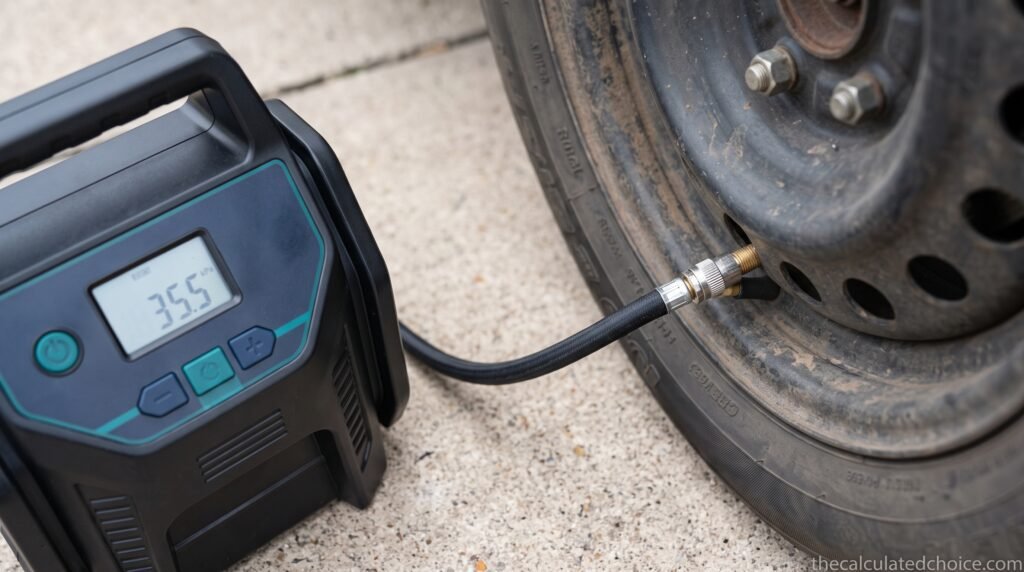
Look for a published accuracy figure. Fanttik, for instance, states ±1 PSI for the X8 Apex. If a brand does not publish accuracy at all, assume the reading is approximate. Either way, check the inflator against a separate quality tire gauge when it is new. Readings taken while the pump is running can also differ from readings with the pump off, so confirm the final pressure after it stops.
Do not rely on your dashboard tire pressure warning instead. Under federal rules, the system has to warn you when a tire is 25% or more below the recommended cold pressure. On a tire that should be at 36 PSI, that is around 27 PSI, which is far lower than you want to drive on. NHTSA recommends checking all tires, including the spare, at least once a month when they are cold.
Check 5: Duty cycle and heat
Duty cycle is how long a compressor can run before it needs to rest and cool down. Serious brands publish it. VIAIR lists the 88P at 25 minutes of run time at 30 PSI. Many small inflators do not publish a duty cycle at all, and their manuals simply tell you to stop and let the unit cool after a set number of minutes.
For topping up four car tires, duty cycle rarely matters. It starts to matter when you fill large tires from low pressure, reinflate after airing down off-road, or plan to use the pump for several vehicles in a row. For cordless units, the equivalent number is run time per charge. Fanttik quotes up to 40 minutes of continuous work and four consecutive fills of a 25-inch tire from 0 to 35 PSI for the X8 Apex.
Check 6: Make sure it works in the cold
Cold weather is when you are most likely to need an inflator. Michelin notes that tires lose about 1 PSI for every 10°F drop in temperature, so the first cold snap of the year often turns on the tire pressure light for thousands of drivers at once. AAA adds that tires also lose about 1 to 2 PSI a month on their own.
That makes the operating temperature range a real buying check, and it is one that most buying guides skip. Cordless inflators run on lithium batteries, which do not like deep cold. Fanttik rates the X8 Apex for use from 14°F to 113°F. VIAIR’s corded 88P, by contrast, lists a minimum ambient temperature of -4°F. If you live somewhere with hard winters and keep the inflator in the car, a corded unit or a cordless one you store indoors is the safer choice. Our best jump starter for cold weather guide covers the same lithium cold issue for jump packs.
Check 7: Hose, cord and chuck
A plug-in inflator is only useful if it reaches every tire. Measure from your accessory outlet to the far rear tire, then add cord length and hose length together. VIAIR, for example, pairs a 10-foot power cord with a 16-foot air hose on the 88P, which covers most full-size vehicles. Many glovebox inflators have much shorter hoses, so check before you buy, especially for SUVs, pickups and minivans.
Then look at the chuck, the part that connects to the valve. Screw-on chucks seal reliably but you lose a little air while unscrewing. Lever or clip-on chucks are faster but can leak if worn. Brass fittings last longer than plastic ones. If you also want to inflate bike tires, check that a Presta valve adapter is included, since car tires use Schrader valves. Our picks for the best tire inflator for bikes and cars all include one.
Check 8: Brand, warranty and support
As Amazon sellers, we see many inflators that look identical and sell under dozens of brand names. The ones worth trusting have a few things in common:
- A brand website with a product page, a downloadable manual and a support contact.
- A written warranty you can read before buying. Fanttik, for example, publishes a 12-month warranty for the X8 Apex.
- Specs that hang together: a published airflow, duty cycle or run time, accuracy and operating temperature, not just a big PSI number.
- Steady sales and reviews over a long period, rather than a sudden burst of five-star ratings.
Working with a tight budget? We ran these same checks on popular cheap inflators in our guide to the best tire inflator under $50, including the best sellers that failed them.
Spec sheet decoder: what to check behind each claim
This is the checklist we use when we compare a portable tire inflator listing. Use it on any product page.
| Claim on the box | What to check | Red flag |
|---|---|---|
| “150 PSI max” | Airflow (CFM or L/min) and your own highest target pressure | No airflow figure anywhere |
| “Fills a tire in 1 minute” | Tire size, start PSI and end PSI | No tire size or starting pressure given |
| “Accurate digital gauge” | A stated accuracy such as ±1 PSI | Accuracy not published |
| “Inflates 4 tires per charge” | From what pressure, on what tire size | Only tested as small top-ups |
| “Heavy duty” | Published duty cycle at a stated pressure | No duty cycle or cool-down guidance |
| “Works in any weather” | Operating temperature range in the manual | No temperature range listed |
| 12V plug-in | Amp draw vs your outlet’s fuse rating | Amp draw not listed |
Which portable tire inflator type fits you?
| If you… | Choose |
|---|---|
| Drive a car or small crossover and want quick top-ups | Cordless with auto shut-off and ±1 PSI accuracy |
| Want a kit that lives in the car year-round, including winter | 12V plug-in with a long cord and hose |
| Drive a full-size SUV or pickup, or have LT tires | Battery-clamp compressor with published CFM and duty cycle |
| Already own 18V or 20V cordless tools | The inflator from your tool battery platform |
| Want one box for jump starts and tires | A jump starter with a built-in compressor |
If you are building a full roadside kit, the same checklist approach applies to jump power. See our guide on how to choose a jump starter. And when you are ready to compare models, our best portable tire inflator for cars picks apply every check above.
Frequently asked questions
Are portable tire inflators worth it?
Are portable tire inflators accurate?
Is a cordless or corded tire inflator better?
Should I buy a tire inflator or an air compressor?
How much PSI should a portable tire inflator have?
Do portable tire inflators work in cold weather?
How we researched this guide
We compared the published specifications, manuals and warranty terms of popular corded, cordless and battery-clamp tire inflators, and checked tire pressure guidance from NHTSA, AAA, Michelin and vehicle owner’s manuals. We did not hands-on test these products. We did not accept free products or payment from any brand.
Sources: NHTSA tire safety · NHTSA TPMS final rule · Michelin winter tire pressure · AAA tire pressure and temperature · VIAIR 88P specifications · Fanttik X8 Apex specifications · AstroAI inflator comparison · Kia compact spare guidance · LT tire load ranges

Researched by Shahzad
Amazon seller who researches products using sales-rank history, price tracking and owner reviews before recommending anything. Read our disclosure.