
We may earn a commission when you buy through links on this page, at no extra cost to you. It never decides what we recommend. How we make money
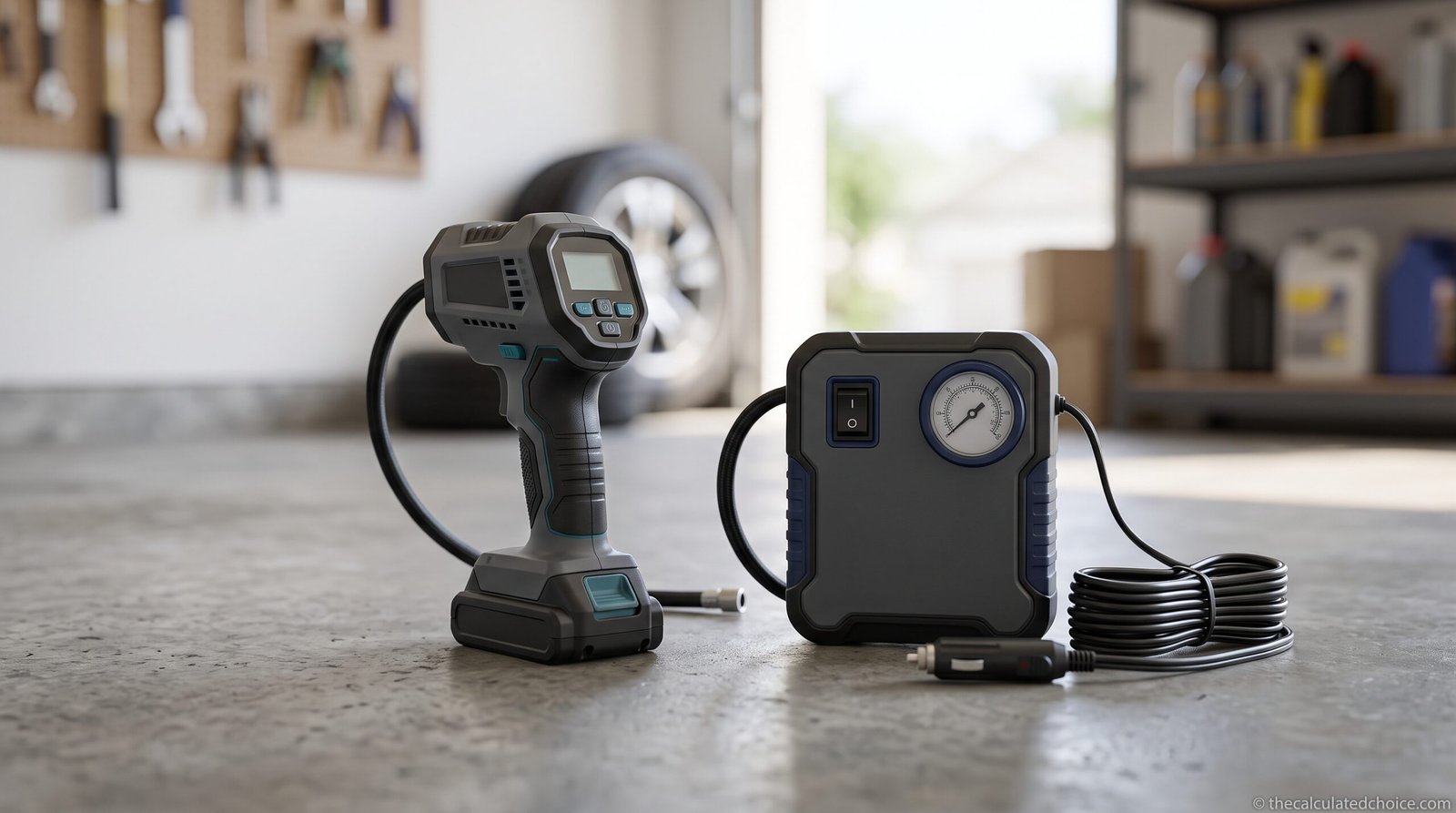
Cordless vs corded tire inflator: which one should live in your car? A cordless inflator runs on its own rechargeable battery, so you can grab it and go. A corded 12V inflator plugs into your car’s accessory socket, so it never runs out of charge, but it needs the engine running and a socket that can handle its current. All three of our picks for the best tire inflator under $50 are corded models. This guide is for US drivers choosing between the two. You will see where each type wins, how many tires one battery charge really covers, how to check your 12V socket rating, and a quick decision table by vehicle.
Cordless vs corded tire inflator: the short answer
- Cordless Best for quick top-ups on cars and crossovers, plus bikes and balls. No cord to route, but run time is limited by the battery, and it has to be kept charged.
- Corded 12V Best as a trunk kit that cannot arrive dead, and for bigger tires. Run time is set by the duty cycle, not a battery, but the engine should be running and the plug must suit your socket’s amp rating.
- Trucks For full-size truck or SUV tires filled from low pressure, a corded model, often one that clamps to the battery, is the safer bet.
- Both Hybrid inflators run on a tool battery or a 12V cord, which suits anyone who cannot decide.
Cordless vs corded tire inflator: the key differences
Both types use the same basic pump. What changes is where the power comes from, and that one choice shapes run time, reach, upkeep and how the inflator copes with cold weather. Here is the side-by-side view.
| Factor | Cordless (battery) | Corded 12V (plug-in) |
|---|---|---|
| Power source | Built-in lithium battery or a power-tool battery | Your car’s 12V accessory socket |
| Run time | Limited by the battery; one charge may cover only a few car tires filled from flat | Limited by the duty cycle, not a battery |
| Engine running? | No | Yes, makers such as VIAIR and Honda call for it |
| Power ceiling | Set by the battery and motor | Set by the socket, usually 10 to 15 amps |
| Reach | Goes anywhere, no cord | Cord plus hose must reach the far rear tire |
| Cold weather | Battery weakens; cannot be charged below 32°F | Works as long as the car starts and runs |
| Upkeep | Recharge on a schedule | None; just store it |
| Best for | Quick top-ups, bikes, balls, garages and parking lots | Emergency kit, bigger tires, longer jobs |

Cordless tire inflators: where they win and where they struggle
A cordless tire inflator is the easiest to use for the job most drivers actually do: adding a few PSI when the tire pressure light comes on. You walk out, screw on the chuck, press start and let the auto shut-off stop it at your target.
Where cordless wins
- No cord to route around the vehicle
- Works with the engine off, so it is fine in a garage or parking lot
- Quick for top-ups of a few PSI
- Handy for bikes, balls and inflatables
- Tool-battery versions share batteries you may already own
Where it struggles
- The battery can be flat when you need it most
- Limited air per charge on big tires
- Cold cuts performance, and lithium cells cannot be charged below 32°F
- Batteries lose capacity as they age
- Small units may need cool-down breaks on long fills
Battery size matters more than the brand name. A pocket-size unit is fine for a sedan’s weekly check but can run out partway through filling a pickup tire from low pressure. Before you buy, look for a battery capacity in watt-hours (Wh) and a tires-per-charge claim that names the tire size.
Corded 12V tire inflators: strengths and limits
A corded, or plug-in, tire inflator plugs into the 12V accessory socket, the one that used to hold a cigarette lighter. As long as the engine runs, it has power, so it is the type that still works after a year forgotten in the trunk.
Where corded wins
- Never needs charging
- Run time set by the duty cycle, not a battery
- Often costs less for the same job
- Better suited to long fills on bigger tires
- No battery to wear out
Its limits
- The engine should be running, which means working outdoors
- The plug must match your socket’s amp rating
- Cord and hose must reach all four tires
- Bulkier to store with the cord and hose
- Less handy for bikes or balls away from the car
Some corded compressors skip the socket and clamp straight to the battery. That lets them draw more current: VIAIR lists a 20-amp maximum draw for its 88P, more than a typical socket allows. Clamp-on models are what many truck owners choose for bigger tires and longer fills, and our best portable tire inflator for trucks guide compares the best of them.
How many tires can a cordless inflator fill per charge?
This is the question most comparisons skip, and it decides whether cordless will work for you. Few brands publish it, but Fanttik does for four of its models, which gives us a useful yardstick.
The watt-hour rule
Fanttik’s comparison chart lists how many 25-inch tires each model can fill from 0 to 35 PSI on one charge: 4 for the 28.8 Wh X8 Apex, 3 for the 18.5 Wh X9 Pro and 12 for the 92.5 Wh X9 Ultra. Divide battery size by tires and every model lands between about 6 and 8 Wh per tire:
About 7 Wh of battery per small-car tire filled from 0 to 35 PSIA 25-inch tire has about 1.4 cubic feet of air space, so a fill from 0 to 35 PSI takes about 3.3 cubic feet of outside air. That works out to roughly 0.46 cubic feet of air per watt-hour. We used that ratio, plus the tire-volume math from our tire inflator size guide, to estimate bigger jobs.
| Battery capacity | Car tire, 0 to 35 PSI | Pickup tire (265/70R17), 0 to 35 PSI | Pickup tire, 5 PSI top-up |
|---|---|---|---|
| 18.5 Wh | About 3 (maker’s claim) | About 1 | About 7 |
| 28.8 Wh | About 4 (maker’s claim) | 1 to 2 | About 11 |
| 92.5 Wh | About 12 (maker’s claim) | About 5 | About 35 |
Treat these as best-case planning numbers. Top-ups happen at higher pressure, which takes more energy per cubic foot, and cold weather and an aging battery both cut capacity. Still, the pattern is clear: a typical cordless unit handles a couple dozen car top-ups on one charge but may manage only one or two full-size truck tires from low pressure. For fill times by method, see our guide on how long it takes to inflate a car tire.
Will a corded 12V inflator work in your car’s socket?
The 12V socket is the weak link for plug-in inflators. Each one is fused, and the rating varies by vehicle. A blown socket fuse is a common reason a plug-in pump will not start; our tire inflator not working guide covers that check and nine others. Honda’s owner’s manual limits its accessory socket to accessories rated 180 watts (15 amps) or less, while Mazda’s CX-30 manual allows 120 watts (10 amps). VIAIR says its portable compressors need an outlet rated for 15 amps or 180 watts.
The 10-second socket check
Inflator amps ≈ watts ÷ 12Find your socket rating in the owner’s manual (search for “accessory power socket” or “power outlet”), then compare it with the inflator’s listed draw. Two published examples, plus a clamp-on model for contrast:
| Inflator draw | Example | 10 A / 120 W socket | 15 A / 180 W socket |
|---|---|---|---|
| About 8 A (100 W) | AstroAI AIRUN H | Fits | Fits |
| 15 A | VIAIR 70P | Too much | Fits, at the limit |
| 20 A | VIAIR 88P | Clamps to the battery instead | Clamps to the battery instead |
Whichever type you choose, our guide on how to use a portable tire inflator safely shows what three inflator manuals say about running the engine while you inflate.
The reach test: will the cord reach your far rear tire?
A cordless inflator goes wherever you carry it. A corded one has to stretch from the dash to the tire farthest from the socket, usually the rear tire on the passenger side. Short cords are a common complaint with plug-in models, and it takes a minute to check before you buy.
Reach math for a crew-cab pickup
Ford lists the F-150 SuperCrew with the 5.5-ft box at a 145.4-inch wheelbase and 79.9 inches wide. The straight line between the front and rear wheels on opposite corners is:
√(145.4² + 79.9²) ≈ 166 in ≈ 13.8 ftAdd about 3 feet to get the cord from the dash socket, out the door and down to the ground, and you need roughly 17 feet of cord plus hose. A plug-in model with a 10-foot cord and a short hose comes up short. For a car with a wheelbase of about 9 feet and a width of about 6 feet, the same math gives about 14 feet.
If you come up short, look for a rear 12V outlet in the cargo area or truck bed, add up cord and hose length before you buy, or choose a battery-clamp model. VIAIR’s 88P, for example, pairs a 10-foot power cord with a 16-foot air hose.
Cold weather: which type is more reliable in winter?
Winter is when you need an inflator most. Michelin notes that tire pressure drops about 1 PSI for every 10°F fall in temperature, which is why the first cold morning so often turns on the pressure warning light. Our guide to tire pressure in cold weather has the full drop table.
Cold hurts a cordless tire inflator in two ways. Lithium-ion cells deliver less as they get colder, and Battery University notes that consumer lithium-ion batteries cannot be charged below 32°F (0°C). Fanttik rates the X8 Apex to work from 14°F to 113°F, so a unit left in a frozen trunk overnight may sit at the edge of its range.
A corded tire inflator draws on the car’s electrical system, so it keeps working in the cold as long as the engine starts and runs. If you live where winters are harsh, a corded model in the trunk, or a cordless one kept indoors and charged, is the safer plan.
Hybrid, battery-clamp and 120V options
You do not always have to pick one side. Several designs blur the line:
- Hybrid tool inflators. DEWALT’s DCC020IB can run on a 20V MAX battery, a 12V DC car outlet or 110V AC power, and DEWALT includes the 12V DC cord.
- Battery-clamp compressors. These connect straight to the battery, so they can draw more current than a socket allows. Most are built for truck and off-road tires.
- 120V inflators. These plug into a household outlet. They suit a garage, not a roadside, unless your vehicle has a 120V outlet.
- Jump starter combos. One box covers two jobs, but every minute of inflating drains the battery you may need for a jump. Our best jump starter with air compressor guide compares the options.
Which should you buy? A quick decision table
The right answer to cordless vs corded tire inflator depends less on the pump and more on your vehicle, your climate and how often you use it. Find your situation below.
| Your situation | Better fit | Why |
|---|---|---|
| Sedan or small crossover, mostly quick top-ups | Cordless | Fast to grab, no cord, plenty of top-ups per charge |
| Emergency kit that lives in the trunk for months | Corded 12V | It cannot arrive with a flat battery |
| Full-size SUV or pickup, fills from low pressure | Corded 12V or battery clamps | Run time is not capped by a battery, and airflow is often higher |
| Airing back up after off-road trips | Battery-clamp compressor | More current, a published duty cycle and a long hose |
| Harsh winters | Corded 12V, or cordless kept indoors | Lithium batteries weaken in the cold and cannot be charged below 32°F |
| Car with a 10 A (120 W) socket | Cordless or a low-draw plug-in | Avoids blown fuses |
| You already own 18V or 20V tool batteries | Tool-platform or hybrid inflator | Shares batteries, and some also run on a 12V cord |
| Bikes, balls and inflatables as well as cars | Cordless | Portable, with presets for each job; see our bike and car tire inflator picks |
Still torn? Many households end up with both: a cordless unit for the driveway and a corded one that stays in the vehicle, or a single hybrid. Our guide on how to choose a portable tire inflator covers the other checks, such as gauge accuracy and auto shut-off, and our best portable tire inflator for cars picks include cordless, plug-in, hybrid and battery-clamp options.
Myths vs facts
| Myth | Fact |
|---|---|
| Corded inflators are always faster. | Speed comes from airflow, not the power source. Small plug-in pumps can be slow, and some tool-battery inflators are quick: Milwaukee says its M18 inflator tops off 33-inch light-truck tires in under a minute. |
| Cordless inflators cannot handle truck tires. | They handle top-ups well. Filling a truck tire from low pressure can take most of a small battery, so size the battery to the job. |
| A 12V inflator will drain your car battery. | Not with the engine running, which VIAIR and Honda both call for. Running it with the engine off is what drains the battery. |
| A higher max PSI means a faster inflator. | Max PSI is a ceiling, not a speed rating. Airflow decides how long a fill takes. |
| If the fuse blows, fit a bigger fuse. | Never. Choose an inflator that suits the socket, or one that clamps to the battery. |
Frequently asked questions
Which is better, a cordless or corded tire inflator?
Are cordless tire inflators worth it?
Do cordless tire inflators work on truck tires?
Should the engine be running when I use a 12V tire inflator?
Can a tire inflator blow a fuse in my car?
What is the difference between a 12V and 120V tire inflator?
Can I leave a cordless tire inflator in my car?
How we researched this guide
For this cordless vs corded tire inflator comparison, we checked manufacturer specifications and manuals for cordless, plug-in, battery-clamp and hybrid inflators, plus vehicle owner’s manuals for 12V socket ratings. The watt-hour, socket and reach calculations are our own, built from those published figures and rounded for planning. We did not hands-on test any inflator, and no brand paid for or reviewed this article.
Sources: Fanttik X8 Apex specs and comparison chart · VIAIR FAQ · VIAIR 70P manual · VIAIR 88P specifications · Honda accessory power socket · Mazda CX-30 accessory sockets · Ford F-150 dimensions · DEWALT DCC020IB · Milwaukee M18 inflator · AstroAI 12V inflator · Battery University BU-410 · Michelin winter tire pressure · CDC carbon monoxide

Researched by Shahzad
Amazon seller who researches products using sales-rank history, price tracking and owner reviews before recommending anything. Read our disclosure.