
We may earn a commission when you buy through links on this page, at no extra cost to you. It never decides what we recommend. How we make money
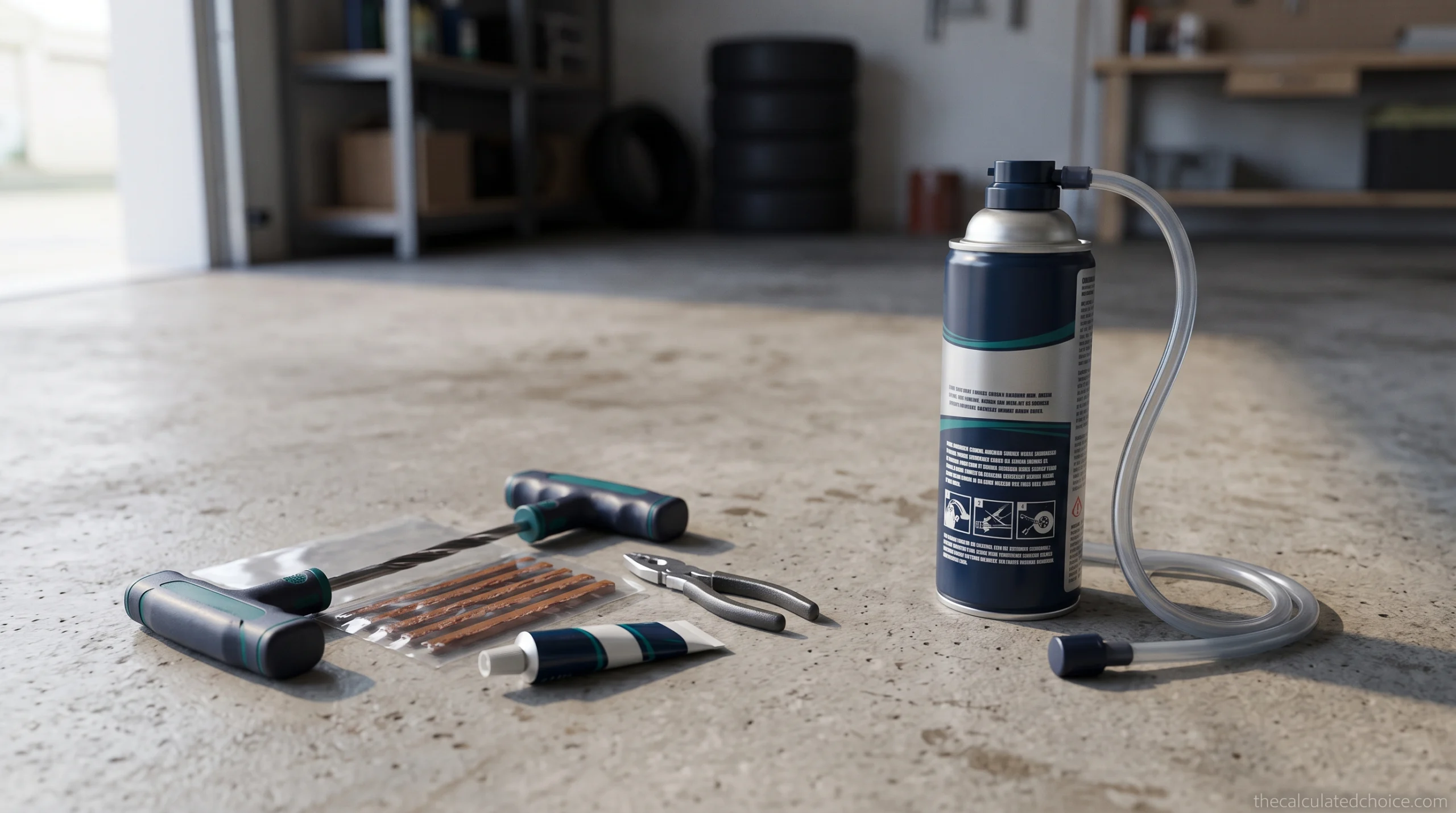
Tire plug vs Fix-a-Flat comes down to two things: what kind of flat you are likely to get, and how much work you are willing to do on the side of the road. A plug kit seals a nail or screw hole from the outside, using a few hand tools and an air source. A can of tire sealant such as Fix-a-Flat seals the hole from the inside in a few minutes, with no tools and no need to find the leak.
This guide is for US drivers deciding what to keep in the trunk, especially if your car came without a spare. We compared the written instructions from Fix-a-Flat, Slime and a carmaker’s factory sealant kit with guidance from the U.S. Tire Manufacturers Association (USTMA), AAA and Consumer Reports, and laid out exactly which flats each one can and cannot handle.
Tire plug vs Fix-a-Flat: the short answer
- Carry a plug kit if you can find the hole and have an air source. It handles the most common flat, a nail or screw in the tread, and puts nothing inside the tire.
- Carry sealant if you want a no-tools fix you can do in the dark, in the rain or when you cannot find the leak. One can covers one tire, once.
- Best setup A plug kit, a small inflator and a gauge, with a can of sealant as a backup for leaks you cannot locate.
- Neither is permanent USTMA calls a plug alone an unacceptable repair, and Fix-a-Flat recommends a proper repair within 3 days or 100 miles.
- Neither fixes sidewall or shoulder damage, cuts, or holes larger than 1/4 inch.
Tire plug vs Fix-a-Flat: side-by-side comparison
Both products deal with the same problem, a small puncture in the tread, but they get there in opposite ways. The table sums up the tire plug kit vs tire sealant differences that matter on the road and at the tire shop afterward.
| What matters | Tire plug kit | Fix-a-Flat or other tire sealant |
|---|---|---|
| How it seals | A sticky rubber-coated strip is pushed into the hole from the outside | Liquid sealant goes in through the valve stem and is pushed into the hole from the inside as the tire rolls |
| Tools needed | Pliers, a reamer, an insertion tool and a knife or blade | Just the can or bottle and its hose |
| Air source | Required: an inflator, compressor or air station | The can adds some air; topping up with an inflator still helps |
| Must you find the hole? | Yes | No |
| Nail or screw still in the tire | Pull it out, then plug the hole | Leave it in, as factory kit instructions say |
| Largest hole | 1/4 inch in the tread, the industry repair limit | 1/4 inch in the tread for Fix-a-Flat and Slime; some factory kits are rated for less |
| Sidewall or shoulder damage | No | No |
| How many repairs | One plug per hole, and kits hold many plugs | One can per tire, one time |
| Inside the tire afterward | Nothing but the plug | Sealant that the shop must clean out |
| Price band | $ for a basic kit, $$ for a heavy-duty kit | $ per can, $$ for a sealant-and-compressor kit |
How a tire plug kit works
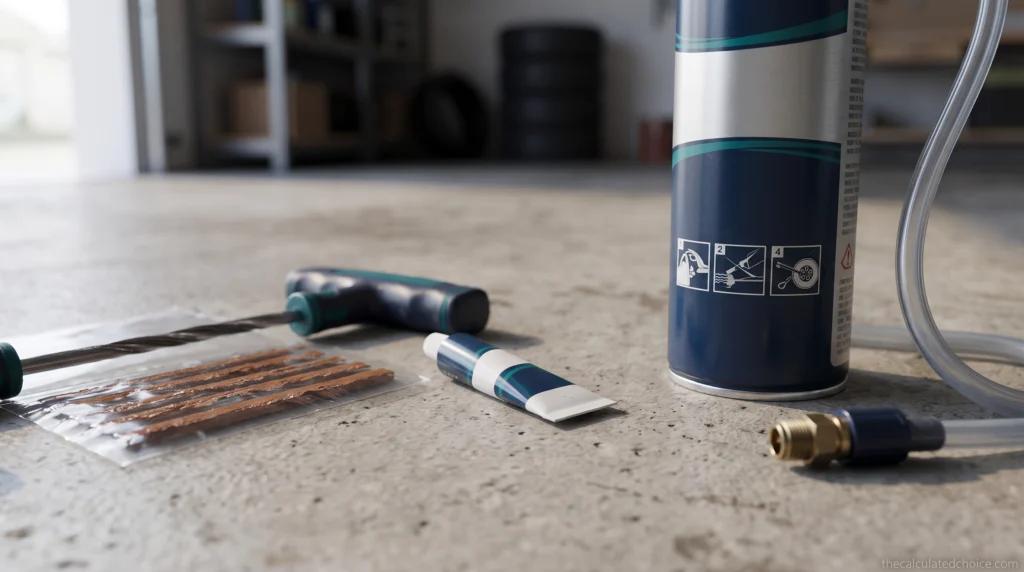
A plug kit repairs the hole from the outside, usually without taking the wheel off the car. The typical kit has a T-handle reamer (a spiral rasp), a T-handle insertion tool with a split eye like a large needle, a pack of sticky string plugs, and sometimes a tube of rubber cement. The basic steps are the same in almost every kit:
- Find the object and pull it straight out with pliers. Spraying soapy water on the tread shows a slow leak as bubbles.
- Ream the hole by pushing the rasp in and out several times to clean and size the channel.
- Load a plug halfway through the eye of the insertion tool, and coat it with cement if your kit includes it.
- Push the plug in until only a short tail is left outside, then pull the tool straight out so the plug stays behind.
- Trim the tail close to the tread, inflate to the pressure on your door label, and check for bubbles again.
The upside is that a plug kit handles the most common flat cheaply and leaves the inside of the tire clean, so your tire pressure sensor never touches anything sticky. The downsides are real, though. You must be able to see and reach the hole, the reaming step takes some force, and you need an air source to refill the tire. A small 12V or cordless inflator does that job; our picks for the best tire inflator under $50 cover the budget options.
Most important, a plug is not a finished repair. USTMA’s repair guidelines say a proper repair needs the tire removed from the wheel and inspected, with a rubber stem filling the hole and a patch sealing the inner liner, and that a plug alone is unacceptable. AAA calls a plug a temporary, emergency fix and says the lifespan of a plug is never certain; some hold for thousands of miles while others fail without warning. Its advice is to stay under 50 mph and drive straight to a repair shop.
How Fix-a-Flat and other tire sealants work
An aerosol can of tire sealant holds liquid sealant plus a propellant. You screw the hose onto the valve stem, empty the can into the tire, and drive off right away so the sealant spreads around the inside and gets forced into the hole. Fix-a-Flat says its can injects enough air to get the tire off the rim, and sizes its cans by tire size, from a compact can up to one for trucks and SUVs.
Many newer cars come with a factory version instead of a spare: a bottle of sealant and a small 12V compressor, often called a tire mobility kit. AAA found that nearly a third of the new vehicles it studied had no spare tire as standard, and it warns that inflator kits cannot fix sidewall damage or blowouts and have a shelf life of only four to eight years.
The appeal is obvious. There is no jack, no reaming and no hunting for the leak, and most of the work happens at the valve stem rather than kneeling at the tread. The trade-off is that the sealant stays inside the tire until a shop cleans it out, and every maker treats it as a short-term fix.
The fine print: hole size, speed and distance limits
Most comparisons skip the limits printed in the instructions, so we pulled them together. The table shows what each source allows, in its own terms. The factory kit is one example from Hyundai’s owner’s manual for the Palisade; other carmakers set their own limits, so check your manual.
| Source | Largest hole | Where on the tire | Speed and distance after | Temperature range | What happens next |
|---|---|---|---|---|---|
| Fix-a-Flat 16 oz aerosol | 1/4 inch | Tread only | Proper repair within 3 days or 100 miles; no speed limit on the product page | 28.4°F to 113°F | An approved repair is recommended |
| Slime Emergency Tire Sealant | 1/4 inch (6 mm) | Tread only | Must be removed within 3 days or 100 miles | 14°F to 122°F | Removed by a professional |
| Hyundai factory Tire Mobility Kit | About 0.16 inch (4 mm) | Not the sidewall | 50 mph maximum, up to 120 miles | Not below −22°F | Have the tire replaced |
| Tire plug (AAA guidance) | 1/4 inch | Main tread | Under 50 mph, straight to a repair shop | Not stated | Plug-and-patch repair from inside |
| Industry repair standard (USTMA) | 1/4 inch (6 mm) | Tread only, not the shoulder or sidewall | Not applicable | Not applicable | Tire removed from the wheel, inspected, plugged and patched |
Three things stand out for anyone weighing a tire plug vs Fix-a-Flat. First, the 1/4-inch limit is universal; nothing here is meant for a gash or a sidewall cut. Second, the factory kit we checked is rated for a smaller hole than the aftermarket cans, and its maker says to replace the tire afterward rather than repair it. Third, the cold limits differ a lot: Fix-a-Flat’s range stops just below freezing, while Slime’s goes down to 14°F.
Turn “100 miles” into a plan
Both aerosol makers give you 3 days or 100 miles, whichever comes first, and AAA says to keep a plugged tire under 50 mph. So the trip to the shop takes at least:
Minimum drive time (hours) = miles to an open tire shop ÷ 50Example: 30 miles takes at least 36 minutes; 100 miles takes at least 2 hours. If the nearest open shop is farther than the window allows, on a rural interstate late on a Sunday, say, a spare tire or a tow is the better plan than either product.
Which one fixes your flat? A scenario table
In the tire plug vs Fix-a-Flat question, neither product wins every time. Match the choice to the flat in front of you:
| Your situation | Plug kit | Sealant | Better choice |
|---|---|---|---|
| Nail or screw visible in the tread | Yes: pull, ream, plug | Yes, leaving the object in | Plug kit, with no sealant to clean out |
| Slow leak and you cannot find the hole | Hard; you cannot plug what you cannot see | Yes, if the leak is in the tread | Sealant |
| Dark, raining or a narrow shoulder | Possible, but you work at the tire | Quicker, mostly at the valve | Sealant, or call for help |
| Hole larger than 1/4 inch, or a cut | No | No | Spare tire or tow |
| Damage on the sidewall or shoulder | No | No | Spare tire or tow |
| Tire was driven flat or came off the rim | No | No; Hyundai says not to use its kit on a tire damaged by driving flat | Spare tire or tow |
| Freezing morning, below 28°F | Still works | Below Fix-a-Flat’s listed range; Slime lists 14°F | Plug kit, or a sealant rated for the cold |
| You want the cheapest permanent repair later | Shop removes the plug and patches from inside | Shop must clean out sealant first | Plug kit |
| Run-flat tires | Check the tire maker’s rules | Check the tire maker’s rules | Follow your owner’s manual |
USTMA notes that some tire makers restrict repairs on run-flat tires, which is why the last row sends you to the manual rather than to either product.
Can you plug a tire after using Fix-a-Flat?
You can push a plug into a hole that already has sealant in it, but it is the messy order. The sealant has to escape through the hole to seal it, so the hole and your tools get coated, and the tire still needs cleaning out later. If you carry both, use the plug first and keep the can for a leak you cannot find.
Whatever you used, tell the tire shop before they work on the tire. USTMA’s technical bulletin on sealants tells technicians to assume any aftermarket product used to seal or inflate a tire is flammable, and to remove the valve core and fully deflate the tire in a well-ventilated area first. The same bulletin says liquids injected through the valve are not considered proper repairs.
Whether the tire can be repaired afterward depends on the product and the shop. Fix-a-Flat recommends an approved repair within its 3-day or 100-mile window, which assumes the tire is repairable. Hyundai’s manual takes the opposite line for its own kit and says to have the tire replaced. Ask the shop before they mount a new tire.
Is tire sealant bad for tires or TPMS sensors?
In the short term, the big aftermarket brands say no: Fix-a-Flat labels its sealant “tire sensor safe,” and Slime calls its emergency sealant TPMS safe. The concern is time. USTMA’s bulletin warns that aftermarket sealants may interfere with or damage tire pressure monitoring sensors. A Tomorrow’s Technician TPMS article adds that sealers left in a tire for an extended period can cause corrosion and damage to the tire, wheel and sensor, and that some carmakers warn against them.
Consumer Reports makes the same point about factory kits, noting that using an inflator kit could damage the tire’s pressure sensor, and suggests choosing a sealant labeled TPMS-safe and water-soluble so the shop can clean it out more easily. The practical rule: if you use sealant, pick a water-based, sensor-safe one and get to a shop inside the label’s window. On this point the tire sealant vs plug comparison is simple: a plug kit avoids the question, because nothing goes inside the tire.
What to carry: plug kit, sealant or both?
For most drivers, tire plug vs Fix-a-Flat is not an either-or choice. What you carry depends on whether you have a spare and how much roadside work you want to do:
- You have a spare and are comfortable with hand tools: a plug kit, a small inflator and a tire gauge. The plug handles nail punctures; the spare handles everything else.
- Your car has no spare: keep the factory kit, check its expiration date, and add a plug kit so a simple nail does not use up your only sealant bottle.
- You do not want to kneel at the tire: a can of sealant sized for your tires, plus a roadside assistance plan for damage sealant cannot fix.
- Long road trips or rural driving: all of it. A plug kit and inflator for the common flat, a sealant can for a leak you cannot find, and a spare for the rest.
If you are shopping for a kit, our picks for the best tire repair kit for cars compare two plug kits, a sealant-and-inflator kit for cars without a spare, and a budget sealant can, all checked against their makers’ labels and warranties.
Whichever you carry, finish every roadside fix at the right pressure. Our guide to using a portable tire inflator safely walks through the fill, and the best digital tire pressure gauge guide explains which gauges are accurate at car pressures. The number to fill to is on your driver’s door label, as our guide to what your tire pressure should be explains.
Tire sealant vs plug: myths vs facts
| Myth | Fact |
|---|---|
| A plugged tire is permanently fixed. | USTMA says a plug alone is an unacceptable repair, and AAA says a plug’s lifespan is never certain. Get a plug-and-patch repair. |
| Fix-a-Flat always ruins the tire. | Fix-a-Flat recommends a proper repair within 3 days or 100 miles. Some carmakers’ kits, such as Hyundai’s, do say to replace the tire. |
| Sealant can fix any flat. | Fix-a-Flat and Slime cover tread punctures up to 1/4 inch. AAA says inflator kits cannot fix sidewall damage or blowouts. |
| If the label says TPMS safe, you can leave it in. | Both aerosol makers set a 3-day or 100-mile limit, and long exposure can corrode sensors. |
| A plug is fine on the sidewall in an emergency. | USTMA limits repairs to the tread. Sidewall and shoulder damage means the spare or a tow. |
| A sealant can in the trunk lasts forever. | Sealant expires. AAA puts factory kits at four to eight years, and Hyundai says not to use expired sealant. |
Frequently asked questions
Is tire sealant better than a plug?
Can you still plug a tire after using Fix-a-Flat?
How far can you drive on Fix-a-Flat?
How long does a tire plug last?
Does Fix-a-Flat ruin TPMS sensors?
Is it safer to patch or plug a tire?
Can you use Fix-a-Flat on a completely flat tire?
How we researched this guide
To compare a tire plug vs Fix-a-Flat, we read the product instructions for Fix-a-Flat’s 16 oz aerosol and Slime’s Emergency Tire Sealant, the tire mobility kit section of a Hyundai owner’s manual, USTMA’s puncture repair guidelines and its technical bulletin on sealants, AAA’s guidance on plugs and spare tires, and Consumer Reports’ advice on sealant kits. The scenario and fine-print tables are our own summary of those documents, and the drive-time math uses AAA’s 50 mph guidance. We did not hands-on test any product, and no brand paid for or reviewed this article.
Sources: USTMA: tire repair basics · USTMA technical bulletin on sealants and mobility kits · AAA: tire plug vs patch · AAA: vehicles missing a spare tire · Fix-a-Flat 16 oz · Slime Emergency Tire Sealant · Hyundai owner’s manual: Tire Mobility Kit · Consumer Reports: are you ready for a flat tire · Tomorrow’s Technician: sealant and TPMS

Researched by Shahzad
Amazon seller who researches products using sales-rank history, price tracking and owner reviews before recommending anything. Read our disclosure.