
We may earn a commission when you buy through links on this page, at no extra cost to you. It never decides what we recommend. How we make money
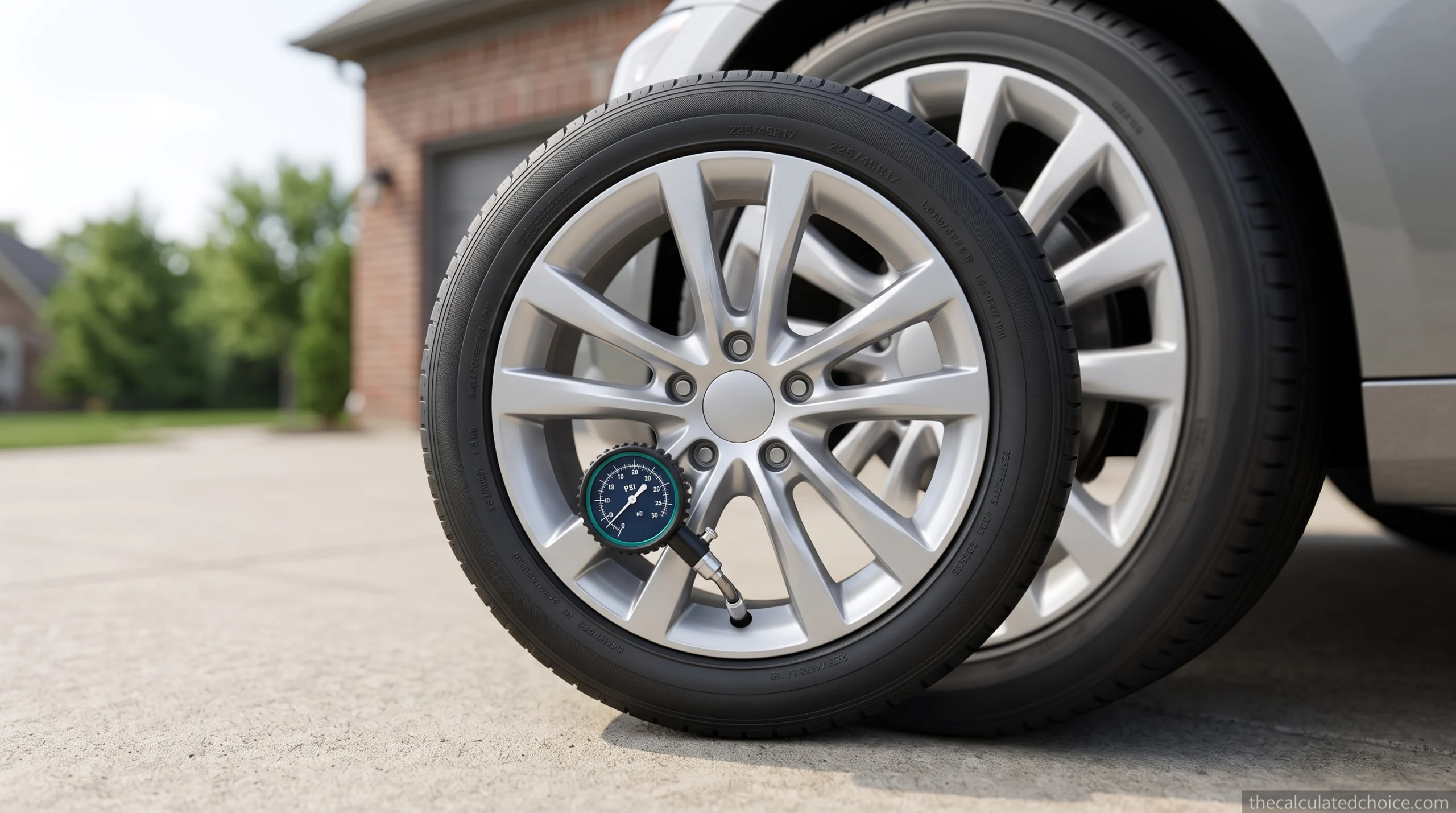
What should my tire pressure be? The right answer is printed on your car, not on your tires: it is the cold inflation pressure on the Tire and Loading Information label, usually on the driver’s door jamb. For most passenger cars that number falls somewhere between 30 and 35 PSI, but it varies by vehicle, and front, rear and spare can each be different. This guide is for US drivers who want to set their tires correctly. You will learn where to find your number, which numbers to ignore, how to check pressure the right way, and how far off you can get before the dashboard light comes on.
What should my tire pressure be? Quick answer
- Use the label Set tires to the cold pressure on the driver’s door jamb label or in your owner’s manual.
- Typical range Most passenger cars call for about 30 to 35 PSI, but your label is the only number that counts.
- Ignore the sidewall The “max. press.” on the tire is a limit, not a target.
- Check cold Measure after the car has been parked 3 hours or driven less than a mile.
- Don’t forget the spare The label lists it separately; compact spares usually need 60 PSI.
Where to find what your tire pressure should be
Open the driver’s door and look at the edge of the door frame, the pillar between the front and rear doors. That is where federal rules put the label. Under FMVSS No. 110, a vehicle’s “Tire and Loading Information” placard goes on the driver’s side B-pillar. If that spot cannot hold a readable label, the rule allows the forward edge of the rear door, the rear edge of the driver’s door, or the inside next to the driver’s seat.
The label has to show the vehicle maker’s recommended cold tire pressure for the front, rear and spare tires, plus the original tire sizes, seating capacity and the most weight the vehicle should carry. Your owner’s manual repeats the pressure and often adds extra detail for heavy loads. On some older vehicles, Firestone notes, the sticker may sit on the doorpost, the glove box door or the fuel door instead.
No sticker? Do this instead of guessing
- Check the owner’s manual, usually in the tires or specifications section.
- Look up the manual online. Most automakers post owner’s manuals on their websites.
- Call a dealer’s service department with your VIN. They can look up the original pressure for your exact model.
Which tire pressure number should you use?
Most confusion comes from the fact that several different pressure numbers are printed on and around a car. Only one of them is your target.
| Number you see | Where it is | Use it as your target? |
|---|---|---|
| Recommended cold pressure | Driver’s door jamb label, owner’s manual | Yes. This is the number to fill to, measured cold. |
| Loaded or towing pressure | Owner’s manual, some labels | Only when the manual says so for that load. |
| “Max. press.” on the tire | Tire sidewall | No. It is the most the tire is built to hold, not what your car needs. |
| TPMS reading on the dash | Instrument cluster, on cars that show it | No. Use it as a warning, then confirm with a gauge. |
| Air machine readout | Gas station pump | No. Check the result with your own gauge. |
| “Hot” reading after driving | Your gauge, right after a drive | No. It will read higher than the cold number. |
NHTSA puts it plainly: the correct pressure is what the vehicle manufacturer lists, not what is printed on the tire itself.
What tire pressure is normal for most cars?
AAA says most recommended pressures fall between 30 and 35 PSI, and Pirelli puts most vehicles between 28 and 36 PSI. That is why “32” and “35” get repeated so often. But a range is not a recommendation for your car. Two cars of similar size can have labels several PSI apart, because the number depends on the vehicle’s weight, the tire size and load rating it left the factory with, and how the maker tuned handling and ride.
Pickups, larger SUVs and vans often run higher numbers, and vehicles on LT (light truck) tires can call for higher pressures still, sometimes different front and rear. So if someone tells you “all cars should be at 35,” the honest answer is: only if your label says 35.
How far off is too far? The TPMS math
Many drivers wait for the tire pressure light. That light is set by federal rule, and it comes on later than most people think. FMVSS No. 138 requires the warning within 20 minutes once a tire falls to 25 percent below the vehicle maker’s recommended cold pressure, or to a minimum activation pressure (20 PSI for standard-load P-metric tires), whichever is higher.
When should your TPMS light come on?
For a typical passenger car:
Warning pressure ≈ door label pressure × 0.75A car with a 35 PSI label may not warn you until a tire is down to about 26 PSI, nearly 9 PSI low. FuelEconomy.gov says gas mileage drops about 0.2% for every 1 PSI drop in the average pressure of all tires, so four tires sitting just above the warning point cost you close to 2% in fuel economy, along with handling and tire life. The light is a last warning, not a maintenance schedule.
| Door label (cold) | TPMS warning at or below about | PSI low before the light | Is 28 PSI OK? |
|---|---|---|---|
| 30 PSI | 22.5 PSI | 7.5 PSI | 2 PSI low: add air |
| 32 PSI | 24 PSI | 8 PSI | 4 PSI low: add air |
| 35 PSI | 26.3 PSI | 8.8 PSI | 7 PSI low: add air before driving far |
| 36 PSI | 27 PSI | 9 PSI | 8 PSI low: add air before driving far |
| 38 PSI | 28.5 PSI | 9.5 PSI | Below the warning point: fill now |
| 42 PSI | 31.5 PSI | 10.5 PSI | Below the warning point: fill now |
The same table answers “is 40 PSI too high?” For a car with a 35 PSI label, 40 PSI is about 14% over. That is still under most tires’ sidewall maximum, but it is above what the car was set up for. Bridgestone’s tire safety manual warns that overinflated tires are more likely to be cut, punctured or broken by a sudden impact. Let air out to the label number while the tires are cold.
How to check tire pressure the right way
- Start cold. Bridgestone defines cold tires as parked for three hours or more, or driven less than a mile at moderate speed. First thing in the morning works best.
- Read your label. Note the front, rear and spare numbers.
- Measure each tire with your own gauge. Press it straight onto the valve stem so it seals without hissing.
- Add air or let it out to reach the label number, then measure again.
- Check the spare and put all the valve caps back on.
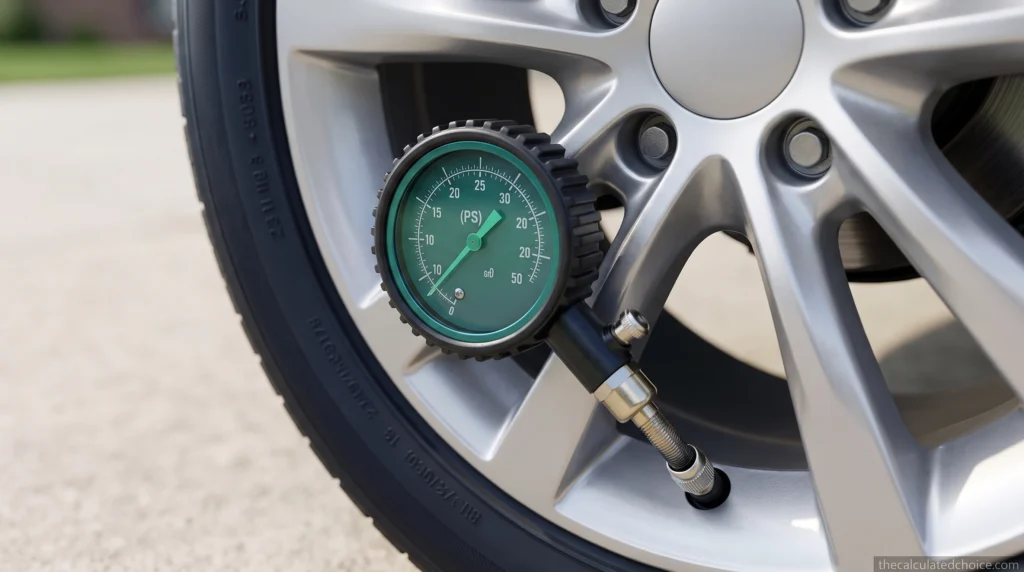
A gauge matters more than most drivers think. Many gauges are rated as a percentage of their full scale, so a cheap high-range gauge can be off by a couple of PSI at car pressures. Our guide to the best digital tire pressure gauge shows how to turn an accuracy rating into real PSI. If you are adding air at home, see how to use a portable tire inflator safely, and for a sense of timing, how long it takes to inflate a car tire.
Front, rear and spare: when the numbers are different
The placard lists front, rear and spare pressures separately because they can differ. Many cars use the same number front and rear, but some do not. Fill each axle to its own number rather than averaging them.
Spares are where people get caught. A full-size spare follows the number on the label. A temporary or compact spare usually needs far more air: Tire Rack notes these spares are kept at 60 PSI cold and limited to 50 mph. Because a spare sits untouched for years, check it whenever you check the other four. NHTSA’s monthly check includes the spare.
Heavy loads, new tire sizes and winter
Heavy loads and towing. Some owner’s manuals list a higher pressure for a fully loaded vehicle or for towing. If yours does, use it only under those conditions. If it does not, stay with the label and stay within the weight limit printed on the same placard.
Different tire size or load rating. The label’s pressure goes with the original tire size printed next to it. If your tires are a different size, load index or load range, ask the installer to confirm the pressure that carries your vehicle’s load. The US Tire Manufacturers Association advises always replacing a tire with a load index equal to or above what the vehicle placard requires.
Cold weather. Your target does not change in winter, but the tire’s pressure does. Bridgestone’s manual says tires can lose about 1 PSI for every 10°F temperature drop, so a tire set in a warm garage can read low outside on a cold morning. Check more often when the weather turns, always to the same cold label number. Our guide to tire pressure in cold weather shows how much it drops at each temperature.
Tire pressure myths vs facts
| Myth | Fact |
|---|---|
| Fill to the PSI printed on the tire. | That is the maximum pressure. NHTSA says to use the vehicle maker’s number, not the tire’s. |
| 32 PSI is right for every car. | Most cars fall around 30 to 35 PSI, but labels vary by vehicle and can differ front to rear. |
| Fill to 10–15% below the sidewall maximum. | We found no automaker or tire maker that recommends this. Use the label number. |
| The TPMS light will tell me when air is low. | Federal rules set the warning at about 25% low. NHTSA says TPMS is not a substitute for regular checks. |
| Check right after driving for an accurate reading. | Warm tires read high. Recommended pressures are cold pressures. |
| The spare is fine until you need it. | Spares lose air too. Compact spares need a much higher pressure, usually 60 PSI. |
Frequently asked questions
Should tire pressure be 32 or 35?
Is 40 PSI tire pressure good?
Is 28 tire pressure OK to drive on?
Is 36 PSI too high for a car?
Why is the PSI on my tire different from my door sticker?
When does the tire pressure light come on?
How often should I check my tire pressure?
How we researched this guide
To answer “what should my tire pressure be,” we went to the rules and documents that set the number: the federal placard standard (FMVSS No. 110), the federal TPMS standard (FMVSS No. 138), NHTSA’s tire safety guidance, Bridgestone’s tire maintenance and safety manual, FuelEconomy.gov and tire-industry guidance on spares and load ratings. The TPMS warning table is our own math from the 25% rule. We did not hands-on test anything for this article, and no brand paid for or reviewed it.
Sources: FMVSS No. 110 (49 CFR 571.110) · FMVSS No. 138 (49 CFR 571.138) · NHTSA tire safety · Bridgestone tire maintenance and safety manual · FuelEconomy.gov · AAA: how to check tire pressure · Pirelli: recommended tire pressure · Firestone: finding your recommended pressure · Tire Rack: compact spares · USTMA tire information bulletin

Researched by Shahzad
Amazon seller who researches products using sales-rank history, price tracking and owner reviews before recommending anything. Read our disclosure.