
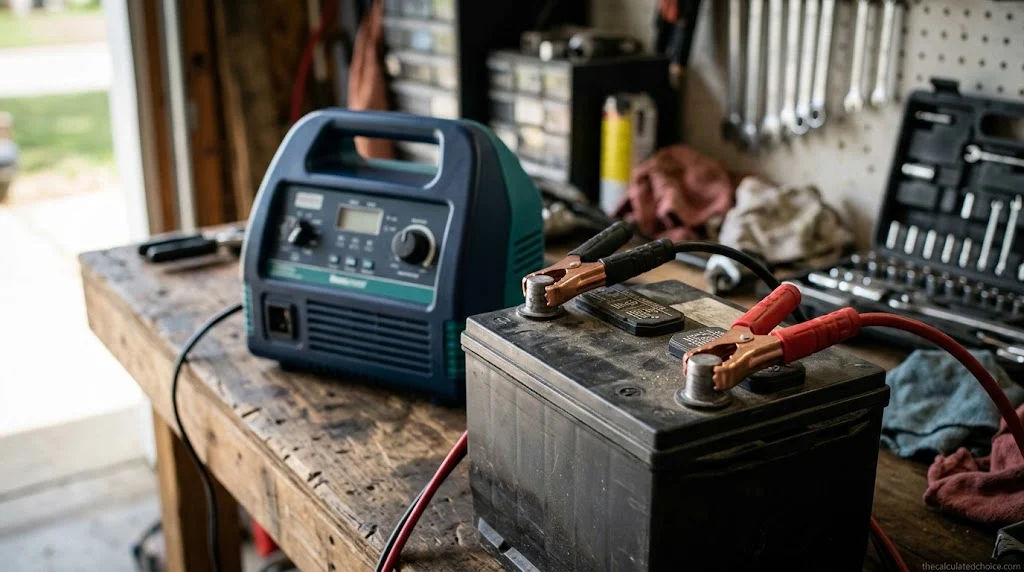
We may earn a commission when you buy through links on this page, at no extra cost to you. It never decides what we recommend. How we make money
How long to charge a car battery comes down to two numbers: how many amp-hours the battery is missing and how many amps your charger pushes. At 2 amps a half-flat battery takes most of a day. At 10 amps it is an evening. At 40 amps the bulk of it goes back in about an hour, but the last stretch does not speed up the way you might expect.
This guide is for US drivers holding a charger and wondering when the car will start again. You get a charge-time table for 2, 10 and 40 amps, the simple formula behind it, and an explanation of why the numbers from Battery Tender, CTEK, OPTIMA and Interstate seem to disagree. They mostly do not, once you line them up.
How long does it take to charge a car battery? The short answer
- At 2 amps About 15 to 24 hours for a half-flat car battery; up to about 2 days if it is dead.
- At 10 amps About 3 to 5 hours for a half-flat battery; about 6 to 10 hours if it is dead.
- At 40 amps Under about an hour of bulk charge for a half-flat battery, then a slower finish. Check your battery maker’s limit first.
- The formula Amp-hours to put back ÷ charger amps × 1.2 for losses.
- The catch The last 10 to 20 percent always charges slower, whatever the charger size.
- Easiest answer A smart charger tells you when it is done. Leave it until the full light comes on.
How to work out how long to charge a car battery
OPTIMA explains the core idea with a simple example: a 20 amp-hour battery on a 10 amp charger could, in theory, be refilled in two hours from empty, but chargers are not 100 percent efficient, so real life takes longer. We turn that into a planning formula you can run on any battery.
Charge time (hours) ≈ amp-hours missing ÷ charger amps × 1.2
Step 1: find the amp-hour (Ah) rating on the battery label or the maker’s spec sheetStep 2: estimate how empty it is from resting voltage: about 12.2V is roughly half, 11.8V or lower is about empty (our voltage chart)Step 3: amp-hours missing = Ah rating × the empty fraction (half = 0.5, dead = 1.0)Step 4: divide by your charger’s amps, then multiply by 1.2Example: 60 Ah battery, half empty, 10 amp charger: 30 ÷ 10 × 1.2 = about 3.6 hoursThe 1.2 is our own planning margin for charging losses, not a manufacturer figure. We checked it against a published number: CTEK lists about 1.5 hours to bring a 40 Ah battery from empty to 80 percent on its 25 amp MXS 25. The formula gives 32 Ah ÷ 25 × 1.2 = about 1.5 hours. Treat the result as time to “starts the car easily,” then let the charger finish the last stretch. Our charger sizing guide uses a slightly more cautious 25 to 30 percent margin; either works for planning.
If you do not have a meter, our car battery voltage chart explains what each reading means, and our battery charger size guide shows how amps relate to battery size.
Car battery charge-time table: 2, 10 and 40 amps
We ran the formula for four common battery sizes. “Half flat” means about 50 percent charged; “dead” means fully discharged. These are planning estimates for the main charge. The slow final top-off can add more time, especially on the 40 amp column.
| Battery size | Starting point | 2 amps | 10 amps | 40 amps |
|---|---|---|---|---|
| 50 Ah | Half flat | ~15 hours | ~3 hours | ~45 min |
| 50 Ah | Dead | ~30 hours | ~6 hours | ~1.5 hours |
| 60 Ah | Half flat | ~18 hours | ~3.6 hours | ~55 min |
| 60 Ah | Dead | ~36 hours | ~7.2 hours | ~1.8 hours |
| 70 Ah | Half flat | ~21 hours | ~4.2 hours | ~1 hour |
| 70 Ah | Dead | ~42 hours | ~8.4 hours | ~2.1 hours |
| 80 Ah | Half flat | ~24 hours | ~4.8 hours | ~1.2 hours |
| 80 Ah | Dead | ~48 hours | ~9.6 hours | ~2.4 hours |
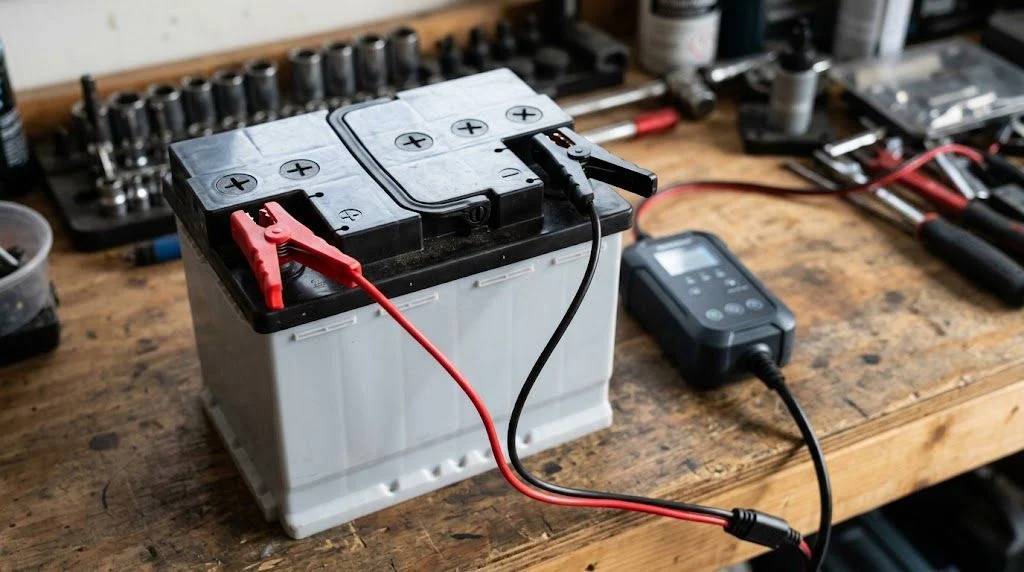
How long to charge a car battery at 2 amps
Plan on most of a day for a half-flat battery and up to two days for a dead one. Battery Tender puts a dead battery on a 2 amp setting at 24 to 48 hours, and our table lands in the same range for 60 to 80 Ah batteries.
Two amps is gentle and runs cool, which is why it suits maintainers and small batteries. It is the wrong tool when you need the car tomorrow morning. A 2 amp unit is really for keeping a healthy battery topped up. Our battery maintainer vs trickle charger guide explains the difference.
How long to charge a car battery at 10 amps
Roughly 3 to 5 hours for a half-flat car battery and 6 to 10 hours for a dead one. Battery Tender gives a range of about 3 to 8 hours at 10 amps depending on the battery’s condition and size, which fits our numbers.
Ten amps is the sweet spot for most cars. OPTIMA’s own example uses it: its 55 Ah YELLOWTOP at about half charge needs around 27 Ah returned, which it says would take almost three hours at 10 amps before adding time for charger losses. That lines up with our ~3.2 hours for the same numbers.
How long to charge a car battery at 40 amps
The bulk charge on a half-flat car battery takes under an hour at 40 amps. A full charge does not finish in that time. As the battery fills, its voltage rises and it accepts less current, so the last stage runs at a fraction of 40 amps no matter what the dial says. CTEK’s published time for its 25 amp charger stops at 80 percent for the same reason.
Read the fine print before you use a 40 amp setting:
- Your battery maker may cap the rate. OPTIMA says it does not recommend exceeding 10 amps when charging its batteries. Check your battery’s maker before going higher.
- 40 amps is often a manual boost setting. Schumacher’s SC1446 wheeled charger, for example, lists 40 amps as a boost mode on a manual unit with a 135-minute timer. Manual means it does not stop on its own, so you have to watch it.
- Small batteries do not suit big chargers. CTEK rates its 25 amp MXS 25 for batteries from 40 Ah upward. A 40 amp charge on a small battery is a mismatch.
- Heat is the warning sign. OPTIMA says to stop charging if a battery vents or gets hot to the touch.
Why charge-time numbers online disagree
Search this question and you will see 2 hours, 12 hours and 48 hours all quoted with confidence. Most of the gap comes from three hidden assumptions: battery size, how empty it starts, and whether the number means “full” or “good enough to start.” Here is how the main published figures line up with our formula.
| Source | What they say | Hidden assumption | Our formula gives |
|---|---|---|---|
| Battery Tender | 24 to 48 hours at 2 amps for a dead battery | Dead battery, size not stated | 30 to 48 hours for 50 to 80 Ah |
| Battery Tender | About 3 to 8 hours at 10 amps | Depends on condition and capacity | 3 to 9.6 hours across our table |
| OPTIMA | Almost 3 hours at 10 amps for 27 Ah | 100% efficient charger; add time | About 3.2 hours |
| CTEK MXS 25 | 1.5 hours, 40 Ah battery, empty to 80% | Stops at 80%, not full | About 1.5 hours |
| Interstate | 4 to 8 hours to start a few times; 10 to 24 hours to full | Typical smart charger, size not stated | Fits a 4 to 6 amp charger on a 60 to 80 Ah battery |
What makes charging take longer
- Cold. Battery Tender notes cold weather lengthens charging time. A frozen battery should not be charged at all.
- Age and sulfation. Battery Tender says older or damaged batteries may take longer and may not hold the charge.
- A deeply dead battery. Many smart chargers will not start below a minimum voltage. NOCO says its GENIUS10 detects batteries down to 1 volt and needs a manual Force Mode below that.
- Charging in the car. Clocks, alarms and computer modules draw a little current the whole time, which the charger has to cover.
- The final stage. The last 10 to 20 percent is slow by design, so the battery is not overcharged.
Which charging rate should you use?
| Your goal | Best rate | Why |
|---|---|---|
| Keep a stored car topped up | 1 to 2 amps (maintainer) | Runs indefinitely without overcharging on a smart unit |
| Battery is low, car needed tomorrow | About 10 amps, smart charger | Overnight is enough for most car batteries |
| Truck or large battery, low | 10 to 15 amps | Keeps times reasonable on 70 to 80 Ah batteries |
| Need to start the car within the hour | Jump start, then charge properly | A 40 amp boost or a jump starter gets you moving; finish with a slower full charge |
For the full hook-up procedure, see our step-by-step guide on how to charge a car battery at home. If you are relying on the car itself, our guide on how long to drive to charge a car battery shows why the alternator rarely fills it.
Frequently asked questions
How long does a dead car battery take to recharge?
How long should I charge a car battery at 10 amps?
How long to charge a car battery at 2 amps?
Is it safe to charge a car battery at 40 amps?
Can a completely dead car battery be recharged?
Is 20 minutes enough to charge a car battery?
Can you overcharge a car battery with a smart charger?
How we researched charge times
We collected published charge-time figures from battery and charger makers, noted the assumptions behind each, and checked them against one formula. We did not time chargers ourselves; the table is calculated, and every outside figure is linked below.
Sources: Battery Tender: charge times · OPTIMA: charging a dead battery · OPTIMA: how long to charge · CTEK MXS 25 data sheet (PDF) · Schumacher SC1446 · Interstate: steps to charge

Researched by Shahzad
Amazon seller who researches products using sales-rank history, price tracking and owner reviews before recommending anything. Read our disclosure.