
We may earn a commission when you buy through links on this page, at no extra cost to you. It never decides what we recommend. How we make money
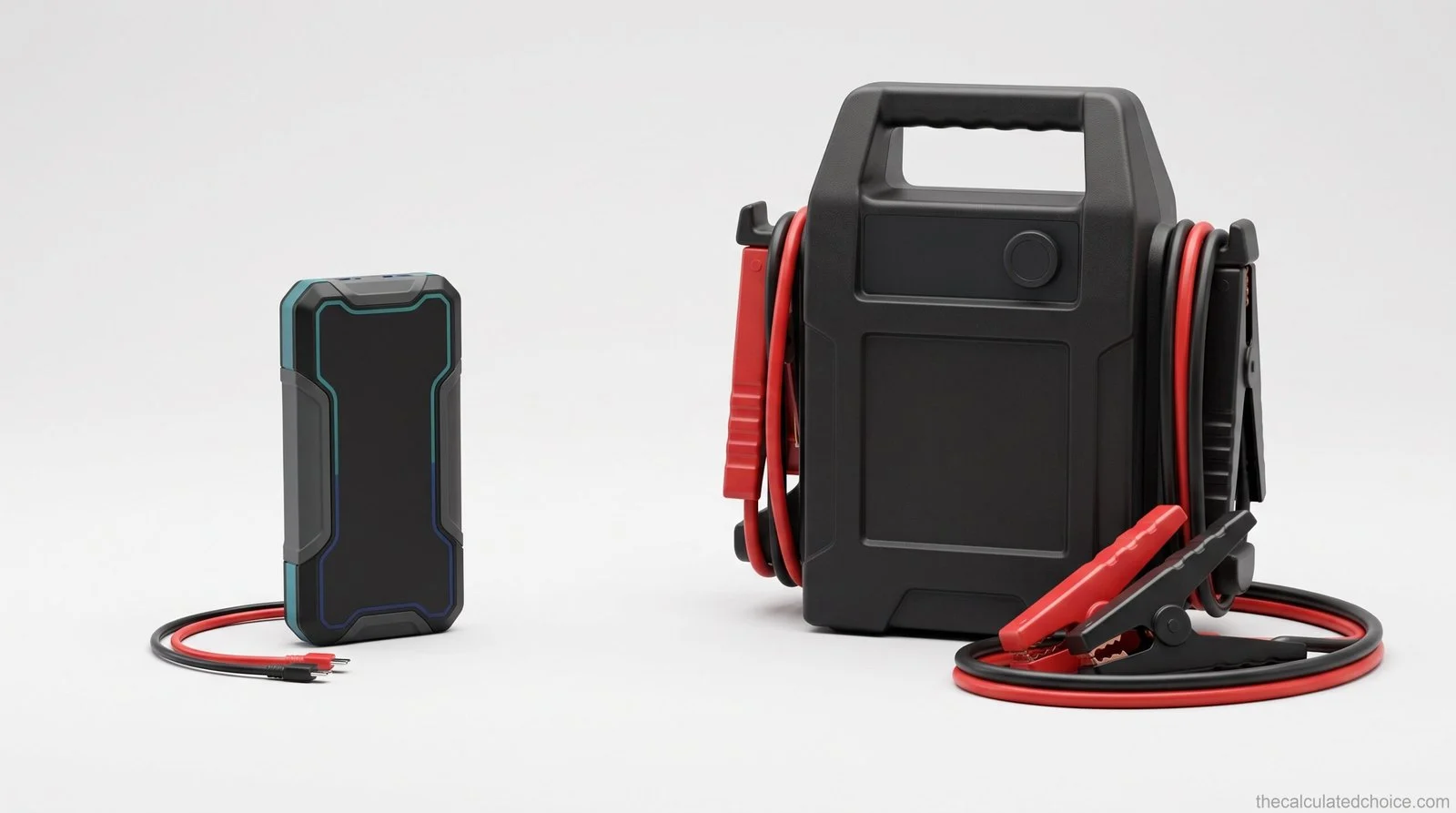
Lithium vs lead-acid jump starters is a real choice, not just a question of age. Lithium packs have taken over the retail shelves because they are small and light, but heavy lead-acid jump boxes are still what many professional workshops reach for. To compare them fairly, we looked at two jump starters from the same manufacturer — one lithium, one lead-acid — so brand quality does not skew the result.
Lithium vs lead-acid jump starters: the quick answer
- Choose lithium if you want a pack that lives in your car, fits in a glovebox and is ready when you need it.
- Choose lead-acid if you run a shop, fleet or tow truck and jump vehicles often from a unit kept on a charger.
- Biggest difference Weight and size: lead-acid boxes weigh many times more for similar headline ratings.
- Watch out Most lithium packs must be charged above freezing — bring them indoors in winter.
Lithium vs lead-acid at a glance
| Factor | Lithium | Lead-acid |
|---|---|---|
| Size and weight | Handheld, fits a glovebox or under a seat | Large box, typically 9–20+ lbs |
| Everyday storage | Holds charge well between uses | Designed to stay on a charger |
| Cold weather | Works within its rated range; charge above freezing | Tolerates cold storage, but output drops as temperature falls |
| Cables | Usually shorter and thinner | Often long, heavy welding-grade cable |
| Extras | Power bank, flashlight, USB-C | 12V DC outlet on some models |
| Best for | Most drivers Most people | Workshops, fleets, tow operators |
Same brand, two technologies
Clore Automotive makes both types under its Jump-N-Carry name, which makes it a useful side-by-side. Here is how its lithium JNC325 compares with its lead-acid JNC660 on published specifications:
| Spec | Clore JNC325 (lithium) | Clore JNC660 (lead-acid) |
|---|---|---|
| Peak amps | 2,000A | 1,700A |
| Sustained rating | 450 start assist amps | 425 cranking amps |
| Engine rating | Up to 8.0L gas / 6.0L diesel | Not published |
| Cables | 24 in, 6 AWG | 46 in, #2 AWG welding cable |
| Weight | Handheld pack | 18 lbs |
| Charging | Charge between 40°F and 140°F | Built-in automatic charger |
| Safety certification | UL 2743 (SGS) | Sealed lead-acid (AGM) |
| Warranty | 1 year | 1 year |
The headline numbers are surprisingly close — 2,000 vs 1,700 peak amps, and 450 vs 425 sustained amps. The real differences are everything else: the lead-acid unit trades portability for longer, heavier cables and an always-on-charger design built for shop use.
Size and weight
This is the biggest practical difference. Lead-acid batteries store far less energy per pound than lithium cells, so lead-acid jump boxes are heavy. Clore’s JNC660 weighs 18 lbs, and even its smaller lead-acid JNC300XL — rated at 900 peak and 225 cranking amps — weighs 9 lbs. A lithium pack with a comparable headline rating is a handheld unit you can keep in a door pocket or glovebox.
If the jump starter will live in your vehicle, portability matters more than almost any spec, because the best jump starter is the one you actually have with you.
Storage and keeping it charged
A jump starter is useless if it is flat when you need it. Lead-acid jump boxes are designed to be kept on a charger — the JNC660 has a built-in automatic charger for exactly that reason — and lead-acid batteries can be damaged if they are left discharged for long periods. That suits a workshop where the unit sits plugged in between jobs.
Lithium packs generally hold their charge well in storage, which suits a pack that lives in a car for months. Even so, check it every few months and recharge it after every use, following your manual’s interval.
Cold-weather performance
Both types lose some performance in the cold. For lithium, the key limitation is charging: most lithium packs should not be charged below freezing. Clore rates the lithium JNC325 to operate from −10°F to 140°F, but to charge only between 40°F and 140°F. Lead-acid batteries can be stored in the cold, but their output falls as the temperature drops — the same reason car batteries are rated in cold cranking amps at 0°F.
If you regularly start vehicles below freezing, check the operating temperature range on any pack you consider, and plan to recharge a lithium pack indoors. Our guide to how many amps to jump start a V8 covers cold-weather sizing.
Cables and clamps
Professional lead-acid units usually come with much heavier, longer cables. The JNC660 uses 46-inch #2 AWG welding cable, while the lithium JNC325 uses 24-inch 6 AWG cables. With cable gauge, a lower number means a thicker cable. Longer, thicker cables make it easier to reach batteries in awkward spots, which is why shops value them.
For a driver keeping a pack in the car, 24-inch cables are usually enough — but check the cable length on smaller lithium packs, as some are much shorter.
Safety
Modern lithium jump starters include electronic protections such as reverse-polarity and spark-proof clamps, and the best ones are certified to UL 2743, the safety standard for portable power packs. The JNC325 is certified by SGS to UL 2743. Sealed lead-acid (AGM) units avoid liquid electrolyte spills, and many — like the JNC660 — include reverse-polarity protection.
Whichever you choose, follow the connection order in the manual. Our guide on how to choose a jump starter covers the full safety checklist.
Which one should you buy?
| You are… | Choose | Why |
|---|---|---|
| A driver who wants a pack in the car | Lithium | Small, light, holds charge, ready anywhere |
| A truck owner in a cold climate | Lithium with a wide operating range | Portable, but charge it indoors |
| A workshop or fleet | Lead-acid | Stays on a charger, heavy cables, frequent use |
| A tow or roadside operator | Lead-acid (or a heavy-duty lithium unit) | Built for repeated jumps and awkward access |
Buying for a truck? See our best jump starter for V8 trucks picks, or use the jump starter size calculator to find the rating you need.
If you are also comparing packs by their amp ratings, read our breakdown of peak amps vs cranking amps first — the headline number on the box is rarely the one that starts the engine. For winter use specifically, see our best jump starter for cold weather picks, ranked by published operating temperature.
Frequently asked questions
Is a lithium or lead-acid jump starter better?
Why are lead-acid jump starters so heavy?
Do lithium jump starters work in the cold?
How long do jump starters hold a charge?
Why do lead-acid jump boxes have longer cables?
How we researched this guide
We compared two jump starters from the same manufacturer so that differences reflect battery technology rather than brand quality. Specifications come from Clore Automotive’s product information and manual, and from published retailer spec sheets for the lead-acid models. No brand paid to be included.
Sources: Clore Automotive — JNC325 · JNC325 operator’s manual · JNC660 specifications (JB Tools) · JNC300XL specifications (NAPA)

Researched by Shahzad
Amazon seller who researches products using sales-rank history, price tracking and owner reviews before recommending anything. Read our disclosure.