

We may earn a commission when you buy through links on this page, at no extra cost to you. It never decides what we recommend. How we make money
The best LiFePO4 battery charger is one that charges your 12V lithium iron phosphate battery inside the voltage window its maker allows, finishes without overcharging, and carries a real North American safety listing. That last check knocks out more chargers than you would expect. We looked at 13 popular lithium chargers from six brands, and only three cleared every check we run.
This guide is for US owners of 12V LiFePO4 batteries: RV and van house batteries, trolling motor and boat batteries, solar storage, and lithium powersport or starting batteries. You will see which charger fits which battery size, the charge voltages that actually matter, how long a charge takes, and the fine print we found along the way.
Quick answer
- Best overallBattery Tender 15/8/2 Amp: LiFePO4 setting, rated for 14 to 250Ah batteries, ETL and cETL listed, sold by Amazon.
- Best for big lithium banksVictron Blue Smart IP22 12/30: 30 amps, a 14.2V lithium mode, app control and a UL 1236 certificate.
- Best for small lithium batteriesBattery Tender 4 Amp: 14 to 100Ah, 6V or 12V, IP65 case.
- How to chooseMatch the charge voltage to your battery maker’s window (most allow 14.2 to 14.6V), size the amps to your amp-hours, and insist on a UL or ETL listing.
- Left outNOCO GENIUS10, CTEK LITHIUM US and LiTime chargers have good specs, but we found no published North American safety listing for them.
Quick comparison
| Charger | Best for | Max current | Battery size (maker) | LiFePO4 voltage | Safety listing | Warranty | Price |
|---|---|---|---|---|---|---|---|
| Battery Tender 15/8/2 Amp | RV, trolling motor, solar | 15A | 14 to 250Ah | Not published | ETL and cETL | 5 years | $$ |
| Victron Blue Smart IP22 12/30 | Big banks, app control | 30A | Not stated | 14.2V absorption | UL 1236 and CSA certificate | 5 years | $$$ |
| Battery Tender 4 Amp | Powersports, small packs | 4A | 14 to 100Ah | Not published | ETL and cETL | Conflicting (see fine print) | $ |
All three picks charge both lithium and lead-acid batteries, so one charger can cover a mixed garage. If you only own car batteries, our best car battery charger guide covers that side in more depth.
Best LiFePO4 battery charger picks
Battery Tender 15/8/2 Amp Selectable (022-0234)
Best for 12V LiFePO4 deep-cycle batteries from about 50 to 250Ah: RV house batteries, trolling motors and solar storage.
On Battery Tender’s product page, this charger lists 15, 8 and 2 amp output settings, LiFePO4 among its battery types, a 14Ah to 250Ah battery range, ETL and cETL certification, and a 5-year limited warranty. Charge voltage adjusts automatically for temperature, and the page describes a winter mode for storage.
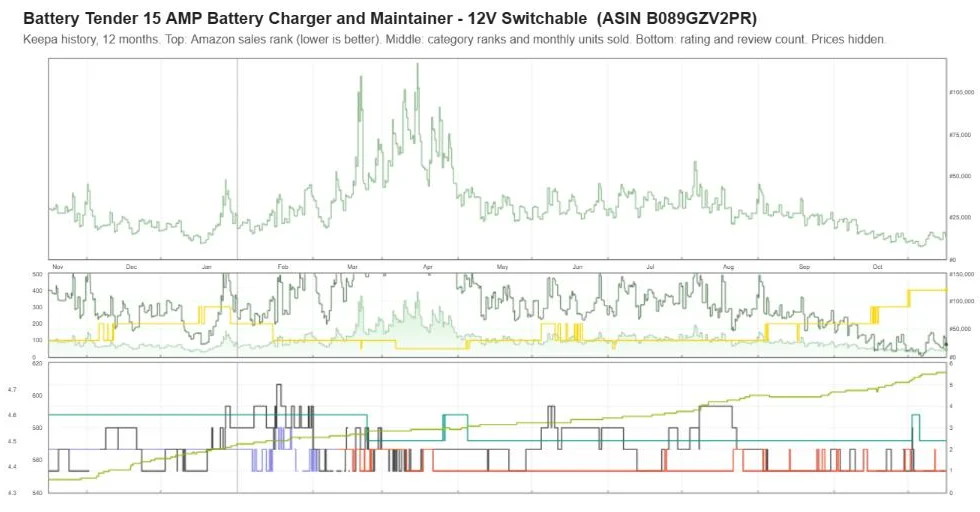
Our Keepa check showed tracking since mid-2020, Amazon as the seller, and a rating count that climbed slowly and evenly across the past year with no sudden bursts. The price held a narrow band for most of the year, and the average sales rank sat around 31,000 in Automotive. That is steady niche demand from real buyers, not a launch spike.
Fine print: Battery Tender does not publish the voltage its lithium setting charges to, so we list it as not verified. The same page also lists battery types slightly differently in the description and the spec table. Neither is a safety problem, but if your battery maker gives a tight voltage range, ask Battery Tender support to confirm the number before you buy.
What we like
- Three amp settings cover small and large lithium batteries
- ETL and cETL listed
- 5-year written warranty
- Sold and shipped by Amazon
Watch out for
- Lithium charge voltage not published
- 12V only, no 6V setting
- More charger than a motorcycle battery needs
Verdict: The safest all-round choice for a 100Ah-class lithium battery. The 15A setting refills a deep-cycle battery overnight, and the 2A setting handles storage.
Victron Energy Blue Smart IP22 12/30 (120V)
Best for large RV, van and solar lithium banks, and for owners who want to see and adjust charge settings on a phone.
The Victron Blue Smart IP22 120V manual lists three built-in charge modes, Normal, High and Li-ion, with Li-ion absorption at 14.2V, and the recondition stage is not available in Li-ion mode. The manual also describes a low current mode and a night mode. Victron’s IP22 product page links a certificate of compliance to UL 1236 and CSA C22.2 for Smart IP22 chargers, plus its 5-year warranty.
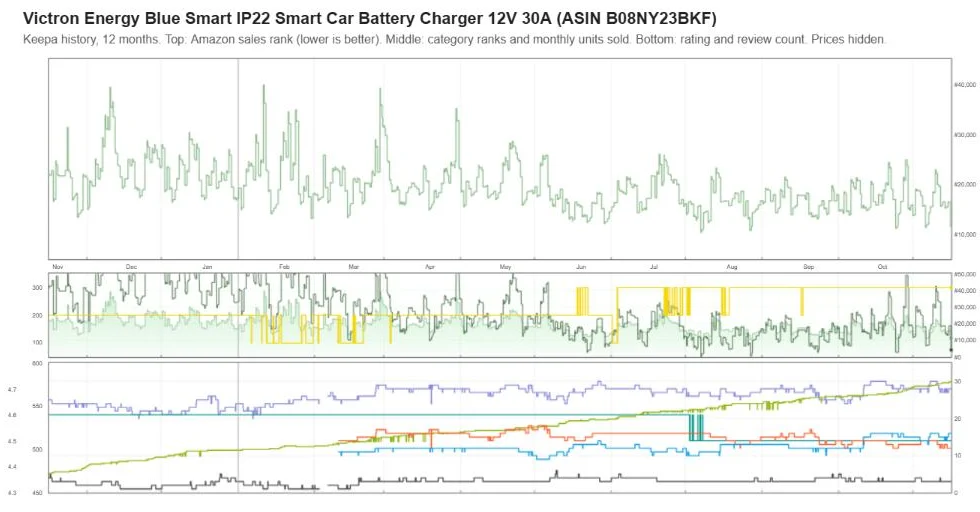
Keepa shows tracking since early 2021 and a rating count that grew evenly over the past year. Amazon itself does not sell it. Third-party sellers do, and the price moved in a wider band than our other picks, so compare the seller and price before you buy. The average sales rank sat near 19,500 in Automotive, which is solid for a charger at this price.
Fine print: Victron’s page links the UL 1236 and CSA certificate for Smart IP22 chargers but does not list each model on the page itself, so we could not match the exact 12/30 part number. IP22 also means it is built for dry, indoor spots, not an open boat deck. At 14.2V, its lithium mode sits at the gentle end of most LiFePO4 makers’ windows.
What we like
- 30A refills a large bank fast
- Lithium voltage published in the manual
- Phone app shows charge stage and settings
- UL 1236 and CSA certificate on file
Watch out for
- Not sold by Amazon; price moves
- IP22 is for dry, indoor mounting
- Overkill for a single small battery
Verdict: The pick for 200Ah and larger lithium banks, or anyone who wants real control over the charge profile. Buy it from a seller you trust.
Battery Tender 4 Amp Selectable (022-0209)
Best for small lithium batteries from 14 to 100Ah: motorcycles, ATVs, lithium starting batteries and portable packs.
Battery Tender’s 4 amp page lists 6V and 12V output at 4 amps, a 14Ah to 100Ah battery range, AGM, gel, flooded and LiFePO4 battery types, ETL and cETL certification, an IP65 rating and automatic temperature compensation.
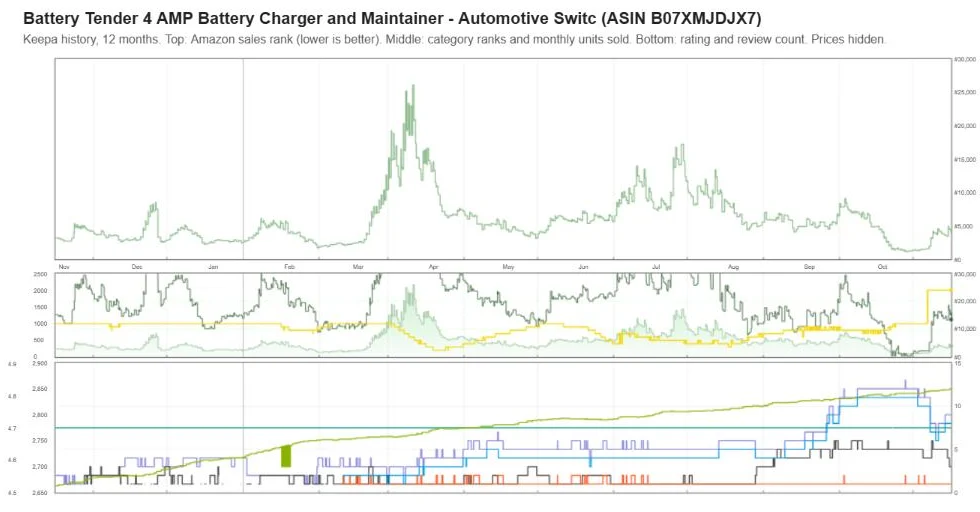
Keepa shows more than six years of tracked sales, Amazon as the seller, no out-of-stock time in the last 90 days, and a rating count in the thousands that grew smoothly across the year. Its average sales rank sat around 5,800 in Automotive, the strongest demand of our three picks, and the price stayed in a narrow band.
Fine print: The warranty is listed as 5 years in the page’s spec table but described as a 3-year limited warranty in the text. Plan on 3 years until Battery Tender clears it up. Like the 15 amp model, the lithium setting’s charge voltage is not published.
What we like
- Right-sized for powersport lithium batteries
- 6V and 12V in one unit
- ETL and cETL listed, IP65 case
- Strongest, steadiest sales of our picks
Watch out for
- Slow on a 100Ah battery (see the math below)
- Warranty length stated two ways
- Lithium charge voltage not published
Verdict: The easy choice for a lithium motorcycle, ATV or small starting battery, and a good storage charger for anything up to 100Ah.
Does a LiFePO4 battery need a special charger?
It needs the right settings more than a special box. Battle Born Batteries, a major US LiFePO4 maker, recommends 14.4V for bulk and absorption and says chargers set between 14.2 and 14.6V with a 13.6V float will work. It also says float charging is not necessary for its batteries.
A lead-acid-only charger can go wrong in two ways. Its repair or desulfation mode can push voltage far past that window, and some chargers will not start at all on a lithium battery whose battery management system (BMS) has shut it off at low voltage. That is why lithium chargers advertise BMS reset or 0V activation features.
Here is where the lithium settings we checked actually land. This is the table we wished existed when we started.
| Source | 12V LiFePO4 charge voltage | Where it sits |
|---|---|---|
| Battle Born (battery maker) | 14.4V recommended; 14.2 to 14.6V works; float 13.6V or none | The target window |
| Victron IP22, Li-ion mode | 14.2V absorption | Low end, gentle |
| CTEK LITHIUM US | 14.4V output | Middle |
| NOCO GENIUS10, 12V lithium mode | 14.6V | Top of the window |
| LiTime 12V 20A | 14.6V output | Top of the window |
| Battery Tender lithium settings | Not published | Not verified |
| NOCO GENIUS10, 12V repair mode | Up to 16.5V | Never use on lithium |
Every lithium mode with a published number lands inside Battle Born’s window, but they do not land in the same spot. A 14.2V charger stops a little short of the very top and is easy on the cells. A 14.6V charger fills to the top of the window. If your own battery maker publishes a narrower range, that range wins over anything here.

Charge time and amp sizing for a LiFePO4 battery
Amps decide how long you wait. LiFePO4 takes most of its charge at a steady current and then slows down near the end, so a simple formula gets you close.
Our charge-time formula
Hours ≈ amp-hours to put back ÷ charger amps × 1.1100Ah battery at 20%: about 80Ah to put back4A: 80 ÷ 4 × 1.1 ≈ 22 hours | 15A: ≈ 6 hours | 30A: ≈ 3 hoursThe 1.1 covers the slower final stretch. As a cross-check, Battery Tender says its 15A setting brings a 100Ah battery back from 50% in about 4 hours; the formula gives 3.7. Before you pick a big charger, check the maximum charge current on your battery’s label or spec sheet and stay under it. For lead-acid sizing, see our battery charger size guide.
A practical rule from that math: a 4A charger suits batteries up to about 30Ah if you want an overnight charge, a 15A charger suits 100Ah, and 30A makes sense for 200Ah and up. Smaller chargers still work on big batteries. They just take a long time.
Safety listing check: the step most lists skip
A charger plugs into your wall and sits next to a battery for hours, often unattended. In the US, the standard for battery chargers is UL 1236, and listings from UL or ETL (Intertek) show a third party tested the design. LiTime’s lithium chargers, for example, list only CE and RoHS marks, which are not North American safety listings. A big brand name is not enough on its own, either.
| Charger | Safety listing published | LiFePO4 voltage published | Warranty | Our call |
|---|---|---|---|---|
| Battery Tender 15/8/2 Amp | ETL and cETL | No | 5 years | Pick |
| Victron IP22 12/30 | UL 1236 and CSA certificate | 14.2V | 5 years | Pick |
| Battery Tender 4 Amp | ETL and cETL | No | 5 or 3 years (conflict) | Pick |
| NOCO GENIUS10 | Not found; manual lists FCC | 14.6V | 3 years | Left out |
| CTEK LITHIUM US | Not found | 14.4V | 5 years | Left out |
| LiTime 12V 20A | CE and RoHS only | 14.6V | 2 years | Left out |
One more catch: LiTime’s charger page shows a 5-year warranty banner at the top, but the charger’s own spec table says 2 years. The banner appears to cover its batteries. Always read the spec table, not the banner.
Chargers we left out and why
- NOCO GENIUS10 and GENIUS5: huge sales and a clear 14.6V lithium mode, but we found no UL or ETL listing in NOCO’s published specs, the same reason we left NOCO out of our car charger guide. Keepa also showed the GENIUS10 out of stock at Amazon for about a fifth of the last 90 days.
- CTEK LITHIUM US: the best spec sheet for small LiFePO4 batteries, with 14.4V charging, BMS reset and a 5-year warranty. CTEK’s page lists no North American safety listing, and on Amazon a third-party seller handles it.
- LiTime 12V 10A and 20A: a real brand with support and 0V activation, but only CE and RoHS marks. One LiTime 10A listing also showed a rating count that dropped during the year, a pattern we do not trust.
- Victron IP65 12/10 and IP22 12/15: same Victron engineering, but thin Amazon sales and third-party prices that swung more than the 12/30.
- Battery Tender Power Tender 10 Amp: cETLus listed to UL 1236, but too new on Amazon, with only a few dozen ratings so far. Worth a second look later.
- OptiMate Lithium 4s: a respected powersport charger, but on Amazon it was sold by a third party above its own list price.
- Generic 14.6V “LiFePO4 chargers”: many top search results come from sellers with no support site or written warranty we could find.
Myths vs facts about charging LiFePO4
| Myth | Fact |
|---|---|
| Every “lithium” button charges the same way. | The lithium modes we checked range from 14.2V to 14.6V. All are inside Battle Born’s window, but they finish at different points. |
| LiFePO4 needs a float charge to stay full. | Battle Born says float charging is not necessary for its batteries, and a float under 13.6V is fine if your charger has one. |
| Repair or desulfation mode can revive a dead lithium battery. | Repair modes are built for lead-acid. NOCO’s GENIUS10 manual lists its 12V repair mode at up to 16.5V, far above any LiFePO4 window. |
| You can charge lithium in any weather. | Battle Born says to keep its batteries above 35°F. CTEK rates the LITHIUM US to operate only from 41°F to 122°F. |
How we chose these chargers
We never claim hands-on testing. We compared published specs, safety listings, warranties and one year of Amazon sales data for 13 chargers from six brands.
Sources: Battery Tender 15/8/2 Amp · Battery Tender 4 Amp · Victron Blue Smart IP22 · Victron IP22 120V manual · Battle Born charging guide · NOCO GENIUS10 support · CTEK LITHIUM US · LiTime 12V 20A
Charging batteries that live in a boat? An onboard charger built to marine standards is the safer setup; see our best marine battery charger guide.
If your RV house bank runs on LiFePO4, check which picks in our best battery maintainer for RVs guide include a lithium mode.
Frequently asked questions
Do I need a special charger for LiFePO4 batteries?
Can I charge a LiFePO4 battery with a regular car battery charger?
What voltage should I charge a 12V LiFePO4 battery to?
How long does it take to charge a 100Ah LiFePO4 battery?
Can you charge a LiFePO4 battery below freezing?
Can I leave a LiFePO4 charger connected all the time?

Researched by Shahzad
Amazon seller who researches products using sales-rank history, price tracking and owner reviews before recommending anything. Read our disclosure.