
We may earn a commission when you buy through links on this page, at no extra cost to you. It never decides what we recommend. How we make money
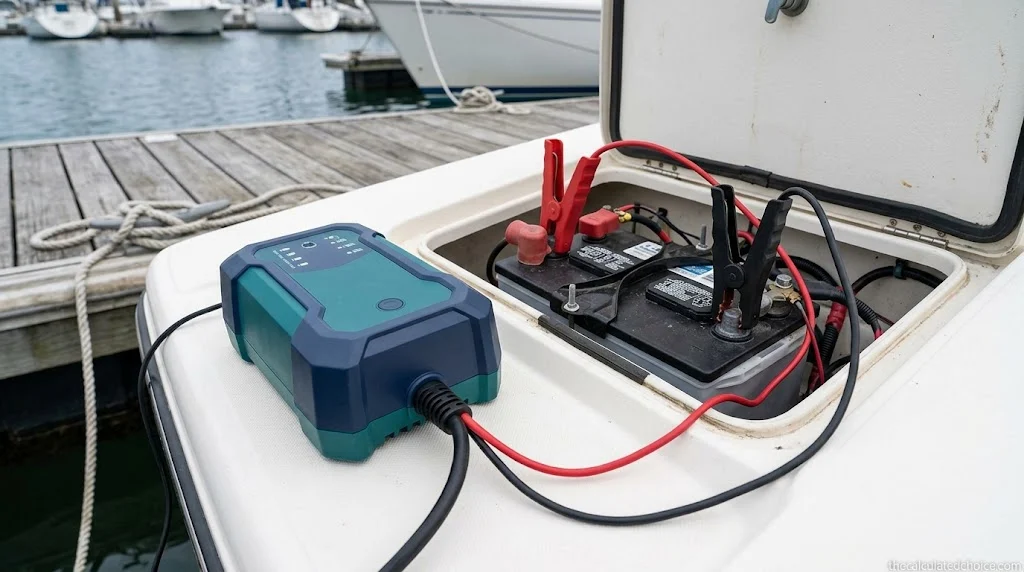
The best marine battery charger for most boats is an onboard charger: mounted in the boat, waterproof, ignition protected, built to the marine version of UL 1236 and the ABYC A-31 standard, with one output bank per battery. We checked 18 onboard chargers and maintainers from four brands against those marks and one year of Amazon sales data. Only two cleared every check, and we explain exactly why the others did not.
This guide is for US owners of fishing, ski and pontoon boats with one to three 12V batteries. You will see which charger fits which setup, how many amps and banks you need, the mounting rules buried in the manuals, and what to do if your boat runs lithium.
Quick answer
- Best overallProMariner ProSportHD 20 (2 banks, 20A total): listed to UL Marine 1236, ABYC A-31, IP67, ignition protected, sold by Amazon.
- Best for small boatsGuest ChargePro 4/4 (2 banks, 4A each): UL 1236 and CSA, ABYC A-31, IP67, ignition protected.
- How to chooseOne bank per 12V battery, about 10% of each battery’s amp-hours per bank, and the UL 1236 marine and ABYC A-31 marks on the spec sheet.
- Lithium boatsNo lithium-capable charger passed every check on Amazon. See our lithium section before you buy.
- AvoidUsing a portable car charger aboard. Even NOCO’s manuals say a marine battery must be removed and charged on shore.
Quick comparison
| Charger | Best for | Banks | Output | Battery types | Marine listings | Waterproof | Warranty | Price |
|---|---|---|---|---|---|---|---|---|
| ProMariner ProSportHD 20 (44020) | Most 2-battery boats | 2 | 20A total | Flooded, AGM, gel; approved LiFePO4 on current units | UL Marine 1236, CSA, ABYC A-31 | IP67 | 3 years | $$$ |
| Guest ChargePro 4/4 (2707A) | Small boats, two 12V batteries | 2 | 4A per bank | Flooded and AGM only | UL 1236, CSA, ABYC A-31 | IP67 | 2 years | $$ |
Best marine battery charger picks
ProMariner ProSportHD 20 (44020)
Best for most boats with two 12V batteries, such as a starting battery plus a trolling motor battery, or a 24V trolling motor pair.
ProMariner is part of Navico Group, a Brunswick division. Its ProSportHD catalog page lists the line as UL Marine 1236 listed, CSA C22.2 No. 107.2 certified, designed and built to ABYC A-31, ignition protected, with a 3-year warranty. The ProSportHD owner’s manual lists the 44020 at 20 amps over two banks for 12V or 24V systems, an IP67 rating, and charge profiles of 14.6V absorption and 13.4V float for flooded batteries, 14.7V and 13.6V for AGM, and 14.1V and 13.8V for gel.
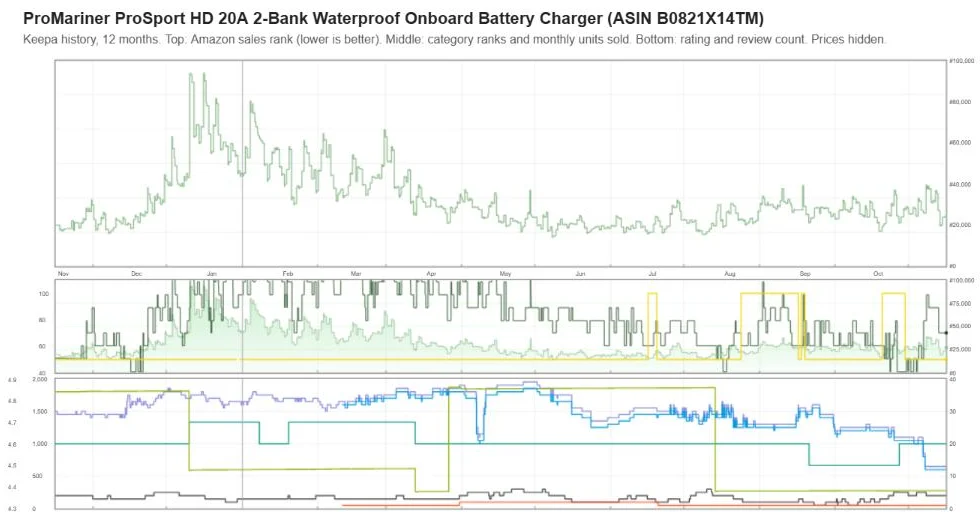
Keepa shows the 44020 listed on Amazon since late 2019, sold by Amazon, with no Amazon out-of-stock time in the last 90 days and an average sales rank near 32,000. That is steady for a charger at this price. The price held near one level for most of the year and moved down a little in recent months, which favors buyers.
Fine print: ProMariner’s current chargers page lists ProSportHD models as designed for LiFePO4, flooded, AGM and gel batteries, and the catalog says lithium support covers ProMariner-approved LiFePO4 batteries. The manual we found lists only flooded, AGM and gel, and neither document gives a lithium charge voltage. If you run lithium, confirm your exact unit and battery with ProMariner first.
What we like
- Full marine listing set: UL Marine 1236, CSA, ABYC A-31
- IP67, fully sealed for wet bilges and consoles
- Published charge voltages for flooded, AGM and gel
- Sold and shipped by Amazon
Watch out for
- Lithium voltage not published
- Manual says not for 4D or 8D batteries
- Only two banks; three-battery boats need the 3-bank model
Verdict: The charger to buy for a typical two-battery fishing or ski boat. It carries every marine mark we look for and has years of steady Amazon sales behind it.
Guest ChargePro 4/4 (2707A)
Best for small boats with two 12V lead-acid or AGM batteries that sit on the charger between weekend trips.
The Guest ChargePro spec sheet lists the 2707A at 4 amps per bank across two banks for 12V or 24V systems. It says the charger conforms to UL STD 1236, is certified to CSA C22.2 No. 107.2, and is designed and constructed to ABYC A-31, with ignition protection, IP67 sealing and a 2-year warranty. It charges at a constant current up to 14.6V, holds 14.6V for up to three hours, then maintains at up to 13.4V.
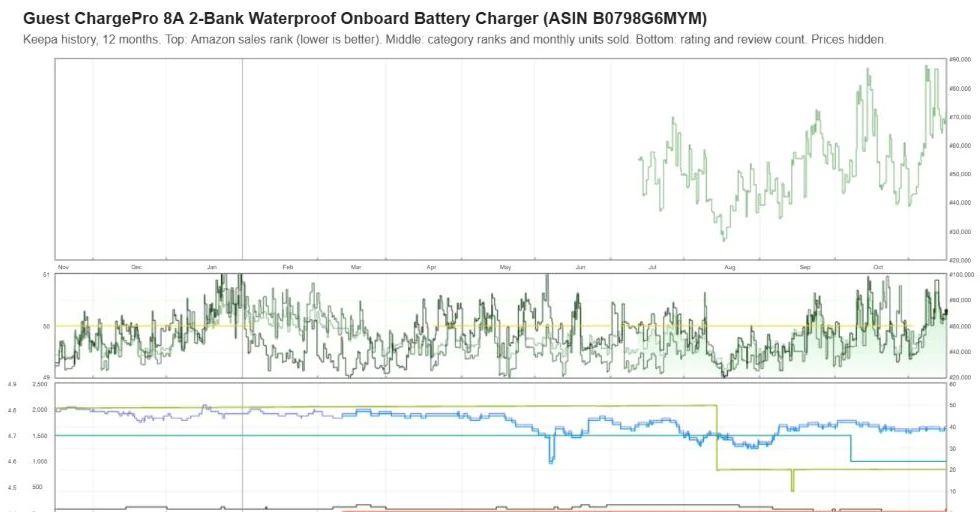
Keepa shows the 2707A listed since late 2017, sold by Amazon, with no Amazon out-of-stock time in the last 90 days and an average sales rank near 52,000 across the ChargePro family. The price stepped up once early in the year and has moved within a modest band since.
Fine print: This is a lead-acid charger only. The spec sheet says flooded and AGM 12V batteries, not 6V, and not 4D or 8D. At 4 amps per bank it is slow on a big deep-cycle battery, so it fits boats that sit on shore power between trips.
What we like
- UL 1236, CSA and ABYC A-31 on the spec sheet
- IP67 and ignition protected
- Published charge and maintenance voltages
- Lower cost than the bigger onboard chargers
Watch out for
- No lithium or gel setting
- Only 4A per bank
- 2-year warranty, shorter than ProMariner’s
Verdict: A properly listed onboard charger at an entry-level price. Right for small boats that charge overnight at the dock or in the driveway.
Why a car battery charger is the wrong tool on a boat
A car charger is built to sit on a garage floor. A marine charger is built to live in a damp, closed hull near fuel. That is what the marine marks on our picks are about: UL 1236’s marine listing, the ABYC A-31 standard for marine battery chargers, waterproof sealing and ignition protection, which means the charger is designed not to ignite fuel vapor around it.
Here is the detail almost nobody mentions. The NOCO GEN series user guide, written for chargers NOCO sells as onboard marine chargers, still says a marine battery must be removed and charged on shore. NOCO’s GENIUS10 car charger guide says the same. If a charger’s own manual tells you to take the battery off the boat, it is not the charger to bolt inside the boat.
If you only charge a small boat battery at home on the bench, a good car charger is fine. Our best battery charger for AGM batteries covers that use.

How many banks and amps does your boat need?
Start with banks. You want one charger bank for each 12V battery, including each battery in a 24V or 36V trolling motor string. Two batteries means a 2-bank charger, three means 3-bank.
Then amps. Boating Magazine’s charger guide suggests output of at least 10% of battery capacity, erring higher. On the upper end, Minn Kota’s onboard charger manual says the maximum safe charging current for most deep-cycle batteries is 20 amps, so check your battery maker’s limit before buying a bigger unit.
Our per-bank sizing and charge-time math
Amps per bank ≈ battery amp-hours × 0.10 (minimum)Hours ≈ amp-hours to put back ÷ amps per bank × 1.1100Ah battery used down to 50%: 50Ah back. At 4A ≈ 14 hours. At 10A ≈ 5.5 hours.A 4A-per-bank charger is below the 10% guideline for a 100Ah battery but fine for a boat that sits plugged in overnight or between weekends. If you fish two days in a row, size for 10A per bank or more. Our battery charger size guide walks through the same math for single batteries.
If your boat runs lithium (LiFePO4)
This is where we could not give a clean pick. Every lithium-capable onboard charger we looked at missed at least one check:
- Minn Kota Precision PCL: built for LiFePO4 by bank and able to wake a lithium battery from standby. Minn Kota’s help page says the chargers are designed to work within the limits of UL 1236 for marine chargers, which is a design statement, not a listing. Its sources also disagree on the lithium voltage: the 15-amp PCL manual lists a 14.2V maximum, while the help page says 14.5V. Amazon sales were also thin.
- NOCO GENPRO and GEN series: a 14.6V lithium mode, IP68 and big sales, but no UL 1236 or ABYC listing in the guide, and the guide’s own marine-battery warning above.
- ProMariner ProSportHD: our top pick now lists approved LiFePO4 support, but no published lithium voltage. ProMariner’s ProTournament elite line publishes a 14.2V LiFePO4 profile and an approved-battery list, yet had only a handful of Amazon ratings.
Our advice for lithium boats: pick the charger your battery maker approves, confirm the lithium charge voltage in writing, and check that it falls inside the window your battery’s spec sheet allows. Our best LiFePO4 battery charger guide explains the voltage windows in detail.
Mounting rules hiding in the manuals
We pulled the installation rules from the ProMariner and Minn Kota manuals into one checklist. Follow your own charger’s manual first.
| Rule | Source |
|---|---|
| Keep about 6 inches of open space around the charger for airflow | ProMariner and Minn Kota manuals |
| Never mount the charger directly above the battery; battery gases corrode it | Minn Kota manual |
| Do not mount below the waterline or right next to fuel tanks | Minn Kota manual |
| Do not mount on carpet, upholstery, vinyl, varnish or other combustible surfaces | ProMariner manual |
| Keep the AC cord at least 21 inches from the charger, batteries and fuel fill lines | ProMariner manual |
| Make sure mounting screws cannot reach a live well, fuel or oil tank, or the hull bottom | ProMariner manual |
| Keep DC fuse holders within 7 inches of the battery terminals if you extend leads | Minn Kota help page |
| Use only a sine-wave generator if you charge from one | Minn Kota manual |
Marine listing check across the chargers we looked at
| Charger | UL 1236 marine / ABYC A-31 | Lithium | Waterproof | Warranty | Our call |
|---|---|---|---|---|---|
| ProMariner ProSportHD | UL Marine 1236 listed; ABYC A-31 | Approved LiFePO4; voltage not published | IP67 | 3 years | Pick |
| Guest ChargePro | Conforms to UL 1236; CSA; ABYC A-31 | No | IP67 | 2 years | Pick |
| Minn Kota Precision PCL | Designed within UL 1236 limits; no listing published | Yes; 14.2V vs 14.5V conflict | Waterproof | 3 years | Left out |
| NOCO GEN / GENPRO | Not published; FCC and USCG connection note only | Yes, 14.6V | IP68 | 3 years | Left out |
Chargers we left out and why
- NOCO GEN5X2 and GENPRO10X2: the best sellers in this category by far, but no UL 1236 or ABYC A-31 listing in NOCO’s guide, which also tells you to charge marine batteries on shore. Keepa showed the GEN5X2 out of stock at Amazon for about a fifth of the last 90 days. Several boaters on The Hull Truth forum also reported failures, though that is anecdotal.
- Minn Kota Precision PCL (MK-220, MK-230, MK-440): strong lithium features and a 3-year replacement warranty, but no published safety listing, a lithium voltage conflict, and thin Amazon sales.
- Minn Kota MK 330D: an older digital model sold by third-party sellers, with a rating count that fell sharply during the year.
- Guest ChargePro 5/5/5 (3-bank): same listings as our Guest pick, but its Amazon price swung widely during the year and it had a stretch out of stock.
- ProMariner ProSportHD 20 Plus (3-bank): same marine listings as our top pick, but Amazon was out of stock for about a quarter of the last 90 days. If you need three banks and it is in stock from Amazon, it is the same family.
- ProMariner ProTournament elite: published lithium profile and a 5-year warranty, but only a handful of Amazon ratings so far.
How we chose these chargers
We never claim hands-on testing. We compared manuals, spec sheets and marine listings, then pulled one year of Keepa data for 18 onboard chargers and maintainers from four brands.
Sources: ProMariner ProSportHD catalog · ProMariner chargers · ProSportHD manual · Guest ChargePro spec sheet · Minn Kota PCL manual · Minn Kota PCL help page · NOCO GEN support · Boating Magazine
Storing a camper or motorhome too? Our best battery maintainer for RVs guide covers portable chargers and 2-bank onboard options for house and chassis batteries.
Frequently asked questions
Can I use a regular car battery charger on a boat battery?
How many amps should a marine battery charger be?
What does ignition protected mean on a marine charger?
Do I need a separate bank for each battery?
Can I leave an onboard marine charger plugged in all the time?
Can a marine battery charger charge lithium batteries?

Researched by Shahzad
Amazon seller who researches products using sales-rank history, price tracking and owner reviews before recommending anything. Read our disclosure.