
We may earn a commission when you buy through links on this page, at no extra cost to you. It never decides what we recommend. How we make money
Yes, you can charge a car battery without disconnecting it in most modern cars. Both charger manuals we checked, from Battery Tender and NOCO, include a step-by-step procedure for a battery that stays installed in the vehicle. The catch is in the details: which clamp goes where, which chargers are safe to leave on a connected battery, and the handful of cars and situations where disconnecting is still the better call.
This guide is for US drivers charging a 12V lead-acid or AGM car battery at home. You will learn what the manuals actually say, a quick table for deciding whether to disconnect, the exact clamp order, and what changes on cars with a battery sensor or a battery in the trunk.
Quick answer
- Short answerYes. Use a smart, automatic charger and leave the battery connected.
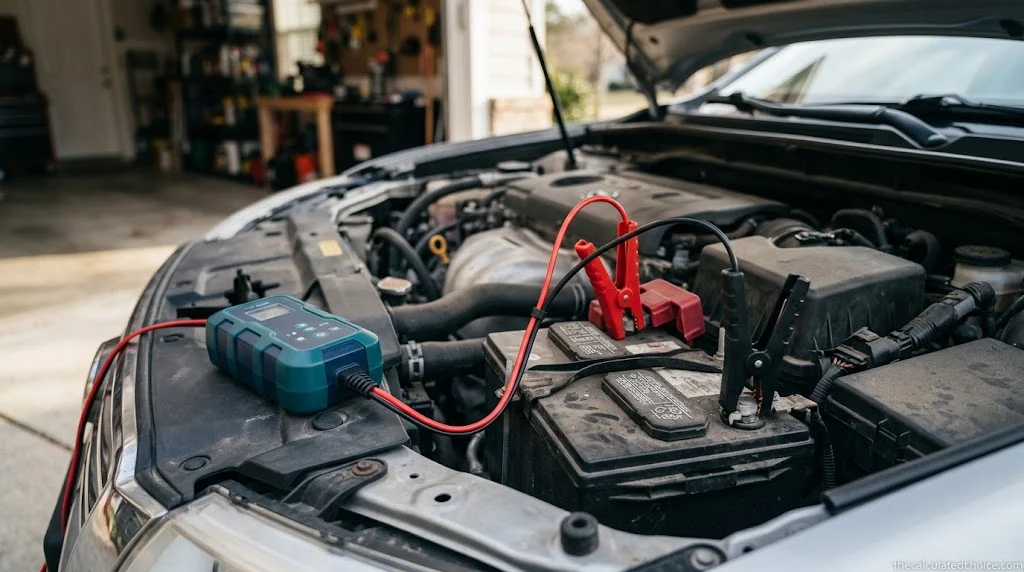
- Clamp orderRed clamp on the positive post first, then black clamp on bare chassis or engine-block metal away from the battery. Plug the charger in last.
- Battery sensor carsIf your negative cable has a sensor, do not clamp the negative post. Use the ground point your owner’s manual names.
- Disconnect whenYou use an old manual charger, the car will sit for weeks without a maintainer, or your owner’s manual says to.
- Never chargeA frozen, cracked or leaking battery, in the car or out of it.
Can you charge a car battery without disconnecting it? What the manuals say
The charger makers say yes, and they spell out how. The Battery Tender PowerPlus manual has a full section for a battery installed in a vehicle, and the NOCO GENIUS10 user guide has a matching one titled for when the battery is installed in the vehicle. Neither tells you to unbolt a cable first.
Both manuals use the same pattern for a negative-ground car, which is nearly every car on US roads. The red clamp goes on the positive battery post. The black clamp goes on the vehicle chassis or engine block, away from the battery, and never on the carburetor, fuel lines or thin sheet-metal body parts. NOCO adds that you plug the charger into the wall only after the clamps are on.
Leave it connected or disconnect? A quick decision table
Whether you can charge a car battery without disconnecting it depends on the car, the charger and how long it will sit. We pulled the situations from the charger manuals, two automaker owner’s manuals and the questions drivers actually ask. Find your row.
| Your situation | What to do | Why |
|---|---|---|
| Modern car, smart automatic charger, battery under the hood | Leave it connected | Battery Tender and NOCO both give an in-vehicle procedure |
| Negative cable has a battery sensor on it | Leave it connected; clamp black to the ground point, not the negative post | Ford warns that grounding devices on the negative post can throw off its battery management system |
| Battery in the trunk or under a seat | Leave it connected; use the posts the owner’s manual names under the hood | BMW’s manual says to charge in the vehicle only through the engine-compartment terminals |
| Old manual charger with no automatic shutoff | Disconnect, or better, use a smart charger | No regulation means nothing stops it from overcharging |
| Car will sit 30+ days with no charger or maintainer on it | Disconnect the battery cables | Ford recommends this for storage without recharging |
| Battery is frozen, cracked, swollen or leaking | Do not charge it at all | NOCO’s guide warns against charging a frozen battery; replace a damaged one |
| Terminals badly corroded or battery being replaced anyway | Remove it and clean or replace | A clean, tight connection matters more than where you charge |
How to charge a car battery without disconnecting it, step by step
Here is how to charge a car battery without disconnecting it. These steps follow the in-vehicle procedure in the Battery Tender and NOCO manuals for a negative-ground car. Your charger’s manual is the final word, so skim its in-vehicle section before you start.
- Park, shut the engine off and pull the key. Turn off lights and accessories. Work outdoors or in a garage with the door open.
- Check the battery. If the case is cracked, bulging or leaking, or the battery is frozen, stop. Do not charge it.
- Find the positive post and your ground point. The positive post is marked + and is usually larger. For ground, pick heavy, bare metal on the engine block or frame, away from the battery and away from fuel lines and moving parts.
- Set the charger. With the charger unplugged, choose the right battery type (standard, AGM or lithium) and amp setting.
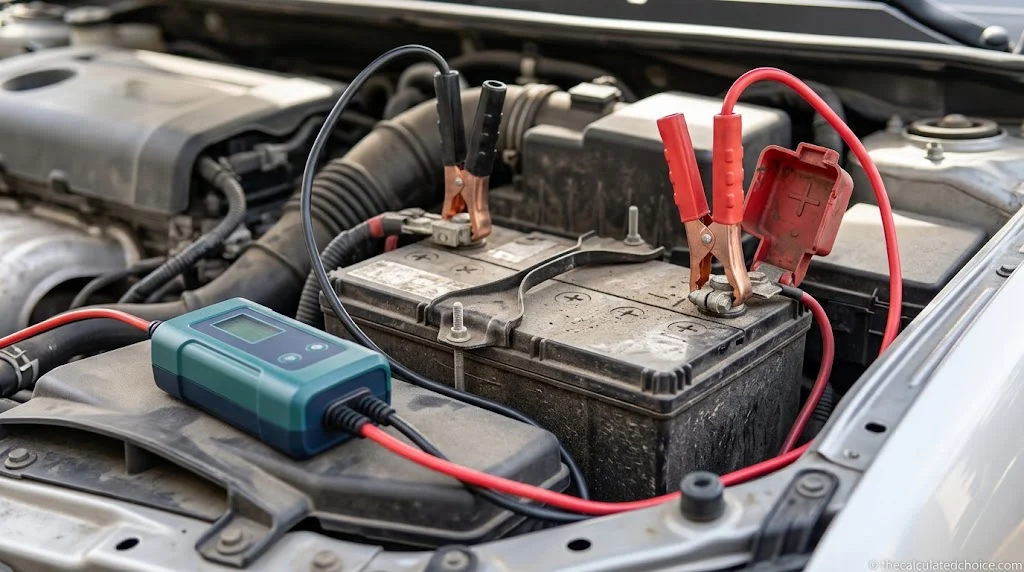
- Clamp red to positive. Attach the red clamp firmly to the positive post.
- Clamp black to ground. Attach the black clamp to your ground point, not the negative post, unless your charger’s manual tells you otherwise.
- Plug in last. Plug the charger into the outlet and let it run until it shows full or switches to maintenance.
- Disconnect in reverse. Unplug the charger from the wall first, then remove the black clamp, then the red clamp.
How long it takes depends on the charger’s amps and how flat the battery is. Our guide on how long to charge a car battery at 2, 10 and 40 amps has the math. For the full walkthrough, including charging a battery out of the car, see how to charge a car battery at home.
Cars with a battery sensor or remote charging posts
Many newer cars watch the battery with a small sensor clipped onto the negative cable. It counts current in and out so the car knows how charged the battery is. In its owner’s manual battery section (this one is for the Focus Electric), Ford says not to connect an electrical device’s ground directly to the battery’s negative post, because it can cause inaccurate battery readings and incorrect system operation.
That lines up with the charger manuals: black clamp on the chassis or engine block, not the negative post. Current then flows back through the sensor, and the car sees the charge.
Some cars move the battery to the trunk or under a seat and give you charging posts under the hood. A BMW M5 owner’s manual, for example, says to charge the battery in the vehicle only through the terminals in the engine compartment, with the engine off. If your battery is hard to reach, look up “jump starting” or “charging the battery” in your owner’s manual before you clamp anything.
Can you trickle charge a car battery without disconnecting it?
Yes, and that is what battery maintainers are built for. A smart maintainer charges, then drops to a low maintenance level and holds it, so it can stay on a connected battery for weeks. An old-style trickle charger that never shuts off is different: left on for days, it can overcharge the battery. Our battery maintainer vs trickle charger guide explains the difference.
If you will not keep a maintainer on, Ford’s owner’s manual recommends disconnecting the battery cables when storing a vehicle for more than 30 days without recharging the battery. Either approach protects against slow drain. Leaving a parked car with nothing at all is the one that tends to end in a dead battery.
What disconnecting the battery costs you
Disconnecting is not free. Pulling the negative cable cuts power to everything in the car, so expect to reset the clock and radio presets, and other stored settings may be lost too. That is why Interstate suggests plugging a backup power source into the OBD-II port if you do disconnect.
It also adds a step where things go wrong: a loose cable put back on, or a wrench touching the positive post and metal at the same time. If your charger can do the job in place, choosing to charge a car battery without disconnecting it is usually the simpler and safer route.
Myths vs facts
| Myth | Fact |
|---|---|
| You must always disconnect the battery to charge it. | Battery Tender and NOCO both publish an in-vehicle charging procedure. Disconnecting is a choice, not a rule. |
| The black clamp always goes on the negative post. | For a battery in the car, both manuals say chassis or engine block, away from the battery. Ford adds that grounding to the negative post can confuse its battery management system. |
| Any charger is fine on a connected battery. | An unregulated charger with no automatic shutoff can overcharge. Use a smart charger or disconnect. |
| You can charge with the engine running to save time. | BMW’s manual says to charge with the engine off, and the charger manuals warn to keep clear of fans, belts and pulleys. |
How we researched this
We read the in-vehicle charging sections of two charger manuals and the battery sections of two automaker owner’s manuals, then compared them with a battery maker’s charging guide and an occupational safety source. Where sources disagree, we say so above.
Sources: Battery Tender PowerPlus manual · NOCO GENIUS10 support and guide · Ford owner’s manual, 12V battery · BMW M5 owner’s manual, charging battery · Interstate Batteries · CCOHS battery charging
Frequently asked questions
Is it okay to charge a car battery while it is still connected?
Do you need to disconnect a car battery when charging it?
Which clamp do you connect first when charging a battery in the car?
Can charging a battery in the car damage the electronics?
Can you trickle charge a car battery without disconnecting it?
Can I charge the battery with the engine running?

Researched by Shahzad
Amazon seller who researches products using sales-rank history, price tracking and owner reviews before recommending anything. Read our disclosure.