

We may earn a commission when you buy through links on this page, at no extra cost to you. It never decides what we recommend. How we make money
Your car battery won’t charge, the charger just blinks or sits on standby, and the car still clicks. Before you buy a new battery, know this: a lot of “dead” batteries are fine, and the problem is the charger’s own safety logic, a bad connection, or the wrong mode.
This guide is for US drivers charging a 12V car battery at home with a plug-in charger. You will learn why a smart charger refuses a very low battery, the exact minimum voltage three popular brands need to start, a voltage-based decision table that tells you whether to keep trying or replace the battery, and when the real problem is your alternator instead of the battery.
Quick answer
- Most common causeThe battery is too low for the charger to detect. Smart chargers need a minimum voltage to start: about 1V for NOCO GENIUS10, 2.0V for CTEK MXS 5.0 and 3V for Battery Tender.
- Check firstClean, tight clamps on bare metal, the right battery mode (AGM, flooded or lithium), a live outlet, and the charger’s inline fuse.
- Charger shows an errorCTEK and NOCO both say a repeated error or “bad battery” light usually means a sulfated or failed battery that may need replacing.
- Charges but goes flatThe battery has lost capacity, or something drains it. Get a load test and check for a parasitic draw.
- Never chargeA frozen, swollen, cracked or leaking battery.
Car battery won’t charge? 5 checks before you blame the battery
These take five minutes and fix more “car battery won’t charge” cases than you might expect.
- Clamps and terminals. White or green crust on the posts blocks current. Unplug the charger, clean the posts, and clamp onto bare metal. A loose clamp is enough to stop a smart charger from reading the battery.
- Polarity. Red to positive, black to negative or a bare ground point. Many smart chargers show a reverse-polarity light and simply refuse to start.
- The right mode. A lithium (LiFePO4) battery on a lead-acid mode, or a 12V battery on a 6V mode, can trigger an error or a refusal. NOCO’s GENIUS10 shows an overvoltage light when the battery is too high for the selected mode.
- Power and fuse. Try another outlet and skip the extension cord. A tripped GFCI outlet in a garage is common. NOCO lists a loose or blown inline fuse as a reason the GENIUS10 stays on standby.
- Temperature. Chargers pause outside their range. CTEK lists -4°F to 122°F for the MXS 5.0, and NOCO says its charger pauses when it is too cold and resumes when conditions return to normal.
Charging with the battery still in the car? That works with most smart chargers, but some cars need a specific ground point. Our guide on charging a car battery without disconnecting it covers battery-sensor cars and clamp order.
Why a charger won’t charge a completely dead car battery
This is the one that confuses most people. When a car battery won’t charge on a smart charger, the battery is often just too low. A smart charger checks the battery’s voltage before it sends any current. If it reads too low, the charger assumes nothing is connected, or that the battery is unsafe to charge, and it does nothing. It is a safety feature, not a broken charger.
Each brand sets its own floor. Here is what the makers publish:
| Charger | Minimum battery voltage to start | What the maker says to do below it |
|---|---|---|
| NOCO GENIUS10 | 1V | Use Force Mode for about 5 minutes; NOCO warns all safety features are off in this mode |
| CTEK MXS 5.0 | 2.0V | We found no low-voltage override in the manual we checked |
| Battery Tender (smart chargers) | 3V | Pre-charge it with a different charger or jump-start it, then reconnect |
Sources: NOCO GENIUS10 support page, the CTEK MXS 5.0 user manual, and Battery Tender’s explanation of its spark-free circuitry. Other chargers have their own limits, so check the manual for yours.
Car battery won’t charge with a charger: decision table by voltage
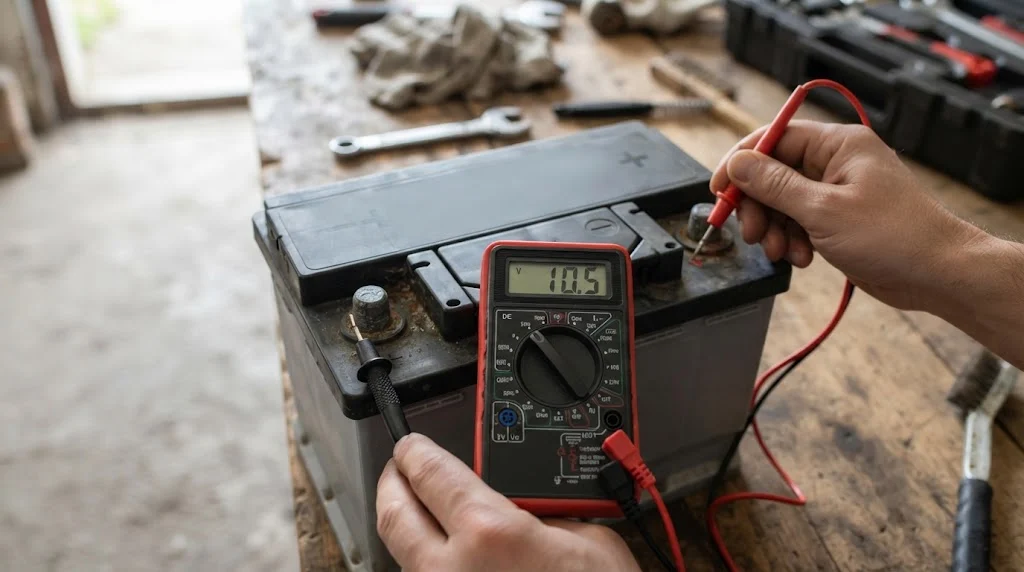
An inexpensive multimeter answers the “is it the battery or the charger?” question in seconds. Measure the battery at rest, with the charger and car off, then find your reading below. If you have not used a meter on a battery before, follow our multimeter battery test guide.
| Resting voltage | What it usually means | What to do |
|---|---|---|
| 12.4V or higher | The battery has charge. The charger may simply show “full” quickly. | If the car still will not start, get a load test. The battery may have lost capacity. |
| About 10.5V to 12.4V | Discharged but chargeable | Any working charger should start. If it errors out, see the next section. |
| Stuck near 10.5V even after charging | Often one dead cell (our math below) | Replace the battery. |
| Below about 10.5V down to your charger’s minimum | Deep discharge. Possible sulfation. | Charge with a smart charger. Expect it to take longer, and test it afterwards. |
| Below your charger’s minimum (1V to 3V) | The charger will not detect it | Follow your charger maker’s low-voltage advice above, or take it to a parts store for a test. |
| 0V or close to it | Likely an internal short or a destroyed battery | Replace it. |
Why 10.5V points to a dead cell
Step 1: a 12V lead-acid battery is 6 cells in seriesStep 2: a full battery rests around 12.6V, so each cell gives about 12.6 ÷ 6 = 2.1VStep 3: if one cell shorts, you lose about 2.1V: 12.6 − 2.1 ≈ 10.5VStep 4: a battery that charges, rests, and still reads near 10.5V most likely has one dead cellThis is our own arithmetic from standard cell voltages, used as a quick screening rule, not a manufacturer test. A load or conductance test at a parts store confirms it. For full-charge readings by battery type, see our car battery voltage chart.
What the charger’s error or “bad battery” light means
When a charger does start but stops with an error, the battery is usually the problem. The manuals are surprisingly direct about it:
- CTEK MXS 5.0: if charging is interrupted in step 1, the manual says the battery is seriously sulfated; in step 2, it cannot accept charge; in step 5, it cannot hold charge. In all three cases it says the battery may need replacing.
- NOCO GENIUS10: the Bad Battery light means a possible battery short or a battery that will not hold a charge, and NOCO says to have it evaluated by a battery shop. All error lights flashing together means a temperature problem, not a bad battery.
- Battery Tender: no output at all usually means it has not detected at least 3V, the clamps are not attached, or the polarity is reversed.
Sulfation is the big one behind these errors. Lead sulfate builds up on the plates when a battery sits discharged, and Crown Battery says it is not easily reversed once it hardens. Some chargers have a desulfation or reconditioning step. CTEK’s manual describes a pulsing desulfation step and a separate recond mode for empty flooded batteries. They can help a lightly sulfated battery. They will not bring back one that sat dead for months.
Car battery charges fully but won’t hold a charge
Sometimes the problem is not that the car battery won’t charge at all. The charger does its job, the light goes green, and the battery is flat again two days later. That is a different problem, and it usually has one of two causes.
- Lost capacity. An old or sulfated battery can show full voltage with very little energy behind it. A load test reveals it.
- A parasitic draw. Something in the car keeps drawing power with the key off: a glovebox light, an aftermarket alarm, a module that will not sleep. We walk through finding it in why does my car battery keep dying.
Quick test: fully charge the battery, disconnect the negative cable (if your owner’s manual allows it), and measure again the next day. If the voltage holds off the car but drops on the car, look for a draw. If it drops either way, the battery is the problem.
Car battery won’t charge while driving
If the battery is fine on a plug-in charger but runs down while you drive, look at the alternator. With the engine running, Fluke says a good alternator should produce about 13.7 to 14.7 volts at the battery. A reading that stays near the battery’s resting voltage means it is not being charged. Check the drive belt, the battery cables, and have the charging system tested. A reading above about 15 volts is the opposite problem, which we cover in can you overcharge a car battery.
When to stop trying and replace the battery
- The case is swollen, cracked or leaking, or the battery got hot during charging.
- It froze. A John Deere service guide notes a fully discharged battery may freeze at about +5°F, while a full one will not freeze until far below zero. Never charge a frozen battery.
- It reads near 0V, or stays near 10.5V after a full charge.
- Your charger repeatedly shows a bad-battery, sulfation or “cannot hold charge” error.
- It fails a load or conductance test after a full charge.
- It is old and has been deeply discharged more than once.
If your car battery won’t charge because the charger itself is the weak link, an upgrade can help. If you are shopping for a charger that handles low batteries better, our best car battery charger guide compares the trustworthy options, and our battery charger sizing guide helps you avoid one that is too small for a truck battery. Once it is charged, a solar car battery charger can keep a car that sits outdoors from going flat again.
Myths vs facts
| Myth | Fact |
|---|---|
| If the charger does nothing, the charger is broken. | Most smart chargers will not start below a set voltage: 1V, 2.0V or 3V for the three we checked. |
| A green “full” light means the battery is good. | It means it reached full voltage. A worn battery can do that with little capacity left. Only a load test tells you. |
| Any battery can be revived with a recondition mode. | Desulfation helps lightly sulfated batteries. A battery left dead for months, frozen or shorted is usually done. |
| A bigger charger fixes a battery that won’t charge. | More amps will not fix a shorted cell or hard sulfation, and the charger should match the battery size. |
How we researched this
We did not run a teardown. We read the troubleshooting sections of three charger makers’ manuals and support pages, lined up their minimum-voltage limits and error meanings, and checked them against battery and test-equipment sources. The 10.5V dead-cell rule is our own arithmetic, labeled as such.
Sources: NOCO GENIUS10 · CTEK MXS 5.0 · Battery Tender · Crown Battery · John Deere battery tips · Fluke · CCOHS
If the battery is old and may be sulfated, our guide on whether battery desulfator chargers really work explains when recovery is still possible and when it is not.
Car battery won’t charge: FAQ
How do you fix a car battery that won’t charge?
Can a car battery be so dead that it won’t take a charge?
Why won’t my car battery charge with a charger?
What causes a car battery not to charge while driving?
Can you bring a car battery back to life?
Why does my battery charger say full but the car won’t start?

Researched by Shahzad
Amazon seller who researches products using sales-rank history, price tracking and owner reviews before recommending anything. Read our disclosure.