
We may earn a commission when you buy through links on this page, at no extra cost to you. It never decides what we recommend. How we make money
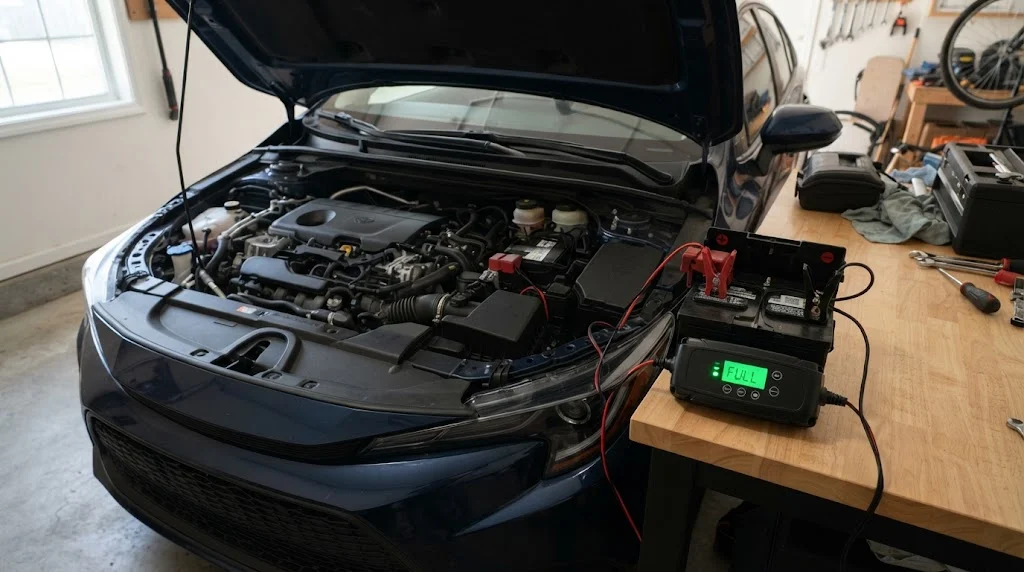
Can you overcharge a car battery? Yes. A 12V lead-acid battery can be overcharged by an old manual charger left on too long, by the wrong charger setting, or by a failing alternator while you drive. It cannot be overcharged by a working smart charger in maintenance mode, and that difference is what most short answers leave out.
This guide is for US drivers and DIYers who want to know whether the charger on their garage shelf is safe to leave connected, and how to tell if a battery has already taken damage. You will get the voltage red lines from the battery makers’ own manuals, a charger-by-charger decision table, the math on how much water an overcharged battery can lose, and a five-minute check you can do with a multimeter.
Quick answer
- Short answerYes, you can overcharge a car battery, but only when voltage is not regulated: a manual charger with no auto shutoff, a wrong battery-type setting, or a faulty alternator regulator.
- Smart chargersA smart charger or maintainer switches to float or maintenance mode when the battery is full. NOCO and Battery Tender both describe their chargers as built for ongoing maintenance with overcharge protection.
- Red lineSustained voltage above about 15V is overcharging. ODYSSEY says above 15.0V causes irreversible damage to its AGM batteries.
- Normal while drivingAbout 13.7 to 14.7V at the battery with the engine running is a healthy charging range, per Fluke.
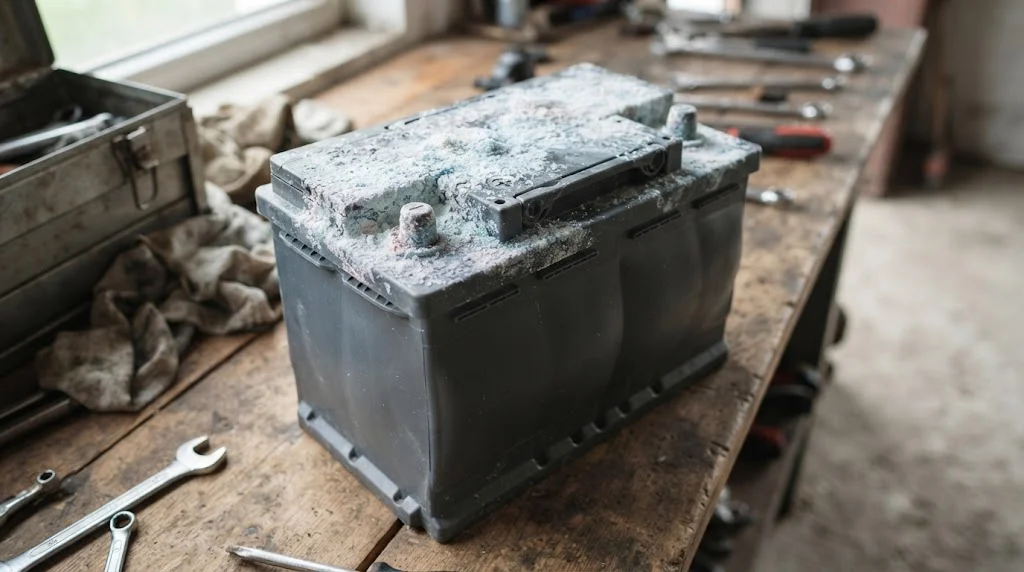
- Warning signsA hot or swollen case, a rotten-egg smell, hissing, or fluid on top of the battery. Unplug the charger at the wall first, then let it cool before touching the clamps.
What overcharging a car battery actually means
A charger pushes current into the battery until the chemistry is full. After that point, the battery cannot store more energy. If voltage keeps climbing and current keeps flowing, the extra energy has to go somewhere, and it turns into heat and gas instead of stored charge.
That is why overcharging is about voltage control, not about how many hours a charger stays plugged in. A battery can sit on a well-regulated float voltage for months and be fine. The same battery can be hurt in a day by a charger that never backs off.
The battery makers draw the line in plain numbers. Optima lists a regular charging range of 13.8 to 15.0 volts and a float or trickle range of 13.2 to 13.8 volts at 1 amp or less. ODYSSEY’s technical manual sets float at 13.6 volts for its AGM batteries and warns that anything above 15.0 volts causes irreversible damage. If you want the resting-voltage side of the picture, our car battery voltage chart covers what a full, half and dead battery read.
What overcharging does to a car battery
The damage depends on the battery type under your hood. Most US cars use either a flooded (wet-cell) battery or an AGM battery, and the two fail in different ways.
Flooded batteries: they boil off water
In a flooded battery, overcharge current splits the water in the electrolyte into hydrogen and oxygen. The gas vents out, and the water does not come back on its own. Midtronics, which builds battery testers for repair shops, lists the result: plate corrosion, active material shedding from the plates, and electrolyte that drops below the top of the plates. Exposed plates stop working, so the battery loses capacity for good.
AGM batteries: they can lose electrolyte for good
An AGM battery is sealed and normally recombines its gas inside. Push it hard enough and the pressure valves open, and that lost electrolyte cannot be refilled. Midtronics says AGM and EFB batteries are more sensitive to overcharging than flooded ones and notes that even a brief spike to 16 volts or more can do serious harm. This is the main reason an AGM battery needs a charger with an AGM setting.
Lithium starter batteries
Lithium (LiFePO4) starter batteries have their own built-in protection board, but they still need a charger with a lithium mode and should never be charged on an old manual charger. We cover the safe options in our LiFePO4 battery charger guide.
Can you overcharge a car battery with a charger? It depends on the type
This is the question most people are really asking. Here is how the common charger types compare, based on the manufacturer documents we checked.
| Charger type | Can it overcharge? | Safe to leave on? | What the maker says |
|---|---|---|---|
| Smart maintainer (1 to 2 amps, automatic) | No, when set to the right battery type | Yes, for storage | NOCO says its GENIUS10 keeps maintaining the battery until you disconnect it; Battery Tender describes float maintenance as 24/7 without overcharging |
| Smart charger (multi-stage, 5 to 15 amps) | No, it drops to float when full | Yes, once the green full light is on | CTEK says its chargers switch to long-term maintenance after a full charge |
| Manual trickle charger (no auto shutoff) | Yes, over days or weeks | No, check and unplug it | Optima warns cheaper chargers may not regulate current well |
| Manual high-amp or wheeled charger | Yes, in hours | Never unattended | Follow the timer and the charger manual |
| Smart charger on the wrong setting | Yes, slowly (wrong voltage for the chemistry) | Only after you fix the setting | Optima and ODYSSEY both say to use the AGM setting for AGM batteries |
Smart chargers and maintainers
A smart charger reads the battery’s voltage, charges in stages, and then holds it at a lower float or maintenance voltage. NOCO’s GENIUS10 support page says the charger keeps providing maintenance until it is disconnected, and Battery Tender’s product page describes float maintenance delivered 24/7 without overcharging. CTEK’s FAQ says its chargers hold float for about 10 days and then switch to a pulse maintenance mode. So with one of these, the real answer to “can I leave my battery charger on overnight?” is yes.
The difference between a maintainer and an old trickle charger is the whole story here, and we break it down in battery maintainer vs trickle charger.
Manual trickle chargers
A basic trickle charger has no brain. It keeps feeding current whether the battery needs it or not. Over a weekend that may be harmless. Left on a car in storage for a month, it can slowly cook a flooded battery dry.
Manual high-amp chargers
Older 10, 20 or 50 amp manual chargers can overcharge a battery in a few hours because they push far more current. If you use one, stay nearby, follow its timer and manual, and stop when the charger’s meter shows the current has dropped and the battery reads full. Our charge-time guide for 2, 10 and 40 amps shows how long a normal charge should take, so you know when something has gone on too long.
How much water can an overcharged battery lose? Our math
No competitor we found puts a number on this, so we ran it ourselves. When a flooded battery is full, overcharge current mostly goes into splitting water. Basic chemistry (Faraday’s law) tells you how much water a given amount of current can break down.
Water lost ≈ 2 grams per amp-hour of overcharge
Step 1: 1 amp-hour of current can split about 0.34 g of water in one cellStep 2: a 12V battery has 6 cells in series, and the same current flows through all of them: 6 × 0.34 ≈ 2 g per amp-hourStep 3: a 2 amp manual trickle charger on a full battery for 24 hours = 48 amp-hours of overchargeStep 4: 48 × 2 ≈ 97 g of water per day, about 3.3 fl oz, or roughly 16 g from each cellOne week like that: about 23 fl oz, close to a pint and a halfThis is a worst-case ceiling, not a lab measurement. Many basic chargers put out less current as the battery’s voltage rises, so the real loss is lower. The point is direction, not decimals: an unregulated charger keeps removing water every hour it stays on a full battery, while a smart maintainer drops to a float voltage that is meant to avoid that.
That is also why a sealed AGM battery is less forgiving. It cannot be topped up, so every bit of vented electrolyte is permanent.
Car battery overcharging while driving
Your car’s alternator is a charger too. A voltage regulator keeps it in a safe range. When that regulator fails, the alternator can push the battery too high every time you drive, and that kind of overcharging is easy to miss until the battery swells or the headlights start burning out.
| Engine-running reading at the battery | What it means | Source |
|---|---|---|
| Below about 13.7V | Possibly undercharging; have the charging system tested | Fluke normal range starts at 13.7V |
| 13.7 to 14.7V | Normal for a healthy alternator | Fluke |
| 14.2 to 14.5V | What ODYSSEY expects for its AGM starting batteries | ODYSSEY manual |
| Steady above 15V | Regulator problem; the battery is being overcharged | Midtronics |
| 16V or higher, even briefly | Risk of serious AGM damage; stop driving and get it checked | Midtronics |
Sources do not agree on one exact “normal” range. Midtronics gives 13.5 to 14.5 volts in one place and 13.8 to 14.8 volts in another, while Fluke says 13.7 to 14.7. They all agree on the part that matters: a steady reading above about 15 volts is not normal. If a new battery is going in, Midtronics recommends testing the charging system first so the new one does not get cooked by the same fault.
Signs your car battery is overcharged
- A hot battery case after charging or driving. ODYSSEY says never to charge its batteries above 104°F (40°C).
- A swollen or bulging case. Gas pressure has pushed the walls out.
- A rotten-egg or sulfur smell, or hissing from the vents. The electrolyte is gassing hard.
- Wet or crusty residue on top of the battery or heavy corrosion on the terminals.
- Low electrolyte in a flooded battery with removable caps, with plates showing.
- Bulbs and fuses failing often, or a battery warning light that comes on while driving. A high-voltage fault can trigger the same light as a low one.
- A battery that will not hold a charge anymore. If it will not take one at all, see car battery won’t charge. Midtronics notes an overcharged battery can look normal until it fails a test.
Several of these overlap with general battery failure, so our signs of a bad car battery guide is worth a look if you are not sure overcharging is the cause.
The 5-minute overcharge check with a multimeter
- Look first, touch second. If the case is swollen, cracked, leaking or very hot, stop here and skip to the next section.
- Charger test: with your charger connected and showing full, set a multimeter to DC volts and read across the battery posts. A smart charger in float should sit in the low 13-volt range (Optima’s float window is 13.2 to 13.8V). A reading that keeps climbing past the charger’s normal charging range after the charger says full points to a charger problem.
- Alternator test: start the engine, let it idle, and read the battery again. Compare it with the table above. Above 15 volts and steady is the red flag.
- Load it up: turn on the headlights and blower. A good regulator holds voltage steady. Big swings up suggest a regulator fault.
- Write the numbers down and bring them to the shop. A charging-system test is often free at US auto parts stores.
New to the meter? Our step-by-step on how to test a car battery with a multimeter shows the settings and probe placement.
What to do if your car battery got overcharged
- Stop the charge safely. Unplug the charger from the wall first, then remove the clamps, so you do not make a spark near battery gas.
- Ventilate and wait. Open the garage door and let the battery cool. Charging releases hydrogen, and CCOHS warns that charging areas need ventilation and no sparks or flames.
- Inspect it. Do not recharge or jump-start a battery that is swollen, cracked or leaking. Replace it and recycle the old one where you buy the new one.
- Check the water (flooded batteries with removable caps only). If the plates are exposed, top up with distilled water only after the battery has cooled, following the battery maker’s instructions. Sealed and AGM batteries cannot be refilled.
- Test before you trust it. Charge it with a smart charger on the correct setting, let it rest, then have it load- or conductance-tested.
- Fix the cause. Replace a manual charger with a smart one, change the setting, or get the alternator regulator checked.
Myths vs facts
| Myth | Fact |
|---|---|
| Leaving any charger on overnight ruins the battery. | A working smart charger or maintainer drops to float. The risk comes from unregulated manual chargers. |
| A 2 amp charger is too small to overcharge anything. | Low current only slows it down. A manual 2 amp charger left on a full battery for days can still boil off water, as the math above shows. |
| Overcharging only happens with a plug-in charger. | A failing alternator regulator can overcharge the battery every time you drive. |
| If the charger has an AGM button, any setting is fine. | The wrong setting means the wrong voltage. Optima specifically warns against the “gel” setting for its AGM batteries. |
| A bulging battery is fine once it cools down. | Swelling is internal damage. Replace it. |
How we researched this
We did not overcharge a battery to make a video. We read the charging sections of battery and charger maker documents, lined up their voltage limits side by side, flagged where they disagree, and ran the water-loss math from basic chemistry.
Sources: Optima · ODYSSEY technical manual · Midtronics · Fluke · NOCO GENIUS · Battery Tender · CTEK FAQ · CCOHS battery charging
Thinking about running a repair or desulfation mode? Read whether battery desulfator chargers really work before you try one.
Can you overcharge a car battery? FAQ
Can you ruin a car battery by overcharging it?
How do I know if my car battery is overcharging?
Can you overcharge a car battery with a trickle charger?
Can I leave a battery charger on overnight?
Can you overcharge a car battery at 2 amps or 10 amps?
Can an alternator overcharge a car battery?
Is a 20-minute drive enough to charge a car battery?

Researched by Shahzad
Amazon seller who researches products using sales-rank history, price tracking and owner reviews before recommending anything. Read our disclosure.