
We may earn a commission when you buy through links on this page, at no extra cost to you. It never decides what we recommend. How we make money
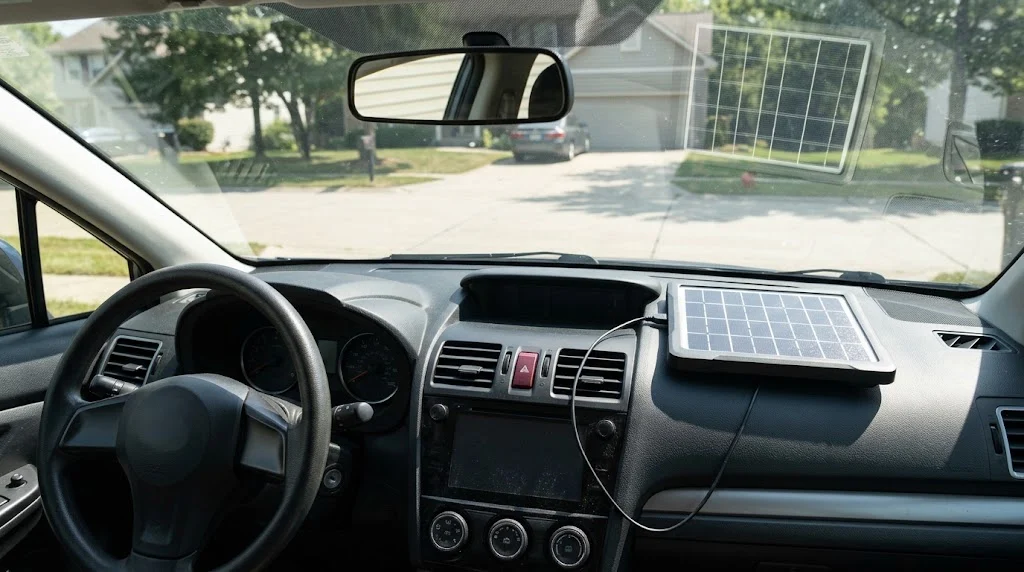
The best solar car battery charger for most drivers is a 10 to 20 watt panel with a built-in charge controller that clamps straight to the battery. That is enough to keep a parked car, truck or boat battery topped up while it sits. It is not a way to bring a dead battery back, and a tiny dashboard panel often cannot keep up with a modern car’s standby drain.
This guide is for US drivers with a vehicle that sits outdoors for weeks: a second car, a classic, a work truck, a camper or a boat on a trailer. We checked 11 popular solar maintainers against their makers’ own pages and a year of Amazon sales and review history in Keepa. Only three passed every trust check. You will also get our sizing math, so you can see whether a given panel can actually keep up with your vehicle.
Quick answer
- Best overallSUNER POWER 12W Solar Battery Charger Pro: MPPT controller, 3-stage charging and steady sales history.
- Best budgetECO-WORTHY 10W solar battery charger: a simple trickle kit from a solar brand with a published warranty.
- Best for trucks, RVs and boatsSUNER POWER 20W Solar Battery Charger Pro: more output for bigger batteries or short winter days.
- Size ruleIn our math, a 10W panel just covers a 50 mA parked drain on a day with about 4 peak sun hours. Go bigger for cloudy regions or winter.
- Not for dead batteriesCharge a flat battery with a plug-in charger first; a solar maintainer only keeps it full.
Our picks at a glance
| Pick | Best for | Panel | Controller | Warranty | Price band |
|---|---|---|---|---|---|
| SUNER POWER 12W Pro | Most cars and SUVs | 12W | MPPT, 3-stage | 12 months | $$ |
| ECO-WORTHY 10W | Budget, small engines, light drain | 10W | Basic trickle circuit with blocking diode | 1 year (PV modules) | $ |
| SUNER POWER 20W Pro | Trucks, campers, boats, cloudy areas | 20W | MPPT, 3-stage | 12 months | $$ |
Price bands: $ is the low end of this category and $$ the middle. Exact prices move often, so check the listing.
Best solar car battery charger picks
SUNER POWER 12W Solar Battery Charger Pro
Best for: most cars, SUVs and pickups that sit outside for weeks
This is the pick we would hand to most people. SUNER POWER’s own product page lists a built-in MPPT controller with a 3-stage charging routine, overcharge, reverse-polarity and short-circuit protection, and a panel cable of about 9.8 feet. The brand runs its own store and support email, and its warranty page spells out a 30-day return window and a repair or replace process; the product page lists a 12-month warranty.
On Keepa, the listing has been tracked for years, sells in the thousands of units a month, and has held a 4.4 rating while reviews kept growing at a normal pace. At 12 watts, our sizing table below shows it covers a typical 50 mA parked drain with some margin on an average day.
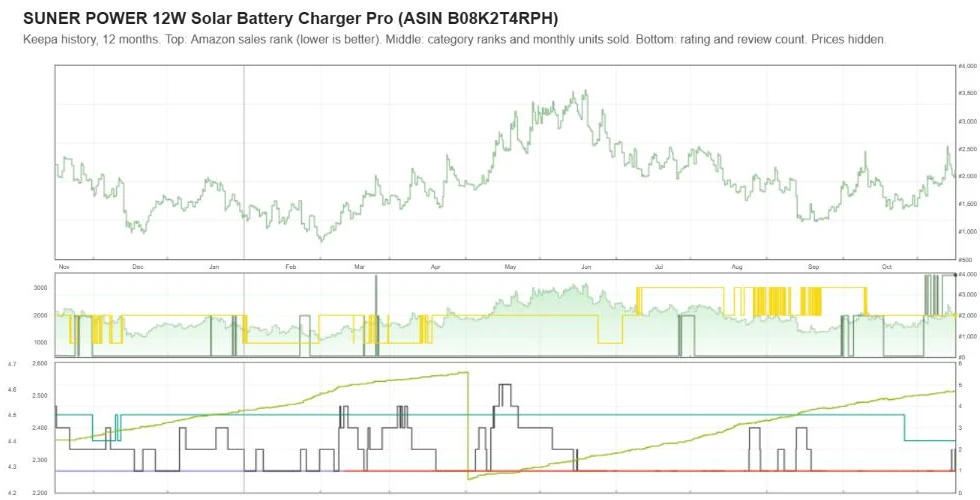
Fine print: the review count dropped in one step during the year and then grew steadily again. That pattern usually comes from a listing change or Amazon removing some reviews; the rating stayed level, so we kept it, but you should know. The “20 to 30 percent better” efficiency claim on the Amazon listing is marketing we could not verify.
What we like
- MPPT controller with a published 3-stage routine
- Long enough cable to reach from a windshield or roof to the battery
- Brand store, support email and written warranty
- Years of steady Amazon sales
Watch out for
- Middle of the price range for a 12W panel
- Efficiency marketing claims not verified
- Not enough output for heavy standby drains
Verdict: The safest default for a car or SUV that sits outside. Enough panel for normal standby drain, a real controller, and a brand you can actually contact.
ECO-WORTHY 10W 12V Solar Battery Charger
Best for: budget buyers, lawn tractors, ATVs and cars with a light standby drain
ECO-WORTHY is a solar company that sells everything from small panels to home battery systems through its own US store, and its warranty page lists a 1-year warranty on PV modules and battery chargers. This 10W kit is the simplest pick here: a monocrystalline panel with a blocking diode so the battery does not drain back through the panel at night, plus alligator clips and a cigarette-lighter plug.
Keepa shows this listing has been tracked for about a decade, with a stable 4.3 rating and slow, natural review growth. Sales have cooled over the past year but still run in the hundreds of units a month, sold and shipped by the brand.

Fine print: the listing describes trickle charging with overcharge protection, but it does not publish a multi-stage charging profile the way the SUNER units do, and we could not find a separate product page or manual on ECO-WORTHY’s own site for this exact kit. Specs here come from the brand’s Amazon listing.
What we like
- Lowest price band of our picks
- Long sales history from an established solar brand
- Blocking diode for night-time protection
- Clamps and lighter plug included
Watch out for
- No published multi-stage charging profile
- Lighter plug only works if your socket stays live with the car off
- 10W leaves little margin in winter
Verdict: A fair, low-cost choice for a lawn tractor, ATV or a car with a light drain in a sunny area. For a newer car with more electronics, the 12W SUNER is the better buy.
SUNER POWER 20W Solar Battery Charger Pro
Best for: bigger batteries, campers, boats on trailers and cloudy or northern areas
The same controller approach as our top pick with nearly twice the panel. SUNER POWER’s 20W product page lists the MPPT controller, 3-stage charging and the same protection set, and in its answers to buyer questions the company gives an operating range of -40°F to 185°F for the panel.
Keepa shows a listing tracked for years, hundreds of units a month and a steady 4.4 rating. In our sizing table, 20 watts is the size that still covers a typical 50 mA drain on a short winter day, which is why we point truck, camper and boat owners here.
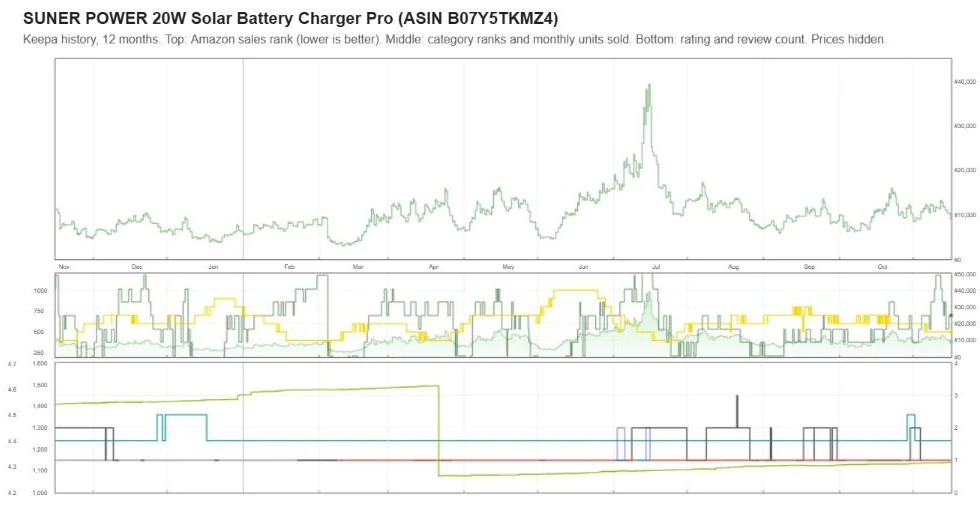
Fine print: SUNER says the 20W Pro ships with four mounting screws and no stand, so plan how you will mount or prop it. Like the 12W, its review count dropped in one step during the year and then grew normally again.
What we like
- Most output of our picks
- MPPT controller with 3-stage charging
- Wide published operating temperature range
- Same brand support and warranty as our top pick
Watch out for
- No stand in the box
- Larger panel is harder to place inside a car
- Costs more than a 10 to 12W kit
Verdict: Pick this when the battery is big, the vehicle sits for months, or you live where winter sun is short. For an average car in decent sun, the 12W is enough.
Will a solar car battery charger keep up? Our sizing math
Every parked car draws a little power for its clock, alarm and computer modules. Fluke says a parked draw under 50 milliamps (mA) is normal and over 100 mA is suspect. A solar maintainer only works if it puts back at least that much each day. Nobody in the top search results does this math, so here it is.
Drain a panel can offset (mA) ≈ watts × sun hours × 0.5 ÷ 14V ÷ 24h
Step 1: panel watts × peak sun hours = watt-hours collected in a dayStep 2: multiply by 0.5, our planning allowance for panel angle, heat, dirt, controller and glass lossesStep 3: divide by about 14V charging voltage to get amp-hours put back per dayStep 4: divide by 24 hours (and × 1,000) to get the steady drain in mA it can coverExample: 10W × 4 h × 0.5 = 20 Wh; 20 ÷ 14 ≈ 1.4 Ah a day; 1.4 ÷ 24 ≈ 60 mAA normal 50 mA drain uses about 1.2 Ah a day, so a 10W panel in 4 hours of good sun only just keeps up. The 0.5 factor is our own conservative assumption for small kits, not a maker’s figure. Look up typical sun for your area on NREL’s solar resource maps.
| Panel size | 2 sun hours (winter, cloudy) | 4 sun hours (average) | 6 sun hours (sunny summer) |
|---|---|---|---|
| 2.4W dash panel | about 7 mA | about 14 mA | about 21 mA |
| 5W | about 15 mA | about 30 mA | about 45 mA |
| 10W | about 30 mA | about 60 mA | about 89 mA |
| 12W | about 36 mA | about 71 mA | about 107 mA |
| 20W | about 60 mA | about 119 mA | about 179 mA |
Read it like this: find your panel size, pick the column that matches your sun, and compare the number with your car’s parked drain. If you do not know your drain, assume about 50 mA for a healthy modern car. The takeaway is blunt: small 2 to 5 watt dashboard panels cannot keep up with a typical modern car, which matches what many owners report. If your car’s drain is above 100 mA, fix that first; our guide on why a car battery keeps dying shows how to measure it.
Fine print we checked before recommending anything
- A solar maintainer does not revive a dead battery. ODYSSEY’s technical manual says float and maintenance chargers are not suitable for recharging deeply discharged batteries. Recharge it with a plug-in charger first, then let the panel hold it. If it will not take a charge at all, see car battery won’t charge.
- The lighter-socket plug may do nothing. In many cars the 12V socket switches off with the ignition. Check your owner’s manual or test the socket with a meter with the car off. Clamping to the battery or using a ring-terminal lead avoids the question.
- Behind the windshield means less power. Glass, tint and a steep angle all cut output. We did not find a published figure from these makers, which is one reason our math uses a conservative 0.5 factor. Outdoors and facing south is better.
- Overcharging is a controller question. A regulated controller stops pushing current when the battery is full. A bare panel with only a diode does not. More on that in can you overcharge a car battery.
- No UL-type listing applies here the way it does for jump starters. None of the small solar maintainers we checked showed a third-party safety listing on the pages we read, so we leaned harder on brand presence, warranty terms and sales history.
Popular solar chargers we rejected, and why
| Product | Why it did not make the list |
|---|---|
| POWOXI 7.5W | Very popular, but the listing claims 25 to 30 percent panel conversion efficiency, which is far above what typical consumer panels are sold at. A spec that does not add up fails our checks. |
| Voltset 20W | Review count rose very quickly over the past year relative to its history. That kind of growth needs more time before we trust it. |
| Sun Energise 25W | Hundreds of reviews added within about six months. Same concern. |
| SOLPERK 20W | We could not find an official brand website or published warranty outside Amazon. |
| Renogy 10W trickle charger | A trusted solar brand, but this listing’s sales rank slid through the year and its review count fell. We prefer a listing that is holding steady. |
| Topsolar 10W | The Buy Box seller name did not match the brand, and sales slid through the year. |
| Small 2.4 to 5W dash panels | Too little output to cover a typical modern car’s parked drain, per our sizing table. |
None of this means those products are unsafe. It means we could not verify them to the level we want before recommending them.
How to set up a solar car battery charger
- Start with a full battery. Charge it with a plug-in charger if it is low.
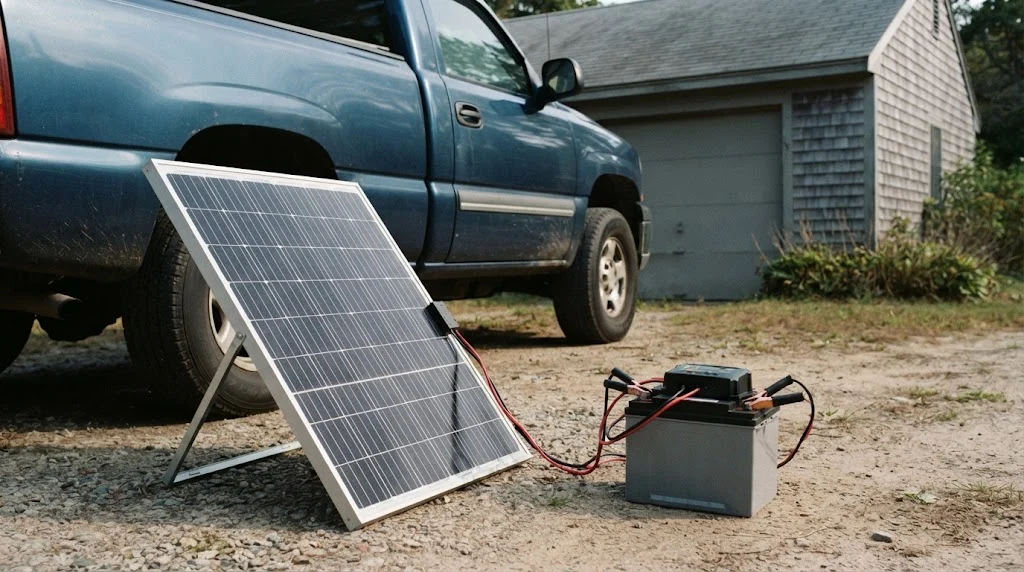
- Read the maker’s instructions for connection order. Most say to connect to the battery first, then plug in the panel lead.
- Connect red to positive, black to negative with the clamps, or install the ring-terminal lead for a permanent setup.
- Place the panel facing south in the US, tilted toward the sun, with nothing shading it during the middle of the day.
- Route the cable through a door seal or hood gap without pinching it.
- Check the indicator light and, after a few days, check the battery’s resting voltage with a meter.
Myths vs facts
| Myth | Fact |
|---|---|
| Any solar panel will keep a car battery charged. | Small dash panels put back less than a typical modern car draws. Size matters. |
| A solar charger can bring back a dead battery. | Maintainers are built to hold a charge, not to recharge a deeply discharged battery. |
| Solar chargers cannot overcharge. | A bare panel with no regulation can. Choose one with a controller that stops at full. |
| More watts will overcharge a small battery. | With a proper controller, extra watts mostly mean better performance on cloudy days. |
How we chose these chargers
We did not test panels on a roof. We started with 11 of the most popular solar maintainers on Amazon and ran each through six trust checks: a real brand beyond Amazon with support and a written warranty, at least one to two years of steady sales in Keepa, specs that make sense, any safety listing that applies, a stable review pattern with no sudden bursts, and in-stock new units sold by the brand or a reputable seller. Only three passed.
Sources: SUNER POWER 12W Pro · SUNER POWER 20W Pro · SUNER warranty · ECO-WORTHY warranty · Fluke parasitic drain · ODYSSEY technical manual · NREL solar maps · CCOHS
Solar car battery charger FAQ
Do solar car battery chargers really work?
What is the best solar car battery charger?
What size solar panel do I need to maintain a car battery?
Can a solar charger overcharge a car battery?
Will a solar battery charger work through a windshield?
Can a solar charger charge a dead car battery?

Researched by Shahzad
Amazon seller who researches products using sales-rank history, price tracking and owner reviews before recommending anything. Read our disclosure.