
We may earn a commission when you buy through links on this page, at no extra cost to you. It never decides what we recommend. How we make money
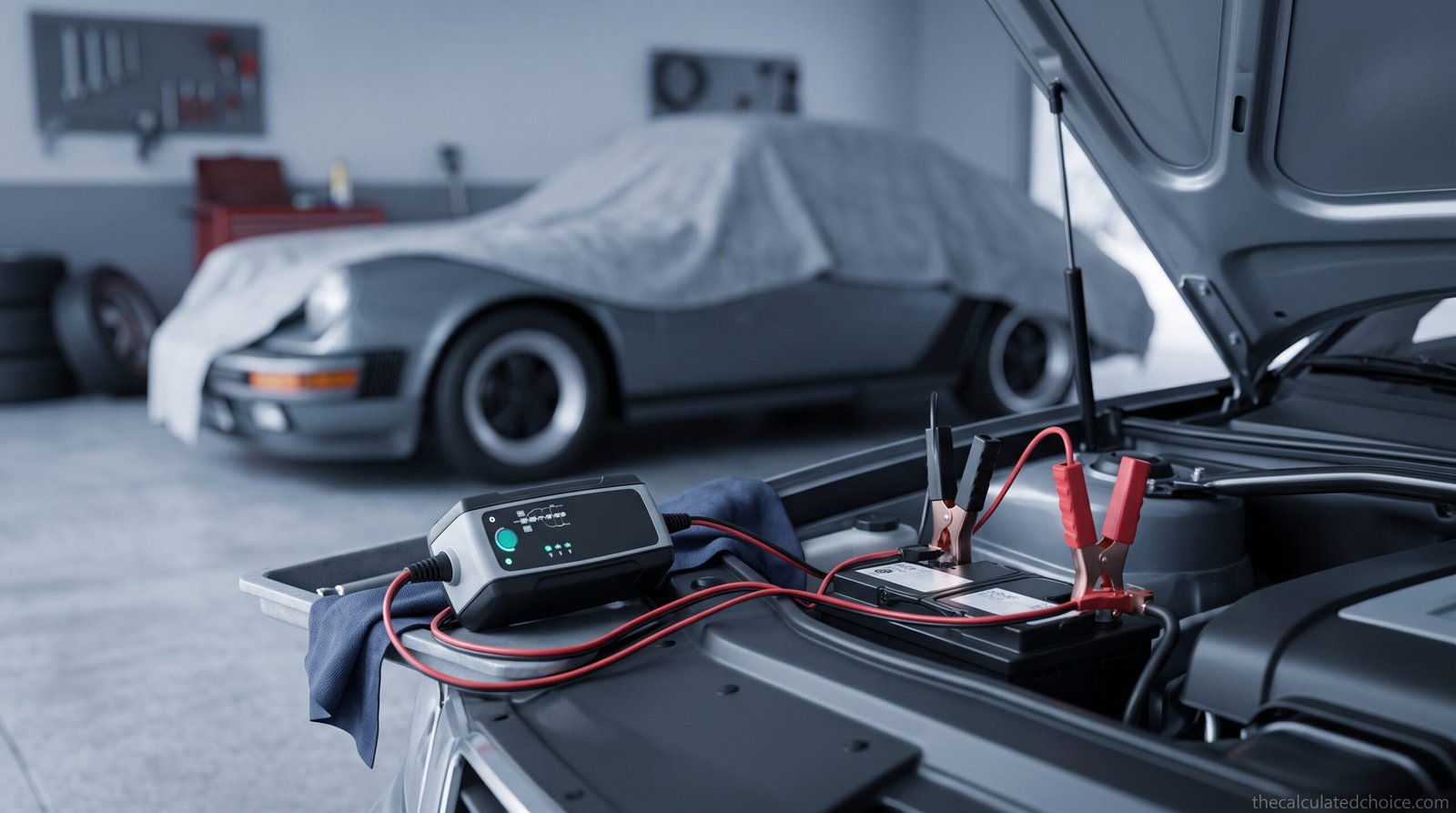
The best battery maintainer for winter storage is one you can connect in autumn and forget until spring. It should hold the battery at full charge with a gentle, regulated float current, adjust its voltage for cold garages, and never cook the battery over months of use. A parked battery does not just sit still. It slowly loses charge on its own, modern cars drain it further through alarms and computer modules, and a battery that runs low in freezing weather can be damaged for good. A good maintainer solves all three problems for the price of a single tank of fuel.
Best battery maintainer for winter storage: quick picks
- Best overall Battery Tender Plus — a 1.25 amp, four-stage maintainer for 14 to 80Ah batteries, with temperature compensation and a ten-year warranty.Check price →See review ↓
- Best for bigger batteries, cold garages and lithium Battery Tender 4 Amp — rated for 14 to 100Ah, with a LiFePO4 setting, temperature compensation, an IP65 housing and ETL listing.Check price →See review ↓
- Best mounted maintainer for boats and RVs ProMariner ProSportHD 6 — a 6 amp, single-bank onboard charger that bolts in place, UL Marine 1236 listed, with a monthly storage mode.Check price →See review ↓
Side-by-side comparison
| Spec | Battery Tender Plus | Battery Tender 4 Amp | ProMariner ProSportHD 6 |
|---|---|---|---|
| Best for | Best overall | Bigger batteries, cold garages, lithium | Boats and RVs on shore power |
| Output | 1.25A | 4A | 6A (1 bank) |
| Voltage | 12V | 6V or 12V | 12V |
| Battery size | 14–80Ah | 14–100Ah | Group 24–31 (not 4D or 8D) |
| Battery types | Flooded, AGM, gel, maintenance-free | Lead-acid, AGM, gel, LiFePO4 | Flooded, AGM, gel, approved LiFePO4 |
| Temperature compensation | Yes | Yes | Charge current controlled by temperature |
| Lithium mode | No | Yes (LiFePO4) | Approved LiFePO4 only |
| Mounting | Portable | Portable | Bolt-on onboard |
| Weather rating | Not listed | IP65 | IP67 (retailer spec) |
| Safety listing | ETL and cETL | ETL and cETL | UL Marine 1236, CSA |
| Warranty | 10 years | 3 or 5 years (maker’s page conflicts) | 3 years |
| Price | Check price | Check price | Check price |
Why batteries die during winter storage
Three things work against a parked battery. The first is self-discharge. Battery University puts lead-acid self-discharge at about 5% per month, and notes that the rate roughly doubles with every 10°C (18°F) rise in temperature. That sounds slow, but it adds up over a four or five month winter.
The second is parasitic drain. A modern car never fully switches off. The alarm, keyless entry, clock and various control modules all draw small amounts of current, and together they can pull a battery down far faster than self-discharge alone. That is why so many cars that sit all winter will not start in spring. Our guide to how long car batteries last covers how many weeks a parked car’s battery typically holds out.
The third is freezing. A battery’s electrolyte becomes more watery as it discharges. According to Interstate Batteries, a fully charged battery will not freeze until about −76°F, while a fully discharged battery can freeze at around 32°F. A frozen battery can crack or buckle internally, and it should never be charged or jumped. Keeping the battery full is the simplest protection there is, and that is exactly what a maintainer does. To see how full your battery is before you store it, check its resting voltage against our car battery voltage chart.
A maintainer is not the same as an old trickle charger. A trickle charger keeps pushing a small current whether the battery needs it or not, while a maintainer switches to a regulated float and only tops up when the voltage drops. If you are unsure which you have, our battery maintainer vs trickle charger guide explains the difference.
How we chose the best battery maintainer for winter storage
To find the best battery maintainer for winter storage, we started with the best-selling maintainers on Amazon and checked each one’s price history, sales history and review volume. We then confirmed the specifications on manufacturer pages and dropped anything without a regulated float stage, a published warranty or a UL or ETL safety listing we could confirm.
1. Battery Tender Plus — best overall
Battery Tender Plus
Best for: cars, SUVs and light trucks parked for the winter
Battery Tender has been the default answer for winter storage for a long time, and the Plus is the model we would buy for a car. It delivers 1.25 amps, which is gentle enough to leave connected for months and enough to bring a slightly low battery back to full before switching to float. Its four-stage program runs an initial check, a bulk charge, an absorption stage and then float maintenance, and it adjusts the charging voltage automatically with the surrounding temperature.
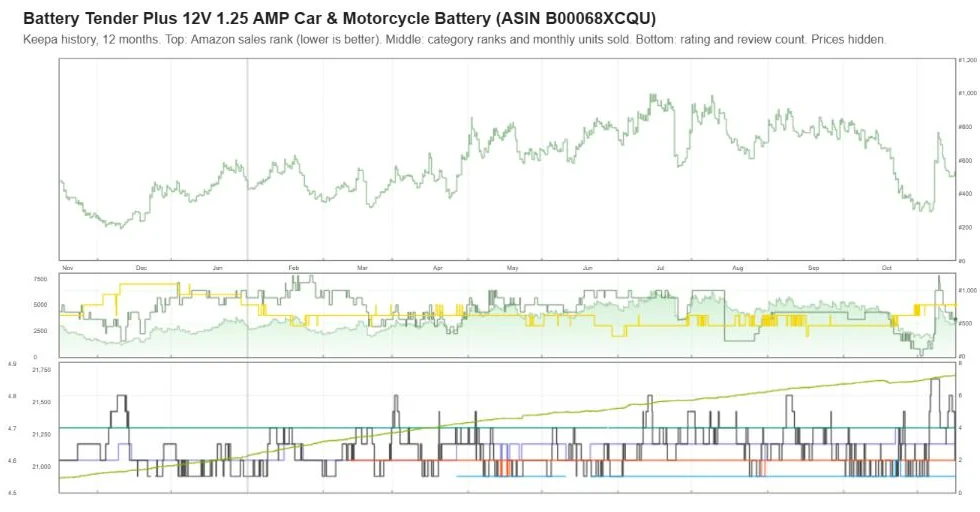
Battery Tender rates it for 12V batteries from 14 to 80Ah, which covers most cars, SUVs and light trucks. It works with flooded, AGM, gel and sealed maintenance-free batteries, and comes with both alligator clips and a ring-terminal cable, so you can bolt the ring terminals to the battery once and simply plug in each autumn. On Amazon it is one of the most-reviewed maintainers in its category, its sales rank has been steady, and its price has stayed stable. The ten-year warranty is the longest of any maintainer we checked, and Battery Tender’s product page lists ETL and cETL safety certification.
What we like
- Gentle 1.25 amp output that is made to stay connected
- Temperature compensation for cold garages
- Ring-terminal lead for quick seasonal connection
- Ten-year warranty
Watch out for
- No lithium mode
- Slow if the battery is already flat — charge it fully first
- Not rated for batteries over 80Ah
2. Battery Tender 4 Amp — best for bigger batteries, cold garages and lithium
Battery Tender 4 Amp Charger and Maintainer
Best for: trucks, SUVs, larger batteries, unheated garages and LiFePO4 lithium batteries
If your battery is bigger than the Plus is rated for, or it is a lithium battery, the 4 Amp is the step up. Battery Tender’s product page rates it for 6V and 12V batteries from 14 to 100Ah, with settings for standard lead-acid, AGM, gel and LiFePO4 lithium. It adjusts its charging voltage to the surrounding temperature on both voltage settings, its housing is rated IP65, and the same page lists ETL and cETL safety certification.
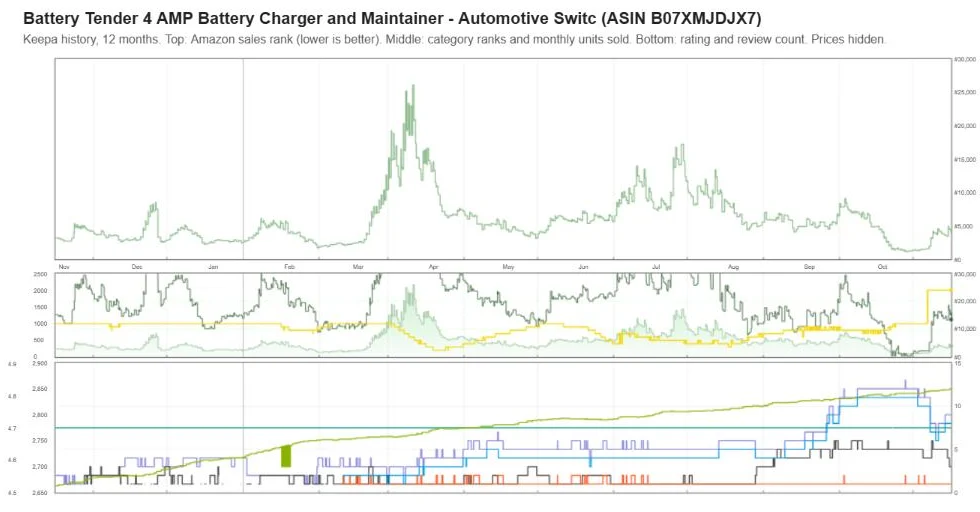
Like the Plus, it comes with both alligator clips and a ring-terminal lead, so it suits the same connect-once routine for the winter. On Keepa it has years of tracked history, a 4.7-star rating across thousands of reviews and a price that stays in a narrow band, and Amazon itself was selling it when we checked.
One piece of fine print: Battery Tender’s page lists a 3-year warranty in the description and 5 years in the spec table. We could not tell which is current, so plan on 3.
What we like
- Rated for batteries up to 100Ah
- Lithium (LiFePO4) setting as well as AGM and gel
- Temperature compensation and an IP65 housing for cold, damp garages
- ETL and cETL safety certification
Watch out for
- Not rated for batteries over 100Ah
- The 6V/12V switch must be set before you connect
- Warranty length is listed two ways on the maker’s page
3. ProMariner ProSportHD 6 — best mounted maintainer for boats and RVs
ProMariner ProSportHD 6 (44006)
Best for: boats, RVs and campers that sit on shore power in the same spot every winter
If the battery lives in a boat or RV that sits on shore power all winter, a charger bolted in place beats clips you have to reconnect each season. The ProSportHD 6 is a single-bank onboard charger from ProMariner, part of Navico Group. ProMariner’s catalog lists it as UL Marine 1236 and CSA certified and designed to ABYC A-31, and gives separate charge profiles for flooded (14.6V), AGM (14.7V), gel (14.1V) and ProMariner-approved LiFePO4 batteries.
For storage, its last two stages are what matter. Auto-Maintain tops the battery up as needed to hold a full charge, and a once-a-month Storage Recondition mode runs for up to three hours. ProMariner describes the charger as safe for short- and long-term storage. Retailer specs list an IP67 rating, 6-foot DC leads and battery sizes from Group 24 to 31.
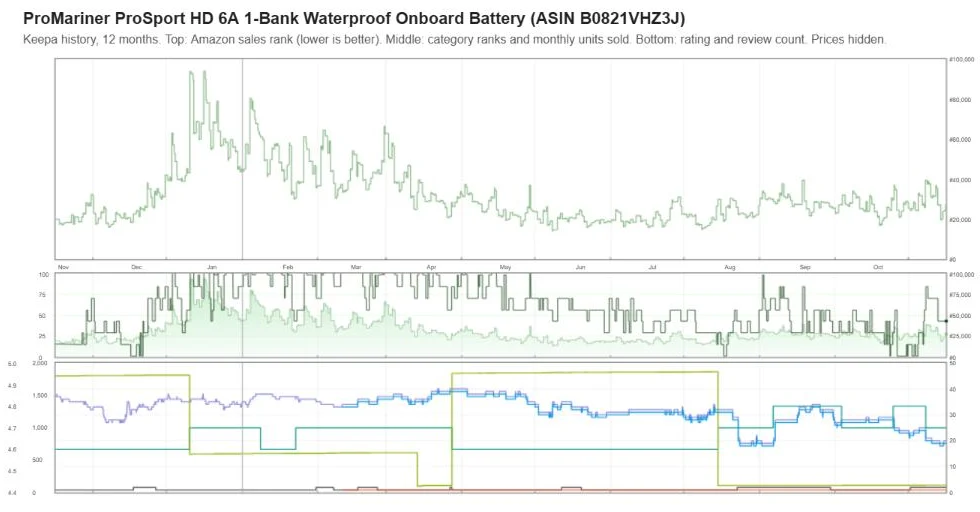
On Keepa it has close to seven years of tracked history and a 4.7-star rating, and over the past year it averaged around the top 10 in its battery charger category. Its price held a steady band apart from a holiday-season dip. Amazon was selling it when we checked, though a third-party seller sometimes held the Buy Box at a slightly lower price.
What we like
- Bolts in place, so there is nothing to reconnect each season
- UL Marine 1236 and CSA certified, designed to ABYC A-31
- Separate flooded, AGM, gel and approved-lithium profiles
- Monthly storage recondition mode for long lay-ups
Watch out for
- Costs more than a plug-in maintainer
- Sized for Group 24 to 31 batteries, not 4D or 8D
- Needs a permanent install and an AC outlet nearby
- Lithium only with ProMariner-approved batteries
Which winter battery maintainer fits you?
| If you… | Choose |
|---|---|
| Store a car, SUV or light truck for the winter | Battery Tender Plus |
| Have a large truck or diesel battery, an unheated garage or a lithium battery | Battery Tender 4 Amp |
| Store a boat, RV or camper on shore power in the same spot each year | ProMariner ProSportHD 6 |
| Store a motorcycle, ATV or anything with a lithium battery | A small powersports tender with a lithium mode — see our best motorcycle battery tender picks |
How to store a battery for winter with a maintainer
- Start with a full battery. A maintainer keeps a battery full, but it is slow at refilling a flat one. If the battery is low, charge it first with a proper charger.
- Clean the terminals. Remove corrosion so the maintainer reads the battery voltage accurately.
- Check flooded batteries. If the battery has removable caps, check the electrolyte level and top up with distilled water if needed.
- Connect the battery side first. Attach the clips or ring terminals to the battery, then plug the maintainer into the wall outlet.
- Ventilate and protect the charger. Keep the maintainer off the floor, away from fuel and puddles, in a spot with some airflow.
- Check it now and then. Glance at the status light every few weeks, especially after a power cut.
Should you remove the battery or leave it in the vehicle? Either works with a maintainer. Leaving it in place is easier and keeps the car’s settings intact. Removing it and storing it on a maintainer indoors keeps it warmer, which helps in very cold climates. If you remove it, follow the vehicle manual’s steps for disconnecting the battery.
If you also want to understand charger sizing for when the battery does run flat, our guide on what size battery charger you need walks through the amp math.
What we left out, and why
- CTEK MXS 5.0 and NOCO GENIUS2D. Both are well-known maintainers with steady demand on Amazon, but we could not confirm a UL or ETL safety listing for either in the makers’ published specs, and the GENIUS2D user guide lists FCC compliance only. We do not recommend on assumptions; if either maker publishes a listing, we will revisit.
- NOCO GENIUS1, GENIUS2 and GENIUS5. Good smart chargers with lithium modes, but they had no new offers available on Amazon when we checked, so we could not recommend buying them there.
- Old-style trickle chargers. Without a regulated float stage, they can overcharge a battery over a long winter.
- Small solar trickle panels. Short winter days and snow cover limit their output, so they are not a reliable replacement for a plug-in maintainer. If there is no outlet, size up: our solar car battery charger guide shows which panel sizes keep up.
A maintainer cannot save a battery that is already worn out. If a battery will not hold its charge after a full charging cycle, have it load-tested before winter rather than discovering the problem in spring. If you want to check it yourself, our guide to the best car battery tester compares home testers, including a handheld load tester.
Storing a boat for the winter? Our best marine battery charger guide covers onboard chargers that can stay installed in the hull.
Storing a riding mower over the off-season? See our picks for the best battery charger for lawn mowers. If an RV or camper sits all winter, compare the best battery maintainer for RVs.
Frequently asked questions
What is the best battery maintainer for winter storage?
Can you leave a Battery Tender on all winter?
Is it okay to leave a battery maintainer on all the time?
What is the best way to store a car battery during winter?
What is the best battery maintainer for cold weather?
What size battery maintainer do I need for winter storage?
How we researched this guide
We shortlisted the best-selling battery maintainers on Amazon, then checked each one’s price history, sales history, review volume and availability in new condition. Specifications and warranty terms come from manufacturer pages, self-discharge figures from Battery University, and freezing temperatures from Interstate Batteries. We did not accept free products or payment from any brand.
Sources: Battery Tender Plus · Battery Tender 4 Amp · ProMariner catalog (ProSportHD 6) · Battery University on self-discharge · Interstate Batteries on freezing (via Cars.com)

Researched by Shahzad
Amazon seller who researches products using sales-rank history, price tracking and owner reviews before recommending anything. Read our disclosure.