
We may earn a commission when you buy through links on this page, at no extra cost to you. It never decides what we recommend. How we make money
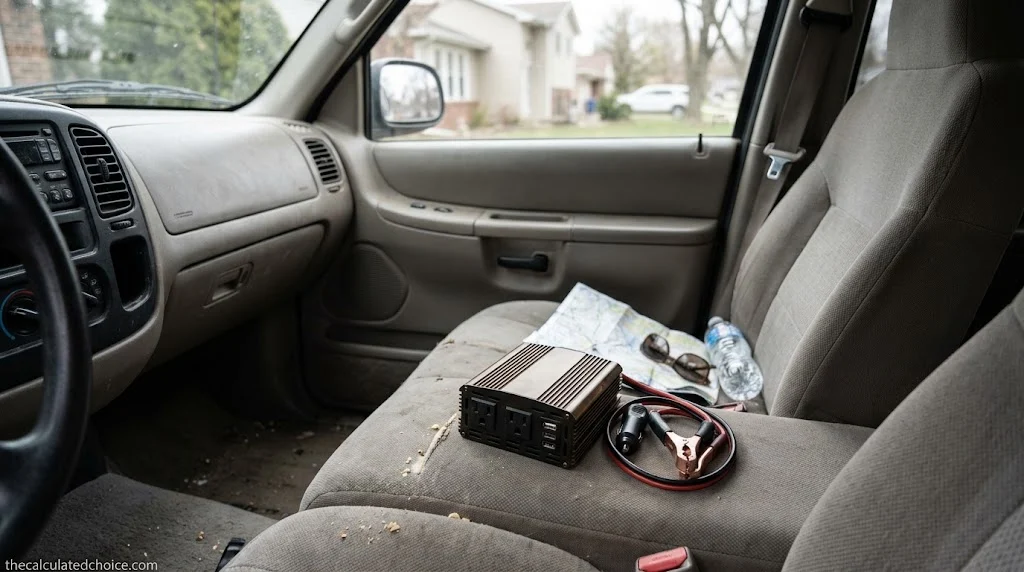
When drivers ask what size power inverter do I need, most only add up the running watts printed on their laptop brick, coffee maker, or power tool. In a 12V vehicle electrical system, that single number is only one-third of the equation—and ignoring the other two-thirds is the main reason car inverters pop dashboard fuses, scream a continuous low-voltage alarm, or shut down the instant a compressor kicks on.
Buy an undersized inverter—or plug a 300W inverter into a 15A dashboard socket and pull full load—and you risk blowing the vehicle’s accessory fuse, overheatingundersized DC cables, or deep-cycling your starter battery past its 30% discharge limit (DEWALT manual; ResMed Battery Guide). Buy an oversized 2000W or 3000W unit for small electronics, and its idle current draw (up to 0.8A to 2A with no load plugged in) will quietly drain your battery between drives (Renogy 2000W spec).
We pulled the exact sizing formulas, startup surge multipliers, fuse ratings, and copper wire-gauge tables from AIMS Power, Xantrex, Kriëger, Renogy, and DEWALT manuals so you can calculate the right inverter size on the first try.
Table of Contents
Quick answer
- 12V cigarette socket limit (120W–150W)Standard 12V vehicle accessory sockets are fused at 15A to 20A. Even if you buy a 300W plug-in inverter, your continuous AC load through the dashboard socket must stay under 120W to 150W (DEWALT manual).
- Continuous vs surge sizingAdd the running watts of all devices operating at the same time, ensure the inverter’s surge rating covers the highest motor startup spike (2x to 8x running watts), and add a 20% continuous headroom buffer.
- 12V battery amp mathDivide AC watts by 10 (or divide by 12V and multiply by 1.10 for a 90% efficient inverter) to find DC amps: a 1000W AC load pulls 91.6A to 100A DC from a 12V battery (AIMS manual).
- Quick tier match140W–300W for laptops, phones, and CPAPs; 500W–700W for TVs, fans, and small drills wired to the battery; 1000W–2000W+ for microwaves, coffee makers, and compressor fridges using 4 AWG to 1/0 AWG cables.
Inverter size tiers by vehicle setup
Use this decision table to match your target appliances to the required continuous wattage, connection method, and 12V DC current draw before diving into the step-by-step math.
| Inverter Size Tier | Connection Method | Approx. 12V DC Draw at Full Load | What It Safely Runs | What Will Trip It |
|---|---|---|---|---|
| 140W to 300W ($ to $$) | 12V accessory socket (capped at ~120W–150W by car fuse) | 12A to 30A DC | Laptops, tablets, camera chargers, string lights, CPAP without heated humidifier (150W MSW) or with humidifier (300W PSW on 20A+ circuit, per ResMed guide) | Coffee makers, space heaters, hair dryers, toaster ovens, or drawing >150W from a 15A car socket (BESTEK) |
| 400W to 600W ($$) | Direct-to-battery clamps or hardwire (12 AWG to 4 AWG) | 40A to 60A DC | Desktop monitors, gaming consoles, CPAP with heated humidifier, small fans, corded drills, portable coolers | Microwaves, full-size refrigerators, high-draw kitchen blenders, circular saws |
| 1000W to 1100W ($$ to $$$) | Hardwire to 12V deep-cycle battery (4 AWG cables + 110A–250A fuse) | 92A to 118A DC (AIMS / Kriëger) | Single-serve coffee makers (up to 900W), compact 600W–700W cooking-power microwaves (check rear input label), shop vacuums, sump pumps | 1500W space heaters, full-size hair dryers, running a microwave and coffee maker simultaneously |
| 1500W to 2000W ($$$) | Hardwire to multi-battery bank (2 AWG to 1/0 AWG + 150A–250A fuse) | 150A to 215A DC (Kriëger / Xantrex) | Standard household microwaves, 1500W heat guns, circular saws, refrigerator + laptop + lighting combined | Single 12V starter battery (voltage sags below 10.5V under 150A+ load, triggering immediate shutdown) |
The 4-step power inverter sizing formula
Every power inverter carries two ratings: continuous watts (what it can supply non-stop for hours) and surge or peak watts (what it can supply briefly to start a motor). Follow these four steps from the AIMS Power and Kriëger manuals to calculate both numbers.
Step 1: Convert appliance AC amps into running watts
Check the data plate stamped on the back or bottom of every device you plan to run at the same time. If the label lists power consumption in amps (A) instead of watts (W), multiply AC amps by 120V AC (DEWALT and AIMS manuals):
- Formula: Running Watts = AC Amps × 120V
- Example: A portable compressor fridge rated at 1.5A AC draws 1.5A × 120V = 180W running, while a full-size 8A refrigerator draws 8A × 120V = 960W (AIMS manual).
Step 2: Calculate startup surge watts (2x to 8x multiplier)
Resistive loads (lights, heating elements) and modern USB-C power bricks have virtually no startup surge. Inductive loads with electric motors or compressors draw a heavy inrush current the instant they spin up:
- Standard motorized tools and appliances (2x multiplier): The Kriëger manual uses Running Watts × 2 as a baseline starting load for most appliances.
- Refrigerators, pumps, and air conditioners (3x to 8x multiplier): AIMS Power notes that equipment startup requirements typically run 3 to 5 times running wattage, while Kriëger warns that pumps, freezers, and air conditioners can spike up to 8 times their rated running watts.
- Check surge duration in the fine print: Many compact inverters sustain their peak surge rating for only a fraction of a second—for example, the AIMS PWRI60012120S rates its 1200W surge capacity for 40 milliseconds. If a compressor takes half a second to start, an inverter with a 40 ms surge window will trip on overload unless its continuous rating is higher. Turn on your highest-surge appliance first before switching on smaller loads (Kriëger manual).
Step 3: Avoid the microwave “cooking watts” trap
According to page 12 of the Kriëger KR1100 instruction manual, the wattage printed on the front door of a microwave oven (such as “700W”) is cooking power—the RF energy delivered to the food—not the electrical power drawn from the inverter. A “700W” microwave typically lists 1,050W to 1,150W of actual AC input power on its rear sticker, requiring at least a 1000W to 1500W inverter.
Step 4: Add a 20% continuous buffer and pick the right waveform
Running an inverter at 100% of its continuous rating generates maximum internal heat and pushes the cooling fan to full speed (for example, the AIMS manual triggers thermal shutdown at 149°F ± 8°F). Multiply your total simultaneous running watts by 1.20 (a 20% safety margin) so the inverter operates in its cool, high-efficiency sweet spot. Also verify whether your appliances require pure sine wave vs modified sine wave in our guide to pure sine vs modified sine wave inverter.
Worked example: sizing an overland truck & campsite inverter
Simultaneous loads: 65W laptop charger + 15W LED camp lights + 180W compressor cooler = 260W continuousStep 1 (20% continuous buffer): 260W × 1.20 = 312W minimum continuous ratingStep 2 (Compressor startup surge at 4x): 180W × 4 = 720W surge + 80W (laptop + lights) = 800W peak surgeStep 3 (12V DC battery draw at 260W, 90% efficiency): 260W ÷ 12V × 1.10 = 23.8A DC continuous (approx. 66.7A DC during the 800W surge)Because 23.8A DC exceeds a standard 15A–20A dashboard cigarette lighter fuse, this setup requires at least a 400W to 600W pure sine wave inverter wired directly to the 12V battery. Sources: AIMS PWRI60012120S Manual, Kriëger KR1100 Manual
The 12V cigarette lighter trap (why 300W plugs blow fuses)
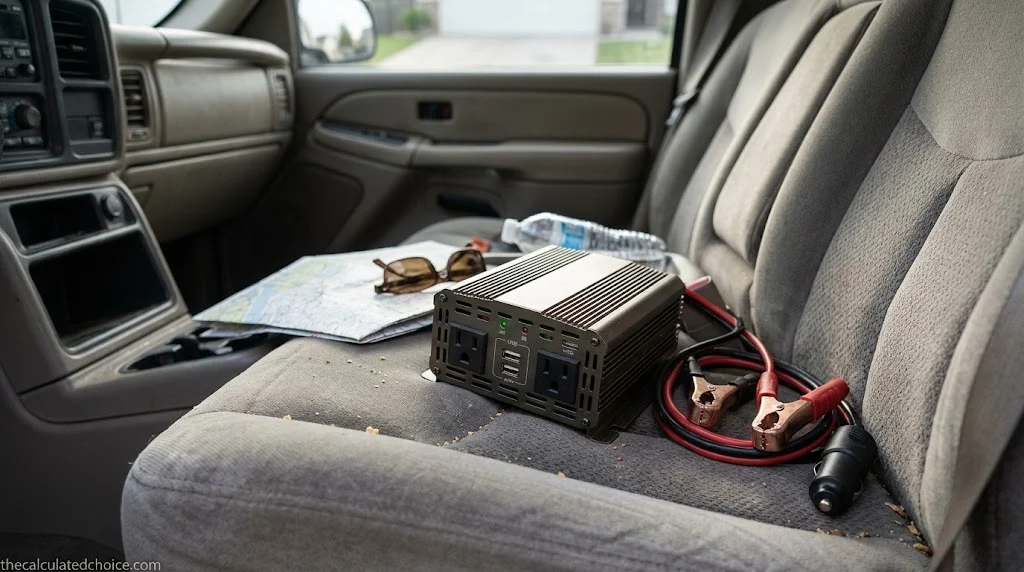
Walk down any auto parts aisle and you will see 300W and 400W power inverters with a 12V cigarette lighter plug attached. What many product titles leave out—and what BESTEK’s official product FAQ explicitly warns—is that a 300W inverter rating does not mean your car’s 12V accessory socket can supply 300W.
Look at the numbers in the DEWALT DXAEPI140 instruction manual:
- 12A DC draw for 120W–140W AC: DEWALT rates the DXAEPI140 to draw 12 amps at 13.8V DC (13.8V × 12A = 165.6W DC input) to deliver 120W continuous AC power (and 140W for up to 60 minutes).
- 15A plug and vehicle fuse ceiling: Most passenger cars protect the 12V dashboard socket with a 15A or 20A fuse. If you plug a 250W appliance into a 300W plug-in inverter, the inverter tries to pull roughly 25A DC (250W ÷ 12V ÷ 0.83 = 25.1A) through that socket—instantly blowing the car’s 15A or 20A fuse.
Sizing your 12V battery bank and runtime
Even a properly sized inverter will shut down with a low-voltage alarm if your 12V battery cannot sustain the DC amp draw. Both the Xantrex PROwatt SW and DEWALT DXAEPI140 manuals state that their inverters automatically cut off when DC input voltage drops to 10.5V DC (and 10.0V ± 0.5V DC on the Renogy 1000W).
Starter batteries vs deep-cycle batteries (30% vs 50%–80% limit)
As explained in ResMed’s Technical Services Battery Guide and the Kriëger manual, standard automotive starting batteries are built with thin “lead sponge” plates to deliver brief Cold Cranking Amps (CCA), not sustained inverter loads:
- Automotive starting batteries (30% max discharge): Discharging a car starter battery by more than 30% causes the lead sponge plates to shed and fall to the bottom of the cells. A starter battery survives only about 30 deep cycles (ResMed guide).
- Marine hybrid batteries (60% max discharge): Thicker plates allow discharges up to 60% before recharging (ResMed guide).
- True deep-cycle lead-acid / AGM & LiFePO4 batteries (50% to 80% discharge): AIMS Power recommends keeping lead-acid deep-cycle batteries above 50% depth of discharge for maximum cycle life, while Renogy and ResMed note deep-cycle/lithium batteries can discharge to 80%.
Battery runtime formula (AIMS Power method)
Step 1 (DC Amps with 10% inverter loss): DC Amps = (AC Load Watts ÷ 12V) × 1.10Step 2 (Full-depletion hours): Total Hours = Battery Capacity (Ah) ÷ DC AmpsStep 3 (Safe 50% deep-cycle runtime): Usable Hours = Total Hours × 0.50Example (1000W load on a 12V 200Ah deep-cycle bank): (1000W ÷ 12V) × 1.10 = 91.6A DC. 200Ah ÷ 91.6A = 2.18 hours to 0%, or 1.09 hours (65 minutes) at a safe 50% discharge.To run a 1000W load for 1 hour without dropping below 50% charge, you need a 200Ah 12V deep-cycle battery bank. Source: AIMS Power PWRI60012120S Manual (Page 4)
DC cable gauge, voltage drop, and inline fuse chart
When an inverter pulls 60A to 200A at 12V DC, thin or overly long battery cables act like resistors. As shown in Table 1 of the Xantrex PROwatt SW Owner’s Guide, voltage drop across DC cables is calculated over the round-trip length (positive cable length + negative cable length, or One-Way Length × 2). If undersized cables drop 1.5V to 2V under load, a healthy 12.2V battery reads 10.2V at the inverter’s rear terminals—causing the inverter to shut down even though the battery is full.
Xantrex recommends a size 0 copper cable for these inverters (its voltage-drop table runs from 0.000253 ohms per foot for 4 AWG down to 0.000100 ohms per foot for 0 AWG), limits each cable to a maximum of 6 feet (1.8 m), and warns never to use aluminum wire, which has roughly one-third higher resistance than copper (Xantrex manual, page 10).
| Inverter Continuous Rating | Approx. 12V DC Draw | Recommended Copper Cable (3 ft to 6 ft max) | Inline Battery Fuse (ANL or Class T) | Published Manual Source |
|---|---|---|---|---|
| 400W to 500W | 40A to 50A DC | 12 AWG to 10 AWG (16-in direct-to-battery cables included) | Internal / inline per kit | Cobra CPI400PSW / CPI500W |
| 600W (540W–600W) | 60A DC | 10 AWG min (AIMS) / size 0 recommended, 6 ft max (Xantrex) | 80A ANL or Class T (Xantrex manual) | Xantrex PROwatt SW 600 |
| 1000W to 1100W | 100A to 118A DC | 4 AWG (3-ft pair included with Renogy & Kriëger) | 110A ANL (Kriëger) / 150A (Xantrex) | Kriëger KR1100 / Renogy 1000W |
| 1500W | 150A to 161A DC | 2 AWG (3-ft pair) | 150A inline ANL fuse | Kriëger KR1500 manual |
| 2000W | 200A to 215A DC | 2 AWG (Kriëger) to 1/0 AWG (Renogy 2000W / Xantrex) | 200A ANL (Kriëger) / 250A ANL or Class T (Xantrex) | Kriëger KR2000 / Renogy 2000W |
| 3000W | 300A DC | 1/0 AWG (0 AWG, 3-ft pair) | 300A inline ANL fuse | Kriëger KR3000 manual |
What to buy for your wattage tier
Once you have calculated your continuous watts, surge watts, and 12V connection limit, narrow your shortlist to two proven categories:
- Under 150W continuous (12V accessory socket): Pick a 300W plug-in inverter—either a pure sine wave model ($$) for laptops, CPAPs, and sensitive chargers, or a budget modified sine wave unit ($) for simple low-voltage power bricks—and keep your actual plug load within your vehicle’s 15A–20A fuse limit.
- 500W to 1000W continuous (direct battery hardwire): Choose a UL 458 certified 1000W 12V pure sine wave inverter ($$$) that includes 3-foot 4 AWG copper battery cables, GFCI outlets, and a wired remote switch.
Compare the exact models that passed our Keepa sales-history and manual checks in our best car power inverter guide, and check pure sine vs modified sine wave inverter if you are unsure whether your appliances require pure sine wave output.
Wondering what a small plug-in unit can actually run once you know your wattage? See what a 300W power inverter can run.
How we researched this guide
We did not lab-test these inverters; instead, we compiled the load formulas, startup surge multipliers, fuse tables, and copper cable resistance specs directly from manufacturer installation manuals and electrical standards.
Sources: Xantrex PROwatt SW Manual, AIMS PWRI60012120S Manual, Kriëger KR1100–2000 Manual, DEWALT DXAEPI140 Manual, ResMed Battery Guide
Frequently asked questions
How many watts can I plug into a car cigarette lighter socket?
What size inverter do I need to run a 700W microwave?
What size inverter do I need for a refrigerator or mini fridge?
How many amps does a 1000W inverter draw from a 12V battery?
Will a power inverter drain my car battery when nothing is plugged in?
What size wire and fuse do I need for a 1000W 12V inverter?

Researched by Shahzad
Amazon seller who researches products using sales-rank history, price tracking and owner reviews before recommending anything. Read our disclosure.