
We may earn a commission when you buy through links on this page, at no extra cost to you. It never decides what we recommend. How we make money
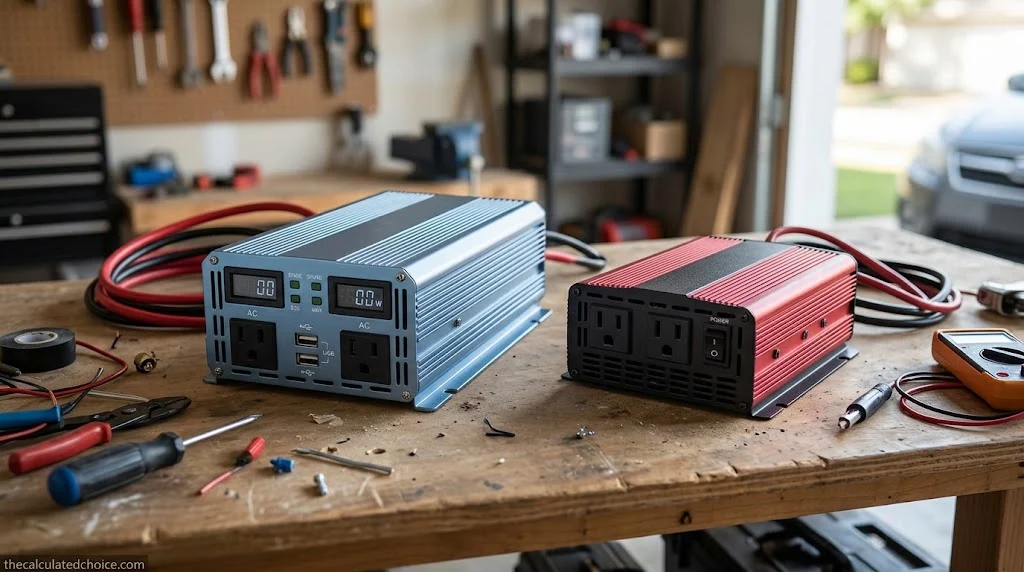
Choosing between a pure sine vs modified sine wave inverter is not just about budget—it determines whether the 120V AC outlets in your car, truck, or camper will safely run your gear or quietly overheat it. Both inverter types take 12V DC power from your vehicle battery and step it up to household-style alternating current, but they shape that electrical wave in two completely different ways.
Pick the wrong waveform and the consequences show up fast. According to owner manuals from DEWALT and Kriëger, plugging transformerless cordless tool battery chargers, medical CPAP humidifiers, or capacitive-coupled electronics into a modified sine wave inverter can blow internal appliance fuses, trigger GFCI nuisance tripping, or burn out charging circuits.
We analyzed manufacturer engineering manuals, UL 458 vehicle inverter standards, and medical battery guides to show you the exact electrical differences, which appliances require pure sine wave power, and when a lower-cost modified sine wave unit is still enough.
Table of Contents
Quick answer
- Waveform & THDPure sine wave inverters produce a smooth 60 Hz wave with under 3% to 5% Total Harmonic Distortion (THD), matching household grid power, while modified sine wave inverters output a stepped square wave with 10% to 45% THD.
- When pure sine is mandatoryBuy a pure sine wave inverter for CPAP machines with heated humidifiers, cordless power tool chargers, variable-speed motors, compressor fridges, microwaves, audio gear, and newer laptop bricks.
- When modified sine worksA modified sine wave inverter ($ to $$) safely powers simple resistive loads (incandescent work lights, basic heating elements) and universal switching adapters rated for 100–240V that do not carry transformerless charger warnings.
- Efficiency & battery drawPure sine wave models typically reach over 90% peak conversion efficiency and keep AC motors running cooler, whereas modified sine models range from 83% to 90% efficiency and waste extra battery energy as harmonic heat in inductive loads.
Pure sine vs modified sine wave at a glance
Before checking individual appliances, compare the core electrical specifications published in manufacturer manuals from Renogy, Xantrex, BESTEK, and Kriëger.
| Specification | Pure Sine Wave Inverter | Modified Sine Wave Inverter |
|---|---|---|
| Output waveform shape | Smooth, continuous sinusoid matching utility grid AC | Stepped square wave with abrupt voltage transitions |
| Total Harmonic Distortion (THD) | < 3% linear load / < 5% non-linear load (Renogy P2 spec) | 10% to 45% (Kriëger KR1100 manual) |
| Peak conversion efficiency | > 90% (AIMS / Xantrex) | > 83% (BESTEK 300W) to 90% (Cobra 500W) |
| AC motor & compressor behavior | Runs at normal speed, torque, and temperature | Runs hotter due to eddy current and core losses; audible hum |
| Cordless tool battery chargers | Compatible with all 120V AC tool chargers | Risk of charger damage on transformerless designs (Kriëger manual) |
| Medical CPAP with heated humidifier | Approved when sized to 300W continuous / 500W peak (ResMed guide) | Not recommended; can damage heated humidifiers or void warranty |
| Audio, radio & video gear | Silent operation without harmonic buzz | Audible 60 Hz / harmonic buzz in speakers and snow lines on weak TV signals |
| Typical price band | $$ to $$$ | $ to $$ |
How the two inverter waveforms work inside
A 12V vehicle battery supplies direct current (DC), where electrons flow in one steady direction at roughly 12.6V (engine off) to 14.4V (alternator charging). Household 120V AC outlets reverse polarity 60 times per second (60 Hz), rising smoothly from 0V to a positive peak of about 170V, dropping back through 0V to -170V, and returning to 0V—yielding a Root Mean Square (RMS) effective voltage of 120V (EDECOA Inverter Fundamentals).
How a modified sine wave inverter builds stepped AC
As documented in the DEWALT DXAEPI140 instruction manual and the Kriëger KR1100 manual, a modified sine wave inverter converts 12V DC in two basic stages. First, a DC-to-DC converter steps the 12V battery input up to a high-voltage DC bus of 145V DC. Second, a full-bridge MOSFET transistor stage switches that 145V DC on, pauses at 0V, and switches to negative 145V DC at 60 Hz.
Instead of a smooth curve, the voltage jumps vertically in staircase steps: 0V to +145V, back to 0V, down to -145V, and back to 0V. Those vertical voltage cliffs contain sharp high-frequency energy spikes known as odd harmonics.
How a pure sine wave inverter synthesizes utility-grade AC
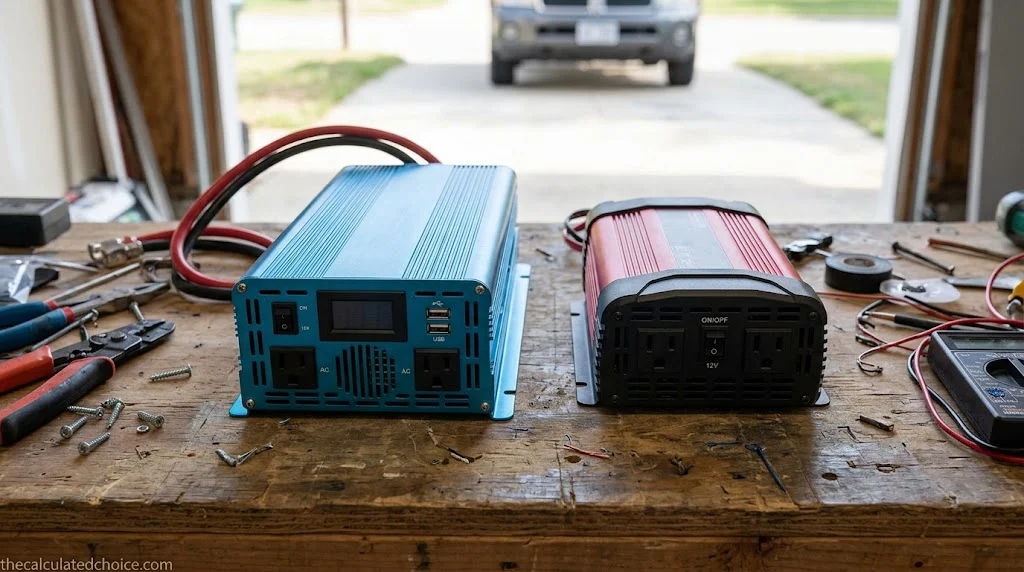
A pure sine wave inverter adds high-speed Pulse-Width Modulation (PWM)—often switching at frequencies above 20 kHz—followed by a heavy inductor-capacitor (LC) low-pass filter (EDECOA technical guide). By varying the width of thousands of micro-pulses per second and smoothing them through the LC filter, the output traces the exact mathematical sine curve of utility power. That extra filtering hardware is why a pure sine wave inverter weighs slightly more and sits in a higher price band ($$ to $$$) than a modified sine wave unit of the same wattage.
Total harmonic distortion (THD) and 12V battery draw
Engineers measure AC waveform cleanliness using Total Harmonic Distortion (THD)—the ratio of harmonic voltages (multiples of 60 Hz, such as 180 Hz, 300 Hz, and 420 Hz) to the fundamental 60 Hz frequency. Standard utility grid power stays under 3% THD, and quality pure sine wave inverters match that benchmark: both the Renogy 1000W 12V Pure Sine Wave Inverter and the AIMS 600W Pure Sine Inverter specify < 3% THD under linear loads (and < 5% under non-linear loads).
By contrast, the Kriëger KR1100 modified sine wave manual publishes a THD rating of 10% to 45% depending on the load. Those extra harmonic frequencies do not perform useful work inside an AC induction motor or transformer; instead, they create core eddy currents and copper losses (I²R) that turn directly into waste heat (EDECOA).
12V DC battery current draw: pure sine vs modified sine efficiency
Formula: DC Amps = AC Load Watts ÷ (12V DC × Inverter Efficiency)Pure Sine at 90% efficiency (Renogy / Xantrex): 300W ÷ (12V × 0.90) = 27.78A DCModified Sine at 83% efficiency (BESTEK MRI3011BU manual): 300W ÷ (12V × 0.83) = 30.12A DCExample over 4 hours: 27.78A × 4 hr = 111.1 Ah (pure sine) vs 30.12A × 4 hr = 120.5 Ah (modified sine)A lower-efficiency inverter pulls 2.34 more amps from a 12V system at a 300W load—even before counting the extra harmonic current drawn by motors or transformers on a stepped wave. Sources: AIMS PWRI60012120S Manual, BESTEK MRI3011BU Manual
If you need to calculate exact cable gauges, fuse sizes, and battery amp-hours for your specific load, see our companion guide on what size power inverter you need.
Device compatibility: what fails on modified sine wave
A common myth is that if an appliance turns on when plugged into a modified sine wave inverter, it is completely safe. As EDECOA’s engineering documentation notes, harmonic distortion rarely causes an immediate explosion on motor and transformer loads—instead, it causes silent internal heating and accelerated insulation breakdown. However, on several specific circuits, manufacturer manuals warn that modified sine wave power causes rapid failure.
| Device or Load Category | Required Waveform | What Happens on Modified Sine Wave (Manual & Technical Evidence) |
|---|---|---|
| Cordless power tool battery chargers | Pure Sine Wave | Chargers with “dangerous voltages at battery terminals” labels can overheat or burn out internal circuitry (Kriëger manual; Inverter.com). |
| Direct plug-in NiCd/NiMH rechargeable flashlights, razors & toothbrushes | Pure Sine Wave | Transformerless capacitive charging circuits draw excessive peak current on vertical voltage steps and burn out (DEWALT manual). |
| CPAP machines with heated humidifiers | Pure Sine Wave | Heated humidifiers malfunction or overheat on stepped waveforms; ResMed’s Battery Guide lists a 300W continuous / 500W peak pure sine wave inverter as the minimum when using heated humidifiers. |
| Microwave ovens | Pure Sine Wave | DEWALT’s manual lists microwave ovens under products that can be damaged by modified sine wave; Renogy notes microwaves run slower, hotter, and louder on MSW. |
| AC induction motors, pumps & compressor mini-fridges | Pure Sine Wave | High THD (10%–45%) induces torque ripple and core heating; synchronous fan motors can also change RPM (Kriëger manual). |
| Laptops, monitors & switching power bricks | Pure Sine Recommended | Many external bricks (outputting ≤30V DC) tolerate MSW, but DEWALT and Renogy warn some laptops fail to operate, buzz, or crash. |
| Audio amplifiers, stereos & TVs | Pure Sine Wave | Power supplies cannot filter out steep harmonic edges, producing a constant audible buzz in speakers and interference lines on weak TV signals (DEWALT manual). |
| Simple resistive loads (incandescent work lights, basic non-digital heaters) | Either Waveform | Purely resistive elements respond to RMS voltage and are insensitive to harmonic distortion (EDECOA), provided wattage stays within the inverter and socket limit. |
What inverter manuals bury in the fine print
When we checked the safety pages of major modified sine wave manuals, three identical engineering warnings stood out:
- Transformerless and capacitive-coupled chargers: Small rechargeable devices that plug straight into an AC wall outlet without a separate low-voltage transformer brick use a capacitor to limit current. Because a capacitor’s impedance drops as frequency rises, the high-frequency edges of a modified sine wave let a massive current spike pass through, destroying the circuit (DEWALT DXAEPI140 manual).
- The 10-minute temperature check for battery chargers: Both DEWALT and Kriëger instruct owners who plug a battery charger into a modified sine wave inverter to monitor the charger’s temperature by hand for the first 10 minutes. If the charger gets abnormally warm, you must unplug it immediately.
- Separate low-voltage adapter bricks (30V or less): According to the Kriëger KR1100 manual, portable electronics that use an external AC adapter brick whose label specifies a low-voltage DC or AC output of 30 volts or less generally operate without damage on modified sine wave—though active power-factor-corrected (PFC) laptop bricks can still buzz or run warm.
Why multimeters read low and outlet testers fail
Two of the most frequent owner complaints on car power inverters have nothing to do with a defective inverter—they come from how test meters and GFCI circuits react to inverter waveforms and floating grounds.
1. Standard multimeters read 90V to 102V on modified sine wave
If you probe a modified sine wave inverter with an inexpensive average-responding digital multimeter, the screen will often read between 90V and 102V AC instead of 115V–120V AC. Both Cobra’s technical FAQ and the Kriëger troubleshooting guide explain why: standard multimeters measure average voltage and multiply by a fixed sine-wave calibration factor. Because a modified sine wave is a stepped square wave, only a meter explicitly labeled True RMS on the front panel (such as a Fluke 177/179, as noted in the AIMS manual) calculates the true heating value of the stepped wave and displays the correct 115V–120V output.
2. Three-prong outlet testers show “open ground” and external GFCIs trip
Plug a three-light household receptacle tester into a portable car inverter and it will typically light up “open ground.” According to Cobra’s inverter documentation, household outlet testers assume your neutral and ground wires are bonded together inside a home breaker panel, whereas a portable car inverter uses an isolated or floating neutral design. Furthermore, the Kriëger manual warns that external GFCI devices plugged into a modified sine wave inverter may fail to reset or trip unexpectedly. If you need ground-fault protection in a vehicle, camper, or work truck, choose an inverter with built-in GFCI receptacles certified to UL 458 (the safety standard for land vehicle and marine power inverters).
What to buy for your vehicle
Once you know which waveform your equipment requires, match the inverter’s wattage and connection style to your vehicle’s electrical limits:
- For laptops, CPAPs, camera batteries, and everyday 12V socket use (under 150W–180W): Choose a compact 300W pure sine wave plug-in inverter, and keep your actual continuous load below your vehicle’s 12V accessory fuse limit (typically 120W to 180W on a 15A or 20A fuse).
- For basic travel chargers on a tight budget ($): A 300W modified sine wave plug-in inverter works fine for low-voltage adapter bricks (≤30V output) and resistive loads, provided you never plug in cordless tool chargers or medical gear.
- For power tools, microwaves, coffee makers, and overland setups (500W to 1000W+): Step up to a battery-wired pure sine wave inverter certified to UL 458 with built-in GFCI outlets and 4 AWG battery cables.
See our full Keepa-verified buying guide to the best car power inverter for the exact models that passed our sales-history and manual checks, and use our inverter sizing guide to calculate your continuous watts, surge watts, and 12V fuse limits before you buy.
Not sure what a small plug-in unit can actually run? See what a 300W power inverter can run.
How we researched this guide
We did not lab-test these inverters on an oscilloscope; instead, we analyzed published manufacturer instruction manuals, medical device battery guides, and electrical safety standards to verify how pure sine and modified sine waveforms behave under load.
Sources: ResMed Battery Guide, DEWALT DXAEPI140 Manual, Kriëger KR1100 Manual, Renogy 1000W Pure Sine Spec, Intertek UL 458 Overview
Frequently asked questions
Can I plug a laptop into a modified sine wave inverter?
Why does my cordless tool battery charger fail on a modified sine wave inverter?
Do I need a pure sine wave inverter for a CPAP machine?
Does a pure sine wave inverter use less battery power than a modified sine wave inverter?
Why does my multimeter only read 95V to 105V on a 120V modified sine wave inverter?
Will a modified sine wave inverter damage a mini fridge or microwave?

Researched by Shahzad
Amazon seller who researches products using sales-rank history, price tracking and owner reviews before recommending anything. Read our disclosure.