
We may earn a commission when you buy through links on this page, at no extra cost to you. It never decides what we recommend. How we make money
Choosing in a front-only vs front-and-rear dash cam comparison comes down to one trade-off: a simpler windshield setup with one power cable and lower power draw, or two-direction video evidence that needs a second cable run to the back glass. Many drivers assume a forward camera is enough. It covers the road ahead, but it records nothing about what happens behind you, such as a driver who hits your bumper and drives away.
According to the National Highway Traffic Safety Administration (NHTSA), rear-end crashes account for more than 29 percent of all crashes. A second camera also changes the hardware: on VIOFO’s own pages, the single-channel A119 Mini 2 lists a DC 5V / 1A input and the two-channel A229 Plus lists DC 5V / 2A, two video streams go to one microSD card, and the rear cable needs a route that stays away from airbag trim. Here is how the specs, parking-mode power figures, storage demands, and wiring rules compare.
Quick answer
- Crash coverageA front-only vs front-and-rear dash cam comparison starts with blind spots: rear-end crashes account for more than 29 percent of all crashes according to NHTSA, and only a rear lens can record a trailing driver who hits you and leaves.
- Power and heatVIOFO’s single-channel A119 Mini 2 lists a DC 5V / 1A input and its two-channel A229 Plus lists DC 5V / 2A. VIOFO’s published parking-mode test (5.99W to 6.68W) was run on a three-channel camera, while its battery-pack runtime rating assumes a single-channel camera averaging 3W.
- Cable routingA front-only camera needs one power cable. A dual-channel kit adds a rear-camera cable that must reach the back glass, and some makers sell longer extensions for trucks and large SUVs (REDTIGER lists a 33FT rear camera extension cable). Keep the wire away from side curtain airbag trim.
- Storage demandsDual-channel recording writes two video streams at once, so a weak card fails sooner. VIOFO’s study of returned cards ties “Memory Card Error” and “Card Slow” messages to cards not built for continuous dash cam recording.
Front-only vs front-and-rear dash cam at a glance
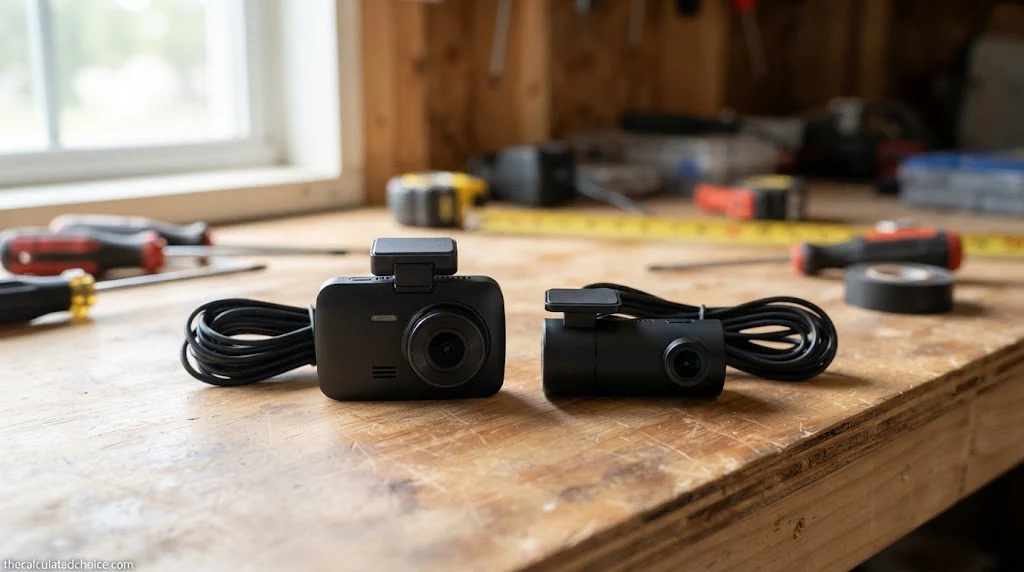
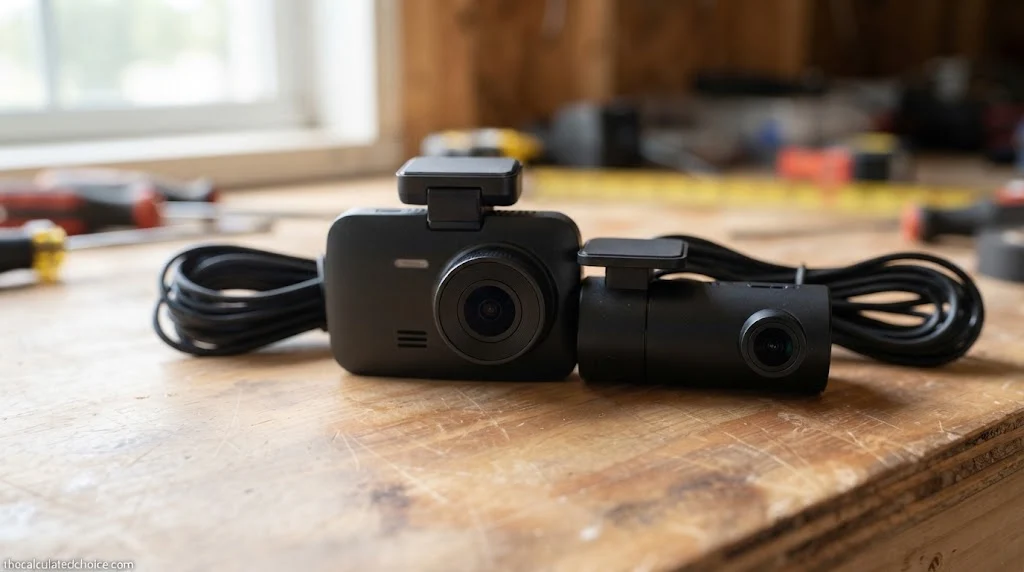
A single-channel (front-only) dash cam mounts to the upper windshield and records the road ahead through one lens. A dual-channel (front-and-rear) system pairs that main windshield unit with a secondary camera mounted on the inside of the rear glass (or an exterior waterproof bracket above the license plate), connected by a data-and-power cable so both views record simultaneously to the same memory card.
To show how specifications change when moving from one channel to two within the same sensor family, we compared published data from VIOFO’s A119 Mini 2 page (1-channel), VIOFO’s A229 Plus 2CH page (2-channel), and REDTIGER’s F7NP specification sheet.
| Specification | Front-Only (1-Channel) | Front-and-Rear (2-Channel) |
|---|---|---|
| Camera modules | 1 forward unit (1.81 x 1.77 x 2.94 inch on VIOFO A119 Mini 2) | Front unit (2.3 x 3.9 x 1.8 inch) + rear unit (2.64 x 1.33 x 1.1 inch) on VIOFO A229 Plus 2CH |
| Sensors & resolution | A119 Mini 2: 2K at up to 60fps, Sony STARVIS 2 sensor | A229 Plus 2CH: 2K front (up to 60fps) + 2K rear (30fps), Sony STARVIS 2 IMX675 5MP on both. A229 Pro 2CH: 4K front (IMX678 8MP) + 2K rear |
| Lens (VIOFO A229) | Forward view only | Front F1.8, 140° FOV; rear F1.9, 160° FOV |
| Rated power input | DC 5V / 1A (VIOFO A119 Mini 2) | DC 5V / 2A (VIOFO A229 Plus 2CH and A229 Pro 2CH) |
| Parking mode power | 3W single-channel average behind VIOFO’s 32-hour BP100 battery-pack rating | Not published for 2 channels. VIOFO’s test on a 3-channel A229 Pro: 5.99W (time-lapse, 10fps) to 6.68W (auto event detection) |
| Cables to route | 1 power cable | 1 power cable + 1 rear-camera cable to the back glass (REDTIGER sells a 33FT extension for long vehicles) |
| Operating temperature | -20°C to 65°C (-4°F to 149°F), supercapacitor (VIOFO A119 Mini 2) | -20°C to 65°C (VIOFO A229) or -20°C to 70°C (REDTIGER F7NP), supercapacitor |
Front-only vs front-and-rear dash cam: what the rear camera captures
In a low-speed rear-end bump where the trailing driver pulls over and exchanges insurance information, a forward dash cam still helps. Its forward video, and its GPS logger if the model has one, can show that your vehicle was stopped at a red light and holding its lane. However, four crash and parking scenarios expose the blind spot of a single-channel camera.
- Hit-and-run after a rear impact: When a car strikes your rear bumper and immediately reverses or turns onto a side street without passing in front of your hood, a forward lens never records the fleeing vehicle or its front license plate.
- Disputed lane-change and merge sideswipes: According to NHTSA’s Analysis of Lane Change Crashes (DOT HS 809 571), the seven most common pre-crash scenarios, which include typical lane changes, merging and drifting, account for about 88% of all two-vehicle lane change crashes. A rear lens (VIOFO lists a 160° FOV for the A229’s rear camera) can show whether a trailing driver moved into your blind spot.
- Multi-car pileups: In a chain collision, the driver behind you may claim you hit the lead car first. Synchronized front and rear timestamps can help show the order of impacts.
- Parking-lot bumps: VIOFO says all channels enter parking mode and save footage simultaneously, so a dual-channel camera watches both ends of the car while you are away.
Front-only vs front-and-rear dash cam power draw and microSD demands
VIOFO’s heat FAQ says higher resolution, higher bitrate and more working channels all raise power consumption, and higher consumption means more heat. In a front-only vs front-and-rear dash cam comparison, that matters most when you park overnight on a battery pack or hardwire kit, and when the cabin gets hot in summer. If you plan to hardwire a camera, it also helps to know your battery’s condition first: see how to test a car battery with a multimeter, or find out why a car battery keeps dying.
VIOFO’s heat FAQ says its supercapacitor cameras can be stored at up to 158°F (70°C) and work at up to 149°F (65°C), and that a camera that overheats stops recording and turns off. VIOFO’s own tip for heat concerns is to choose 2K instead of 4K and a lower bitrate.
Parking-mode runtime on a battery pack: 1 channel vs 3 channels
Step 1: VIOFO lists the BP100 battery pack at 98Wh (12.8V/7650mAh) with a typical runtime of about 32 hours, based on a single-channel dash cam averaging 3W.Step 2: VIOFO’s parking-mode test table (data source: A229 Pro 3CH, a three-channel camera) shows an average of 5.99W in time-lapse at 10fps, 6.49W in low-bitrate recording, and 6.68W in auto event detection.Example: 98Wh / 5.99W = 16.4 hours; 98Wh / 6.68W = 14.7 hours. That is roughly half of the 32-hour single-channel rating.VIOFO does not publish a parking-mode wattage for its two-channel cameras, so treat these figures as a reference point for a camera with more channels, not as a spec for one model. Sources: VIOFO Parking Mode guide and VIOFO BP100 page.
Published parking mode file sizes and power draw
When wired with a 3-wire fuse-box hardwire kit (Red wire to battery, Yellow wire to ACC, Black wire to ground) or an OBD-II constant power cable with ACC detection, all channels enter parking mode simultaneously. Here are the figures from VIOFO’s Parking Mode technical guide, measured on the three-channel A229 Pro 3CH:
| Parking Mode Setting | Audio | File Size (MB) | Avg Watts | How It Works |
|---|---|---|---|---|
| Auto Event Detection with Motion | Yes (✓) | 188 MB | 6.68 W | Buffered standby; saves 15s before and 30s after detected motion |
| Time Lapse Recording at 10fps | No | 152 MB | 5.99 W | Continuous silent video at 1, 2, 3, 5, or 10 fps; lowest power draw |
| Low Bitrate Recording | Yes (✓) | 128 MB | 6.49 W | Continuous recording in reduced file sizes with audio |
MicroSD card failure modes in single vs dual-channel setups
A dual-channel camera writes two video streams at once, so a weak card shows problems sooner. In VIOFO’s study of returned customer microSD cards, cards that were not built for continuous dash cam recording produced six recurring problems:
| Dash Cam Warning | What VIOFO Says It Means |
|---|---|
| Memory Card Error | The camera cannot properly communicate with the card; it is unstable, incompatible, or has worn out its write cycles |
| Card Slow | Write speed cannot keep up with high-bitrate recording (especially 4K), which can mean dropped frames or recording stoppages |
| Memory Card Full (Even After Formatting) | Cheap cards develop file system errors that make the camera think the card is full |
| Slow Startup | A damaged or unstable card can make the boot process take several times longer |
| Frozen Boot Screen | A failing or incompatible card can leave the camera stuck at the VIOFO logo |
| Memory Card Formatting Failed | Low-quality cards often cannot be formatted, which points to a hardware failure inside the card |
VIOFO’s first step for a “Slow Card” warning is a firmware update. It then recommends a high-endurance card, and it lists its own Industrial Grade microSD cards as U3 A2 V30.
Front-only vs front-and-rear dash cam installation and airbag safety
A front-only dash cam needs one power cable from the camera to a 12V socket or a hardwire kit. A front-and-rear system adds a second cable that runs from the rear camera at the back glass to the front unit. VIOFO lists a car charger with an 11.48 ft (3.5M) power cable for the A119 Mini 2 and a RE200 rear camera with a 6M (19.68 ft) Type-C cable, so check the included cable length for the exact model before you buy.
- Long vehicles: On three-row SUVs and crew-cab pickups, a route along the floor sills is longer. REDTIGER sells a 33FT rear camera extension cable and an exterior rear camera.
- Hatchbacks and SUVs: Many liftgates have a rubber wiring boot between the body and the tailgate. Check whether yours does before you route a cable through it, and make sure the wire cannot pinch when the hatch closes.
- Convertibles and sliding rear windows: A folding top has no fixed rear glass to mount on, so a front-only camera is often the practical choice. On a pickup with a sliding rear window, mount on a fixed part of the glass.
How to choose in a front-only vs front-and-rear dash cam comparison
In a front-only vs front-and-rear dash cam choice, a front-only camera and a dual-channel camera bought for the same money split that budget across fewer or more lenses. Compare the sensor and HDR rows on each spec sheet rather than assuming the two layouts match.
| Driver Profile / Vehicle Type | Recommended Setup | Why It Fits Best |
|---|---|---|
| Daily highway commuter or city traffic | Front-and-Rear (2-Channel) | Covers rear-end crashes (more than 29 percent of all crashes per NHTSA) and blind-spot merge disputes |
| Street or public-lot parker | Front-and-Rear (2-Channel) + Hardwire Kit | Monitors both bumpers in buffered Auto Event Detection or 10fps Time Lapse mode |
| Leased car, rental car, or multi-car swapper | Front-Only (1-Channel) | Installs with one power cable and removes without pulling rear trim |
| Convertible or cargo van with solid rear doors | Front-Only (1-Channel) | Standard interior rear cameras cannot see through solid cargo doors or mount to soft tops |
| Single-camera budget prioritizing night plate clarity | Front-Only (1-Channel) with STARVIS 2 + HDR | Puts your full budget into one front sensor; VIOFO’s single-channel A119 Mini 2 lists a DC 5V / 1A input |
What to buy
Whichever side of the front-only vs front-and-rear dash cam choice fits your vehicle, look for three verified specifications on the maker’s sheet: a built-in supercapacitor instead of a lithium battery for cabin heat survival up to 65°C (149°F) or 70°C (158°F), true HDR night processing (ideally paired with a Sony STARVIS 2 IMX675 or IMX678 sensor), and 5GHz or 5.8GHz Wi-Fi so clips transfer quickly to your phone.
If you want full front-and-rear coverage with verified sales rank stability and manufacturer warranty support, our companion guide to the best dash cams for cars compares dual-channel kits including the VIOFO A229 Pro 2CH (4K front + 2K rear), VIOFO A229 Plus 2CH (2K front + 2K rear), ROVE R2-4K Dual, ROVE R2-4K Dual PRO, and REDTIGER F7N Touch. If you want an entry-level single-channel or dual-channel unit, our best dash cam under $100 guide covers the Vantrue E1 Lite, 70mai M310, REDTIGER F9, and 70mai A800S.
How we researched this guide
We did not lab-test dash cams; to evaluate a front-only vs front-and-rear dash cam setup objectively, we compared published electrical, optical, and thermal specifications from manufacturer pages and federal crash reports.
Sources: NHTSA Traffic Safety Facts (DOT HS 811 331), NHTSA Lane Change Crashes (DOT HS 809 571), VIOFO Parking Mode Guide, VIOFO High-Endurance MicroSD Study, REDTIGER Official Specs
Bottom line: In any front-only vs front-and-rear dash cam decision, drivers who commute in heavy traffic or park in public lots gain hit-and-run and lane-change protection from a dual-channel setup, provided they route the rear cable away from side curtain airbag trim and use a high-endurance microSD card. If you drive a leased car, convertible, or work truck where running a rear wire is impractical, a front-only vs front-and-rear dash cam trade-off favors a single-channel camera that needs one cable and, on VIOFO’s published numbers, uses less power in parking mode.
Parked recording also depends on power, so see do dash cams drain your car battery for the current-draw math and dash cam parking mode explained for how each parking mode records. Pickup and work-truck drivers can compare options in our guide to the best dash cam for trucks.
Frequently asked questions
Is a front-only dash cam enough for insurance claims?
Does a front-and-rear dash cam drain the car battery faster in parking mode?
Can I add a rear camera to a front-only dash cam later?
How long is the rear camera cable on a dual dash cam?
Where does the rear dash cam mount?
Does a dual dash cam need a bigger microSD card than a front-only dash cam?

Researched by Shahzad
Amazon seller who researches products using sales-rank history, price tracking and owner reviews before recommending anything. Read our disclosure.