
This battery charge time calculator tells you how long a car battery will take to recharge. Enter your battery size, how flat it is and your charger’s amp rating. The calculator returns the amp-hours you need to put back, a bulk-charge estimate, a realistic time to plan around, and whether your charger is a sensible size for the battery. Every number comes from formulas and tables that battery and charger makers publish themselves (sources at the bottom).
Enter Your Battery Details
How the Battery Charge Time Calculator Works
Battery Tender, NOCO and CTEK all start from the same arithmetic: the amp-hours that were drained, divided by the charger's output in amps.
Hours = (battery Ah × depth of discharge) ÷ charger amps
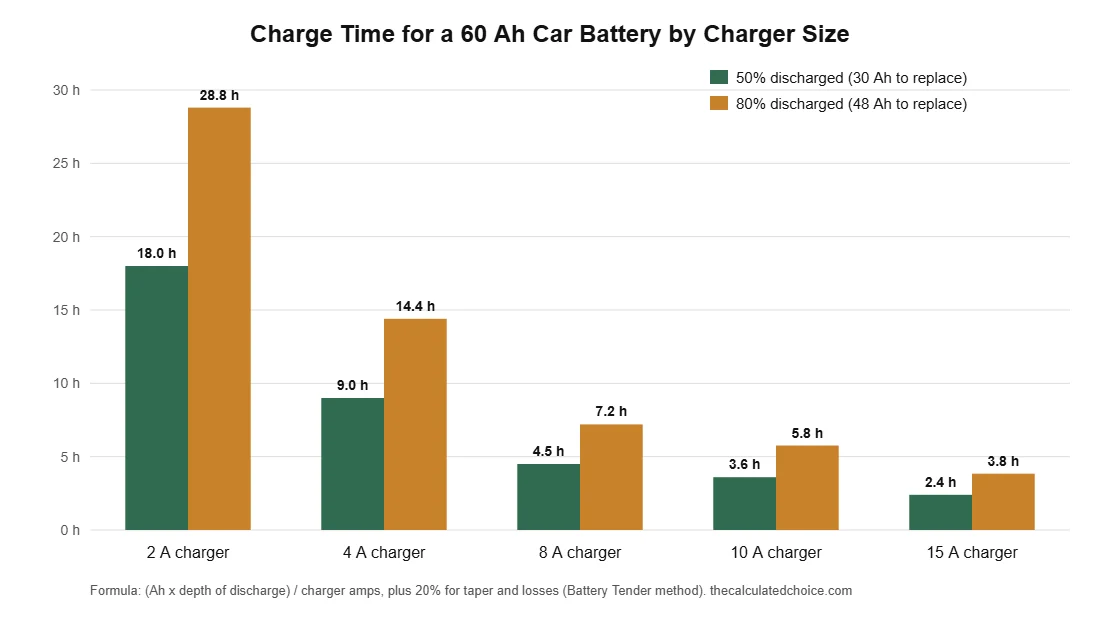
That figure assumes the charger pushes full current from start to finish, which smart chargers do not do. Battery Tender explains that its chargers deliver full current only until the battery reaches about 80% state of charge, then hold the voltage steady while the current tapers to fill the last 20%. To cover that taper and normal charging losses, Battery Tender tells owners to add about 20% to the result. The "Plan on about" figure in the calculator applies that 20% allowance; the "Bulk estimate" shows the raw formula.
Worked example from Battery Tender's own guide: a 60 Ah battery at 50% discharge needs 30 Ah back. On an 8-amp charger that is 30 ÷ 8 = 3.75 hours, or about 4.5 hours once the 20% allowance is added.
Estimating How Flat Your Battery Is
Measure the voltage with a multimeter after the battery has sat for at least four hours with nothing switched on. Battery Tender publishes these approximate resting voltages for a 12V lead-acid battery:
| Resting voltage | Approximate state of charge |
|---|---|
| 12.6 V or higher | About 100% |
| 12.4 V | About 75% |
| 12.2 V | About 50% |
| 12.0 V | About 25% |
| 11.9 V or lower | Deeply discharged, often sulfated |
Treat these as estimates. Makers' voltage charts are not identical: NOCO's own example reads 12.0 V as roughly 45% discharged, while Battery Tender places 12.0 V near 25% charged. Battery temperature and age move the reading too. If you have a battery tester or a smart charger that reports state of charge, use that number with the "I know the % discharged" option.
Is Your Charger the Right Size?
The battery charge time calculator compares your charger's amps with the battery's amp-hour rating. Two makers publish sizing rules, and they overlap rather than match:
- NOCO: choose a charger rated at 7–10% of the battery's amp-hours. A 50 Ah battery pairs with a 3.5–5 amp charger.
- Battery Tender: a charge rate of 10–25% of battery Ah is the practical range. A 60–80 Ah battery suits 15 amps; a 30 Ah battery should use 2–4 amps.
A charger below about 7% of capacity is a maintainer, not a recovery charger. It will keep a charged battery topped up but will take a long time to bring back a flat one. For picks in each size range, see our guide to the best car battery charger.
Why Real Charge Times Run Longer
- The last 20% is slow. Smart chargers taper current near full to avoid overcharging.
- Cold. Below 32°F, lead-acid batteries accept current more slowly. Never charge a frozen battery; let the case thaw first.
- Age and sulfation. A battery left below 12.4 V for weeks, or one that is several years old, accepts current slowly. If a battery will not take a charge at all, work through our car battery won't charge checklist.
- Battery chemistry. AGM and lithium batteries need the matching charger mode. Using the wrong mode can leave the battery undercharged.
A battery charge time calculator gives you the planning number; for the full background on charge stages and timing, read how long it takes to charge a car battery. If you plan to leave the charger connected for days, see can you overcharge a car battery.
Frequently Asked Questions
How long does it take to charge a dead car battery with a 2-amp charger?
Battery Tender's example: a 60 Ah battery that is 80% discharged needs about 48 Ah, which is roughly 24 hours at 2 amps, or about 29 hours once losses are added. A 2-amp charger is better suited to maintaining a battery than recovering a flat one.
How long does it take to charge a car battery at 10 amps?
CTEK's rough guide puts a fully discharged 50 Ah battery at about five hours on a 10-amp charger. A battery that is only half flat needs about half the amp-hours, so the time drops accordingly. Enter your own numbers in the battery charge time calculator above for a specific estimate.
Is this battery charge time calculator accurate?
It gives the same estimate the charger makers' own formulas give, and it adds Battery Tender's 20% allowance for losses and the taper stage. Real times vary with temperature, battery age and the charger's charging profile, so treat the result as a planning figure and confirm a full charge by checking for 12.6 V or higher after the battery rests for one to two hours.
Can I use this battery charge time calculator for a lithium battery?
Yes, with two changes: use the "I know the % discharged" option, because the voltage list applies to lead-acid batteries, and use a charger with a lithium (LiFePO4) mode. Our guide to the best LiFePO4 battery charger covers compatible models.
Sources
- Battery Tender: How long does it take to charge a car battery (formula, 20% allowance, resting-voltage list, 10–25% charge rate)
- NOCO: How long does it take to charge a dead car battery (depth-of-discharge method, 7–10% charger sizing)
- CTEK: How long does it take to recharge a car battery (50 Ah at 2, 10 and 20 amps)