
We may earn a commission when you buy through links on this page, at no extra cost to you. It never decides what we recommend. How we make money
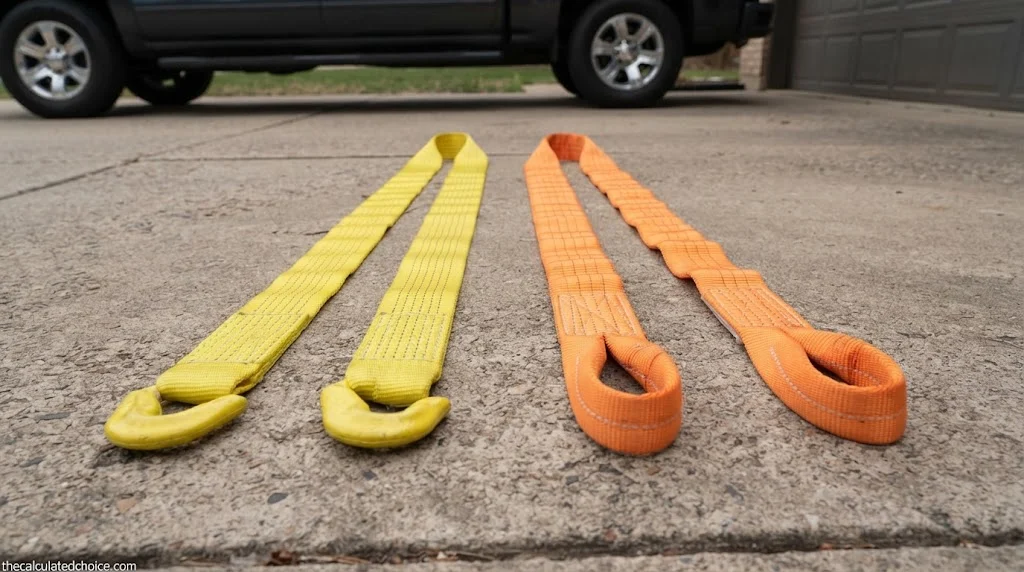
Sorting out tow strap vs recovery strap specs before a vehicle gets buried to the frame rails can save your bumper, your frame horns, and everyone standing near the pull. Walk down any auto parts aisle and both straps look almost identical: wide woven webbing with sewn loop ends or steel hooks. Under load, however, a low-stretch tow strap and an elastic kinetic recovery strap behave in completely opposite ways.
If you hook a rigid polyester tow strap between two trucks and take a running start to yank a bogged four-wheel-drive out of deep mud, there is almost no stretch to cushion the hit. As Vulcan Brands notes in its recovery strap technical guide, running a low-stretch polyester strap through a dynamic kinetic pull sends an unabsorbed jerk straight into the recovery points, which is how tow hooks get ripped out and vehicle frames get cracked. Worse, if a strap with open steel hooks fails or slips under shock tension, Rhino USA warns that snapped metal hooks can become deadly projectiles.
This guide is built for pickup owners, SUV drivers, and off-roaders who want clear, maker-verified rules before buying recovery gear. We compare polyester and nylon webbing stretch percentages, show how to calculate safe working load limits vs minimum breaking strength, break down loop ends vs metal hooks, and explain where tree savers and winch extensions fit in a complete truck kit.
Quick answer
- Core differenceIn a tow strap vs recovery strap comparison, a tow strap uses low-stretch polyester (under 7% to 8% elongation) for rolling flat-ground pulls, while a kinetic recovery or snatch strap uses nylon that stretches 15% to 30% to pull stuck vehicles out of mud, sand, or snow.
- Towing a rolling vehicleUse a low-stretch polyester tow strap such as the Vulcan 3-inch x 20-foot Standard Duty Tow Strap (7,500 lb towing capacity) or Factor 55 Extreme Duty Tow Strap (31,000 lb breaking strength) so the disabled vehicle does not rubber-band into your rear bumper.
- Extracting a stuck vehicleUse a stretchy nylon recovery strap (Vulcan Brands notes nylon typically stretches 15 to 30 percent under load) or a Rhino USA Kinetic Energy Recovery Rope (stretches up to 30%), and size it to the rating printed on the maker’s tag.
- End fittings ruleChoose sewn reinforced eye loops connected with rated shackles for off-road recovery; keep metal hooks strictly for slow, flat-surface towing and tie-down work.
Tow strap vs recovery strap: how material and stretch differ
The core engineering difference in any tow strap vs recovery strap breakdown is the synthetic fiber woven into the webbing and how much energy that fiber stores under tension. Manufacturers build tow straps out of polyester (or low-stretch poly-silk blends) and build kinetic recovery straps – often called snatch straps – out of high-stretch polyamide nylon.
A dedicated tow strap is engineered to keep a constant, predictable distance between a powered tow vehicle and a rolling disabled vehicle. For example, GearAmerica specifies less than 7% elongation under full load on its heavy-duty polyester tow strap, and Rhino USA specifies about 8% stretch on its poly-silk recovery tow strap while explicitly noting that the strap is built for static recoveries with no running start. Factor 55 makes its 2-inch x 30-foot Extreme Duty Tow Strap from 100% low-stretch polyester.
Why is low stretch mandatory when towing a rolling vehicle on pavement or a gravel road? Vulcan Brands states on its 3-inch x 20-foot Standard Duty Tow Strap page that the strap is “designed for towing, not for vehicle recovery,” and notes that recovery straps have more stretch and a “rubber band” effect, so match the strap type to the job.
By contrast, when a truck is mire-deep in mud, snow, or soft sand with zero wheel momentum, a static pull often just spins the lead truck’s tires. That is where an elastic nylon recovery strap or kinetic rope takes over. Vulcan Brands notes that nylon recovery straps stretch 15% to 30% under load. Stepping up to a braided nylon kinetic rope like the Rhino USA Kinetic Energy Recovery Rope gives up to 30% stretch and stores 4 times more energy than a tow strap, smoothing out the pull and lowering peak shock force on both frames.
Side-by-side comparison: tow, snatch, kinetic, and tree straps
Because many brands print “Recovery Tow Strap” on the box for search visibility, reading the title alone is not enough. Always check the material specification, elongation percentage, length, and rated load before you rig a pull. Here is how the four main strap categories compare using verified manufacturer specifications.
| Strap type | Webbing material | Typical stretch under load | Standard length | Primary job | Verified maker example |
|---|---|---|---|---|---|
| Static tow strap | 100% polyester or poly-silk blend | Under 7% to 8% | 20 ft to 30 ft | Flat-ground towing of a rolling vehicle or slow static pull with zero running start | GearAmerica Heavy Duty Tow Strap (<7% stretch, 12,000 lb WLL, 35,053 lb MBS) |
| Flat snatch recovery strap | 100% nylon | 15% to 30% | 20 ft to 30 ft | Dynamic momentum extraction of a vehicle stuck in mud, snow, or sand | Vulcan Brands recovery strap guide (nylon typically stretches 15 to 30 percent) |
| Kinetic recovery rope | Braided nylon rope | Up to 30% | 20 ft to 30 ft | Heavy dynamic extraction storing 4x the energy of a static strap | Rhino USA Kinetic Energy Rope (up to 30% stretch, Lifetime warranty) |
| Tree saver / winch strap | 100% low-stretch polyester | Under 7% | 8 ft to 10 ft | Wrapping a tree anchor, extending a winch line, or forming a Y-bridle across two frame hooks | Factor 55 8′ x 3″ Tree Saver (00077) (9,300 lb straight WLL, 18,600 lb basket WLL) |
Tow strap vs recovery strap sizing math: WLL vs break strength
When shopping for any tow strap vs recovery strap setup, you will see two capacity ratings printed on the safety tag: Working Load Limit (WLL) and Minimum Breaking Strength (MBS). Confusing those two numbers is one of the most common mistakes truck owners make when sizing recovery gear.
As Vulcan Brands explains, break strength is the point at which a strap fails under controlled test conditions, while the Working Load Limit is the rated safe working load, and it advises buyers to always buy to WLL, not break strength. On Rhino USA’s 3-inch strap, for example, the WLL is one-third of the break strength:
- Rhino USA 3-inch x 20-foot and 3-inch x 30-foot Tow Straps: Rated at a 10,000 lb Working Load Limit and 30,000 lb Minimum Break Strength (with 2-inch models rated at 20,000 lb break strength and 4-inch models rated at 40,000 lb break strength).
- GearAmerica Heavy Duty Tow Strap: Rated at a 12,000 lb Working Load Limit and 35,053 lb Minimum Breaking Strength.
- Erickson 3-inch x 30-foot Recovery Strap: Rated at a 27,000 lb breaking strength with a 13,500 lb maximum vehicle weight (Erickson specifies that maximum vehicle weight is one-half of the breaking strength).
- Rhino USA Kinetic Energy Recovery Rope: Rhino USA lists minimum break strengths of 15,100 lb (5/8 in x 20 ft), 28,600 lb (7/8 in x 20 ft), 33,600 lb (1 in x 30 ft) and 52,600 lb (1.25 in x 30 ft).
How to size your strap capacity to your truck
Rule 1 (Static Tow Strap): buy to the Working Load Limit (WLL), not the break strength, and keep it at or above the weight being pulled. On Rhino USA’s 3-inch strap the WLL (10,000 lb) is one-third of the minimum break strength (30,000 lb).Example (7,000 lb GVW full-size 4×4 pickup): a static tow strap needs a Working Load Limit of at least 7,000 lb, such as the Rhino USA 3-inch strap rated at 10,000 lb WLL / 30,000 lb MBS.Always verify how the strap is rigged: Factor 55’s 3-inch x 8-foot Tree Saver (00077) labels three distinct Working Load Limits depending on hitch geometry: 9,300 lb in a straight pull, 18,600 lb in a U-shaped basket hitch, and 7,440 lb in a choker hitch. Sources: Vulcan Brands, Rhino USA, and Factor 55.
Notice how hitch geometry changes your real-world safe working limit. When you wrap an 8-foot strap around a tree trunk in a U-shaped basket configuration and bring both eye loops together into your shackle, the load is split across two legs of webbing – doubling the straight-line WLL on Factor 55’s Tree Saver from 9,300 lb to 18,600 lb. If you thread one eye through the other in a choker hitch, the sharp bend reduces the rated WLL to 7,440 lb.
Loop ends vs metal hooks: why hardware choice matters
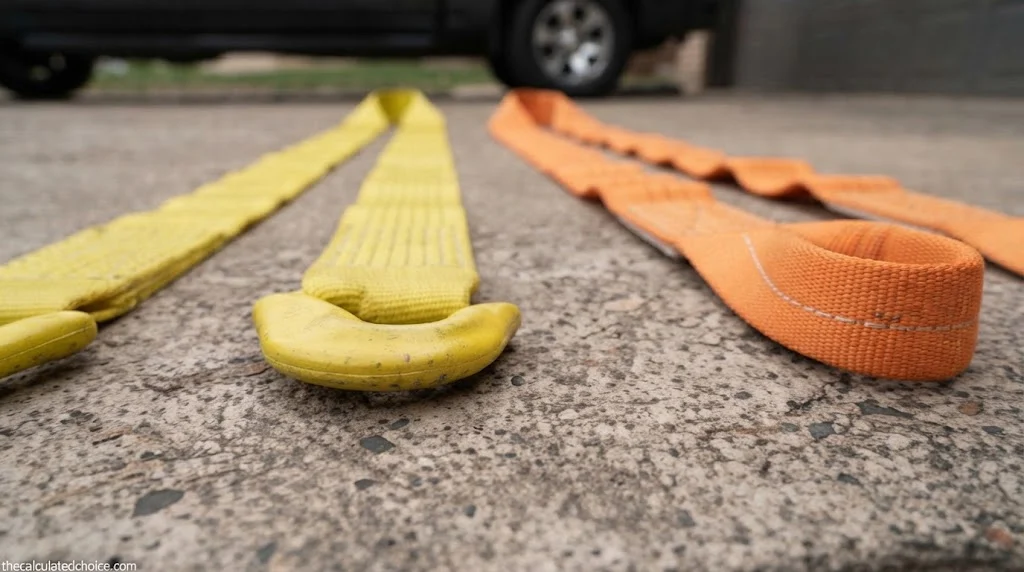
Walk through the hardware options on a tow strap vs recovery strap and you will find two end styles: sewn reinforced fabric loops (eyes) and sewn-in metal hooks (such as forged slip hooks or grab hooks). Picking the wrong end fitting for an off-road pull is a major safety hazard.
When sewn-in metal hooks make sense
Straps with built-in metal hooks are convenient for quick, flat-surface road or yard towing where the vehicle rolls freely on all four wheels and you do not have separate D-ring shackles on hand. Because there is no kinetic yanking on a flat roll, tension stays low and steady. Even then, Vulcan Brands cautions that metal hooks can deform, crack, or slip under high shock loads, so keep hooked straps for gentle, steady pulls.
Why reinforced eye loops and shackles are mandatory for recovery
In an off-road extraction, tension can spike rapidly, and a strap can go slack for a split second as a tire climbs out of a rut. Open hooks can slip off a recovery point during that slack moment, or fracture under shock load. As Rhino USA states on its recovery tow strap specification page, metal hooks can snap during a recovery and become deadly projectiles.
Closed-system rigging solves that problem. By pairing triple-reinforced or Cordura-sleeved eye loops with a closed 3/4-inch D-ring shackle or a synthetic soft shackle, the strap cannot unhook mid-pull. Make sure the shackle’s capacity matches or exceeds the strap: for instance, the Rhino USA Tow Strap and D-Ring Shackle Combo pairs a 30-foot strap (10,000 lb WLL / 30,000 lb MBS) with D-ring shackles rated at a 13,950 lb working load limit and a 41,850 lb max break strength. Also check eye width against your shackle bow: Factor 55 designs its Extreme Duty Tow Strap at a 2-inch width with double-ply construction (31,000 lb breaking strength) specifically so the reinforced eyes fit cleanly inside standard 3/4-inch screw-pin shackles without bunching the outer edges of the webbing.
Where tree savers and winch extensions fit in your kit
Even if your truck carries both a static tow strap and a kinetic snatch strap, wrapping a long 20-foot or 30-foot strap – or worse, a bare winch cable – around a tree trunk is bad rigging practice. GearAmerica warns that running wire rope directly around a tree trunk damages the bark, cuts into the cambium layer, and can kill the tree.
A dedicated tree saver strap (also called a tree trunk protector) is an 8-foot to 10-foot wide flat strap woven from low-stretch polyester. Because it uses non-stretch polyester (less than 7% elongation on GearAmerica’s 3-inch x 8-foot model), it holds sustained winch tension without creeping or storing dangerous recoil energy. A single 8-foot or 10-foot polyester tree strap handles three distinct jobs in a truck kit:
- Tree trunk anchor: Wrap the 3-inch wide webbing around the base of a sturdy tree, slide the protective neoprene or Cordura sleeves over the bark contact points, join both eye loops with a shackle, and attach your winch line.
- Winch extension: When the nearest solid anchor tree is just beyond your winch drum’s reach, a non-stretch polyester strap (such as ARB’s 17,600 lb Winch Extension Strap ARB725LB or GearAmerica’s 3-inch x 8-foot Tree Saver Winch Extension Strap) bridges the gap safely. Never use a high-stretch nylon snatch strap as a winch extension, because stretching a nylon strap under slow winch load stores massive recoil energy if a fitting lets go.
- Short straight tow or bridle: In tight trail turns where a 20-foot or 30-foot strap is too long, an 8-foot strap works as a close-quarters pull strap or a two-point frame bridle.
Pre-use inspection checklist and common rigging mistakes
Synthetic webbing degrades over time when exposed to sunlight, sharp bumper edges, grit, and moisture. Vulcan Brands says to inspect the full length for cuts, fraying, or abrasion, and Erickson Manufacturing says to always inspect a strap for damage before using it. Run through these four checks before every pull:
- Check the full length for cuts, fraying, or edge abrasion: Even a small nick on the outer edge of pressurized webbing reduces its breaking strength.
- Inspect the sewn eyes and load stitching: Look for pulled threads, broken box-stitching, or deformed eye loops where shackles sit.
- Look for UV degradation: Faded webbing color or a dry, chalky surface texture means ultraviolet light has weakened the synthetic fibers.
- Verify hardware and length clearance: Confirm shackles or hooks have zero cracks, bends, or heavy rust at load points, and choose a 20-foot to 30-foot length (Vulcan notes 30 feet is the more common field choice) so the lead truck has room to work on solid ground.
After a muddy recovery, rinse the webbing with clean water and let it air-dry completely before coiling it into its storage bag. Fine sand and dried mud crystals trapped inside woven fibers act like internal sandpaper the next time the strap is tensioned.
What to buy for your truck recovery kit
Once you know where your truck drives and what weight class you need to cover, build your kit around two core recovery tools so you are never forced to misuse a static strap in a mud hole:
- For flat-ground towing, static pulls, and winch anchoring: See our full comparison of the best tow strap for trucks, where we break down verified 20-foot, 30-foot, hooked, and tree-saver straps checked against Keepa sales-rank stability and manufacturer load ratings.
- For solo self-recovery in mud, snow, or sand without a second vehicle: Before hooking up a strap at all, wedging high-grip recovery boards under spinning tires often gets a truck moving in minutes with zero shock load on your frame. Compare our Keepa-verified picks in best traction boards for mud and snow.
How we researched this guide
We did not lab-test straps to destruction; instead, we reviewed manufacturer engineering specifications, load tags, and rigging manuals to explain every tow strap vs recovery strap rule with verifiable numbers.
Sources: Rhino USA, GearAmerica, Factor 55, ARB USA, Vulcan Brands
Bottom line: The right tow strap vs recovery strap choice comes down to whether the disabled vehicle is rolling freely or stuck fast. Keep a low-stretch polyester tow strap (under 7% to 8% stretch) for flat-ground towing and winch work, use a 15% to 30% stretch nylon snatch strap or kinetic rope with closed loop eyes and rated shackles when extracting a stuck 4×4, and never mix up the tow strap vs recovery strap roles by taking a running start on a rigid strap.
Quick recap: the tow strap vs recovery strap choice comes down to stretch. A tow strap uses low-stretch webbing for a rolling vehicle on flat ground, while a recovery strap stretches to help free a stuck 4×4. That is the whole tow strap vs recovery strap difference in one line.
Before every pull, ask which job you have, because the tow strap vs recovery strap rules change with the situation. Treat tow strap vs recovery strap as a safety call, not a price call: match the strap to the pull, check the rating, and inspect the webbing and ends every time. If in doubt, re-read the tow strap vs recovery strap rules above before you rig anything.
When a pull goes wrong, the jack and stands matter as much as the strap: see our guides to the best jack stands and how to use a floor jack safely.
Not sure a strap is the right tool? Compare our Keepa-verified picks in best traction boards for mud and snow.
Frequently asked questions
Can I use a tow strap as a recovery strap if I pull slowly?
Why can I not use a stretchy recovery strap to tow a broken-down car on the road?
Should I size a strap by Working Load Limit (WLL) or Minimum Breaking Strength (MBS)?
Are metal hooks safe for off-road vehicle recovery?
Can I use a nylon snatch strap as a winch extension?
What length tow strap or recovery strap is best for a full-size truck?

Researched by Shahzad
Amazon seller who researches products using sales-rank history, price tracking and owner reviews before recommending anything. Read our disclosure.