
We may earn a commission when you buy through links on this page, at no extra cost to you. It never decides what we recommend. How we make money
Learning how to use a portable tire inflator takes two minutes. The details that keep you and your tires safe take longer to find, because they sit in owner’s manuals, and the manuals do not always agree. This guide is for US drivers using a 12V plug-in or cordless inflator on a car, crossover or SUV. You will get the step-by-step method, the pressure rules from NHTSA and a major tire maker, and the warnings we pulled from three inflator manuals, including the one question they answer differently: should the engine be running?
How to use a portable tire inflator: the quick version
- Find the cold pressure on the label on your driver’s door edge, not the number on the tire.
- Park on flat ground with the parking brake set. Run the engine only if your inflator’s manual says to, and only outdoors.
- Look the tire over. Do not reinflate a tire that was driven flat or has a bulge.
- Plug into a 12V socket rated for 15 amps, or use a charged battery.
- Thread the chuck straight onto the valve until it seats.
- Set the target above the current reading and start the pump.
- Stay with it, respect its run limit, and confirm the result with a separate gauge.
Before you start: four safety checks
1. Know the right number
Your target is the pressure the vehicle maker lists, not the one molded on the tire. NHTSA puts it plainly: the correct pressure is on the Tire and Loading Information label on the driver’s door edge or in the owner’s manual, and the number on the sidewall is not it. Front and rear can differ, and a compact spare often has its own, higher number. Our guide on what your tire pressure should be explains where to find each number.
That figure is a cold pressure, meaning the car has not been driven for at least three hours. If you just drove to the pump, the tire reads high. Bridgestone’s tire safety manual warns never to let air out of a hot tire to reach the cold number, because the tire ends up underinflated once it cools. Add air if you are low, then recheck when the tires are cold.
2. Look at the tire before you add air
An inflator fixes low pressure, not damage. Walk around the tire and look for bulges, cuts or exposed cords. If the tire was driven while flat or very low, Bridgestone’s manual says it must be removed from the wheel and inspected inside for damage you cannot see from the outside. Put the spare on and have it checked instead of pumping it up and driving.
If a tire is completely deflated, the bead can slip off the rim. Slime’s manual notes that air may then leak out as fast as you pump it in, and that you may need to jack up the car before inflating. Seating a bead is a shop job: Bridgestone warns never to exceed 40 PSI to seat beads, and an unsecured tire that bursts can be thrown with explosive force.
3. Check your power source
Plug-in inflators pull a lot of current. Both AstroAI manuals we read call for a 12V socket fused at 15 amps, and Slime’s manual asks for an outlet rated 15 amps or higher and warns against older 8-amp lighter sockets. Never plug a 12V inflator into a 24V truck outlet. If you use a cordless model, charge it before you need it; a battery that sat in a cold trunk all winter may be low.
4. Find your run limit
Budget inflators are not built to run nonstop. The AstroAI manuals limit continuous use to 15 minutes followed by a 10-minute rest, while Slime’s manual says no more than 10 minutes, then about 25 minutes to cool. Know your number before you start a big job, such as four SUV tires on a cold morning. Our guide to how long it takes to inflate a car tire shows how long common jobs really take.
How to use a portable tire inflator, step by step
Step 1: Park safely
Stop on flat, solid ground, put the car in park and set the parking brake. At the roadside, pull as far from traffic as you can and switch on your hazard lights. If your inflator’s manual tells you to run the engine, do this outdoors only. The CDC warns never to run a car or truck inside a garage attached to your house, even with the door open.
Step 2: Power up the way your manual says
For a 12V plug-in model, follow the engine instruction in your manual (more on that below), then push the plug firmly into the socket. For a cordless model, check the battery level first. For an AC/DC model in the garage, plug the AC cord into a wall outlet and leave the car off.
Step 3: Read the current pressure
Unscrew the valve cap and put it somewhere you will not lose it. Check the current pressure with a tire gauge, or connect the inflator and read its display before you start. This tells you how much air you need and whether you are dealing with a top-up or a tire that keeps losing air.
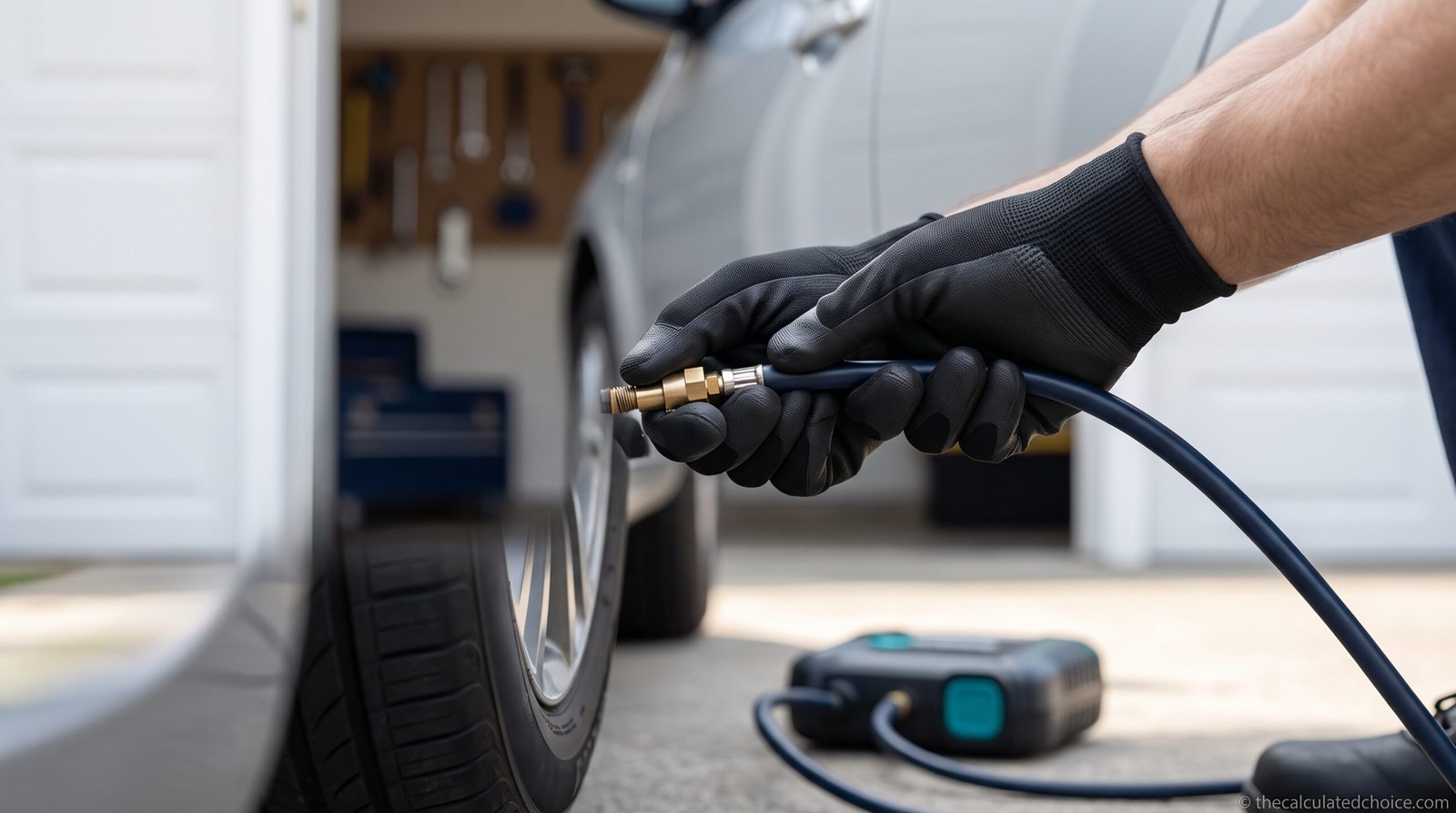
Step 4: Attach the chuck straight and fully
Thread or clamp the chuck onto the valve stem in a straight line. AstroAI’s manual points out that attaching the chuck at an angle can cause a poor seal and an inaccurate reading, and Slime’s manual says the connector must be fully seated to press the valve core open. A short hiss while you thread it on is normal; a steady hiss afterward means the seal is not right, so back it off and try again.

Step 5: Set the target pressure
Choose PSI as the unit and set the cold pressure from your door label. The preset must be higher than the tire’s current pressure. Both AstroAI manuals list a preset lower than the current pressure as a reason the pump will not run or behaves oddly. If you are filling a warm tire, set the cold number and plan to recheck later rather than overfilling.
Step 6: Start the pump and stay with it
Press the power or inflate button. Set the inflator on a hard, clean surface and keep its air vents clear. Do not hold it in your hand while it runs: Slime’s manual labels it hot, and AstroAI’s AC/DC manual says not to touch the air hose during inflation. Slime also says not to leave a running inflator unattended. A pump with auto shut-off stops on its own at the preset; with an analog gauge, you switch it off yourself.
Step 7: Respect the run limit
If the job is long, stop before you hit your manual’s limit and let the pump rest. AstroAI’s built-in protection shuts its 12V pump off after more than 15 minutes of continuous running, and both brands list overheating from long use as a cause of slow inflation. A short break costs less time than a pump that quits halfway through the last tire.
Step 8: Disconnect and check with a separate gauge
Switch the pump off if it has not stopped itself, unplug it, then remove the chuck quickly and squarely. Check the tire with a separate, quality digital tire pressure gauge. Slime’s manual tells you to always use a pressure gauge, and none of the three manuals we read publishes an accuracy figure for the built-in display. If the reading is a little high, let out a small amount of air and check again.
Step 9: Cap the valve and repeat
Screw the valve cap back on to keep dirt and moisture out of the valve. Repeat on the other tires, and include the spare. NHTSA recommends checking all tires, spare included, at least once a month when they are cold.
Engine on or off? What the inflator manuals say
This is the question drivers ask most, and the honest answer is that it depends on the inflator. We compared three manuals side by side:
| Manual | Engine guidance | Run limit | Rest | Other warnings |
|---|---|---|---|---|
| AstroAI CZK-3631 (AIRUN H), 12V | Engine running before use | 15 min | 10 min | 15 A socket; never on 24V; keep out of rain |
| AstroAI CZK-3666, 12V and 120V | Engine running before use (12V) | 15 min | 10 min | Keep away from the exhaust pipe; do not touch the hose while inflating |
| Slime digital tire inflator, 12V | Do not run the vehicle; key in accessory or on, parking brake set, car in park | 10 min | About 25 min | Outlet rated 15 A or more, not 8 A; do not hold in hand; do not leave unattended |
The manuals do not explain why they differ, so the rule is simple: follow the manual for the inflator you own. If yours calls for the engine to run, do it outdoors only. If you inflate in the garage, a cordless inflator or an AC/DC model plugged into a wall outlet avoids the question entirely. If your manual says engine off and the pump slows down, Slime’s troubleshooting section lists low voltage as a cause and says to check the condition of your battery.
Using a Slime digital tire inflator
Slime inflators are among the most common budget pumps in US garages, and their steps differ slightly from AstroAI’s. From Slime’s manual for its digital inflator:
- With the car in park, the parking brake set and the key in accessory or on (engine off), screw the valve connector onto the tire’s valve stem.
- Plug the power cord into the 12V accessory outlet.
- Hold the + or – button for about 5 seconds until the display flashes, set the pressure, then wait 2 to 3 seconds for the display to show your target.
- Press the on/off button. The inflator stops on its own when it reaches the preset.
- Press on/off again, unplug, unscrew the connector and check the pressure with a gauge.
Shopping for a pump that makes this easier? Our guide to the best tire inflator under $50 compares the run limits and fine print of three budget models, including this Slime.
Common mistakes when using a tire inflator
| Mistake | What happens | Do this instead |
|---|---|---|
| Inflating to the number on the sidewall | That figure is the tire’s maximum, not your car’s recommended pressure | Use the cold pressure on the driver’s door label |
| Letting air out of a hot tire | The tire is underinflated once it cools | Add air if low, then recheck cold |
| Setting the target below the current pressure | The pump will not run or behaves oddly | Set the target above the current reading |
| Attaching the chuck at an angle | Air leaks and the reading is off | Thread it on straight until it seats |
| Running the pump past its limit | It slows down or shuts off to protect itself | Rest it 10 to 25 minutes, per your manual |
| Trusting the built-in display alone | No accuracy figure is published for most budget pumps | Confirm with a separate tire gauge |
| Running the engine in a garage | Carbon monoxide builds up, even with the door open | Go outside, or use a cordless or wall-powered inflator |
| Pumping up a tire that was driven flat | Hidden inner damage can fail later | Fit the spare and have the tire inspected |
If your pump runs but the pressure will not climb, the cause is usually a loose connection, a leak or an overheated motor rather than a dead inflator. Our checklist for a tire inflator not working or not reaching PSI walks through each cause.
After you inflate: finish the job
- Check the spare. Bridgestone’s manual says to include the spare in every pressure check and to replace it 10 years after its date of manufacture, whatever its condition.
- Watch for a slow leak. If one tire needs air again within a day or two, it likely has a puncture or a leaking valve. Have it repaired rather than topping it up every morning. If a puncture catches you on the road, our tire plug vs Fix-a-Flat comparison shows which emergency fix suits which flat.
- Let the inflator cool before you pack it away, then store the cord and adapters with it so everything is there when you need it at the roadside.
- Make it a monthly habit. NHTSA recommends a monthly check on cold tires, and Bridgestone adds one before long trips or when carrying extra weight.
Frequently asked questions
How do I use a portable tire inflator?
Can you use a tire inflator without the engine running?
Is it safe to use a tire inflator in the garage?
How long can a portable tire inflator run?
Should I inflate my tires when they are hot or cold?
Can I inflate a tire that went completely flat?
Why does my inflator reading differ from my tire gauge?
How we wrote this guide
We built these steps from the owner’s manuals of three popular budget inflators, NHTSA’s tire-pressure guidance, Bridgestone’s tire maintenance and safety manual, and the CDC’s carbon monoxide guidance. Where manuals disagree, we show both and tell you to follow your own. We did not hands-on test any product, and no brand paid for or reviewed this article.
Sources: NHTSA tire safety · Bridgestone tire maintenance and safety manual · CDC carbon monoxide safety · AstroAI CZK-3631 manual · AstroAI CZK-3666 manual · Slime digital tire inflator manual

Researched by Shahzad
Amazon seller who researches products using sales-rank history, price tracking and owner reviews before recommending anything. Read our disclosure.