
We may earn a commission when you buy through links on this page, at no extra cost to you. It never decides what we recommend. How we make money
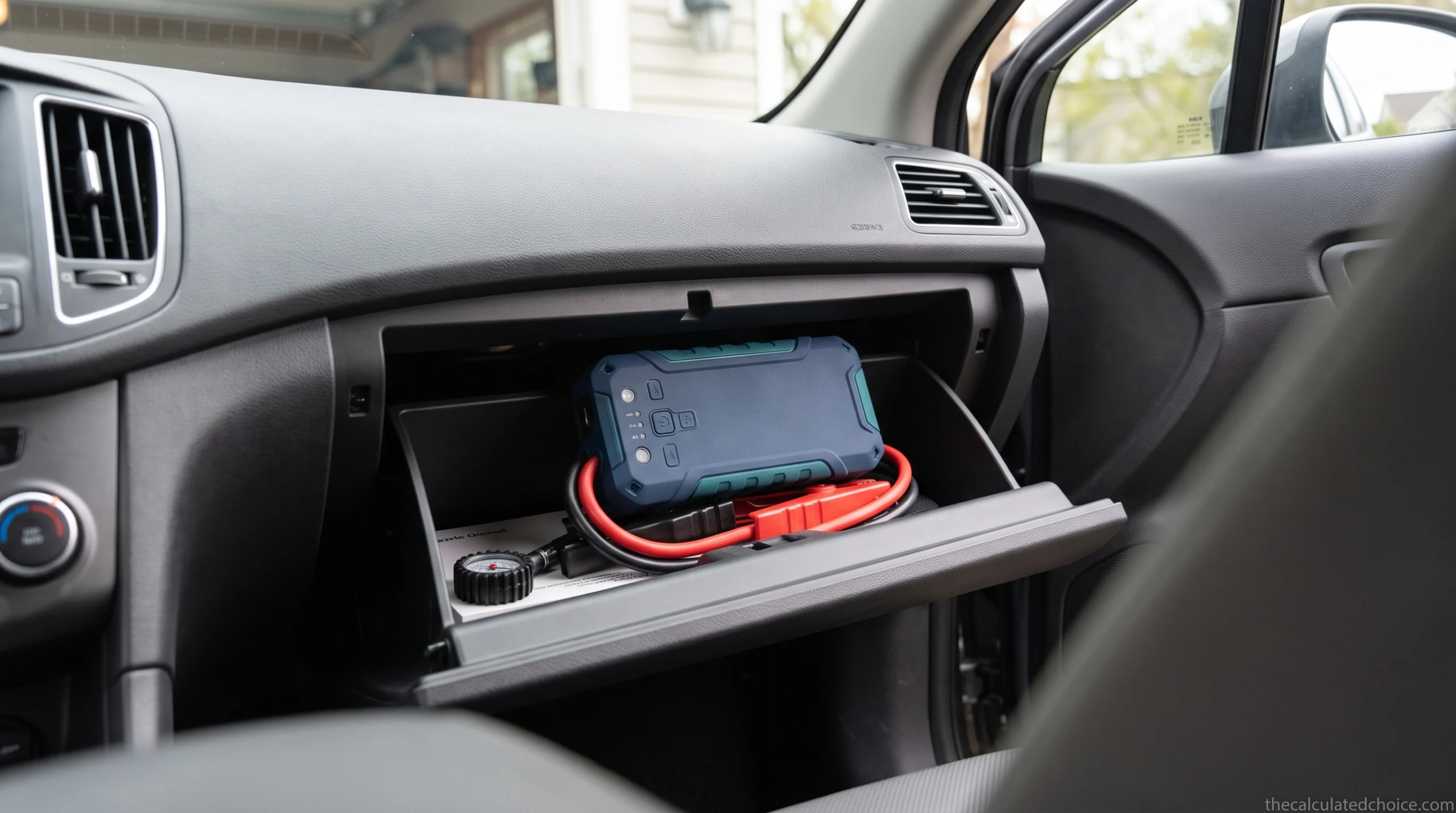
Can you leave a jump starter in your car? Most of the year, yes. That is where it does its job, and most manufacturers expect it to ride along. But a lithium jump starter has temperature limits, and a parked car can blow past them on a summer afternoon or a January night. Leave it in the wrong spot at the wrong time and you get a pack that ages early, refuses to charge, or will not crank when you need it.
This guide is for US drivers who keep a portable jump starter in the car. We pulled the operating, charging and storage limits from manufacturer manuals and support pages, compared them with measured temperatures inside parked cars, and turned the result into a simple plan for where to keep the pack and when to bring it inside. For the rest of your cold-weather trunk and cabin gear, see our guide on what to keep in your car in winter.
Can you leave a jump starter in your car? Quick answer
- Mild weather Yes. Keep it in the cabin, out of direct sun, and recharge it on the maker’s schedule: every 3 months for Clore, at least every 4 to 6 months for NOCO.
- Hot weather Not on hot, sunny days. A car parked in the sun can pass the 122°F storage limit NOCO sets, and the US Fire Administration warns against keeping lithium-ion batteries in hot cars. Bring it inside, and never charge it in a hot car.
- Cold weather Usually fine down to the maker’s storage floor, −4°F for NOCO’s Boost packs. But most lithium packs will not charge below 32°F and give less power when cold, so bring it inside to charge and in deep cold.
Can you leave a jump starter in your car? The short answer
Yes, with conditions. Clore Automotive, which makes the Jump-N-Carry line, says its units can stay in a vehicle year-round under normal conditions. NOCO publishes a storage range of −4°F to 122°F for its Boost packs and tells owners to keep them out of direct sunlight, warning that the air in a car can reach 122°F within 10 minutes. The conditions are what most owners miss: the pack has to stay inside its maker’s temperature limits, it has to be recharged on schedule, and it should never be charged when it is too hot or too cold.
There is one stricter voice. The US Fire Administration advises against putting lithium-ion batteries in direct sunlight or keeping them in hot cars, calling it a fire risk. So in summer, the safest jump starter is one that rides with you and comes inside with you.
The three temperature limits on every jump starter
Manuals list up to three different ranges, and they are not interchangeable:
- Operating temperature is the range in which the pack is rated to jump a car. Outside it, the maker does not promise it will work.
- Charging temperature is almost always the narrowest. Most lithium packs will not charge below freezing, and many stop around 104°F.
- Storage temperature is the range the pack can sit in without damage. It is usually close to the operating range, and it is the number that matters for leaving a jump starter in your car.
Jump starter storage temperature: what the makers say
We pulled the published limits for popular packs, including the ones we recommend in our best jump starter for small cars and best jump starter for SUVs guides:
| Jump starter | Operating | Charging | Storage and vehicle advice |
|---|---|---|---|
| NOCO Boost GB40, GB50, GBX45 | −4°F to 122°F | 32°F to 104°F | Store between −4°F and 122°F; keep out of direct sun; GB40 guide says it is intended to be stored indoors |
| Clore Jump-N-Carry JNC305 | 0°F to 108°F | 32°F to 108°F | Do not store below 50°F when relying on it; recharge every 3 months |
| Clore Jump-N-Carry JNC325 | −10°F to 140°F | 40°F to 140°F | Do not store below 50°F when relying on it; recharge every 3 months |
| TOPDON JS2000Pro | 14°F to 104°F | Not listed | Not listed |
| AstroAI S8 | −4°F to 122°F | Varies by manual version | Not listed |
| Autowit SuperCap 2 (supercapacitor) | −40°F to 158°F | Charges from the car when used | No battery to keep charged |
Two things jump out. First, the ceilings are low compared with a summer car: 104°F to 122°F for most lithium packs. Second, makers do not fully agree with themselves. NOCO’s support page says its Boost packs can be left on a charger at all times, while the GB40 user guide says to avoid charging for more than a week at a time. When sources conflict, we follow the more cautious one: charge it fully, then unplug it.
How hot does a parked car get?
Hotter than most jump starters are rated for. Researchers from Arizona State University and UC San Diego measured cars parked for an hour on summer days in the 100s in Tempe, Arizona, and published the results in the journal Temperature. We set their readings against the limits above:
| Spot in the car (after 1 hour) | Parked in sun | Parked in shade | vs NOCO 122°F storage limit | vs TOPDON 104°F operating limit |
|---|---|---|---|---|
| Cabin air (average) | 116°F | About 100°F | Below, but close in sun | Over in sun |
| Seats | 123°F | 105°F | Over in sun | Over in sun and shade |
| Steering wheel | 127°F | 107°F | Over in sun | Over in sun and shade |
| Dashboard | 157°F | 118°F | Far over in sun | Over in sun and shade |
What the comparison shows
Spot temperature − pack limit = how far over you areA pack sitting on a sunny dashboard would be about 35°F over NOCO’s 122°F storage limit (157 − 122). On a sunny seat it is just over. In the shade, the cabin air stays under NOCO’s limit but already sits near TOPDON’s 104°F operating ceiling and is close to Clore’s 108°F limit for the JNC305. Those are Arizona numbers, and cooler places will read lower, but the pattern holds: direct sun is the problem, and shade makes a big difference.
What heat does to a jump starter left in a hot car
Heat does not need to set anything on fire to cost you. It ages lithium-ion cells permanently, and it does it fastest when the battery is full, which is exactly how a jump starter is meant to be stored. Battery University estimates how much capacity lithium-ion keeps after a year of storage:
| Storage temperature | Stored at 40% charge | Stored at 100% charge |
|---|---|---|
| 32°F (0°C) | 98% | 94% |
| 77°F (25°C) | 96% | 80% |
| 104°F (40°C) | 85% | 65% |
| 140°F (60°C) | 75% | 60% after only 3 months |
Read across the 100% column, because that is a charged jump starter. A full pack kept at 104°F, cooler than the sunny cabin readings above, keeps only about 65% of its capacity after a year by this estimate, against 80% at room temperature. That shows up as fewer jump starts per charge and a pack that seems to empty itself. If yours drains faster every summer, our guide to how long a jump starter holds a charge explains what is normal.
Charging in the heat is the bigger mistake. NOCO says to recharge between 32°F and 104°F and to let a hot pack cool before plugging it in. So do not top it up from the 12V socket while the car sits in a sunny parking lot.
What cold does to a jump starter left in a cold car
Cold is gentler on the battery’s lifespan but harder on its performance. Battery University notes that a lithium-ion battery’s internal resistance rises in the cold, which cuts the current it can deliver, the very thing a jump starter exists to provide. Three practical rules follow:
- Storing it cold is usually fine. NOCO’s Boost packs are rated for storage down to −4°F, and Clore says its units can live in a vehicle under normal conditions, though it suggests bringing them in overnight if temperatures will drop below −20°F.
- Charging it cold is not. Battery University warns that charging lithium-ion below freezing plates metallic lithium on the anode, a permanent loss of performance and safety. NOCO’s packs charge from 32°F and Clore’s JNC325 only from 40°F. Bring the pack inside to charge.
- Warm packs start better. Clore recommends storing its jump starters between 50°F and 70°F for best performance and asks owners who leave one in a car parked outdoors in extreme cold to charge it once a month instead of every three months.
If your winters regularly drop below zero, a supercapacitor pack avoids most of this, because there is no battery to keep warm or charged. We compare those options in our best jump starter for cold weather guide.
Where to keep a jump starter in your car
The goal is simple: out of direct sun, secured, and easy to reach. In order of preference:
- Glovebox, center console or a closed bin. Out of direct sun and easy to grab. A compact pack like NOCO’s GB40, about 6.7 by 3.2 by 1.7 inches per its user guide, fits many gloveboxes; if yours does not fit, a closed console bin is the next best spot.
- Under a seat or on the floor behind a seat, in its case and wedged so it cannot slide. Loose heavy objects can fly forward in a hard stop.
- Trunk or cargo area. Out of sight and out of direct sun, but harder to reach and easy to forget when the weather turns. Fine in mild seasons if you check it on schedule.
- Never on the dashboard, the rear window shelf or a sunny seat. The dashboard and sunny seats were the hottest spots in the study above, and a rear shelf sits in the same direct sun.

Wherever it goes, keep the clamps coiled in the case so the jaws cannot touch, and keep the pack away from anything that could crush or puncture it.
A seasonal plan for keeping a jump starter in your car
| Conditions | Keep it in the car? | What to do |
|---|---|---|
| Mild weather | Yes | Cabin bin or glovebox, out of sun. Recharge every 3 months for Clore, every 4 to 6 months at most for NOCO, and after every use. |
| Hot, sunny days | Only while you drive | Bring it inside when the car will sit in the sun. Never charge it in a hot car; let it cool first. |
| Freezing weather | Usually yes, within its limits | Bring it inside to charge. If the car sits outdoors in extreme cold, Clore suggests charging monthly. |
| Below −4°F, or below −20°F for Clore | No | Outside NOCO’s storage range; Clore suggests bringing its units in overnight below −20°F. Keep it indoors and take it with you. |
| Car parked for months | No | Store it indoors, charged, and top it up on the maker’s schedule. |
Signs heat or cold has damaged your jump starter
The US Fire Administration lists the warning signs for any lithium-ion battery: an odor, a change in color, too much heat, a change in shape, leaking or odd noises. If you see any of them, stop using the pack and do not charge it. Softer signs that a pack is wearing out include a charge that drains in weeks instead of months, fewer jump starts per charge, or a pack that will not charge at all; our guide to why a jump starter won’t charge walks through the fixes. If the pack shows a red or flashing warning light after a hot or cold spell, our jump starter error lights guide explains what it is telling you.
Frequently asked questions
Is it safe to keep a jump starter in your car in summer?
Can a jump starter explode in a hot car?
Can you leave a jump starter in a cold car?
How long can you leave a jump starter in your car?
Where is the best place to keep a jump starter in a car?
Should I charge my jump starter in the car?
Do supercapacitor jump starters handle heat and cold better?
How we researched this guide
We collected the operating, charging and storage limits that jump starter makers publish in their manuals and support pages, and compared them with cabin and surface temperatures measured in parked cars in a peer-reviewed study. Battery aging figures come from Battery University, and fire-safety guidance from the US Fire Administration. Where a maker’s documents disagree, we say so and follow the more cautious advice. We did not run our own heat or cold tests, and no brand paid for or reviewed this article.
Sources: NOCO GB40 support · NOCO GB40 user guide · Clore: getting the most from your jump starter · Clore: jump starter health Q&A · Clore JNC305 manual · TOPDON JumpSurge 2000 Pro · Autowit SuperCap 2 · ASU: hot car temperature study · Battery University: how to store batteries · Battery University: charging at high and low temperatures · US Fire Administration: battery fire safety

Researched by Shahzad
Amazon seller who researches products using sales-rank history, price tracking and owner reviews before recommending anything. Read our disclosure.