
We may earn a commission when you buy through links on this page, at no extra cost to you. It never decides what we recommend. How we make money
The best jump starter for small cars is not the biggest one on the shelf. A four-cylinder compact or subcompact needs far less starting help than a V8 pickup, so the questions change: how much headroom you actually need, how cold the pack can work, whether the clamps reach a cramped battery, and whether the brand stands behind its safety claims.
This guide is for US drivers of compact cars, subcompacts and small hybrids, usually with engines of about 1.0 to 2.5 liters. We compared each maker’s engine ratings, temperature limits and manuals, worked out how much margin each pack gives a typical small engine, and checked years of Amazon sales, price and review history. Three jump starters passed, each for a different kind of small-car owner.
Best jump starter for small cars: quick picks
- Best overall NOCO Boost GB40 — rated for gas engines up to 6.0L, works from −4°F to 122°F per NOCO’s user guide, and has the longest, steadiest sales record of any pack we checked.Check price →See review ↓
- Best budget for 4-cylinders NOCO Boost GB20 — the same compact body and 24 Wh battery as the GB40, rated for gas engines up to 4.0L, which still covers nearly any small car.Check price →See review ↓
- Best for verified safety Clore Jump-N-Carry JNC305 — ETL-listed to UL 2743, with 21-inch 8 AWG cables for cramped engine bays and a 0°F operating rating.Check price →See review ↓
Best jump starter for small cars: side-by-side comparison
| Spec | NOCO Boost GB40 | NOCO Boost GB20 | Clore JNC305 |
|---|---|---|---|
| Best for | Best overall | Budget, 4-cylinder cars | Verified safety |
| Peak current | 1,000A | 500A | 1,000A (300 Start Assist Amps) |
| Gas engine rating | Up to 6.0L | Up to 4.0L | Up to 6.0L |
| Diesel engine rating | Up to 3.0L | Not recommended | Up to 3.0L |
| Internal battery | 24 Wh lithium-ion | 24 Wh lithium-ion | 37 Wh lithium-ion |
| Operating temperature | −4°F to 122°F | Not listed by NOCO | 0°F to 108°F |
| Charging temperature | 32°F to 104°F | Not listed by NOCO | 32°F to 108°F |
| UL 2743 | Not verified | Not verified | Yes (ETL, conforms to UL 2743) |
| Clamp cables | Not published | Not published | 21 in, 8 AWG |
| Weight | 2.4 lb | 2.1 lb | 2.2 lb |
| Warranty | 1 year | 1 year | 1-year limited |
| Sold by | Amazon | Amazon | Amazon |
| Price band | $$ | $ | $$ |
| Price | Check price | Check price | Check price |
Specs come from NOCO’s spec pages and GB40 user guide, and from Clore’s JNC305 manual and product page. NOCO’s own pages differ slightly on the GB40: its user guide lists 2.4 lb, its spec page 2.45 lb. NOCO’s GB20 spec page does not list temperature limits, so we leave those blank rather than borrow the GB40’s.
How much jump starter does a small car need?
Less than most boxes suggest. Typical four-cylinder cars run engines of roughly 1.5 to 2.5 liters, and a few city cars use even smaller three-cylinder engines. The catch is that the big amp number on the box is a poor guide, because brands do not measure peak current the same way. NOCO rates its 500-amp GB20 for gas engines up to 4.0 liters. One of Amazon’s best-selling packs advertises 4,000 amps and claims 8.0 liters gas and 7.0 liters diesel from a 74 Wh battery. Compare the engine rating, not the amps; our guide to peak amps vs cranking amps explains why.
The headroom check
Headroom = the pack’s gas engine rating ÷ your engine sizeOur jump starter size calculator puts small gas engines in the compact class, about 500 peak amps and rated to 4.0 liters. It moves you up one class, to the 1,000-amp standard class rated to 6.0 liters, if you regularly start the car below freezing or your battery is old or often drained flat. The table shows what that means for common small-engine sizes.
| Your engine | Compact class (4.0L rating, e.g. GB20) | Standard class (6.0L rating, e.g. GB40, JNC305) |
|---|---|---|
| 1.2L three-cylinder | 3.3× headroom | 5.0× headroom |
| 1.5L four-cylinder | 2.7× | 4.0× |
| 2.0L four-cylinder | 2.0× | 3.0× |
| 2.5L four-cylinder | 1.6× | 2.4× |
Two things stand out. Every small engine sits comfortably inside even the compact class, so on a mild day with a healthy battery a 500-amp pack does the job. And the only reason to pay more for the 1,000-amp class on a small car is margin: cold, thick oil and a battery that contributes almost nothing both make the pack work harder. That margin is cheap insurance if you see real winters.
How we chose the best jump starter for small cars
We started with the best-selling compact jump starters on Amazon and the packs we had already vetted for other guides, then kept only those that passed every check:
- Sized for small engines. Rated for gas engines of at least 4.0 liters, with a diesel rating clearly below the gas rating, or none.
- Compact. About 2.5 lb or less, so it fits a small car’s limited storage.
- Published limits. Engine ratings and temperature limits in a manual or on the maker’s spec page.
- A real brand. A brand website, a published manual and a written warranty.
- Sales history. At least two years of steady sales in Keepa price-tracking data.
- Clean reviews and honest pricing. No review bursts, and no list price that flips to a “deal” week after week.
- A trustworthy seller. In stock new, sold by Amazon.
- Safety certification. We prefer a verified UL 2743 listing, the safety standard for portable lithium jump starters, and say so plainly when we could not verify one.
1. NOCO Boost GB40 — best overall for small cars
NOCO Boost GB40 1000A Lithium Jump Starter
Best for: most small-car owners, especially where winters dip below freezing
The GB40 is the default answer for a small car, and the numbers explain why. NOCO rates it for gas engines up to 6.0 liters and diesels up to 3.0 liters, three times what a 2.0-liter compact needs. Its user guide lists an operating range of −4°F to 122°F and a charging range of 32°F to 104°F. NOCO adds spark-proof connections and reverse-polarity protection, an IP65-rated case with the ports closed, a 100-lumen flashlight and a USB port for a phone.
Two lines in the user guide are worth knowing before you need it. NOCO says some vehicles need the GB40 connected for up to 30 seconds before you crank, and it asks for no more than five attempts in 15 minutes, followed by a 15-minute rest. It also says the device is intended to be stored indoors when not in use, so if you plan to leave it in the glovebox year-round, keep the car’s temperature limits in mind.
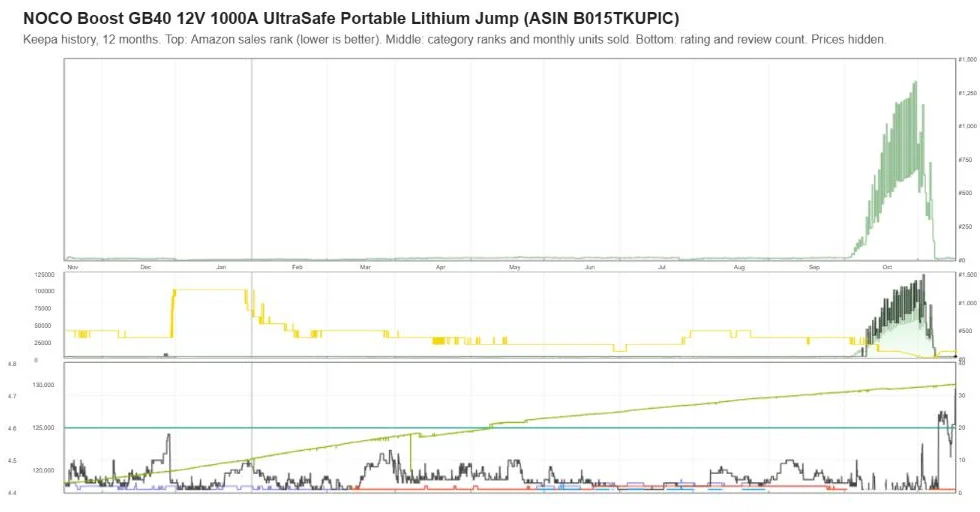
In price tracking, the GB40 has the longest record of any pack we checked: years of sales and a 365-day average rank inside the top 100 of Amazon’s whole Automotive category. Its rating count has passed 129,000 and grows at an even pace, with no bursts. Amazon sells it. Its everyday price sits close to NOCO’s list price, with periodic sales and some stretches out of stock, so the strikethrough price is real rather than inflated.
What we like
- Rated to 6.0L gas, plenty of margin for any small car
- −4°F operating rating in the user guide
- Huge, steady owner base
- Sold by Amazon at an honest list price
Watch out for
- UL 2743 listing not verified
- NOCO says to store it indoors
- 1-year warranty
- Occasional stock gaps on Amazon
Verdict: the pick for most small cars and the one we would choose anywhere with real winters. You are paying for margin you will be glad of on a frozen morning.
2. NOCO Boost GB20 — best budget pick for 4-cylinder cars
NOCO Boost GB20 500A Lithium Jump Starter
Best for: four-cylinder cars in mild climates, with a battery in good health
The GB20 is the GB40’s smaller sibling, and the two are closer than the amp numbers suggest. NOCO’s spec pages list the same 24 Wh lithium-ion battery, the same 7.72 x 3.16 x 1.71-inch body, the same USB-C charging, IP65 rating and 100-lumen light, and the same claim of up to 20 jump starts per charge. The difference is starting current: 500 peak amps instead of 1,000, a gas rating of 4.0 liters, and no diesel rating at all. NOCO lists diesel engines as “not recommended.”
For a small car, 4.0 liters is still generous: twice the size of a 2.0-liter engine and 1.6 times a 2.5-liter one. Where it gets thin is the situation our size calculator flags, a hard freeze or a tired battery. NOCO’s GB20 spec page does not list an operating temperature, so we could not confirm how cold it is rated to work.
Price tracking shows years of steady sales, a 365-day average rank around the top 1,200 in Automotive and thousands of units bought each month. Its rating count grows evenly past 13,000. Amazon sells it, and its usual price runs roughly 20% below the GB40’s.

What we like
- Lowest price of our picks
- Same compact body and 24 Wh battery as the GB40
- Ample for 1.0L to 2.5L gas engines
- Sold by Amazon
Watch out for
- Not for diesel engines
- No published operating temperature
- UL 2743 listing not verified
- Less margin for cold mornings or weak batteries
Verdict: the smart buy for a four-cylinder car in a mild climate if you replace your battery on schedule. If you see hard freezes, spend a little more on the GB40.
3. Clore Jump-N-Carry JNC305 — best for verified safety
Clore Jump-N-Carry JNC305 Lithium Jump Starter
Best for: owners who want third-party safety certification and long cables for a cramped engine bay
Clore Automotive builds Jump-N-Carry packs for repair shops, and the JNC305 is its compact lithium model. Clore rates it at 1,000 peak amps and 300 Start Assist Amps for gas engines up to 6.0 liters and diesels up to 3.0 liters. Its manual lists ETL certification conforming to UL 2743, and its 37 Wh battery is about 50% larger than the 24 Wh packs in the two NOCOs.
The cables are its small-car advantage. Clore lists 21-inch, 8 AWG leads, which help when the battery sits low, behind a fuse box or under a cover. There is an override button for batteries too flat to detect and a USB outlet for a phone. The manual says to clamp the negative lead to an unpainted part of the chassis, crank for no more than 6 seconds, let the unit cool for 3 minutes between tries and stop after four attempts.
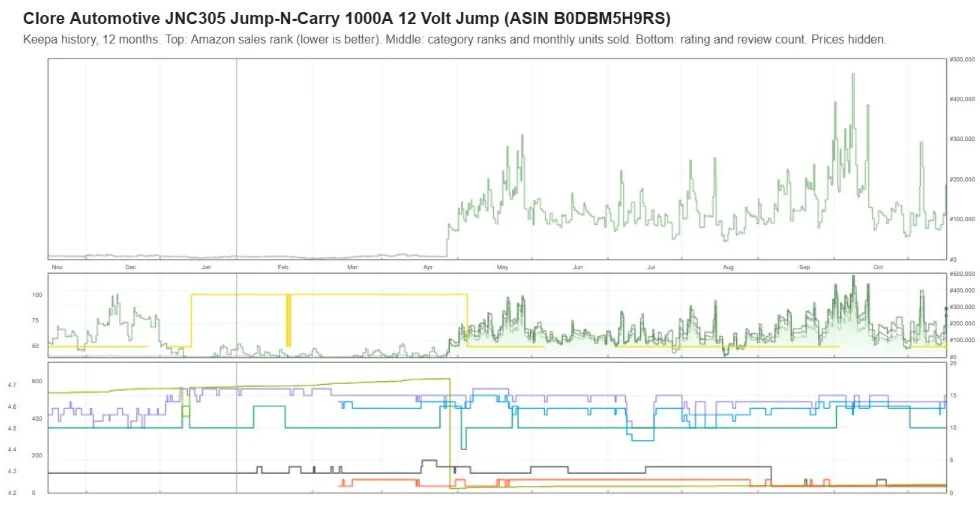
The trade-offs are temperature and track record. Clore rates it to work from 0°F to 108°F and to charge from 32°F to 108°F, and its manual says not to store it below 50°F when you rely on it as a jump starter, with a recharge every three months. In price tracking it has at least two years of history, a steady price, constant stock and Amazon as the seller, but modest sales and only a few dozen ratings.
What we like
- ETL-listed to UL 2743
- 21 in, 8 AWG cables reach tight batteries
- Largest battery of our picks (37 Wh)
- Stable price, sold by Amazon
Watch out for
- Should not be stored below 50°F
- Rated only up to 108°F
- Few owner reviews so far
- More engine rating than most small cars need
Verdict: the choice if certified safety and cable reach matter most to you. Keep it in the house in winter and bring it along when you drive.
NOCO GB20 vs GB40: same box, double the amps
Because these two are the most common small-car choices, we lined up NOCO’s own spec pages side by side. The result is a useful piece of fine print: you are not buying a bigger battery when you step up, only more starting current.
| NOCO GB20 | NOCO GB40 | |
|---|---|---|
| Peak current | 500A | 1,000A |
| Gas engine rating | Up to 4.0L | Up to 6.0L |
| Diesel engine rating | Not recommended | Up to 3.0L |
| Internal battery | 24 Wh lithium-ion | 24 Wh lithium-ion |
| Size | 7.72 x 3.16 x 1.71 in | 7.72 x 3.16 x 1.71 in |
| Weight (spec page) | 2.1 lb | 2.45 lb |
| Jump starts per charge (NOCO claim) | Up to 20 | Up to 20 |
| USB recharge time | About 3 hours at 2.1A | About 3 hours at 2.1A |
| Typical price | About 20% less | Baseline |
Since both store the same energy, the GB40 does not give you more jump starts per charge or more phone charging. What it adds is current, which helps a cold engine with thick oil turn over and helps when the car’s own battery adds almost nothing. If your small car lives somewhere mild and you replace batteries on schedule, the GB20 covers it. If you get hard freezes or tend to run batteries until they quit, the GB40’s extra margin is worth the roughly 20% premium.
Small-car quirks: trunk batteries, hybrids and tight engine bays
Before you buy any small car jump starter, check where your battery lives and how much room there is around it. Small cars have a few habits that bigger vehicles do not:
- The battery may not be under the hood. Some small cars put the 12-volt battery in the trunk or under a seat and provide remote jump-start points in the engine bay. NAPA notes that many hybrids use special jump-start tabs, often inside a fuse box. Your owner’s manual shows where they are; use the points it names.
- Hybrids: 12 volts only. A portable jump starter works on a hybrid’s 12-volt system, never the high-voltage battery. NAPA also points out that some hybrids can restart themselves from the main battery, so check the manual before you reach for a pack.
- Tight engine bays. Small cars tuck the battery behind fuse boxes, covers and air ducts. Longer leads, like the JNC305’s 21-inch cables, make it easier to reach the positive post and a good ground point without stretching the pack across the engine.
- Limited storage, more heat. Small cars have little cargo space, so the pack often ends up in the glovebox or door pocket. A parked car can get hotter than these packs are rated for: 122°F for the GB40 and 108°F for the JNC305. In summer, keep it out of direct sun and bring it inside on the hottest days. Our guide on can you leave a jump starter in your car has the full hot- and cold-weather plan.

Which jump starter fits your small car?
| Your situation | Our pick | Why |
|---|---|---|
| Compact or subcompact, real winters | NOCO GB40 | 6.0L rating and a −4°F floor give the most margin |
| Four-cylinder car, mild climate, healthy battery | NOCO GB20 | Covers gas engines up to 4.0L for about 20% less |
| Cramped engine bay or remote jump points | Clore JNC305 | 21 in cables and a verified UL 2743 listing |
| Small diesel car | NOCO GB40 or Clore JNC305 | Both rated to 3.0L diesel; the GB20 is not for diesels |
| Car that sits outdoors for weeks in deep cold | None of these alone | A lithium pack needs charging indoors; see our cold weather picks |
Shopping on price first? Our best jump starter under $100 guide compares three more packs that passed the same checks. And if your winters regularly drop below 0°F, our best jump starter for cold weather guide covers a supercapacitor pack that can stay in the car. Driving a crossover or a three-row SUV instead? Our best jump starter for SUVs guide sizes packs for bigger engines. And if the garage also holds a motorcycle, our best motorcycle jump starter guide checks which packs are approved for lithium bike batteries.
What we left out, and why
S ZEVZO ET03. One of Amazon’s best-selling jump starters, but its listing claims 8.0 liters gas and 7.0 liters diesel from a 74 Wh battery. Every established maker we checked rates its packs for clearly smaller diesel engines than gas engines. In price tracking, its Buy Box price has also jumped between two very different levels every few weeks, which makes the “deal” price the real price.
AstroAI S8 and TOPDON JS2000Pro. Both passed our checks in the under-$100 guide. For small cars we preferred the NOCOs’ far longer sales record and the JNC305’s verified safety listing; we could not verify a UL 2743 listing for either of these, and TOPDON rates the JS2000Pro only down to 14°F.
Autowit SuperCap 2. A clever supercapacitor pack rated from −40°F to 158°F that can live in the car, but it needs some charge left in your battery, costs more than our picks and is sold by a third-party seller rather than Amazon. It is a cold-weather specialist, not a small-car default.
Unknown brands with huge amp claims. Many listings advertise 3,000 to 6,000 amps with engine ratings that do not add up, or no manual we could find. A small car does not need any of that.
Prefer a set of cables to a jump pack? Compare the best jumper cables for cars and trucks by wire gauge and length.
Frequently asked questions
What is the best jump starter for small cars?
What size jump starter do I need for a small car?
Will a 500 amp jump starter start a car?
Can a jump starter be too powerful for a small car?
Do small jump starters actually work?
Can you use a portable jump starter on a hybrid?
Can I keep a jump starter in my small car?
How we researched this guide
To find the best jump starter for small cars, we started with the best-selling compact jump starters on Amazon and the packs we had already vetted for our other jump starter guides. We checked each candidate’s sales rank, price and review history in Keepa price-tracking data, then read the makers’ spec pages, user guides and manuals for engine ratings, temperature limits, safety listings and warranty terms. The headroom figures are our own math from those published engine ratings. We did not hands-on test any product, and no brand paid for or reviewed this article.
Sources: NOCO GB40 specs · NOCO GB40 user guide · NOCO GB20 specs · Clore JNC305 · Clore JNC305 manual · NAPA: jump-starting a hybrid

Researched by Shahzad
Amazon seller who researches products using sales-rank history, price tracking and owner reviews before recommending anything. Read our disclosure.