
We may earn a commission when you buy through links on this page, at no extra cost to you. It never decides what we recommend. How we make money
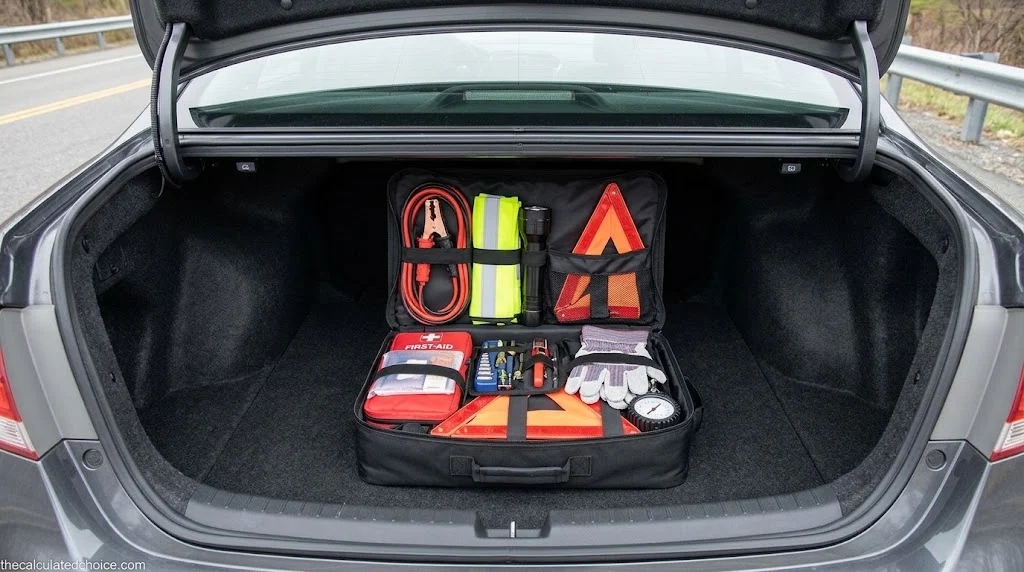
A roadside emergency kit checklist only protects you if the tools inside your trunk actually fit your vehicle. Many pre-packed car bags advertise “100+ pieces,” then pad the count with 70 small adhesive bandages, plastic cable ties, and thin 10-gauge jumper cables that struggle to turn over a cold V6 or SUV engine.
We built this guide for everyday commuters, road-trippers, and cold-climate drivers by combining baseline guidance from the National Highway Traffic Safety Administration (NHTSA), Ready.gov, and federal highway safety rules with real specification checks from tool and kit manuals. Finding out your lug wrench does not fit your wheel nuts or your 12V tire pump blows your car’s accessory fuse on a dark highway shoulder is a preventable mistake.
Table of Contents
Quick answer
- Core 14 itemsCarry visibility markers (3 LED flares or triangles), a reflective vest, a flashlight or headlamp, a jump solution (jumper cables or a lithium jump starter), a 12V or cordless tire inflator, a pressure gauge, a jack with lug wrench and wheel chocks, a seatbelt cutter/window breaker, work and nitrile gloves, a multi-tool with duct tape and cable ties, an optional tow strap, a real first aid kit, a phone charger with a power bank, and a paper map with emergency contacts (NHTSA; Ready.gov).
- Visibility placementPlace 3 road flares or reflective triangles at 10 feet (4 paces), 100 feet (40 paces), and 200 feet behind your car on a divided highway, or 10 feet and 100 feet behind plus 100 feet ahead on a two-way road (49 CFR § 392.22).
- Cable & socket limitsLook for at least 8-gauge jumper cables (12 feet or longer) for daily sedans and crossovers, or a UL 2743 lithium jump starter, and confirm your 12V tire inflator draws 10A to 15A or less so it will not blow your car’s accessory fuse.
- Cold & long-trip add-onsAdd 8 items for winter or rural routes: water and non-perishable food (at least 1 gallon of water per person), a fleece or wool blanket with a Mylar liner, an ice scraper with brush, a collapsible snow shovel, sand or non-clumping cat litter, a rain poncho with warm layers, a UL-rated 5 B:C fire extinguisher, and emergency cash with a whistle (National Weather Service; 49 CFR § 393.95).
The 22-item roadside emergency kit checklist
Rather than dumping a random pile of gear into the trunk, group your checklist by what goes wrong on the shoulder: being seen by oncoming traffic, restarting a dead battery or low tire, treating minor injuries or freeing a jammed seatbelt, and staying warm if help is hours away. Items 1 through 14 belong in every vehicle year-round; items 15 through 22 are essential for freezing weather, rural highways, and long road trips.
| Category | Checklist item | Minimum spec to look for | Where to store it |
|---|---|---|---|
| Visibility (Core) | 1. Three LED road flares or reflective triangles | 360° LED visibility (1+ mile night rating) or weighted triangles; 3-pack minimum | Trunk side pocket (top of bag) |
| Visibility (Core) | 2. High-visibility reflective vest | ANSI/ISEA 107 Class 2 or reflective striping over jacket | Glovebox or driver door pocket |
| Visibility (Core) | 3. LED flashlight or headlamp + spare batteries | Hands-free magnet or headband; store alkaline or lithium cells separately | Glovebox or center console |
| Battery & Tires (Core) | 4. Jumper cables or lithium jump starter | 8 AWG to 4 AWG cables (12–20 ft), or a UL 2743 lithium pack sized to your engine | Trunk organizer |
| Battery & Tires (Core) | 5. Portable 12V or cordless tire inflator | 12V plug rated ≤10A–15A (or cordless), digital gauge with auto-shutoff | Trunk organizer |
| Battery & Tires (Core) | 6. Standalone tire pressure gauge | Pencil, dial, or digital gauge that reads up to at least 60 PSI | Glovebox |
| Battery & Tires (Core) | 7. Vehicle jack, lug wrench, and wheel chocks | Check that the wrench socket fits your lug nuts (plus wheel-lock key if fitted) | Spare-tire well |
| Tools & Cabin (Core) | 8. Seatbelt cutter and window-breaker tool | Spring-loaded or steel carbide tip with recessed razor blade | Center console (within driver reach) |
| Tools & Cabin (Core) | 9. Heavy-duty work gloves + nitrile gloves | Grippy mechanics gloves for tire changes; nitrile gloves inside first aid pouch | Trunk bag & first aid kit |
| Tools & Cabin (Core) | 10. Multi-tool, duct tape, and heavy cable ties | Pliers, wire cutters, Phillips/flat screwdrivers, and a roll of cloth duct tape | Trunk bag |
| Tools & Cabin (Core) | 11. Tow strap or recovery rope (optional by vehicle) | Rated for at least 2x vehicle gross weight; verify your car has recovery points | Trunk spare-tire well |
| First Aid & Comms (Core) | 12. Trauma-capable first aid kit | Sterile gauze pads, elastic wrap, antiseptic wipes, shears, tweezers, and tourniquet | Under passenger seat or trunk |
| First Aid & Comms (Core) | 13. 12V car phone charger, cable, and power bank | Dedicated charging cable matching your phone port + charged USB power bank | Center console |
| First Aid & Comms (Core) | 14. Paper road map and emergency contact card | State highway map + written roadside assistance numbers and insurance policy info | Glovebox |
| Winter & Long-Trip | 15. Drinking water and non-perishable food | Ready.gov baseline: 1 gallon per person per day (use pouches or leave air gap in freezing weather) + calorie bars | Trunk or rear footwell |
| Winter & Long-Trip | 16. Fleece or wool blanket + Mylar thermal blanket | At least one full-size blanket or sleeping bag plus compact Mylar liners | Rear seat or trunk |
| Winter & Long-Trip | 17. Ice scraper and long-reach snow brush | Stiff polycarbonate scraper blade with pivoted brush head | Rear footwell |
| Winter & Long-Trip | 18. Folding or telescopic snow shovel | Metal or reinforced polycarbonate blade to clear snow around tires and exhaust pipe | Trunk |
| Winter & Long-Trip | 19. Traction aid (sand or non-clumping cat litter) | 5–10 lb sealed jug or bag of coarse sand or non-clumping clay litter | Trunk over rear axle |
| Winter & Long-Trip | 20. Rain poncho and extra warm layers | Waterproof poncho, warm hat, thick socks, and insulated mittens | Trunk dry bag |
| Winter & Long-Trip | 21. UL-rated automotive fire extinguisher | Minimum UL rating of 5 B:C with a visual pressure gauge and mounting bracket (49 CFR § 393.95) | Securely mounted in trunk or cabin |
| Winter & Long-Trip | 22. Small emergency cash and whistle | Small bills for rural stations when card networks fail + loud pealess signaling whistle | Glovebox (locked) |
1. Visibility and roadside signaling
Secondary collisions are one of the biggest hazards of a highway breakdown, especially in rain, fog, or darkness. Both NHTSA and Ready.gov list flares or emergency warning markers and a working flashlight among the first items every vehicle should carry. Before you touch a lug wrench or open the hood, your car needs to be visible from several hundred feet away.
- Three LED road flares or reflective warning triangles: A single folding plastic triangle bundled inside a budget emergency bag is not enough to create a lane taper. Carry a set of three magnetic LED road flares or three weighted reflective triangles. Unlike traditional pyrotechnic fusees—which burn for about 30 minutes at extreme heat (49 CFR § 393.95(j)) and should never be used near leaking fuel—battery-powered LED beacons run for hours, attach to the side of a steel vehicle body, and are safe around dry grass or gasoline fumes.
- High-visibility reflective vest: Keep an ANSI/ISEA 107 reflective safety vest in the driver’s door pocket or glovebox, not buried under luggage in the trunk. Putting it on before you step out of the vehicle makes your torso visible to oncoming headlights immediately.
- Hands-free LED flashlight or headlamp: Changing a flat tire or connecting jumper clamps takes both hands. Carry a headlamp or a magnetic worklight along with spare batteries stored outside the light so they cannot corrode the contacts. Do not rely on the tiny 3-LED hand-crank plastic flashlights included in many budget kits; their output is too dim for roadside tire work.
2. Dead battery and flat tire recovery
Dead 12V batteries and slow tire leaks account for the majority of everyday roadside calls. As NHTSA points out, falling temperatures reduce both battery cranking power and tire inflation pressure at the exact same time, while gasoline and diesel engines demand more current to turn over thickened oil.
- Jumper cables or a portable lithium jump starter: Standard jumper cables work reliably if you have a second vehicle nearby and enough cable length to reach both batteries. If you often park in tight commuter lots or drive solo at night, a portable lithium jump starter lets you boost your own battery without flagging down a stranger. Look for a pack that states UL 2743 certification and matches your engine displacement—we cover the full selection checks in our guide on how to choose a jump starter and compare both options in jump starter vs. jumper cables.
- Portable tire inflator and standalone pressure gauge: Many newer cars no longer include a spare tire at all, and those that do often carry a compact temporary spare that slowly loses air in the trunk. A 12V corded or rechargeable portable tire inflator lets you pump up a slow nail puncture to reach a tire shop safely instead of changing a wheel on an active highway shoulder. If you want a single unit that handles both jobs, see our picks for the best jump starter with air compressor.
- Tire inspection and lug tools: NHTSA recommends checking your tires at least once a month when cold (not driven for at least three hours), inflating to the pressure printed on the driver’s door jamb label rather than the maximum PSI stamped on the tire sidewall, and verifying at least 2/32 of an inch of tread depth across every tire—including the spare. Also check that your factory jack is in place and that your lug wrench fits your wheel nuts.
Cable reach, 12V fuse limits and flare spacing math
Three simple numbers separate roadside gear that works on the shoulder from gear that leaves you waiting for a tow truck: jumper cable gauge and length, 12V accessory socket wattage, and warning flare placement distance.
3 roadside spec checks to run before you pack your trunk
1. 12V tire inflator socket limit: Watts = Volts × Amps → 12V × 10A = 120W (or 12V × 15A = 180W)2. Jumper cable reach: nose-to-nose = 12 ft minimum | parked nose-to-tail on a narrow shoulder = 16 to 20 ft3. Highway flare spacing (49 CFR § 392.22): 4 paces (≈10 ft) + 40 paces (≈100 ft) + 80 paces (≈200 ft on divided highways)What the numbers mean: Most passenger cars fuse their 12V cigarette-lighter socket at 10A (120W) or 15A (180W); plugging a heavy-duty compressor that draws more than your socket rating will blow the vehicle fuse immediately. Likewise, 8-foot or 10-foot jumper cables found in budget kits cannot reach from a helper car parked behind you on a narrow one-lane shoulder. eCFR 49 CFR § 392.22 · Everlit Road Guardian Manual · Swiss Safe 2-in-1 Kit Manual
Notice how pre-made emergency kits differ when you check their actual manual numbers. For example, the Everlit Survival Road Guardian kit pairs a 12V digital tire inflator with 12-foot, 8-gauge, 300A copper-clad aluminum (CCA) jumper cables (Everlit manual), and the Swiss Safe 2-in-1 kit manual lists 12-foot cables rated at 300A, while the budget Performance Tool W1555 kit drops down to 8-foot, 10-gauge cables. Lower AWG gauge numbers mean thicker wire: 10-gauge wire has higher electrical resistance than 8-gauge, 6-gauge, or 4-gauge cable, which causes more voltage drop when cranking a cold engine.
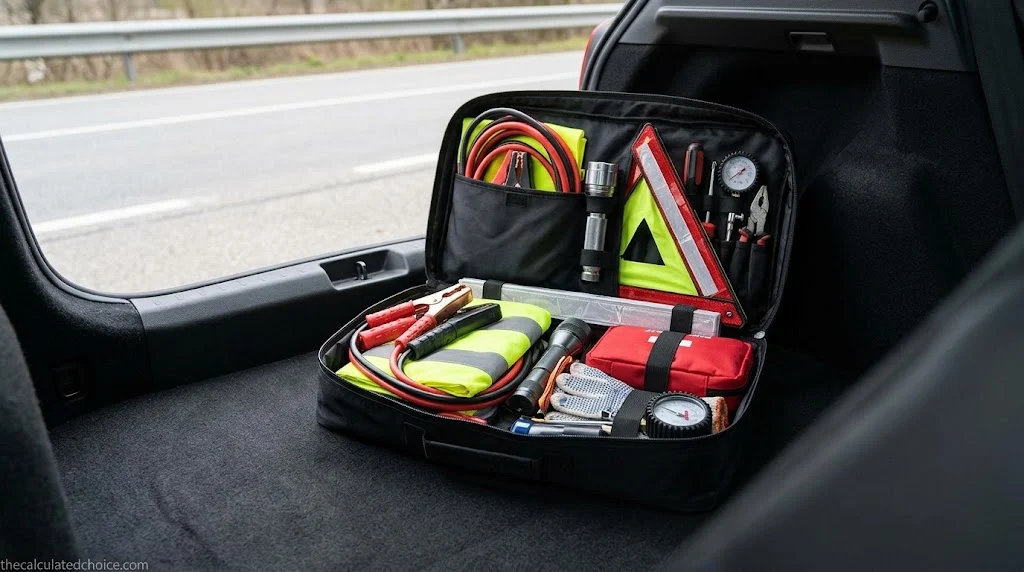
When setting out road flares or reflective triangles, borrow the placement geometry that federal rules mandate for stopped commercial vehicles under 49 CFR § 392.22(b). Turn on your four-way hazard flashers immediately, then pace out your three markers so high-speed drivers have time to react before they reach your bumper:
| Roadway scenario | Marker 1 (closest) | Marker 2 (middle) | Marker 3 (farthest) |
|---|---|---|---|
| Divided highway or one-way road | Within 10 feet (4 paces) of the rear corner on the traffic side | 100 feet (40 paces) behind the vehicle, centered in the shoulder or lane | 200 feet (80 paces) behind the vehicle toward approaching traffic |
| Two-lane, two-way undivided road | 10 feet (4 paces) behind the vehicle on the traffic side | 100 feet (40 paces) behind the vehicle toward approaching traffic | 100 feet (40 paces) ahead of the vehicle in the opposite direction |
| Near a curve, hill crest, or blind obstruction | 10 feet (4 paces) behind the vehicle on the traffic side | 100 feet (40 paces) in the unobstructed direction | 100 to 500 feet toward the curve or hill crest so drivers see it before the blind spot |
Prefer a ready-made trunk bag over building your own from scratch? Compare the five kits that passed our sales-history and spec checks in our best roadside emergency kit guide.
3. First aid, cabin escape and basic tools
A roadside kit covers two different medical and tool jobs: minor cuts or burns while working around a hot engine bay, and serious crash response. Both NHTSA and the American Red Cross recommend keeping a stocked first aid kit inside the vehicle, and NHTSA specifically notes including a tourniquet alongside standard bandages.
- First aid supplies that go beyond adhesive strips: Following the American Red Cross car first aid checklist and NHTSA guidance, make sure your pouch contains sterile gauze pads in multiple sizes, adhesive medical tape, elastic roller bandages, antiseptic wipes, antibiotic ointment, an instant cold pack, non-latex nitrile gloves, trauma shears, tweezers, and a dedicated windlass tourniquet. Check expiration dates on ointments and medications once a year, as Ready.gov advises, because summer cabin heat degrades adhesives and liquids rapidly.
- Seatbelt cutter and window breaker within arm’s reach: A glass breaker and seatbelt cutter stored inside a zippered bag in the trunk cannot help you if a collision jams your door latch or locks the seatbelt retractor. Clip this tool inside the center console, door pocket, or sun visor.
- Gloves, multi-tool, duct tape, and cable ties: Heavy work gloves protect your palms from hot exhaust components and sharp steel cords on a worn tire tread. A stainless multi-tool, a roll of cloth duct tape, and heavy nylon cable ties let you temporarily secure a dragging plastic bumper cover or splash shield after hitting road debris so you can drive off the highway safely.
4. Winter weather and long-trip survival
When a multi-car pileup, blizzard, or rural breakdown closes an interstate for hours, your vehicle becomes a shelter. The National Weather Service (NWS) Car Winter Survival Kit Checklist, NHTSA, and Ready.gov agree on the extra gear required whenever temperatures drop or your route takes you far from town:
- Snow shovel, ice scraper, and traction grit: Carry a collapsible shovel to dig snow away from your wheels and tailpipe, a long-reach brush and ice scraper to keep the windshield clear, and a sealed jug of coarse sand or non-clumping cat litter to pour under spinning drive tires on slick ice. If you are already stuck, our guide on how to get your car unstuck from snow walks through the safe steps.
- Blankets and warm clothing layers: Mylar space blankets reflect body heat well when tucked inside a jacket, but they tear easily and offer zero loft on their own. Pack a real fleece or wool blanket for each regular passenger, plus a dry hat, insulated mittens, and warm boots. If you travel with young children in car seats, remember NHTSA’s car seat rule: dress children in thin, warm layers, buckle the harness snugly first, and place heavy coats or blankets over top of the secured harness so bulky padding cannot compress in a crash.
- Water, non-perishable food, and daily medications: Ready.gov recommends storing one gallon of water per person per day for emergencies alongside high-calorie, non-perishable snacks such as nuts and granola bars. In freezing climates, either use emergency water pouches designed with expansion room or pour a couple of ounces out of plastic bottles so freezing ice does not split the container.
- UL-rated 5 B:C fire extinguisher: Federal motor carrier regulations (49 CFR § 393.95(a)) require non-hazmat commercial vehicles to carry a fire extinguisher with a minimum Underwriters Laboratories rating of 5 B:C (Class B for flammable liquids such as gasoline and oil; Class C for energized electrical wiring), a visual pressure indicator, and a secure mounting bracket so the cylinder cannot roll loose or become a projectile in a sudden stop. Applying the same standard in a family SUV or pickup gives you a real tool for small under-hood electrical or fluid fires.
Why “100-piece” pre-built kits often disappoint
When you shop for a car emergency kit online, listings routinely compete on total piece count—advertising 90, 120, or 150 items for a low price. When we checked the itemized contents lists and manuals of popular kits, four recurring shortcuts stood out:
| Component | What budget pre-built kits include | What actually works on the roadside |
|---|---|---|
| Piece-count padding | 60 to 100 tiny adhesive strips, cotton swabs, and mini zip ties counted as individual “pieces” | Sterile 4×4 gauze pads, elastic trauma wrap, shears, nitrile gloves, and a tourniquet (NHTSA) |
| Jumper cables | Short 8-ft to 10-ft cables made of thin 10-gauge copper-clad aluminum (CCA) wire | At least 12-ft to 20-ft cables in 8 AWG, 6 AWG, or 4 AWG—or a UL 2743 lithium jump starter |
| Tire inflation | No inflator at all, or an analog pump with no auto-shutoff and no published airflow rate | Digital 12V or cordless inflator with auto-shutoff and a fuse draw under 10A–15A |
| Roadside visibility | A single unweighted plastic triangle and a dim hand-crank plastic flashlight | 3 magnetic LED road flares (IP67/IP68 waterproof, 1+ mile night visibility) + a real headlamp |
Also remember that keeping your battery healthy at home prevents most cold-morning no-starts before you ever leave the driveway. If a vehicle sits unused for days at a time or only takes short urban trips in freezing weather, hooking it to an automatic smart charger or maintainer in the garage saves your starter battery—see our guide on how to choose a car battery charger for the amp-hour and chemistry checks.
What to buy: pre-built kit vs. custom setup
You have two sensible ways to finish your roadside emergency kit checklist:
- Start with a vetted all-in-one commuter kit, then add two upgrades: If you want a single organized trunk bag that already includes 12-foot 8-gauge jumper cables, a 12V digital tire inflator with auto-shutoff, a tow strap, a glass breaker, and basic first aid, choose a vetted all-in-one commuter kit and confirm those specs in its manual before you buy. Then drop a 3-pack of LED road flares and a bottle of water into the bag to close the visibility gap.
- Build a custom modular kit piece by piece: If you drive a larger SUV or pickup truck, tow a trailer, or commute in severe winter weather, assemble your own trunk organizer. Pair a dedicated portable tire inflator and a properly sized lithium jump starter (or a jump starter with air compressor) with our picks for the best LED road flares so every tool is sized to your exact vehicle.
How we researched this guide
We did not crash-test vehicles or run lab simulations; we compiled official federal roadside preparedness checklists and cross-checked them against the published manuals and component specifications of top-selling consumer roadside kits.
Sources: NHTSA Winter Driving Tips, Ready.gov Car Safety, Ready.gov Build A Kit, eCFR 49 CFR § 392.22, eCFR 49 CFR § 393.95, NWS Car Winter Survival Kit Checklist, American Red Cross
Frequently asked questions
What are the most important items in a roadside emergency kit?
Is it better to buy a pre-made car emergency kit or build your own?
Where should you keep an emergency kit in your car?
How far behind a car should road flares or reflective triangles be placed?
How can you keep water from freezing in a winter car emergency kit?
How often should you check and replace items in a car emergency kit?

Researched by Shahzad
Amazon seller who researches products using sales-rank history, price tracking and owner reviews before recommending anything. Read our disclosure.