
We may earn a commission when you buy through links on this page, at no extra cost to you. It never decides what we recommend. How we make money
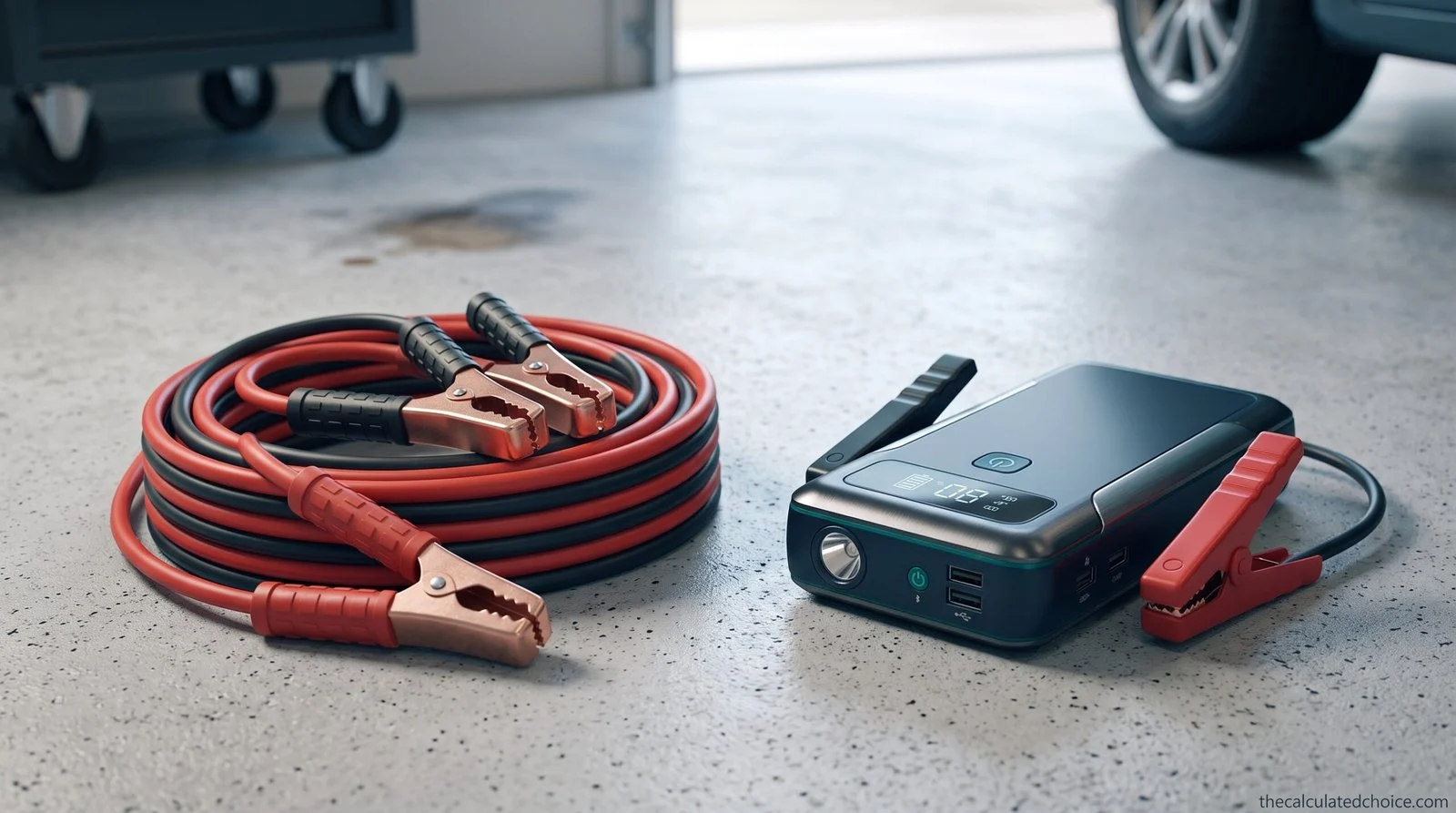
Jump starter vs jumper cables is really a question about who you expect to be around when your battery dies. Jumper cables are cheap, need no charging and last for years — but they are useless without a second running vehicle. A portable jump starter lets you rescue yourself in an empty parking lot at night, but it has to be charged, sized for your engine and kept within its temperature range. Here is how the two compare on the things that actually decide whether your car starts.
Jump starter vs jumper cables: the quick answer
- Choose a jump starter if you often drive alone, at night, in remote areas, or anywhere asking a stranger for help is hard.
- Choose jumper cables if you want the cheapest, zero-maintenance option and there is almost always another car nearby.
- Best setup Keep a charged jump starter as your main tool and a set of cables as a backup that never runs flat.
Side-by-side comparison
| Portable jump starter | Jumper cables | |
|---|---|---|
| Needs a second vehicle | No | Yes |
| Needs charging | Yes, every few months | Never |
| Reverse polarity protection | Usually built in | No (standard cables) |
| Spark protection | Usually built in | No |
| Cold-weather limit | Pack’s rated operating temperature | Depends on the donor car’s battery |
| Engine size it can handle | Limited to the pack’s rating | Depends on cable gauge and donor vehicle |
| Extras | Flashlight, USB power bank on many models | None |
| Typical price | $$ to $$$ for trusted models | $ for a decent set |
| Lifespan | Battery ages over years of use | Many years if stored well |
The biggest difference: needing a second car
In any jump starter vs jumper cables decision, everything else is secondary to this. Jumper cables move power from a running car’s battery to yours, so they only work when someone can park nose-to-nose with you, pop their hood and wait. In a busy lot during the day, that is easy. In a dark garage, a rural road, a snowstorm or a car-park at closing time, it may not happen at all — and it means relying on a stranger. Bad weather adds its own questions; our guide on whether you can jump start a car in the rain covers which packs are rated for wet use.
A jump starter carries its own power. You connect two clamps, switch it on and start the car, usually in a couple of minutes without anyone else involved. That independence is why searches for jump starters have climbed: in Google Trends over the past five years, US interest in “jump starter” has run well above “jumper cables”, with the gap widening every winter.
Safety: packs have guard rails, cables do not
Safety is where the portable jump starter vs jumper cables gap is widest. Standard jumper cables are just thick wires with clamps. They will happily carry current the wrong way if you reverse the connections, and they spark when the last clamp touches metal. That is why the traditional cable order matters: red to the dead battery’s positive, red to the donor’s positive, black to the donor’s negative, and the final black clamp on bare metal on the dead car, away from the battery.
Most modern jump starters add protections that cables cannot: reverse polarity detection that refuses to send power if the clamps are backwards, and spark prevention until a battery is detected. The exception is manual override mode — NOCO’s manual, for example, notes that override disables both protections. Our step-by-step guide on how to use a jump starter safely covers when that mode is appropriate.
Cold weather: a trade-off, not a clear winner
In the cold, the jumper cables or jump starter question gets closer. Cold hits both options, just in different places. AAA reports a car battery loses about 35% of its strength at 32°F and about 60% at 0°F — and with cables, the donor car’s battery is also cold, although its running engine and alternator help. A jump starter has its own limit: every pack has a minimum operating temperature, from about 14°F on some popular lithium models to −10°F on the Clore JNC325 and −40°F on supercapacitor units.
In practice, a charged pack kept in the cabin is the more reliable winter tool for most drivers, while cables remain a useful backup when a pack has been left in a frozen trunk. If winter is your main worry, see our picks for the best jump starter for cold weather.
Cost and maintenance
On cost alone, jump starter vs jumper cables is an easy call: cables win on price. A decent set usually costs far less than any trusted jump starter, needs no charging and can sit in the trunk for years. Look for a low gauge number, because the lower the gauge, the thicker the wire — thin, cheap cables are a common reason a jump feels weak on larger engines.
A trusted jump starter costs more. In our Keepa price tracking, the Clore JNC305 has held a steady price, usually under $100, and the larger Clore JNC325 costs considerably more. Lithium packs also need care: recharge after every use and check the charge every few months, because they slowly lose charge in storage. A supercapacitor pack avoids that by charging from your weak battery at the scene, but it cannot help a fully drained battery without another power source.
Power: which starts bigger engines?
So are jump starters better than cables for big engines? It depends on the donor. With cables, power comes from the donor vehicle, so a pickup helping another pickup through heavy-gauge cables has plenty available. A jump starter is limited to what it is rated for, and those ratings are often exaggerated with headline peak-amp numbers. Match the pack’s published engine rating to your engine — our guides on how many amps it takes to jump start a V8 and peak amps vs cranking amps explain what to look for, and the jump starter size calculator gives you a personal answer.
What neither one can fix
Whichever side of jump starter vs jumper cables you land on, both tools solve the same narrow problem: a battery too weak to crank the engine right now. Neither one repairs a worn-out battery, a failing alternator or a starter motor that has quit. If the engine turns over quickly with help but dies again within a day, the battery is probably at the end of its life or something is draining it overnight. If the engine will not turn over even with a strong jump, the fault is likely the starter, a corroded cable or a bad connection.
There is one small difference here. With cables, you can let the donor car idle for a few minutes before starting, which puts a little charge back into the dead battery and can make the first attempt easier. A jump starter delivers a burst for starting rather than a long recharge. Either way, drive for a while afterwards and get the battery and charging system tested — many auto parts stores do it free.
Jumper cables or jump starter: which should you buy?
| Your situation | Better choice |
|---|---|
| You often drive alone, at night or in remote areas | Jump starter |
| Tight budget, city driving, another car usually nearby | Jumper cables |
| Car sits unused for weeks at a time | Jump starter (or both) |
| You want to help other drivers too | Either — a pack can jump any car within its rating |
| Very cold winters | A cold-rated jump starter, with cables as backup |
| Large diesel truck | Heavy-gauge cables plus a pack rated for your engine |
For most drivers, our recommendation is a jump starter as the main tool and a set of cables as a cheap backup that can never run flat. If you decide on a pack, how to choose a jump starter walks through the specs that matter, and our lithium vs lead-acid comparison helps you pick the right type.
Frequently asked questions
Are jump starters better than jumper cables?
Should I get a portable jump starter or jumper cables?
Will a jump starter start a completely dead battery?
Can jumper cables damage your car?
Is it better to buy a battery charger or a jump starter?
What gauge jumper cables should I buy?
How we wrote this comparison
Safety and operating details come from manufacturer manuals. Prices come from our Keepa tracking of Amazon listings, and search-interest trends from Google Trends. No brand paid to be included.
Sources: NOCO — how to jump start using GB40 · NOCO GB40 user guide · Clore JNC325 operator’s manual · AAA on cold-weather batteries

Researched by Shahzad
Amazon seller who researches products using sales-rank history, price tracking and owner reviews before recommending anything. Read our disclosure.