
We may earn a commission when you buy through links on this page, at no extra cost to you. It never decides what we recommend. How we make money
Knowing what to keep in your car in winter comes down to one rule most checklists ignore: your trunk is a walk-in freezer. Gear that works fine in a heated garage—plastic water bottles, cheap PVC jumper cables, and lithium battery banks—can freeze solid, crack, or refuse to discharge after sitting overnight at 0°F.
This guide is built for daily commuters, parents, and highway drivers who want a practical trunk and cabin packing list backed by National Highway Traffic Safety Administration (NHTSA), National Weather Service (NWS), and Ready.gov standards. We separated every item by where it should live in your vehicle, what temperature rating to check on the label, and how to calculate your fuel runtime if a highway closure traps you overnight.
Packing the wrong supplies carries a real penalty. A standard plastic water bottle splits open when ice expands by roughly 9%, soaking your spare tire well and leaving you with a block of ice you cannot drink. A lithium jump starter left in a -10°F trunk can trip its low-temperature protection circuit right when your 12-volt starter battery loses up to 60% of its cranking power (AAA Oregon/Idaho). If your battery is already weak, our best car battery for cold weather guide explains what to replace it with.
Quick answer
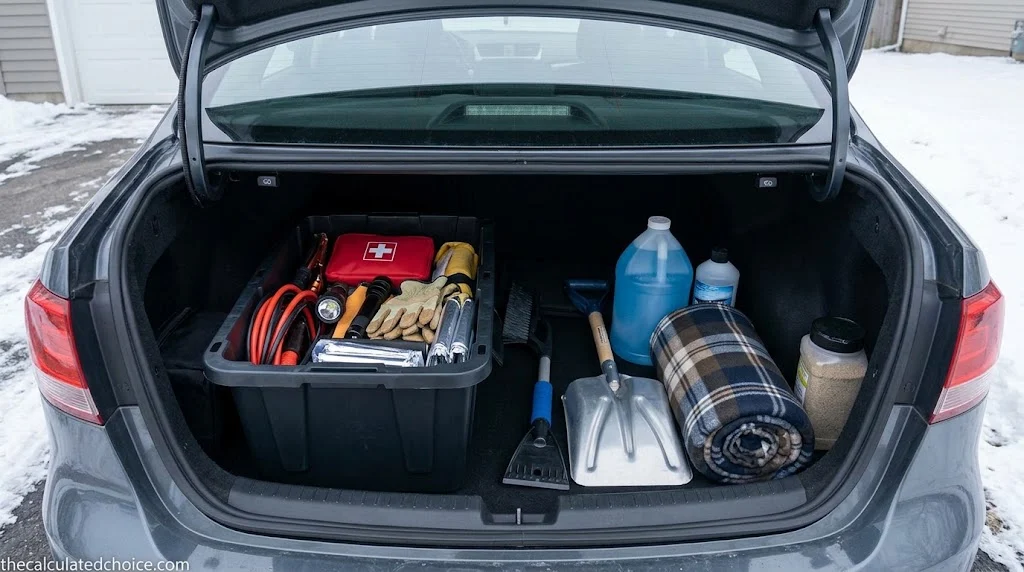
- Trunk recovery gearPack a folding metal snow shovel, 20 lb of non-clumping kitty litter or traction mats, a 10,000-lb tow strap, and 6- to 8-gauge copper jumper cables at least 12 feet long. NHTSA lists a shovel, sand or kitty litter, and jumper cables as winter basics.
- Warmth and shelterCarry a wool or fleece blanket plus aluminized Mylar bivvy sacks, dry wool socks, waterproof insulated gloves, and a knit hat for every passenger (AAA).
- Freeze-tolerant food and waterSkip rigid plastic bottles; store US Coast Guard-approved 4.225-oz (125 mL) foil water pouches and 2,400- to 3,600-calorie ration bars with a 5-year shelf life (Datrex).
- Visibility and signalingKeep a telescoping snow brush with an ice scraper, an extra gallon of -25°F to -34°F de-icer washer fluid, an ANSI high-visibility vest, and three road flares or reflective triangles (Ready.gov).
- Carry-in cabin electronicsBring lithium power banks and portable jump starters inside when temperatures drop below -4°F (-20°C), a common lower operating limit on popular packs such as the NOCO GB40 (see can you leave a jump starter in your car).
Trunk vs. cabin: why cold storage ruins standard gear
Most drivers toss a summer roadside bag into the trunk and assume they are covered for snowstorms. An uninsulated trunk tracks outdoor ambient air within a few hours of parking, which exposes liquids, plastics, and battery chemistry to destructive freeze cycles.
Before you pack your vehicle, divide your gear into three zones: items that must stay in the cabin within arm’s reach of the driver’s seat, heavy hardware that can live in a sub-zero trunk indefinitely, and temperature-sensitive items that belong in a grab-and-go commuter bag you bring indoors at night.
| Item category | What happens in a 0°F trunk | What to pack instead | Where to store it |
|---|---|---|---|
| Drinking water | Rigid plastic bottles freeze, expand, and split their seams | USCG-approved 4.225-oz (125 mL) flexible water pouches (Datrex) | Glovebox or insulated cooler inside trunk |
| Jumper cables | Cheap PVC jacket stiffens and cracks when uncoiled in sub-zero air | Thermoplastic elastomer (TPE) or EPDM rubber-jacketed 6- to 8-gauge cables | Trunk organizer or spare tire well |
| Lithium power banks & jump packs | Electrolyte resistance spikes; many popular packs are rated to operate only down to -4°F (-20°C) | UL 2743 lithium pack kept in your daily work bag, backed up by passive jumper cables in the trunk | Carry indoors overnight during deep freezes |
| Flashlight batteries | Alkaline cells lose voltage and runtime rapidly below freezing | Flashlight loaded with lithium primary cells (CR123A or lithium AA/AAA) or heavy-duty cells checked seasonally | Center console or door pocket |
| Liquid medicines & saline | Contact solution, epinephrine pens, and liquid first-aid sprays freeze | Dry bandages, trauma pad, tourniquet (NHTSA), and personal meds carried on your person | Trauma kit in cabin; liquid meds in coat pocket |
| Escape tool | Unreachable if you are pinned in a seatbelt after sliding into a ditch | Spring-loaded window punch and guarded seatbelt cutter | Clipped to sun visor or center console |
Snow-clearing and visibility items to keep within reach
Visibility failures cause two different winter emergencies: driving blind behind a salted semi-truck when your washer nozzles freeze, and getting rear-ended on the shoulder during a whiteout because approaching traffic cannot see your taillights.
- Long-reach snow brush and ice scraper (26 to 42 inches): Keep your primary scraper on the rear floorboard—not buried in the trunk—so you can open a single door and clear the roof, hood, and glass without dumping snow onto the trunk carpet. AAA lists an ice scraper with brush in its winter emergency kit; clear every window, mirror, and light before shifting out of park.
- Spare gallon of winter de-icer washer fluid (-25°F to -34°F rating): A single highway commute through slush and road brine can empty a 1-gallon reservoir. Carry a sealed jug of winter de-icer formula—such as Prestone De-Icer Windshield Washer Fluid, which is rated down to -34°F (-37°C)—upright in your trunk crate.
- Pyrotechnic road flares or weighted reflective triangles: Your car’s hazard flashers drain a cold 12V battery if left running for hours with the engine off, and blowing snow quickly packs over LED bumper lenses. Ready.gov and NHTSA both specify carrying flares or emergency markers. Non-perchlorate 20-minute wax/strontium flares—like those packed in the Orion Safety Deluxe Roadside Emergency Kit—burn through blowing snow and melt ice around themselves so they do not blow away.
- High-visibility reflective vest and bright distress cloth: Stepping onto an icy shoulder in a dark winter coat is a recipe for get-struck accidents. Keep a neon orange or lime reflective vest in the driver’s door pocket so you can put it on before opening the door, and pack a bright cloth or flag to tie to your antenna or door handle as the National Weather Service advises.
- Headlamp and extra lithium batteries: Changing a flat tire or hooking up jumper cables while holding a phone flashlight in your teeth freezes your fingers and drops your phone in the slush. A simple elastic-band LED headlamp leaves both hands free to work in thick gloves.
Traction, digging, and battery recovery tools for the trunk
When a snowplow buries your parked car behind a compacted ridge of icy slush, or your front tires polish a glaze of ice in a parking lot, spinning the wheels only digs your axle deeper until the undercarriage high-centers on the snowpack.
- Collapsible aluminum or steel snow shovel: Plastic scoop blades flex and snap when chopping through frozen plow berms or packed ice under a differential. Choose a telescoping or three-piece metal shovel with an aluminum or steel blade that breaks down to under 20 inches. You need it both to dig a ramp in front of your drive tires and to clear snow away from your exhaust tailpipe (NWS).
- Abrasive material (10 to 20 lb of non-clumping kitty litter or coarse builders’ sand) or traction boards: NHTSA and Ready.gov both recommend keeping sand or kitty litter in the trunk. Buy non-clumping clay litter or dry traction sand and pour it into a heavy-duty plastic screw-top jug (such as an empty laundry detergent bottle or pet treat jar). Paper bags tear open in a damp trunk, and clumping clay litter turns into slick mud when wet.
- Heavy-duty jumper cables (6-gauge or 8-gauge, 12 to 20 feet long): Short 8-foot, 10-gauge cables work only when a helper car can pull nose-to-nose with yours. If you slide nose-first into a snowbank or are parked between two cars, the donor vehicle must pull up behind you, requiring at least 12 to 16 feet of cable reach. Thicker 6-gauge or 8-gauge conductors carry cold-cranking current with far less voltage drop than thin 10-gauge wire. Compare tested sets in our guide to the best jumper cables for cars and trucks.
- 12V portable tire inflator (plugs into the 12V accessory socket): Tire pressure drops roughly 1 PSI for every 10°F drop in ambient air temperature (see our complete car winterization checklist for the cold-pressure math). A corded 12V air compressor lets you air up soft tires on the spot without hunting for a working gas station air hose with a frozen chuck. See our picks for the best portable tire inflator for cars.
- Woven recovery strap (10,000-lb minimum break strength) with loop ends: If you slide two feet off a plowed driveway into soft snow, a passing pickup can pull you out in thirty seconds—provided you already have a strap and know where your vehicle’s screw-in steel tow eye is stored. Never buy cheap straps with open stamped-steel hooks, which can straighten and launch through a windshield if overloaded.
Warmth, shelter, and spare clothing for stranded passengers
Many drivers run winter errands in a light sweatshirt and sneakers because they expect to walk twenty feet from a heated car into a heated store. If a multi-car pileup shuts down the interstate for eight hours, your cabin loses heat within twenty minutes of shutting off the engine.
Pack a dedicated dry bag or vacuum-sealed pouch in the trunk with clothing that never leaves the car:
- Heavy wool or high-loft fleece blanket plus Mylar thermal bivvy sacks: Thin silver emergency space blankets reflect radiant body heat, but they provide zero loft insulation when pressed against a cold leather or cloth car seat, and they tear easily in the wind. Layer a thick wool or fleece blanket underneath or inside an aluminized Mylar bivvy sack so you have both dead-air insulation and a radiant vapor barrier.
- Waterproof insulated work gloves and knit glove liners: Leather or cotton mechanic’s gloves soak through within two minutes of shoveling wet slush, accelerating frostbite. Pack waterproof ski or winter work mittens alongside thin dexterity liners so you can attach jumper clamps or thread a tow eye without touching sub-zero steel with bare skin.
- Warm knit hat, neck gaiter, and two pairs of wool-blend socks per regular occupant: Stepping out of the car into ankle-deep slush immediately wets everyday dress shoes or athletic sneakers. Having dry wool socks and a pair of slip-on waterproof overshoes or spare winter boots in the trunk prevents trench foot and frostbite while waiting for a tow.
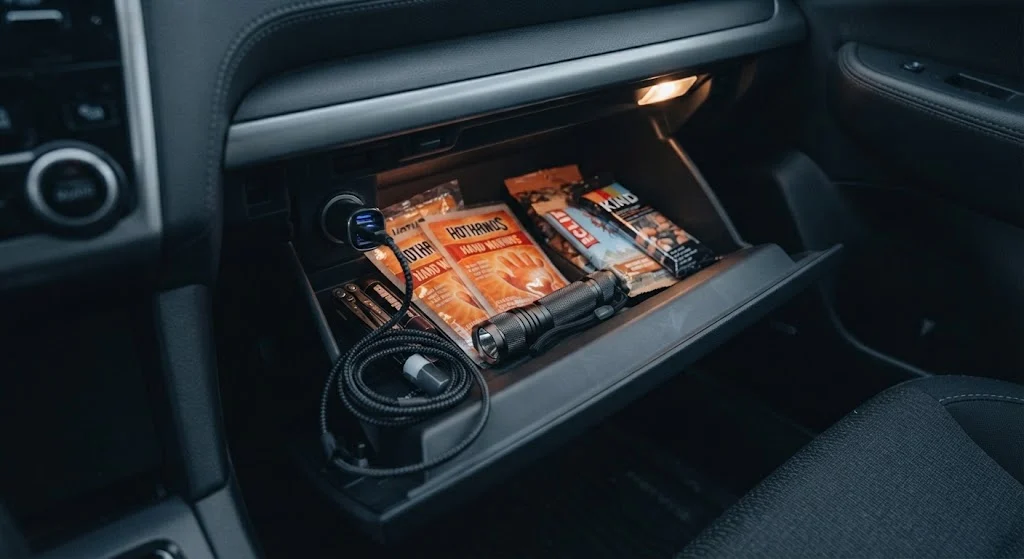
- Air-activated iron-powder hand and toe warmers: Single-use chemical warmers use an exothermic iron-oxidation reaction when exposed to oxygen. Check the expiration date stamped on the outer wrapper at the start of every cold season, and tuck warmers inside your boots and inner coat pockets—never directly against bare skin.
Freeze-proof water, food, and first aid supplies
Staying hydrated and fed helps your body generate metabolic heat while shivering in a cold cabin. However, residential pantry snacks and bottled water fail quickly in a freezing vehicle.
- US Coast Guard-approved emergency water pouches: Instead of rigid plastic bottles, pack individual 4.225-oz (125 mL) foil-laminated water pouches—such as Datrex Emergency Water Rations. Datrex packages each 125 mL pouch for bursting strength and a 5-year shelf life, and a flexible pouch is far less likely to split than a rigid bottle; a small pouch is also easy to thaw inside an inner jacket pocket using body heat.
- Non-thirst-provoking calorie bars and fat/nut snacks: Standard chocolate-coated granola bars turn rock-hard at 0°F and can chip a tooth, while salty chips dehydrate you when drinking water is limited. USCG-certified 2,400-kcal or 3,600-kcal shortbread ration bars (like those included in Ready America cold weather kits and Emergency Zone roadside kits) stay chewable in the cold far better than chocolate-coated bars and carry a 5-year shelf life.
- Trauma-capable first aid kit (including a tourniquet): NHTSA’s winter driving guidelines specifically call for a first aid kit that includes a tourniquet alongside gauze pads, trauma dressings, nitrile gloves, and trauma shears capable of cutting through heavy winter coats.
- 12V car charger, braided charging cables, and a whistle: Cold drains smartphone batteries fast. Keep a dual-port 12V plug-in charger and a dedicated charging cord in the glovebox so you never accidentally take it inside. Add a pea-less plastic whistle to your keychain or mirror; a whistle blast carries much farther over howling blizzard wind and snowplow engines than a human voice.
- Paper highway map and written emergency phone numbers: If a cell tower loses backup power during an ice storm or your phone dies, GPS apps disappear. Ready.gov lists a map in its car emergency kit; keep it in the glovebox along with a laminated card listing your insurance roadside number, state highway patrol non-emergency dispatch, and family contact numbers.
Stranded heating math: how long your gas tank will last
If a blizzard strands you on the highway, your car is both your shelter and your furnace. The National Weather Service instructs stranded motorists to stay inside the vehicle—walking in a whiteout quickly leads to disorientation and hypothermia—and to run the engine and heater for about 10 minutes every hour to stay warm while conserving fuel.
You can calculate exactly why NHTSA and Ready.gov urge drivers to keep their fuel tank close to full during winter weather using U.S. Department of Energy (DOE) idling fuel-consumption figures:
Stranded engine idling runtime calculation
Step 1 (DOE idling burn rate): Idling a passenger vehicle consumes 0.25 to 0.50 gallons of fuel per hour of continuous engine runtime.Step 2 (NWS 10-min/hr cycling factor): Running the engine 10 minutes per hour = 1/6 hour of runtime per clock hour = 0.042 to 0.083 gallons burned per clock hour.Example (16-gal tank at 1/2 full = 8 gal usable, burning 0.40 gal/hr at idle): Continuous idling = 8 gal ÷ 0.40 gal/hr = 20 hours total. NWS 10-min/hr cycling = 20 hours × 6 = 120 hours (5 full days) of intermittent cabin heat.By contrast, if you get trapped with only 1.5 gallons left on the low-fuel warning light, continuous idling empties the tank in 3.75 hours. U.S. Department of Energy & National Weather Service
| Fuel remaining in tank (16-gal tank example) | Continuous idling runtime (at 0.25 to 0.50 gal/hr) | NWS 10-min/hr cycling runtime (intermittent heat) | Safety margin for an overnight highway closure |
|---|---|---|---|
| Low-fuel light (2 gallons) | 4 to 8 hours | 24 to 48 hours | Risky if traffic creeps for hours before stopping |
| Quarter tank (4 gallons) | 8 to 16 hours | 48 to 96 hours | Borderline after normal commute fuel burn |
| Half tank (8 gallons) | 16 to 32 hours | 96 to 192 hours | Recommended daily minimum floor in winter |
| Three-quarters to full (12–16 gallons) | 24 to 64 hours | 144+ hours | Full buffer for multi-day rural blizzard closures |
What to buy: pre-built kits vs. custom trunk crates
You can assemble a winter car survival setup in two ways: start with a vetted commercial roadside bag for your electrical, tire, and signaling hardware, and then drop it into a plastic trunk crate alongside a metal shovel, traction litter, wool blankets, and foil water pouches.
In our companion product review of the best winter car emergency kits, we checked Keepa sales-rank stability, seller history, and manufacturer manuals to separate dependable hardware from flimsy multi-piece bags:
- For an all-in-one roadside hardware core ($$): The Everlit Survival Road Guardian packs 12-foot 8-gauge 300A jumper cables, a 12V digital auto-shutoff tire inflator, a tow strap, a reflective triangle, a glass breaker, and a 108-piece first aid kit in a 17″ × 7″ × 7″, 8-lb bag. Add your own metal snow shovel, blanket, and water pouches to make it blizzard-ready.
- For severe whiteout visibility ($$): The Orion Safety Products Deluxe Roadside Emergency Kit (Item #8901) is one of the few kits built around real 20-minute non-perchlorate pyrotechnic highway flares, a folding reflective triangle, a high-visibility orange safety vest, a thermal blanket, and 8-foot 10-gauge jumper cables.
- For compact trunks on a tight budget ($): The Justin Case Travel Pro covers 8-foot 10-gauge jumper cables, a 12-foot 10,000-lb tow strap, a flashlight, work gloves, a poncho, and 365 days of complimentary 24/7 roadside assistance in a compact 11.4-inch soft case.
Remember that trunk supplies only help after something goes wrong. To prevent dead batteries, frozen washer lines, and hydroplaning before you leave the driveway, work through our complete checklist on how to winterize your car first.
Your cabin gear should always include an ice scraper and snow brush stored inside the passenger compartment rather than locked under a frozen trunk lid. Plastic hardware-store scoops can crack as soon as they hit salted plow ice, so pack a metal portable snow shovel for your car that fits beside your spare tire. Carrying a bag of traction sand and a metal shovel only works if you know the right sequence—read our guide on how to get your car unstuck from snow before you hit the road.
How we researched this guide
We did not conduct destructive cold-chamber testing; we cross-checked federal winter safety protocols, battery and ration manufacturer manuals, and real owner failure reports.
Sources: NHTSA, National Weather Service, Ready.gov, U.S. Department of Energy
Frequently asked questions
How do you keep emergency water from freezing and bursting in your car in winter?
Can I leave a lithium jump starter or power bank in my trunk all winter?
Is cat litter or sand better for winter car traction?
How often should you run your car engine for heat if stranded in a snowstorm?
What food is best to keep in your car for winter emergencies?
What should electric vehicle (EV) drivers keep in their car in winter?

Researched by Shahzad
Amazon seller who researches products using sales-rank history, price tracking and owner reviews before recommending anything. Read our disclosure.