
We may earn a commission when you buy through links on this page, at no extra cost to you. It never decides what we recommend. How we make money
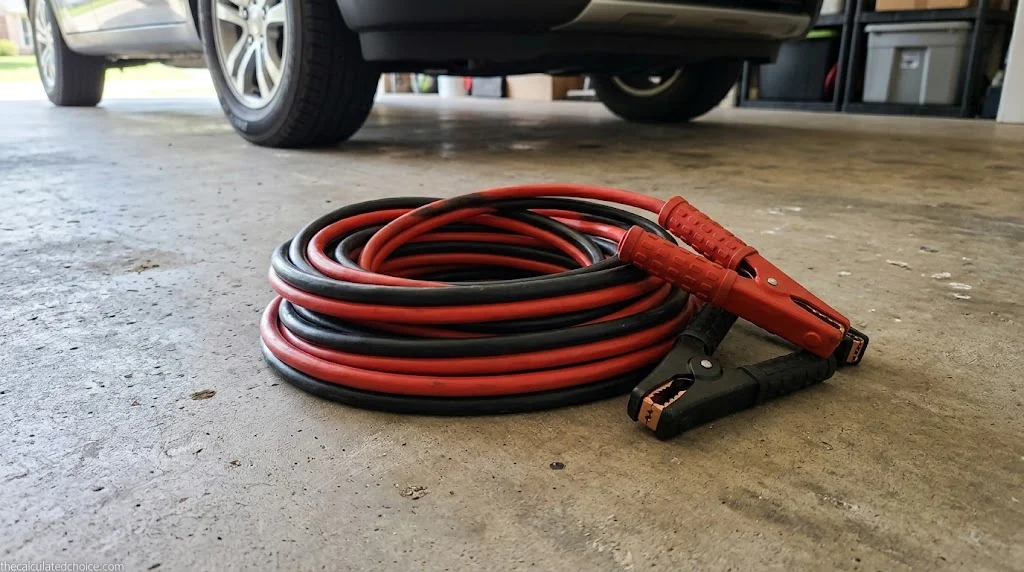
Shopping for the best jumper cables for cars and trucks comes down to two numbers that most product boxes hide in fine print: the actual American Wire Gauge (AWG) thickness and whether the core is pure copper or Copper-Clad Aluminum (CCA). Most drivers grab a bargain set of thin 8-gauge or 10-gauge cables, toss them into the trunk, and only discover the mistake on a freezing morning when the starter motor just clicks. If you would rather buy cables as part of a complete roadside bag, see our picks for the best winter car emergency kit.
When you try to crank a V6 SUV or a V8 pickup through undersized CCA wire, more of the donor car’s current is lost as heat in the cable instead of reaching the starter. Thin cables or a poor clamp connection can make the cables heat up quickly; if they get hot, disconnect them and let them cool before trying again.
We analyzed wire-gauge resistance tables, Copper-Clad Aluminum conductivity data, manufacturer manuals, and Keepa sales-rank and review history to narrow the market down to three dependable sets that cover compact commuters, family SUVs, and heavy full-size trucks.
Quick answer
- Best for most SUVs and trucksEnergizer 2-Gauge 20-Foot balances thick 2 AWG wire with a 20-foot reach.
- Best for full-size trucks and trailer parkingEnergizer 1-Gauge 30-Foot Quick-Connect (ENB130) steps up to 1 AWG wire across a 30-foot span and includes a permanent battery harness for engines up to 8L gas or 6L diesel.
- Best for sedans and compact crossoversTOPDC 4-Gauge 20-Foot (TD-P0420) cuts trunk weight to 5.15 pounds while keeping 20 feet of reach and UL-tested clamps.
- Core sizing ruleBecause all three mainstream sets use Copper-Clad Aluminum (about 63%–65% IACS conductivity), step up one full gauge thicker than old-school pure-copper charts suggest.
Our picks at a glance
Every cable set below uses Copper-Clad Aluminum (CCA) conductors with cold-weather vinyl or PVC insulation that the makers say stays usable down to about -40°. Where a manufacturer does not publish a specific number on its official specification sheet, we state that directly rather than guessing.
| Model & ASIN | Best For | Wire Gauge & Length | Conductor & Clamp Rating | Item Weight | Written Warranty |
|---|---|---|---|---|---|
| Energizer 2-gauge 20-foot set (B0B52D1NWZ) | Midsize/large SUVs, V6/V8 pickups, two-car households | 2 AWG, 20 ft | CCA wire; vinyl-coated clamps | Not listed | 2-year warranty |
| Energizer ENB130 (B01GU4O3GG) | Full-size pickups, diesels up to 6L, bumper-to-tail parking | 1 AWG, 30 ft (with quick-connect harness) | CCA wire; 800A vinyl-coated clamps | About 11 lb | 2-year warranty |
| TOPDC TD-P0420 (B073VHBRFC) | Compact cars, sedans, small crossovers | 4 AWG, 20 ft | CCA wire; UL-tested clamps (amp rating not published on maker page) | 5.15 lb | 36 months when bought from TOPDC’s own store; listing also claims a 5-year quality guarantee |
The best jumper cables for cars and trucks
Energizer 2-Gauge 20-Foot Heavy-Duty Jumper Cables
Best for: Midsize and full-size SUVs, half-ton pickup trucks, and multi-vehicle households
Energizer’s listing for this 2-gauge, 20-foot set describes tangle-free Copper-Clad Aluminum (CCA) cables that stay flexible down to -40°C, a carrying bag, and a 2-year warranty.
On Keepa, this set is sold by TECHBUY (the Energizer brand store) and shipped by Amazon, ranks #1 in Battery Jumper Cables, and shows 300+ units bought in the past month. Its rank and review count are shared with the other Energizer cable sizes on the same listing, so judge the reviews as a family rather than for this size alone.
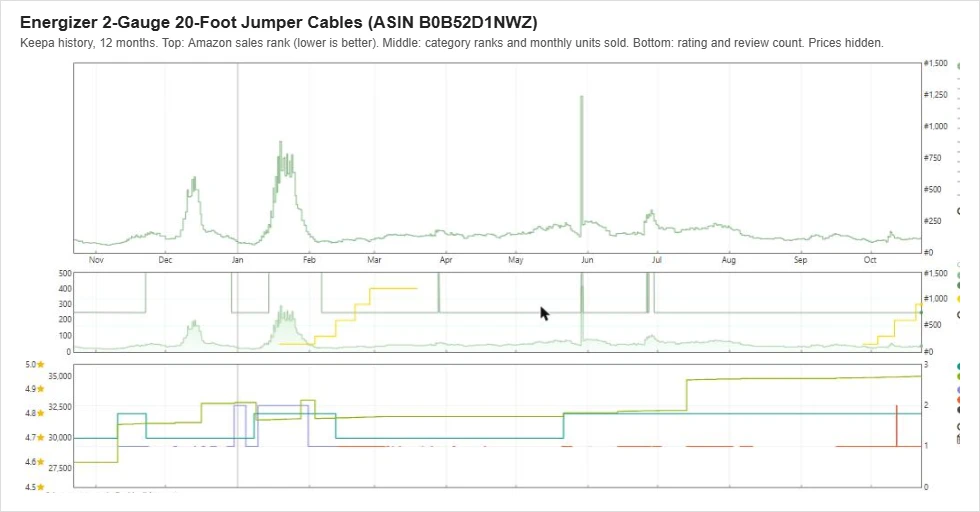
Fine print: Energizer does not publish a clamp amp rating for this 2-gauge set on the listing, so compare it by wire gauge and length rather than by amps. The thick vinyl coating on the clamp handles can also feel bulky when reaching recessed battery posts tucked under a plastic cowl.
What we like
- 2 AWG thickness cuts line resistance by roughly 37% compared to 4 AWG cables of the same 20-foot length
- 20-foot reach lets you boost a vehicle parked nose-to-tail in a narrow single-lane driveway
- Vinyl-coated clamps with a carry bag included
Watch out for
- Uses Copper-Clad Aluminum (CCA) rather than pure electrolytic copper
- Heavier and bulkier in the trunk than a 4-gauge car set
- Thick vinyl clamp insulation can crowd tight engine-bay battery boxes
Verdict: The smart default for SUVs, pickup trucks, and households that own more than one vehicle size. Skip it if you only drive a subcompact car with a tiny trunk organizer, or if you need 30 feet of reach to clear a trailer hitch.
Energizer 1-Gauge 30-Foot Jumper Cables with Quick Connect (ENB130)
Best for: Full-size trucks, SUVs, fleet vans, and engines up to 8-liter gas or 6-liter diesel
When a truck dies nose-first against a garage wall or with a trailer on the hitch, a 16-foot or 20-foot cable may not reach from the donor vehicle. Energizer’s listing for this kit pairs 30 feet of 1-gauge Copper-Clad Aluminum cable with 800A clamps, a carry bag, and a permanent installation kit: ring terminals stay bolted to your battery, and a quick-connect plug lets you hook up the cables later without reaching the battery itself. Energizer rates it for vehicles with up to 8-liter gasoline and 6-liter diesel engines, and retailers list a 2-year warranty.
On Keepa, this set is sold by TECHBUY (the Energizer brand store) and shipped by Amazon, has sold steadily for years with a rank around 40,000 that climbs every winter, and shows 100+ units bought in the past month.
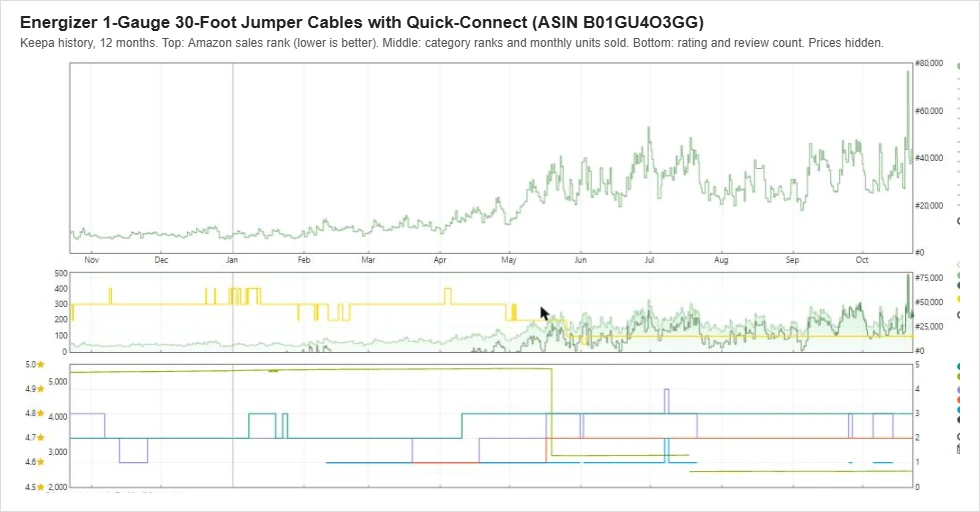
Fine print: Read the installation instructions carefully before bolting on the permanent harness: the quick-connect lead connects directly to your battery posts via ring terminals, so you must secure the plug cap against water, road salt, and bumper impact. Also remember that once you cut or permanently mount the harness onto one vehicle, the quick-connect end is tied to that truck unless you unbolt the ring terminals.
What we like
- 1 AWG conductor compensates for the extra voltage drop of a 30-foot cable run
- Includes ring terminals, mounting hardware, and a quick-connect plug for hood-closed boosting
- Explicitly rated by the maker for up to 8L gasoline and 6L diesel engines, with cables that stay flexible down to -40°F
Watch out for
- Weighs about 11 pounds, making it heavy to coil by hand
- Costs more than standard clamp-on 2-gauge or 4-gauge sets
- Quick-connect bumper plug requires careful routing away from hot exhaust manifolds and spinning belts
Verdict: Purpose-built for pickup owners, tow vehicles, and work vans that frequently jump-start equipment from behind another vehicle. Skip it if you don’t want to store an 11-pound bag or have no plans to use the 30-foot reach and quick-connect harness.
TOPDC 4-Gauge 20-Foot Heavy-Duty Jumper Cables (TD-P0420)
Best for: Compact cars, midsize sedans, small crossovers, and budget-conscious daily commuters
For a 4-cylinder sedan or compact crossover, an 11-pound truck cable is more than you need. According to TOPDC’s product page, this set uses 20 feet of 4-gauge Copper-Clad Aluminum wire in freeze-resistant PVC, with UL-tested clamps that grip both top-post and side-terminal batteries. It weighs 5.15 pounds and comes in a zippered 600D Oxford fabric bag.
On Keepa, the TOPDC set is sold by TOPDC and shipped by Amazon, ranks around #387 overall in Automotive and #2 in Battery Jumper Cables, shows 3,000+ units bought in the past month, and has been strong for years. Its review count once dropped, most likely when Amazon split its size variations apart, rather than jumping in a suspicious burst.

Fine print: TOPDC does not publish an amp rating for this set. Its website advertises a 36-month warranty for purchases from TOPDC’s own store, while the product description also mentions a 5-year quality guarantee. If you buy on Amazon, ask TOPDC which warranty applies before you need it.
What we like
- Lighter 5.15-pound weight and a zippered 600D Oxford carry bag
- Clamps have passed UL testing for extreme temperatures (-40°F to 140°F) and grip both top and side posts
- Full 20-foot length where many budget sets are only 12 or 16 feet
Watch out for
- 4 AWG CCA has higher electrical resistance than 2 AWG, making it underpowered for large V8 trucks or diesel engines
- Maker does not publish an amperage rating on the official TD-P0420 spec sheet
- Warranty terms differ between TOPDC’s own store and the product description
Verdict: An honest, easy-to-store 20-foot emergency set for 4-cylinder and small V6 passenger cars. Skip it if you drive a full-size pickup, a heavy SUV, or a diesel engine—step up to the 2-gauge or 1-gauge Energizer sets instead.
Sizing math: AWG resistance and CCA voltage drop
Why do so many 6-gauge and 8-gauge booster cables struggle to start a dead truck even when the donor vehicle is running? Because most consumer jumper cables use Copper-Clad Aluminum (CCA): an aluminum core with a thin copper outer layer, typically 10% to 15% of the conductor by volume.
According to conductor test data from CB Cables, pure electrolytic copper achieves 97% to 100% IACS (International Annealed Copper Standard) electrical conductivity, whereas Copper-Clad Aluminum reaches only about 63% to 65% IACS. That means a CCA wire has roughly 1.54 to 1.59 times the electrical resistance of a pure copper wire of the exact same AWG number.
How to calculate round-trip voltage drop across CCA jumper cables
Step 1 (Round-trip wire length): Current travels out through the red (+) cable and returns through the black (-) cable. A 20-ft cable set = 40 ft of total conductor path; a 30-ft set = 60 ft.Step 2 (Pure copper baseline at 20°C): Per the HyperPhysics AWG table, resistance per 1,000 ft of copper is 0.124 Ω (1 AWG), 0.1563 Ω (2 AWG), 0.2485 Ω (4 AWG), and 0.3951 Ω (6 AWG).Step 3 (Adjust for CCA at 63% IACS): Divide copper resistance by 0.63 (R_CCA = R_Cu ÷ 0.63). That gives 0.1968 Ω/1,000 ft for 1 AWG CCA, 0.2481 Ω/1,000 ft for 2 AWG CCA, and 0.3944 Ω/1,000 ft for 4 AWG CCA.Example (250-amp cranking draw): Multiply round-trip resistance by 250 A (V_drop = I × R). Across 20 ft (40 ft round trip), 4 AWG CCA drops 3.94 V (250 A × 0.01578 Ω), while 2 AWG CCA drops only 2.48 V (250 A × 0.00992 Ω). Across 30 ft (60 ft round trip), 1 AWG CCA drops 2.95 V (250 A × 0.01181 Ω).Saving nearly 1.5 volts across the cable during a 250-amp crank keeps the starter solenoid engaged instead of chattering. Sources: HyperPhysics AWG Resistance Table and CB Cables CCA vs Pure Copper Guide
Here is how standard wire gauges compare side by side when you combine the HyperPhysics AWG dimensions with the 63% IACS Copper-Clad Aluminum factor and manufacturer vehicle recommendations:
| AWG Size | Metal Diameter (in) | Circular Mils Area | Pure Copper Ω / 1,000 ft (20°C) | Estimated CCA Ω / 1,000 ft (at 63% IACS) | Recommended Vehicle Match |
|---|---|---|---|---|---|
| 1 AWG | 0.2893 in | 83,694 CM | 0.1240 Ω | 0.1968 Ω | Full-size pickups, 30-ft long-reach runs, gas up to 8L / diesel up to 6L |
| 2 AWG | 0.2576 in | 66,373 CM | 0.1563 Ω | 0.2481 Ω | Midsize & large SUVs, V6/V8 pickups, cold-climate multi-vehicle kits |
| 4 AWG | 0.2043 in | 41,742 CM | 0.2485 Ω | 0.3944 Ω | Compact cars, sedans, coupes, small 4-cylinder crossovers |
| 6 AWG | 0.1620 in | 26,250 CM | 0.3951 Ω | 0.6271 Ω | Light-duty short-reach (16 ft max) boost on warm subcompacts only |
| 10 AWG | 0.1019 in | 10,381 CM | 0.9989 Ω | 1.5856 Ω | Not recommended for direct cranking; trickle-transfer only |
Buying checks and manual fine print
Before you click buy on any set of booster cables, check four physical details that separate a working roadside tool from thick plastic jacket hiding thin wire:
- Don’t confuse insulation thickness with wire gauge: A thick outer PVC jacket can make thin wire look heavy-duty. Always check the AWG number and the weight: the TOPDC 20-foot 4 AWG set weighs 5.15 pounds, and the Energizer 30-foot 1 AWG kit weighs about 11 pounds.
- Check the cold-weather temperature rating: Standard hardware-store PVC turns stiff in freezing weather, making the cables fight you like frozen garden hoses. Check what the maker says about deep cold: Energizer says its cables stay flexible down to -40°C, and TOPDC says its clamps passed UL testing from -40°F to 140°F.
- Inspect the clamp jaws and spring tension: Even 1-gauge wire fails if the clamp teeth only touch a tiny corner of the lead post. Look for jagged copper-plated or double-layer copper jaws with heavy coil springs that bite through surface oxidation on both top-post and GM-style side-terminal batteries.
- Protect CCA conductors from nicks and moisture: CCA relies on its thin copper skin for corrosion resistance. If the cladding gets gouged near the clamp crimp and road salt gets in, the aluminum core can corrode. Wipe the clamps dry after rainy roadside use before zipping the bag shut.

Popular picks we rejected
Many top-selling jumper cables on Amazon rack up thousands of reviews because they are cheap and fit in a glovebox, not because they can pull a dead battery through a cold crank. Here are the popular configurations we passed on after checking their manuals and wire physics:
| Cable Configuration | Published Specs Checked | Why We Rejected It |
|---|---|---|
| 10-Gauge 12-Foot Booster Cables | 10 AWG CCA wire, 12-foot length | At 0.9989 Ω/1,000 ft in copper (and ~1.59 Ω/1,000 ft in CCA), 10-gauge wire has more than 6 times the resistance of 2-gauge wire. And at 12 feet long, it cannot reach unless cars park nose-to-nose. |
| 6-Gauge 16-Foot Light-Duty Cables | 6 AWG CCA wire, 16-foot length | 6 AWG wire has about 2.5 times the resistance of 2 AWG wire, which is thin for midsize SUVs or trucks, and the 16-foot length is 4 feet shorter than our 20-foot picks. |
| Unbranded “1,500A–2,000A Peak” Bargain Cables | No published AWG circular-mil area, no UL clamp testing, no brand warranty page | Sellers advertise fantasy peak-amp numbers on thin 6-gauge or 8-gauge CCA wire that can run hot during a long crank, with no verifiable manufacturer support. |
Safe connection order and terminal prep
Even a 1-gauge cable cannot push current through a layer of white crust on your battery posts. If you see powdery buildup, follow our step-by-step guide on how to clean car battery terminals before you clamp on, so poor contact does not overheat the clamps.
To keep any spark away from the battery, follow the standard four-step clamp order:
- Red (+) to the dead battery: With both ignitions and all accessories turned off, clamp one red positive lead firmly onto the positive (+) post of the stalled battery, wiggling the jaws slightly so the teeth bite into clean metal.
- Red (+) to the booster battery: Clamp the other end of the red positive cable to the positive (+) post of the good battery.
- Black (-) to the booster battery: Clamp one black negative lead to the negative (-) post of the good battery.
- Black (-) to unpainted chassis metal on the stalled vehicle: Attach the final black negative clamp to a heavy, unpainted metal bracket on the stalled vehicle’s engine block or frame—far away from the battery, fuel lines, and spinning fan belts. Start the donor vehicle, let it charge the weak battery for 3 to 5 minutes, crank the stalled vehicle, and remove the clamps in the exact reverse order (ground clamp first).
How we chose these picks
We did not lab-test these cables; we analyzed Keepa sales-rank and review history, manufacturer user manuals, official brand spec pages, and electrical engineering wire tables to verify which cables deliver real conductor mass without inflated claims.
Sources:, TOPDC TD-P0420 Official Page, HyperPhysics AWG Wire Table, OSHA Battery Safety eTool
Frequently asked questions
Are 2-gauge or 4-gauge jumper cables better?
What gauge jumper cables do I need for a pickup truck or diesel engine?
Does jumper cable length reduce cranking power?
Are Copper-Clad Aluminum (CCA) jumper cables safe to use?
Why do jumper cables get hot when trying to start a car?
Why does the last black clamp go on unpainted metal instead of the negative battery post?

Researched by Shahzad
Amazon seller who researches products using sales-rank history, price tracking and owner reviews before recommending anything. Read our disclosure.