
We may earn a commission when you buy through links on this page, at no extra cost to you. It never decides what we recommend. How we make money
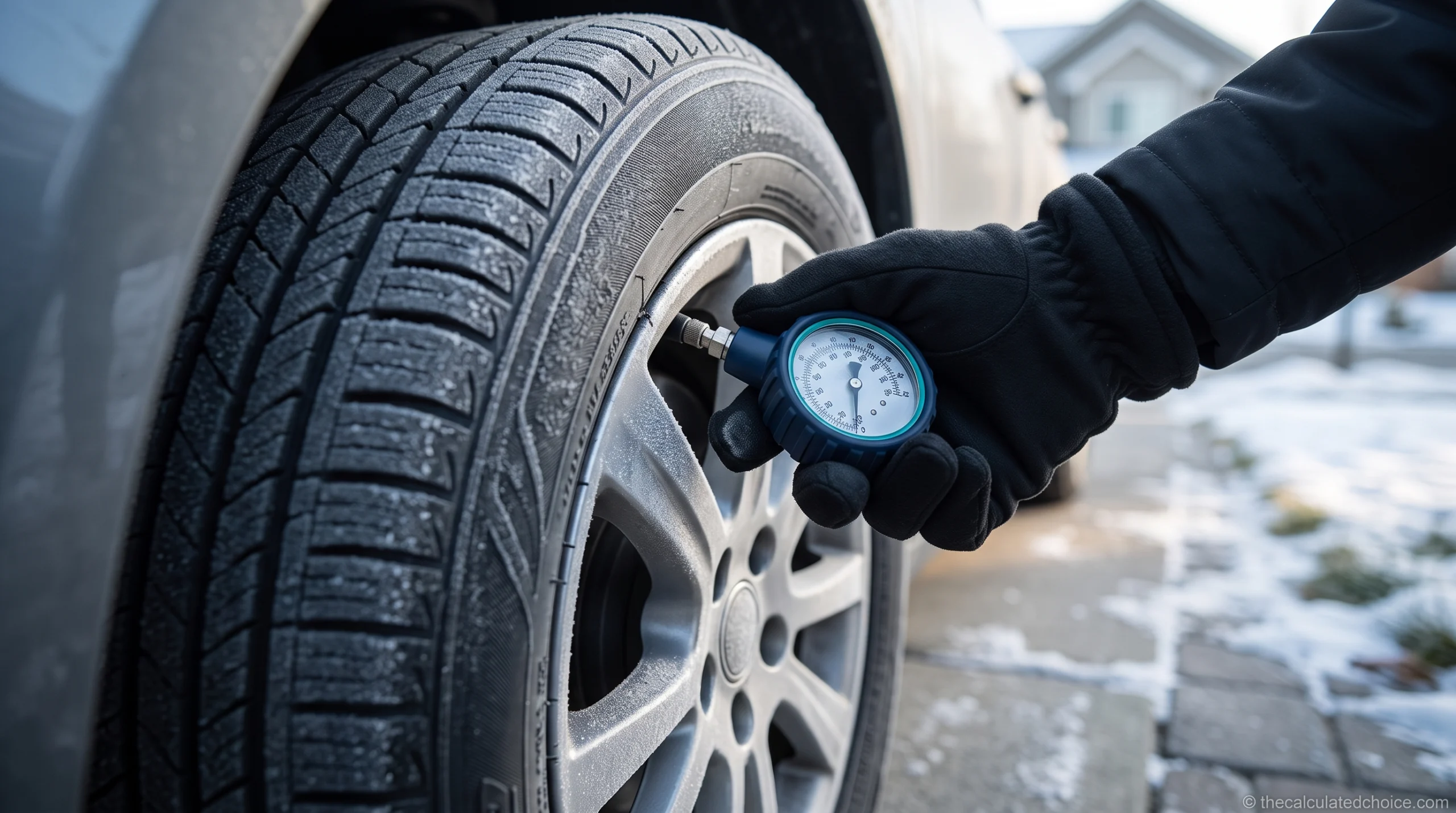
Tire pressure in cold weather drops by about 1 PSI for every 10°F the air cools, on a typical car tire. A tire you set to 35 PSI on a 70°F afternoon will read about 30 PSI on a 20°F morning, with no leak at all. This guide is for US drivers heading into fall and winter who want to know how much pressure they will really lose, why the tire pressure light comes on during the first cold snap, and exactly how much air to add without overdoing it. We worked out the numbers ourselves and checked them against AAA, Bridgestone, Michelin and Tire Rack.
How much does tire pressure drop in cold weather?
- The rule About 1 PSI per 10°F drop on car tires in the 30s, and about 2 PSI on 80 PSI light-truck tires.
- Real example 35 PSI set at 70°F reads about 30 PSI at 20°F and about 28 PSI at 0°F.
- No leak needed Cold air simply pushes less. The pressure comes back as the tire warms.
- What to do Add air to the door-label number, measured cold at the outdoor temperature.
- Don’t overdo it Do not add extra “winter” PSI beyond the label; from a warm garage, add 1 PSI per 10°F difference.
Cold weather tire pressure chart: how much it drops
Air in a sealed tire behaves like any gas: its pressure follows its absolute temperature, as NASA’s equation of state explains. We used that relationship to work out what a tire set on a mild day will read on colder mornings. The table assumes the tire was filled at 70°F and loses no air. Tire pressure is only one part of cold-weather prep, so run through our full how to winterize your car checklist before the first hard freeze.
| Outside temperature | Car tire set to 32 PSI | Car tire set to 35 PSI | LT tire set to 80 PSI |
|---|---|---|---|
| 70°F (when filled) | 32.0 | 35.0 | 80.0 |
| 60°F | 31.1 | 34.1 | 78.2 |
| 50°F | 30.2 | 33.1 | 76.4 |
| 40°F | 29.4 | 32.2 | 74.6 |
| 32°F | 28.6 | 31.4 | 73.2 |
| 20°F | 27.6 | 30.3 | 71.1 |
| 10°F | 26.7 | 29.4 | 69.3 |
| 0°F | 25.8 | 28.4 | 67.5 |
| −10°F | 24.9 | 27.5 | 65.7 |
| −20°F | 24.1 (just above the TPMS point) | 26.6 (near the TPMS point) | 63.9 |
Work it out for your own tires
Use absolute pressure and absolute temperature, then convert back to a gauge reading:
New reading ≈ (PSI + 14.7) × (new °F + 460) ÷ (old °F + 460) − 14.7Example: 35 PSI set at 70°F, checked at 20°F: (49.7 × 480 ÷ 530) − 14.7 ≈ 30.3 PSI, a drop of about 4.7 PSI. This assumes sea-level air pressure, no air loss and a tire that does not change size. Real tires flex slightly, so treat the answer as close, not exact.
Does tire pressure drop 1 or 2 PSI per 10 degrees?
You will see both numbers online. AAA, Bridgestone’s tire safety manual and Michelin all say about 1 PSI per 10°F. Goodyear and several service chains say 1 to 2 PSI. Continental says 1 to 2 PSI per 10°C, which is an 18°F change. They are not really disagreeing; they are describing different tires.
Tire Rack explains the pattern: pressure changes about 2% for every 10°F. On a 30 to 50 PSI car tire that is roughly 1 PSI, and on an 80 to 100 PSI heavy-duty tire it is roughly 2 PSI. Our math agrees: about 0.9 PSI per 10°F at 35 PSI, and about 1.8 PSI at 80 PSI. The other reason for the “2 PSI” figure is ordinary air loss. AAA says tires also lose 1 to 2 PSI a month on their own, so over a few weeks of falling temperatures, the two effects stack.
What “cold tire pressure” means (and what temperature counts)
The pressure on your door-jamb label is a cold inflation pressure, and “cold” describes the tire, not the weather. A Kia owner’s manual gives a typical definition: the car has not been driven for at least three hours, or has been driven less than a mile. Driving heats the tires, and the same manual says warm tires usually read 4 to 6 PSI above the cold number.
So there is no single outside temperature that counts as cold. Check the tires in the morning before you drive, at whatever the weather is that day, and compare that reading to the label. On a freezing morning the reading is lower than in summer, which is the drop shown in the chart above, and that is when you add air back to the label number.
Why the tire pressure light comes on in cold weather
Federal rules require the TPMS warning when a tire falls 25% below the vehicle’s recommended cold pressure (about 26 PSI for a 35 PSI label). Temperature alone rarely gets a correctly filled tire that low. What usually trips the light is temperature on top of a tire that was already a little low. NHTSA describes it exactly: on cold mornings the light may come on for a short time and then turn off as the tires warm up, because pressure that was marginally low dipped below the threshold overnight.
The first-cold-morning math
Say you set your tires to 35 PSI on a 75°F day in early fall and do not check them again for two months.
Temperature drop to 25°F ≈ −4.7 PSI · Normal air loss (AAA: 1–2 PSI a month) ≈ −2 to −4 PSIThat leaves about 26 to 28 PSI on the first frosty morning, right around the 26 PSI warning point for a 35 PSI car. Nothing is wrong with the tire; it simply has not been topped up since summer.
If the light stays on after the car warms up, or one tire is much lower than the others, look for a real leak. For a full breakdown of the 25% rule by label pressure, see our guide on what your tire pressure should be.
Should you add air to tires in cold weather?
Yes, if they read below your door-label number when checked cold. The label pressure is a cold pressure, and “cold” in winter means at the outdoor temperature, before you drive. Fill to that number and stop there.
What you should not do is add extra pressure “for winter.” Michelin says to follow the vehicle maker’s recommended pressure and warns that too much air reduces the tire’s contact area and grip on icy roads. Continental likewise advises keeping to the vehicle maker’s recommended pressure. And do not let air out later in the day if the tires read high after driving; Bridgestone’s manual says never to release pressure from a hot tire.
The warm garage rule
There is one case where you set the gauge above the label number on purpose: filling tires inside a heated or attached garage before driving out into the cold. Tire Rack’s advice is to add 1 PSI to the cold pressure for each 10°F difference between the garage and the outside air. The tire then settles at the correct number once it reaches outdoor temperature.
| Garage temperature | Outside temperature | Label pressure | Fill to in the garage (Tire Rack rule) | Our gas-law check |
|---|---|---|---|---|
| 65°F | 35°F | 35 PSI | 38 PSI | About 38.0 PSI |
| 65°F | 15°F | 35 PSI | 40 PSI | About 40.2 PSI |
| 60°F | 0°F | 32 PSI | 38 PSI | About 38.1 PSI |
This is not overinflation: once outside, the tire sits at the label pressure. The simpler option is to check the tires outside after the car has been parked there for a few hours. Either way, never go above the maximum pressure printed on the tire’s sidewall.
A cold-weather tire pressure routine
- Check more often. AAA suggests doubling your usual once-a-month check during winter, and Continental suggests every two weeks in cold months. Check again after any big temperature drop.
- Check in the morning, before driving. That is the cold reading the label refers to.
- Keep your gauge warm. Some digital gauges have cold limits; one popular model’s manual lists a 23°F minimum. Store it in the house and bring it out to check.
- Top up to the label number and recheck each tire, including the spare.
- Watch for one tire that keeps dropping. Temperature affects all four tires about equally; a single low tire usually means a leak.
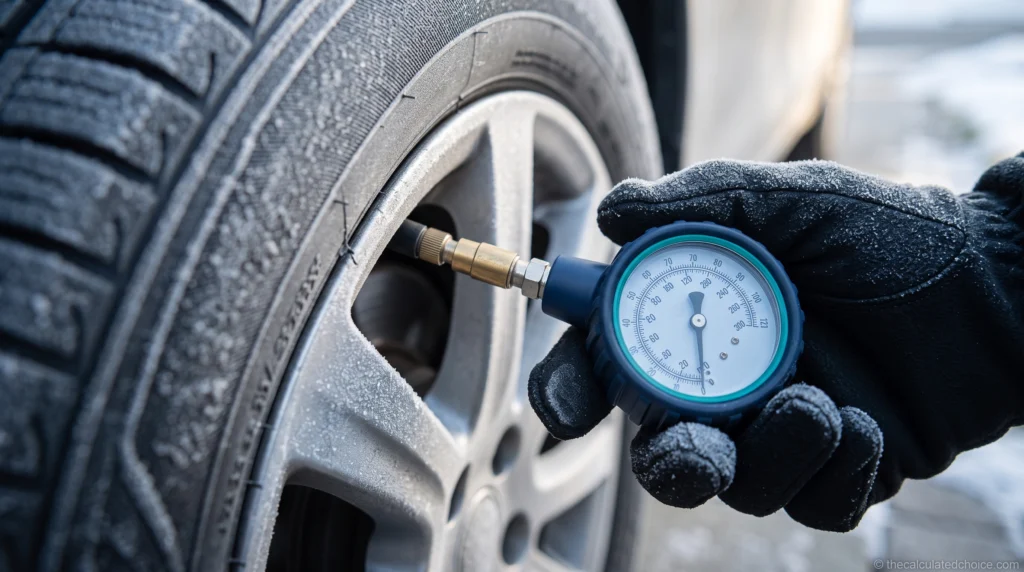
If you are buying a gauge for winter, our guide to the best digital tire pressure gauge compares operating temperatures and accuracy at car pressures. Cordless inflators can also struggle in the cold; our cordless vs corded tire inflator comparison covers what cold does to battery-powered pumps, and our guide to using a portable tire inflator safely walks through the fill step by step.
Does tire pressure go back up when it warms up?
Yes. The part of the drop caused by temperature reverses as the air warms, which is why a TPMS light that comes on at dawn can go off by lunchtime. Driving and sunshine raise the reading too. In a Tire Rack test, tires set to 35 PSI climbed to 36.5 PSI in the shade and 40 PSI in direct sun on a warm day.
That is the reason to make every adjustment on cold tires. The air lost to normal seepage does not come back on its own, so if your tires are still below the label number on a cold morning, they need air.
Cold weather tire pressure myths vs facts
| Myth | Fact |
|---|---|
| Low pressure on a cold morning means a puncture. | Not necessarily. A 50°F drop takes about 5 PSI out of a car tire with no leak at all. |
| Add a few extra PSI for winter. | Michelin and Continental both say to keep the vehicle maker’s pressure. Too much air reduces grip on ice. |
| Every tire loses 2 PSI per 10 degrees. | About 2% per 10°F: roughly 1 PSI on car tires and 2 PSI on 80 PSI truck tires. |
| Check after driving so the tires are “warmed up.” | Label pressures are cold pressures. Warm tires read high. |
| If the TPMS light goes off, the problem is solved. | It went off because the tire warmed up. It is still low when cold, so add air. |
Frequently asked questions
Does tire pressure drop in cold weather?
Do I need to put air in my tires when it’s cold?
What should my tire pressure be in winter?
Is 27 tire pressure too low?
Can cold weather raise your tire pressure?
Why does my tire pressure light come on when it’s cold?
How much does tire pressure drop overnight?
What temperature is considered cold tire pressure?
How we researched this guide
To explain tire pressure in cold weather, we compared the guidance from AAA, Bridgestone, Michelin, Continental, Tire Rack and NHTSA, then calculated our own pressure-versus-temperature tables with the ideal gas relationship, using sea-level air pressure and no air loss. Where sources give different rules of thumb, we explain why. The garage table compares Tire Rack’s rule with our own math. We did not hands-on test anything for this article, and no brand paid for or reviewed it.
Sources: AAA: low tire pressure in winter · Bridgestone tire maintenance and safety manual · Michelin: preparing your car for winter · Continental: tire pressure in winter · Tire Rack: temperature and tire pressure · NHTSA tire safety · FMVSS No. 138 · NASA: equation of state

Researched by Shahzad
Amazon seller who researches products using sales-rank history, price tracking and owner reviews before recommending anything. Read our disclosure.