
We may earn a commission when you buy through links on this page, at no extra cost to you. It never decides what we recommend. How we make money
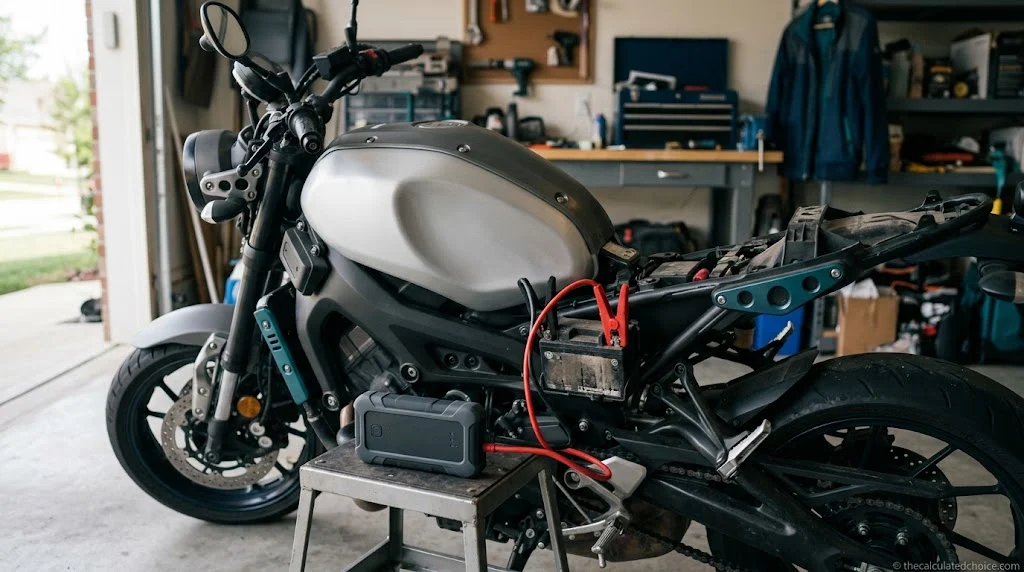
The best motorcycle jump starter is the one its maker allows on your bike’s battery. That sounds obvious, but it is the detail most buying guides skip. NOCO, the best-selling brand, says its Boost packs are for 12-volt lead-acid batteries only, and many newer and upgraded bikes run lithium batteries. Size matters far less: almost any decent compact pack has more starting power than a motorcycle needs.
This guide is for US riders with a dead or weak battery, from 250cc commuters to big-twin cruisers and touring bikes. We read each maker’s manual and FAQ for battery-type rules, temperature limits and safety listings, worked out how much margin each pack gives a motorcycle engine, and checked years of Amazon sales, price and review history. Four jump starters passed, each for a different kind of rider.
Best motorcycle jump starter: quick picks
- Best overall NOCO Boost GB20 — rated for gas engines up to 4.0L, about double a 117 cubic-inch V-twin, with a long, steady sales record. For 12V lead-acid and AGM batteries only.Check price →See review ↓
- Best to carry on the bike Battery Tender 600A Jump Starter — 0.8 lb and about 5.5 inches long, made by a motorcycle battery brand, and listed for lithium as well as lead-acid batteries.Check price →See review ↓
- Best for lithium batteries Clore Jump-N-Carry JNC305 — its manual approves lead-acid and lithium vehicle batteries, and it is ETL-listed to UL 2743.Check price →See review ↓
- Best for a car-and-bike garage NOCO Boost GB40 — rated for gas engines up to 6.0L, so the same pack covers your bike and your car. Lead-acid batteries only.Check price →See review ↓
Best motorcycle jump starter: side-by-side comparison
| Spec | NOCO Boost GB20 | Battery Tender 600A | Clore JNC305 | NOCO Boost GB40 |
|---|---|---|---|---|
| Best for | Best overall | Carrying on the bike | Lithium batteries | Car-and-bike garage |
| Battery types the maker allows | 12V lead-acid only | AGM, gel, lithium, flooded lead-acid | Lead-acid and lithium | 12V lead-acid only |
| Peak current | 500A | 600A (300A start current) | 1,000A (300 Start Assist Amps) | 1,000A |
| Engine rating | Gas up to 4.0L | Gas up to V6, diesel up to 3.0L | Gas up to 6.0L, diesel up to 3.0L | Gas up to 6.0L, diesel up to 3.0L |
| Operating temperature | −4°F to 122°F | 32°F to 104°F (manual) | 0°F to 108°F | −4°F to 122°F |
| Weight | 2.1 lb (spec page) | 0.8 lb | 2.2 lb | 2.4 lb |
| Cable reach | Not published | 15.5 in, 8 AWG | 21 in, 8 AWG | Not published |
| Water rating | IP65, ports closed | Not published | Usable in rain, never submerged | IP65, ports closed |
| UL 2743 | Not verified | cETLus (UL 2743) on maker’s page | Yes (ETL, conforms to UL 2743) | Not verified |
| Warranty | 1 year | 1 year | 1 year | 1 year |
| Sold by | Amazon | Amazon | Amazon | Amazon |
| Price band | $ | $$ | $–$$ | $$ |
| Price | Check price | Check price | Check price | Check price |
Specs come from NOCO’s GB20 page and FAQ, NOCO’s GB40 user guide, Battery Tender’s product page and manual, and Clore’s JNC305 manual. Two conflicts are worth knowing. NOCO’s GB20 spec page lists 2.1 lb while its product page says 2.4 lb. Battery Tender’s product page says its pack works in below-freezing weather, but its manual lists an operating range of 32°F to 104°F, so we go by the manual.
Check your motorcycle battery type before you buy a jump starter
Car buyers rarely need this step. Riders do, because motorcycles use three kinds of batteries and jump starter makers do not treat them the same way. Before you buy any motorcycle battery jump starter, find your battery type: it is printed on the battery itself and listed in your owner’s manual.
- 12-volt lead-acid, including AGM and gel. Most stock bikes use these. Every pack in this guide can jump them.
- 12-volt lithium (usually LiFePO4). Common as an upgrade and on some newer bikes. NOCO’s FAQ answers “Can Boost jump start a lithium battery?” with a flat no, saying lithium batteries are sensitive to how current is applied. Clore’s JNC305 manual approves lead-acid and lithium vehicle batteries, and Battery Tender lists lithium among its 600A pack’s compatible types.
- 6-volt. Found on some older and vintage bikes. Every pack here is a 12-volt jump starter, and NOCO’s FAQ warns that jumping a 6V battery could be extremely dangerous. A 6V bike needs a 6V charger, not a 12V pack.
| Your battery | NOCO GB20 / GB40 | Battery Tender 600A | Clore JNC305 |
|---|---|---|---|
| 12V lead-acid, AGM or gel | Allowed | Allowed | Allowed |
| 12V lithium (LiFePO4) | Not allowed by NOCO | Listed as compatible | Allowed in the manual |
| 6V | Not allowed | Not listed (12V pack) | Not listed (12V pack) |
How much jump starter does a motorcycle need?
Very little, compared with a car. The cold cranking amps (CCA) rating on your bike’s battery is a good guide to how hard the starter works, and motorcycle batteries are small. Here are real figures from Yuasa’s powersports application guide. Even the big-twin battery at the bottom of the table is rated for a few hundred cold cranking amps.
| Yuasa battery | CCA | Capacity | Example bikes Yuasa lists |
|---|---|---|---|
| YTX5L-BS | 80 | 4 Ah | — |
| YTX7A-BS | 105 | 6 Ah | — |
| YTX9-BS | 135 | 8 Ah | — |
| YTZ10S | 190 | 8.6 Ah | Honda CBR1000RR, BMW S1000RR (early years) |
| YTX14-BS | 200 | 12 Ah | — |
| YTX20L-BS | 270 | 18 Ah | — |
| YTX20HL-BS | 310 | 18 Ah | Harley-Davidson Softail and Dyna, Honda Gold Wing (early 2000s) |
The motorcycle headroom check
Headroom = the pack’s gas engine rating ÷ your engine size in litersJump starter makers rate packs by car engine size, so convert your bike’s displacement to liters (1,000cc = 1.0L; a 117 cubic-inch V-twin is about 1.9L) and divide. We use the same method in our best jump starter for small cars guide. Battery Tender rates its 600A pack as “up to V6” rather than in liters, so it is not in this table.
| Your engine | 4.0L class (NOCO GB20) | 6.0L class (Clore JNC305, NOCO GB40) |
|---|---|---|
| 250cc single (0.25L) | 16× headroom | 24× headroom |
| 650cc twin (0.65L) | 6.2× | 9.2× |
| 1,000cc sportbike (1.0L) | 4.0× | 6.0× |
| 117 cu in V-twin (about 1.9L) | 2.1× | 3.2× |
On paper, the smallest pack in this guide covers every motorcycle on the road with room to spare. The case for a bigger pack is margin, not need: a big twin with a 300-plus CCA battery, a cold morning and a battery that is completely flat all make the pack work harder. Bigger amp numbers on the box do not tell you much on their own, because brands measure peak current differently; our guide to peak amps vs cranking amps explains why the engine rating is the better number to compare.
How we chose the best motorcycle jump starters
We started with the best-selling portable motorcycle jump starters on Amazon, the compact car packs many riders buy instead, and packs from motorcycle battery brands, then kept only those that passed every check:
- Battery-type rules in writing. The maker states which battery types the pack can jump, so riders with lithium batteries can choose safely.
- Enough for any motorcycle. Rated for at least a 4.0L gas engine or a V6, about double the largest common V-twins.
- Published limits. Temperature limits, cranking rules and warranty terms in a manual or on the maker’s site.
- A real brand. A brand website, a support channel and a written warranty.
- Sales history. At least two years of steady sales in Keepa price-tracking data.
- Clean reviews and honest pricing. Ratings that grow evenly, with no bursts, and no inflated list price.
- A trustworthy seller. In stock new and sold by Amazon.
- Safety certification. We prefer a UL 2743 listing, the safety standard for portable lithium jump starters, and say plainly when we could not verify one.
1. NOCO Boost GB20 — best overall for most motorcycles
NOCO Boost GB20 500A Lithium Jump Starter
Best for: riders whose bike uses a stock 12V lead-acid or AGM battery
The GB20 is the default pick for a motorcycle with a stock battery, and the numbers show why. NOCO rates it for gas engines up to 4.0 liters, which is about double a 117 cubic-inch big twin and four times a 1,000cc sportbike. NOCO’s FAQ answers “Can Boost jump start a motorcycle?” with yes, as long as the battery is 12-volt lead-acid. It lists an operating range of −4°F to 122°F and says thermal sensors stop the pack from working outside it.
Two details suit riders in particular. The case is rated IP65 with the port covers closed, which NOCO says means it can be exposed to water but not submerged, so a wet roadside is not a problem. And if your battery is so flat the pack cannot see it, below about 2 volts, the GB20 has a Manual Override that you hold for three seconds. NOCO warns that override switches off the safety protections, so use it only as a last resort and only with the clamps placed correctly.
In price tracking, the GB20 has more than six years of history, a 365-day average rank around the top 1,200 in Amazon’s whole Automotive category and thousands of units bought each month. Its rating count has passed 13,000 and grows in a straight line, with no bursts. Amazon sells it, and its price sits close to NOCO’s list price.

What we like
- Rated for about double the largest common V-twins
- −4°F operating rating and an IP65 case
- Huge, steady owner base
- Lowest price of our picks
Watch out for
- NOCO says no to lithium and 6V batteries
- UL 2743 listing not verified
- NOCO lists two different weights
- Not for diesel engines
Verdict: the right pack for most riders with a stock lead-acid or AGM battery. If your bike has a lithium battery, skip it and look at the next two picks.
2. Battery Tender 600A — best motorcycle jump starter to carry on the bike
Battery Tender 600 Amp Lithium Jump Starter (030-1000-WH)
Best for: riders who want a pack small enough for a tank bag or under-seat space, including bikes with lithium batteries
Battery Tender is a powersports battery brand first, and this is the pack most clearly built with riders in mind. Its product page names motorcycles, ATVs and powersports vehicles and rates it for gas engines up to a V6 and diesels up to 3.0 liters. It weighs 0.8 lb and measures 5.51 x 2.31 x 2.14 inches, less than half the weight of our other picks. It also lists AGM, gel, lithium and standard lead-acid batteries as compatible, which makes it one of the few small packs that suits a lithium-battery bike.
The manual gives a 300-amp start current and 600-amp peak, tells you to wait at least 30 seconds between attempts and to check the vehicle after three tries, and asks you to recharge the pack every three months in storage. Its smart clips signal problems with an amber light and beeps for reverse polarity, low pack voltage and overheating. Our jump starter error light guide decodes each of these signals.
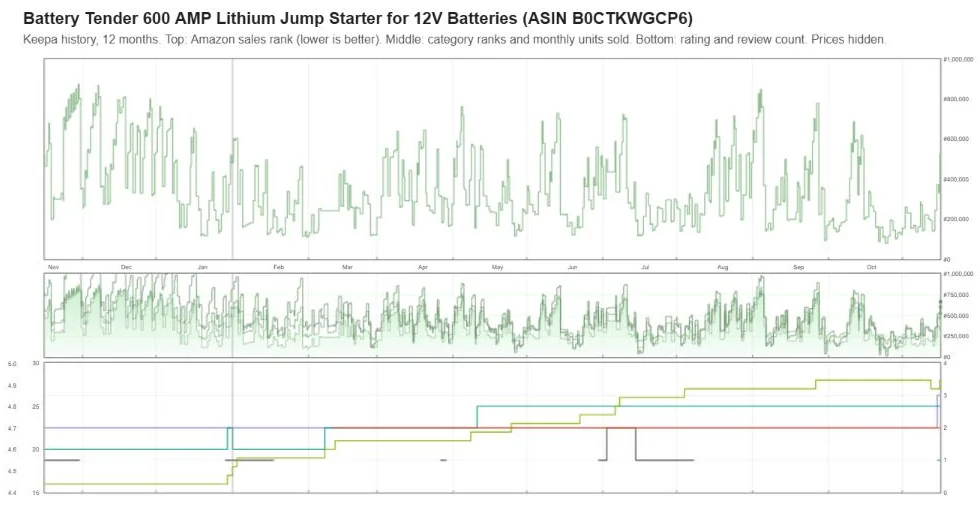
Read the limits before you rely on it. The manual’s operating range is 32°F to 104°F, narrower than the NOCOs’, even though the product page says it works below freezing. The product page lists a cETLus (UL 2743) certification, but the certification line in the manual we read names other marks only, so check the label on the unit. In price tracking it has more than two years of history, slow but steady sales, 28 ratings at 4.8 stars that have grown evenly, and Amazon as the seller at a price below Battery Tender’s own list price.
What we like
- Lightest and smallest pick by far
- Lithium batteries listed as compatible
- UL 2743 listing on the maker’s page
- Motorcycle-focused brand and manual
Watch out for
- Rated only from 32°F to 104°F in the manual
- Engine rating given as “V6,” not liters
- Few owner reviews so far
- Certification details differ between page and manual
Verdict: the one to carry on the bike, especially if you have a lithium battery and ride in fair weather. In cold weather, keep it inside your jacket or the house until you need it.
3. Clore Jump-N-Carry JNC305 — best for lithium batteries
Clore Jump-N-Carry JNC305 Lithium Jump Starter
Best for: lithium-battery bikes, and riders who want a verified safety listing in the manual
Clore Automotive builds Jump-N-Carry packs for repair shops, and the JNC305 has the clearest battery-type rule of any pack we checked. Its manual says to use it for jump starting lead-acid and lithium vehicle starting batteries only. It also lists ETL certification conforming to UL 2743, rates the pack at 1,000 peak amps and 300 Start Assist Amps for gas engines up to 6.0 liters, and says it may be used in any weather, including rain and snow, as long as it is never submerged. Our guide on jump starting in the rain compares what other makers allow.
For a motorcycle, the 21-inch, 8 AWG cables help when the battery sits under a seat or behind a side cover and the only good ground point is a few inches away. The manual tells you to crank for no more than 6 seconds, let the unit cool for 3 minutes between tries and stop after four attempts. A Boost Status light turns solid green when the connection is right and solid red with an alarm when the clamps are reversed.
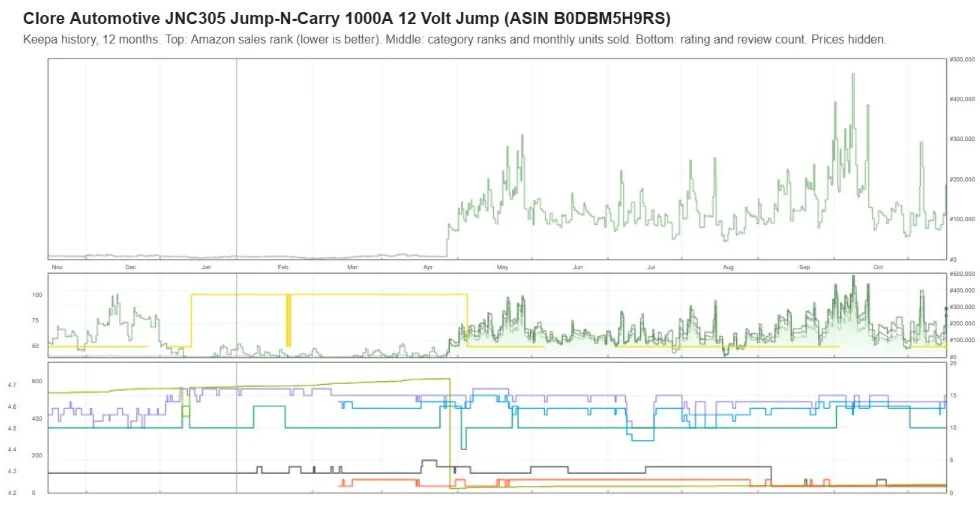
The trade-offs are weight and storage. At 2.2 lb it is a garage or saddlebag pack, not a pocket one, and Clore says not to store it below 50°F when you rely on it as a jump starter. In price tracking it has more than two years of history, steady sales, a 4.5-star average from a few dozen ratings and Amazon as the seller. Its price has moved around more than the NOCOs’, so it can swing between our $ and $$ bands.
What we like
- Manual approves lead-acid and lithium batteries
- ETL-listed to UL 2743
- Usable in rain per the manual
- Long 21 in cables for hidden batteries
Watch out for
- Should not be stored below 50°F
- Heavier than a pocket pack
- Few owner reviews
- Price moves around
Verdict: the safest choice on paper for a lithium-battery bike, and a good garage pack for any motorcycle. Keep it in the house in winter.
4. NOCO Boost GB40 — best for a car-and-bike garage
NOCO Boost GB40 1000A Lithium Jump Starter
Best for: households that want one pack for a lead-acid motorcycle battery and the family car
The GB40 is more than any motorcycle needs, and that is the point of this pick. Rated for gas engines up to 6.0 liters and diesels up to 3.0 liters, it covers a big-twin cruiser with three times the headroom and still starts most cars and small SUVs. If you keep one jump starter in the garage for everything, this is it.
The same battery rule applies as with the GB20: NOCO’s GB40 user guide says it is for 12-volt lead-acid batteries only, and warns that other chemistries may cause injury or damage. The guide allows no more than five jump starts in 15 minutes, followed by a 15-minute rest, and says some vehicles need the pack connected for up to 30 seconds before starting. It works from −4°F to 122°F and has an IP65 case with the ports closed.
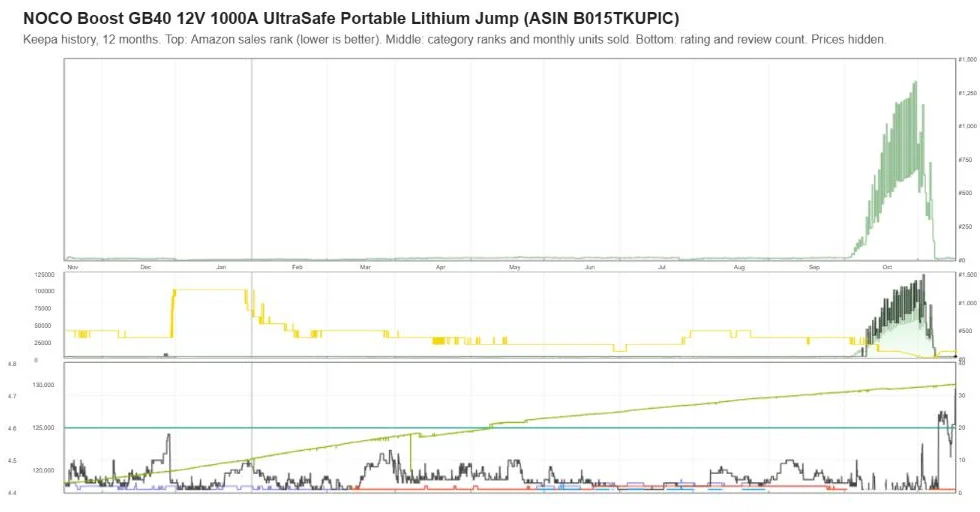
In price tracking, the GB40 has the longest and strongest record of any pack we checked: years of sales, a 365-day average rank inside the top 100 of Amazon’s whole Automotive category and well over 100,000 ratings growing at an even pace. Amazon sells it at a price close to NOCO’s list price.
What we like
- One pack for your bike and your car
- Huge, steady owner base
- −4°F operating rating
- Sold by Amazon at an honest price
Watch out for
- Not for lithium or 6V batteries
- Heaviest NOCO here at 2.4 lb
- UL 2743 listing not verified
- More power than a bike alone needs
Verdict: buy it if the same pack has to rescue a lead-acid motorcycle battery and a car. For a bike alone, the GB20 does the job for less.
Motorcycle quirks: seats, pigtails and owner’s manual warnings
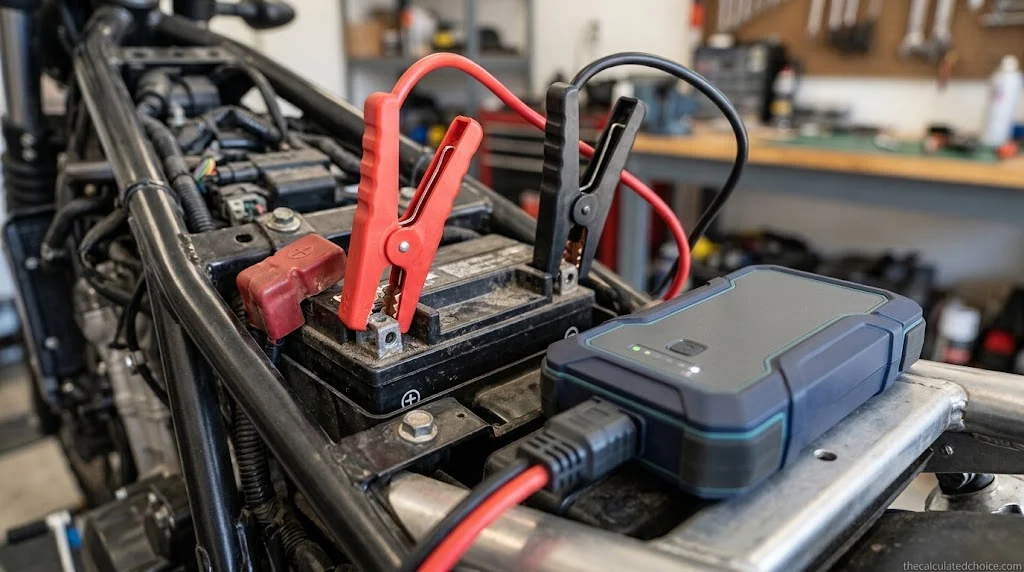
Using a motorcycle jump starter is the same basic job as on a car, red clamp first and black clamp second, but bikes add a few traps. Our step-by-step guide to how to use a jump starter covers the full sequence; these are the motorcycle-specific points.
- Read your owner’s manual first. Some makers discourage jump starting. Honda’s owner’s manuals for the Gold Wing and CBR1000RR, for example, say jump starting from an automobile battery can damage the motorcycle’s electrical system and is not recommended. They do not mention portable packs, so if your manual has a warning like this, ask your dealer before relying on one, or charge the battery instead.
- Do not jump through the charging pigtail. Many riders leave an SAE plug on the battery for a maintainer. NOCO says the SAE cable is not rated for a jump starter’s output, and suggests its GBC007 eyelet cable, installed alongside the SAE lead, if you want a plug-in connection. Clamp the battery posts or the eyelet cable, never the trickle-charge lead.
- Plan to remove the seat or a side cover. Many bikes hide the battery, so carry the tool your manual says you need. Longer leads, like the JNC305’s 21-inch cables, reach a ground point more easily.
- Small terminals, close together. Motorcycle battery posts are small and often close to the frame. Make sure the red clamp touches only the positive post and that the clamps never touch each other.
- A dead battery after storage needs a charger, too. A jump start gets you home, but a battery that sat flat all winter needs a proper charge. Our best motorcycle battery tender guide covers chargers that handle lead-acid and lithium batteries.
Which motorcycle jump starter fits your bike?
| Your situation | Our pick | Why |
|---|---|---|
| Stock lead-acid or AGM battery, any size bike | NOCO GB20 | 4.0L rating, −4°F floor, lowest price |
| You want a pack that lives on the bike | Battery Tender 600A | 0.8 lb and 5.5 in long, lithium listed |
| Lithium (LiFePO4) battery, mostly in the garage | Clore JNC305 | Manual approves lithium; ETL-listed to UL 2743 |
| One pack for a lead-acid bike and a car | NOCO GB40 | 6.0L rating covers both |
| Vintage bike with a 6V battery | None of these | All are 12V packs; use a 6V charger |
| Owner’s manual says not to jump start | None until you ask your dealer | Follow the manual and charge the battery instead |
Want to see how the GB20 and GB40 compare on a car? Our best jump starter for small cars guide lines up NOCO’s spec pages side by side and shows the two share the same 24 Wh battery.
What we left out, and why
Antigravity 400A Lithium Jump Starter. Antigravity is a respected motorcycle battery brand, and its pocket-sized Micro-Start packs are popular with riders. But the original XP-1 is discontinued on Antigravity’s site, and the newer 400A model’s Amazon listing has less than a year of history, only a handful of ratings and a third-party seller. It may earn a place once it has a track record.
Battery Tender Charge N Start combos. These pair a battery maintainer with a jump starter, which is a smart idea for a garage. Their Amazon listings are new, though, and they are built to sit on a shelf rather than ride along.
High-amp packs from little-known brands. Several of the best-selling results for “motorcycle jump starter” claim 4,000 to 6,000 amps and gas ratings of 8.0 liters or more from compact packs. Those claims do not line up with the ratings established makers publish, and a motorcycle needs a small fraction of that.
Frequently asked questions
What is the best jump starter for a motorcycle?
Can you use a car jump starter on a motorcycle?
Can you jump start a motorcycle with a car?
Can you jump start a lithium motorcycle battery?
What size jump starter do I need for a motorcycle?
Can I jump start my motorcycle through the battery tender plug?
Can you jump start a 6 volt motorcycle with a 12 volt jump starter?
How we researched this guide
To find the best motorcycle jump starter, we started with the best-selling motorcycle and compact jump starters on Amazon and packs from motorcycle battery brands. We checked each candidate’s sales rank, price and review history in Keepa price-tracking data, then read the makers’ manuals, FAQs and product pages for battery-type rules, temperature limits, safety listings and warranty terms. Battery CCA figures come from Yuasa’s application guide, and the headroom figures are our own math from the makers’ engine ratings. We did not hands-on test any product, and no brand paid for or reviewed this article.
Sources: NOCO GB20 how-to and FAQ · NOCO GB20 specs · NOCO GB40 user guide · Battery Tender 600A · Clore JNC305 manual · Yuasa powersports application guide · Honda Gold Wing and CBR1000RR owner’s manuals (battery section)

Researched by Shahzad
Amazon seller who researches products using sales-rank history, price tracking and owner reviews before recommending anything. Read our disclosure.