
We may earn a commission when you buy through links on this page, at no extra cost to you. It never decides what we recommend. How we make money
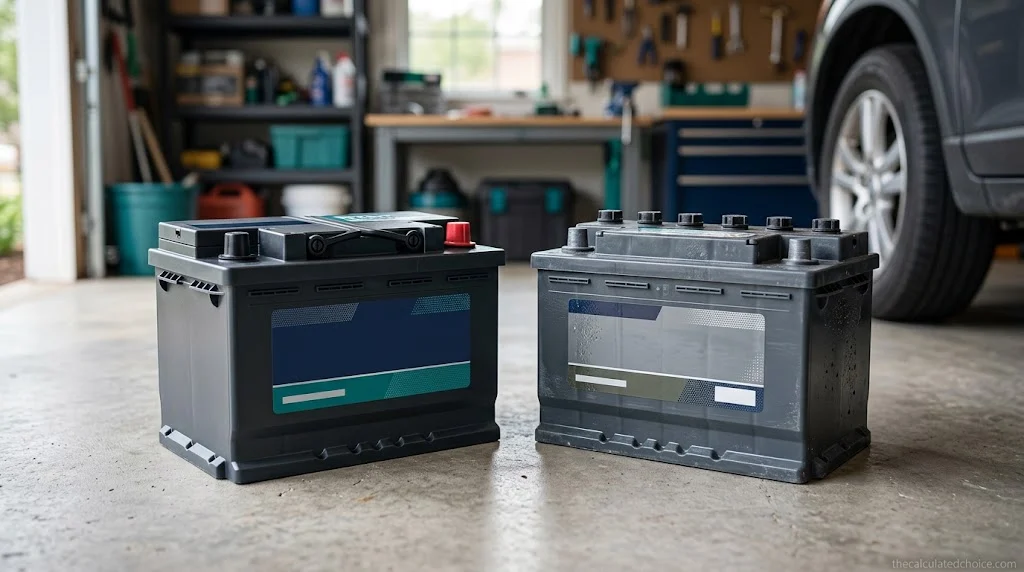
AGM vs flooded battery is the choice most drivers face the first time a parts store asks, “Do you want the standard one or the AGM?” The AGM costs about twice as much, and the counter answer is usually “it’s better.” That is only half true. For some cars an AGM is required, for some it is a smart upgrade, and for plenty of older cars it is money you will not get back.
This guide is for US drivers replacing a car or truck battery. You will learn what is actually different inside, which cars must stay AGM, whether you can swap one type for the other, how the cost works out per year of service, and how to tell which type you have right now.
AGM vs flooded battery: the short answer
- Both are lead-acid AGM holds the acid in glass mats; a flooded battery has free liquid acid.
- Match the factory type AAA’s rule: replace with the same type your car came with.
- Never AGM to flooded Clarios says flooded and EFB batteries should never replace an AGM.
- Flooded to AGM is an upgrade It is allowed, but some European cars need the new battery registered.
- Start-stop cars Need AGM, or EFB only where the car came with EFB.
- About 2x the price AGM costs roughly double; with paid installs the yearly cost lands within about 6% of flooded.
- Charge it right Use a charger with an AGM mode; AGM is less forgiving of overcharging.
AGM vs flooded battery: what is actually different
Start with the part that confuses a lot of searches: an AGM battery is a lead-acid battery. People type “AGM vs lead acid,” but both types use the same lead plates and sulfuric acid. The difference is where the acid lives.
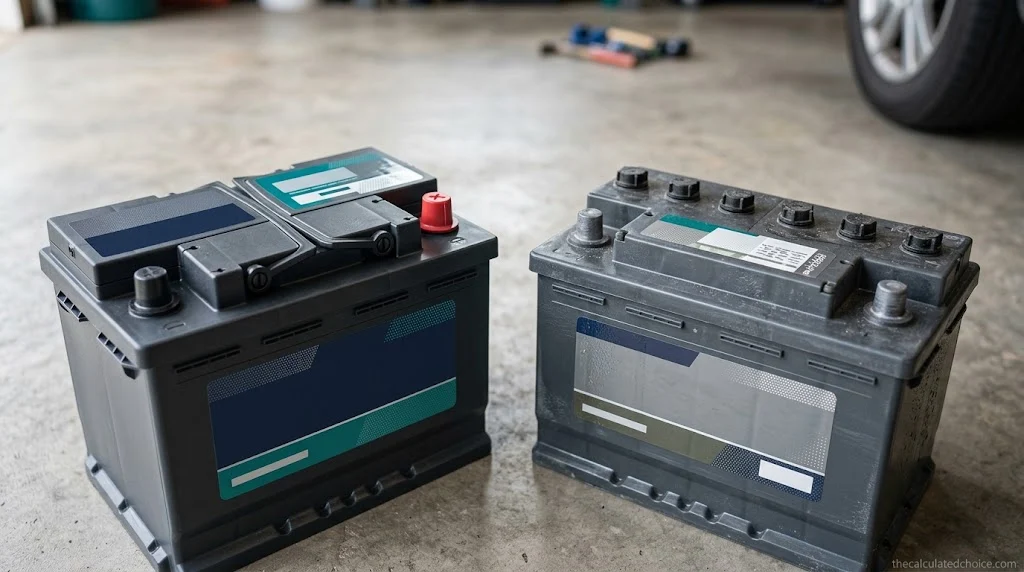
In a flooded battery, the plates sit in free liquid electrolyte. Charging splits a little water into gas, which vents out, so the battery has to stay upright and may need distilled water in hot climates. In an AGM (absorbent glass mat) battery, the acid is soaked into very fine fiberglass mats pressed between the plates. The case is sealed and valve-regulated, so it does not spill and needs no water.
That one design change drives every other difference in the table below.
| What you care about | Flooded (standard) | AGM | Source |
|---|---|---|---|
| Electrolyte | Free liquid acid, vented | Acid held in glass mats, sealed and valve-regulated | Battery University, Battery Tender |
| Typical service life | 3 to 5 years | 5 to 8 years | Battery Tender |
| Deep-discharge cycles before big capacity loss | About 200 to 300 | About 400 to 600 or more | Battery Tender |
| Price band | $ to $$ | $$ to $$$ (roughly double) | Battery Tender price ranges |
| Start-stop cars | Not suitable | Built for it | Clarios, Battery Tender |
| Maintenance | Check water level in hot climates; keep terminals clean | No water; keep terminals clean and charge correctly | Battery Tender |
| Mounting | Upright only | Sealed design allows odd angles | Battery University |
| Charging | More tolerant of a basic charger | Sensitive to overcharging; use an AGM setting | Battery University |
| Sitting unused | Needs a topping charge about every six months in storage | Less prone to sulfation; holds charge longer | Battery University |
AGM also has very low internal resistance, which is why it can deliver high current on demand and accept a charge faster. That faster charge acceptance matters more than it sounds, and we come back to it in the short-trip section.
Which cars need an AGM battery
Some cars give you no choice. Clarios, the company behind several of the biggest US battery brands, lists these as AGM territory, and Battery Tender’s guidance lines up with it:
- Any car that came with an AGM from the factory. Check the label on the battery or the owner’s manual.
- Start-stop vehicles, the ones that shut the engine off at red lights. They cycle the battery far more than a normal car.
- Batteries mounted in the trunk, under a seat or inside the cabin. A sealed AGM does not release acid or gas into the passenger space in normal use.
- High electrical loads: hybrids, big audio systems, heated and cooled seats, driver-assist cameras and multiple screens.
Battery Tender notes that most luxury brands, including BMW, Mercedes-Benz, Audi and Cadillac, have used AGM as original equipment since the early 2010s. If your manual says AGM, the decision is made.
For an older car without start-stop, with the battery under the hood and a normal electrical load, a flooded battery is still a fair choice. That is the one case where the AGM vs flooded battery question is really about money, not compatibility.
Can you swap AGM and flooded batteries?
AAA’s rule is simple: your replacement battery should be the same type as the one installed at the factory, because the automaker tunes the charging system to that battery. Clarios goes a step further and lays out which swaps work. We turned that into a table you can use at the parts counter.
| Your car came with | Flooded OK? | EFB OK? | AGM OK? | Watch out for |
|---|---|---|---|---|
| Flooded (no start-stop) | Yes | Yes | Yes, an upgrade | Same group size and terminal layout; registration on cars with a battery management system |
| EFB (start-stop) | No | Yes | Yes, an upgrade | Never go down to a standard flooded battery |
| AGM | No | No | Yes | Registration or coding on many European cars |
Why a flooded battery in an AGM car fails early
The flooded battery is not built for the deep, repeated cycling that start-stop and heavy electronics put it through. Battery Tender says a standard flooded battery in a start-stop vehicle typically fails within 12 to 18 months. Battery University describes the same pattern: flooded batteries in start-stop service lose capacity sharply after about two years. You save money on the battery and spend it again, often with a no-start along the way.
Upgrading from flooded to AGM
Going the other way is allowed. Clarios says an AGM can replace a standard flooded or EFB battery. Before you buy, check three things:
- Same group size and terminal position. The group number on your current battery is the easiest match.
- Cold cranking amps at least as high as the original. Your manual or old label lists it.
- Battery registration. Midtronics explains that many BMW, Mini, Volkswagen, Audi, Mercedes-Benz, Porsche and Volvo models must be told a new battery is installed, using a scan tool that supports it. Some also need the battery type coded. Skip it and the car may overcharge or undercharge the new battery.
Where EFB fits: enhanced flooded vs AGM
EFB stands for enhanced flooded battery. It is still a flooded battery with free liquid acid, but with improved plates and internal parts so it handles more cycling than a standard one. Clarios positions it for entry-level start-stop cars with moderate electrical loads.
The ranking is easy to remember: standard flooded, then EFB, then AGM. You can always move up a step. You should never move down. If your car came with an EFB, an AGM is the upgrade; a standard flooded battery is the downgrade that leads to early failure.
Is AGM worth the money? Cost per year of service
Most comparisons stop at “AGM costs more but lasts longer.” We wanted to know whether it actually costs less per year. To keep the math evergreen, we turned Battery Tender’s published price, life and installation ranges into price units, with a flooded battery equal to 1.0.
Cost per year = (battery price + install) ÷ years of service
Price units from Battery Tender’s range midpoints: flooded 1.0 · AGM about 2.0 · paid install about 0.4Life midpoints: flooded 4 years (range 3 to 5) · AGM 6.5 years (range 5 to 8)Battery only: flooded 1.0 ÷ 4 = 0.25 per year · AGM 2.0 ÷ 6.5 = about 0.31 per year (about 25% more)With paid installs: flooded 1.4 ÷ 4 = about 0.36 · AGM 2.4 ÷ 6.5 = about 0.38 (about 6% more)Break-even: an AGM has to last about 8 years to match flooded on battery cost alone, or about 7 years if you pay for each installSo in a simple car that is happy with a flooded battery, an AGM is close to break-even, not a money saver. It pays off when it prevents a problem: a flooded battery that would die early from short trips or heavy electrical use, a car that sits for weeks, or one roadside call you avoid.
One more way to read the math: if your flooded batteries keep dying at three years instead of four, the gap closes fast. Your own history is the best input. If you have never got past three years with a flooded battery, an AGM is likely the better buy even when it is not required. If batteries keep dying much sooner than that, the battery type is rarely the whole story; see why a car battery keeps dying.
Heat, cold and short trips
Cold: Battery Tender says quality flooded and AGM batteries at the same price point have similar cold cranking amp ratings, but the AGM holds its voltage better under load, so it tends to crank more reliably on a cold morning. If you live where winters bite, our AGM picks for cold weather show which batteries passed our checks.
Heat: here the sources disagree, so we show both sides. Clarios and Battery Tender recommend AGM for hot climates, partly because a flooded battery loses water faster in the heat. Battery University says AGM and other sealed batteries dislike heat and should be kept away from engine heat where possible. Both can be true: an AGM will not dry out, but heat still shortens any lead-acid battery’s life. In the South, expect less than the averages in our battery life by climate guide, whichever type you choose.
Short trips: an AGM accepts charge faster than a flooded battery, and Battery Tender lists frequent short trips as a reason to choose one. Optima also notes that acid stratification, where heavy acid settles at the bottom of a flooded battery that is never fully charged, is a much smaller concern in AGM batteries. Our guide on how long to drive to charge a car battery shows why short trips fall behind in the first place.
Charging and upkeep differences
AGM batteries are sensitive to overcharging, and Battery University says they have tighter tolerances than other sealed types. That is the practical reason to own a smart charger with an AGM mode rather than an old unregulated trickle charger. Our guide to the best battery charger for AGM batteries covers which chargers have a true AGM profile.
For a sense of how specific the limits are, Optima publishes these numbers for its own AGM batteries: 13.8 to 15.0 volts on a battery charger at no more than 10 amps, and 13.2 to 13.8 volts for float charging at no more than 1 amp. Other brands set their own limits, so follow the label or manual on your battery.
Flooded batteries are more forgiving of the charger but need one job an AGM never does: in hot climates, check the electrolyte level if the caps come off, and top up only with distilled water. Both types read differently on a meter, too. A fully charged AGM sits a little higher than a flooded battery, which our car battery voltage chart explains reading by reading.
How to tell if your battery is AGM or flooded
- Read the label. AGM batteries almost always say “AGM,” and many also say “non-spillable” or “VRLA” (valve-regulated lead-acid).
- Check the owner’s manual for the battery type and any registration note.
- Look at where it lives. A battery in the trunk, under a seat or in the cabin is usually AGM.
- Does the car shut off at stops? A start-stop system means AGM or EFB.
- Do not judge by the caps alone. Many flooded batteries are sold as “maintenance-free” with tops that look sealed.
AGM vs flooded battery myths
| Myth | Fact |
|---|---|
| “AGM is not lead-acid.” | AGM is a type of lead-acid battery. Only the way the acid is held is different. |
| “AGM is always the better buy.” | In a simple car, our math puts AGM within about 6% of flooded per year with paid installs. It wins when it prevents early failures. |
| “A flooded battery is fine in a start-stop car if it fits.” | Battery Tender says it typically fails within 12 to 18 months in that use. |
| “No caps on top means AGM.” | Many flooded batteries look sealed. The label is the reliable check. |
| “Any charger works on any battery.” | AGM is sensitive to overcharging. Use a charger with an AGM setting. |
| “Just drop in the new battery.” | Many European cars need the new battery registered, and sometimes coded, with a scan tool. |
AGM vs flooded battery FAQ
Is it okay to jump start an AGM battery?
How do you tell if a battery is flooded or AGM?
Is there a downside to AGM batteries?
Is it okay to trickle charge an AGM battery?
Can I replace an AGM battery with a regular battery?
Can I put an AGM battery in a car that had a regular battery?
How long do AGM batteries last compared to flooded?
How we researched AGM vs flooded batteries
We compared battery construction and limits from Battery University’s AGM article, replacement rules from AAA and Clarios, life, cycle and price ranges from Battery Tender, registration requirements from Midtronics, and charging limits from Optima’s published FAQ. Where sources disagree, as they do on AGM in hot climates, we show both views instead of picking one. The swap table and the cost-per-year math are our own work built from those sources; the price units are midpoints of published ranges, not quotes. We did not hands-on test any battery for this article, and no brand paid for or reviewed it.
Sources: Battery University BU-201a: AGM · AAA: car battery life and replacement type · Clarios: AGM vs EFB vs flooded · Battery Tender: AGM vs flooded · Midtronics: battery registration · OPTIMA FAQs

Researched by Shahzad
Amazon seller who researches products using sales-rank history, price tracking and owner reviews before recommending anything. Read our disclosure.