
Pages on The Calculated Choice may include affiliate links. If you buy through them, we may earn a commission at no extra cost to you. Read our disclosure.
Choosing the basic car tools every driver should own comes down to separating roadside survival gear from home driveway maintenance tools. Carrying a massive, poorly organized chest in your trunk adds dead weight and still leaves you stranded if it lacks a simple tire pressure gauge, a hands-free work light, or deep 6-point sockets that clear recessed battery hold-down studs.
This guide is built for everyday commuters, apartment dwellers, and beginner DIY owners who want to handle dead batteries, flat tires, loose battery terminals, cabin filter swaps, and basic routine inspections safely. Buying the wrong tools costs more than money: a 12-point socket or a sprung adjustable wrench can round off a rusted 10 mm bolt head, and relying on a scissor jack without proper blocking or wheel support creates a severe crush hazard.
The quick answer
The basic car tools every driver should own split into two tiers: an 8-item trunk kit for roadside emergencies and a 4-item home garage upgrade for driveway maintenance.
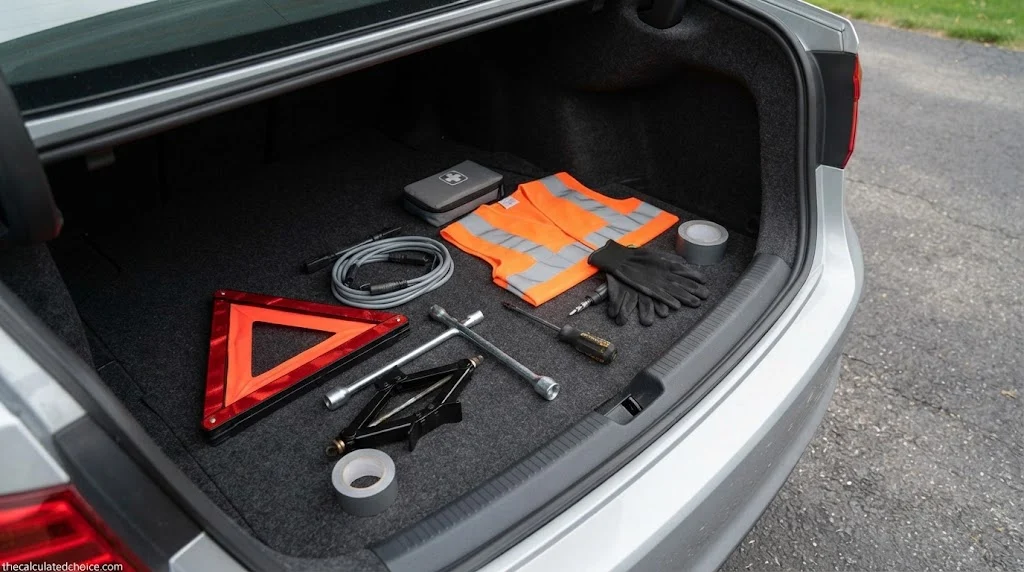
- Keep in the trunk: A tire pressure gauge, a rechargeable magnetic work light, heavy-duty jumper cables, a factory jack with a firm ground mat and wheel chocks, a 3/8-inch drive 6-point socket and ratchet set (covering 8 mm to 19 mm and 5/16 inch to 3/4 inch in both shallow and deep sockets), a multi-bit screwdriver, long-nose and slip-joint pliers, and work gloves with duct tape.
- Keep in the home garage: An 18-inch 3/8-inch or 1/2-inch drive breaker bar, a 1/2-inch drive click-type torque wrench, a dedicated hydraulic floor jack, and a matched pair of jack stands.
- Skip bloated piece-count kits: Low-cost “200-piece” cases often pad their count with dozens of tiny hex keys and screwdriver bits while leaving out the deep metric sockets you reach for most.
The 12 basic car tools every driver should own: Trunk kit vs garage drawer
Most drivers make one of two mistakes when assembling their first kit: they either toss a cheap pouch of pliers and electrical tape into the spare-tire well, or they haul a heavy three-drive mechanics chest everywhere they go. The U.S. Department of Energy’s FuelEconomy.gov notes that an extra 100 pounds in your vehicle could reduce your MPG by about 1%, while an unsecured heavy case can become a projectile in a hard stop.
Organizing the basic car tools every driver should own by location solves both problems. Keep compact diagnostic, lighting, electrical, and 3/8-inch fastener tools inside the car, and store heavy lifting and high-torque wheel tools in the garage or apartment closet.
| Tool | Where it lives | Primary job | Key spec to verify before buying |
|---|---|---|---|
| 1. Tire pressure gauge | Glove box | Checking cold tire pressure monthly and before trips | Easy-to-read scale covering passenger car PSI range |
| 2. Rechargeable work light | Glove box / trunk | Hands-free illumination under the hood or wheel well | 375 to 500 lumens on flood mode, magnetic base, IP54 to IP67 rating |
| 3. Jumper cables | Trunk spare well | Starting a vehicle with a discharged 12V battery | Insulated clamps and tangle-free jacket long enough to reach bumper-to-bumper |
| 4. Jack, ground mat, and flares | Trunk spare well | Emergency roadside tire change and visibility | Marked manufacturer load limit, stop indicator, and firm base block or mat |
| 5. 3/8-in drive 6-point socket set | Trunk organizer | Battery terminals, engine covers, brackets, and hose clamps | 6-point shallow and deep sockets (8-19 mm, 5/16-3/4 in), 72-tooth or 90-tooth ratchet |
| 6. Multi-bit screwdriver | Trunk organizer | Air filter housings, interior trim screws, and hose clamps | Phillips (#1, #2), slotted, and Torx (T15, T20, T25, T30) bits |
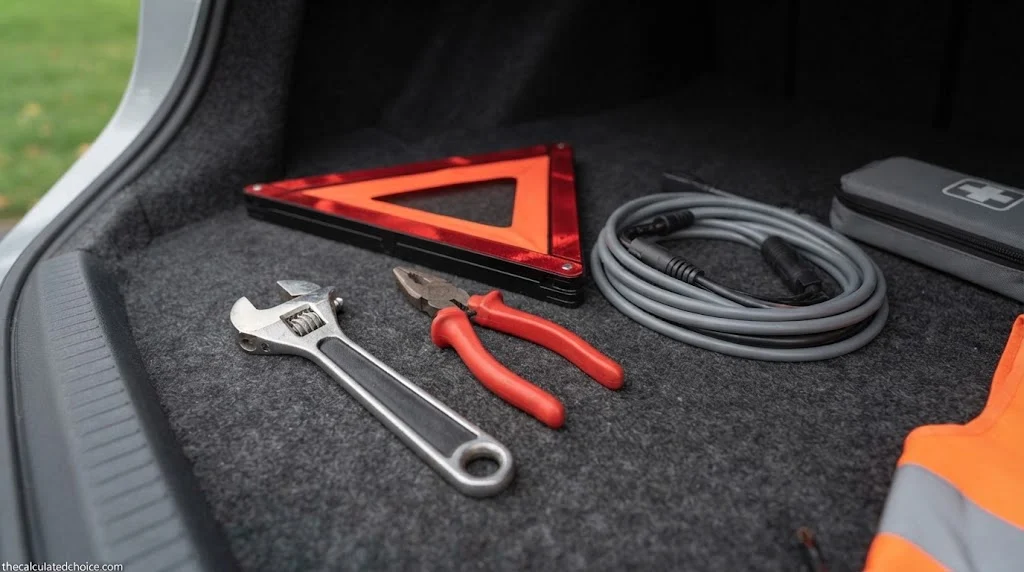
| 7. Pliers and adjustable wrench | Trunk organizer | Spring-style radiator/intake hose clamps and cotter pins | Long-nose and slip-joint pliers with dipped grips; hex-jaw adjustable wrench |
| 8. Work gloves and duct tape | Trunk organizer | Hand protection on hot or sharp metal; temporary hose patch | Cut- and abrasion-resistant palm; cloth-backed duct tape |
| 9. 18-in breaker bar | Home garage | Breaking loose stubborn lug nuts and suspension bolts | 18-inch handle with a 230° pivoting head for leverage |
| 10. 1/2-in drive torque wrench | Home garage | Tightening wheel lug nuts to exact manufacturer specification | Range that covers your owner’s manual lug nut torque, with a clear click at the set value |
| 11. Hydraulic floor jack | Home garage | Lifting the vehicle at reinforced frame or pinch-weld points | Marked load rating and saddle height matched to your vehicle clearance |
| 12. Pair of jack stands | Home garage | Supporting the lifted vehicle before any under-car work | Sold and rated in pairs; mechanical locking pawl or pin |
Tier 1: Roadside safety and tire tools that stay in the vehicle
According to the National Highway Traffic Safety Administration (NHTSA), a driver’s emergency roadside kit should include a cell phone and charger, a first aid kit, a flashlight, flares and a white flag, jumper cables, a tire pressure gauge, a jack and ground mat for changing a tire, work gloves, basic repair tools, and duct tape for temporarily repairing a hose leak. Focusing on the mechanical tools in that list prevents the two most common roadside breakdowns: tire failure and battery or lighting failure.
- Tire pressure gauge and tread depth check: NHTSA states that underinflation is the leading cause of tire failure and its tire safety page advises checking the pressure of all tires, including the spare, at least once a month when they are “cold” (at least three hours after driving). Never inflate to the maximum pressure molded into the tire sidewall; always match the vehicle manufacturer’s placard inside the driver’s door jamb and verify that tread depth is at least 2/32 of an inch across all tires.
- Hands-free rechargeable work light: Holding a phone flashlight in your teeth while loosening a battery terminal in the dark is frustrating and unsafe. A dedicated garage and roadside light needs a magnetic base or hanging hook and a broad flood beam. For example, the Klein Tools 56412 pairs a 500-lumen front flashlight with a 375-lumen side work light and a magnetic end cap in a 6.9-ounce body, while the Klein Tools 56403 delivers 460 lumens on high for 9 hours, a 270° magnetic kickstand, and a 5V, 0.5A USB-A port that can top up a phone in an emergency.
- Jumper cables and battery terminal tools: Modern engine bays pack the 12V battery tight against fuse boxes and plastic cowls. Alongside heavy-duty jumper cables, you need a deep 6-point socket in the right size (10 mm is common) to tighten a loose clamp or remove a hold-down bracket.
- Emergency jack, ground mat, and blocking: Under OSHA Publication 3080 (Hand and Power Tools), every jack must have a permanently marked manufacturer load limit and a stop indicator, and a block must be placed under the base of the jack whenever the foundation is not firm. Carrying a kneeling mat and a flat wood or composite base block keeps a trunk scissor jack from sinking into soft asphalt or gravel on a highway shoulder.
How to size the basic car tools every driver should own
When shopping for the basic car tools every driver should own, socket geometry and drive size matter far more than the total piece count printed on the front of a plastic box. Ratchets and sockets come in three common square-drive sizes—1/4-inch, 3/8-inch, and 1/2-inch—and two internal socket profiles: 6-point and 12-point.
For automotive fasteners, always prioritize 6-point sockets over 12-point sockets. As documented on the TEKTON SKT15301 specification page, a 6-point opening with radiused corners applies force to a fastener’s flat sides rather than its sharp corners, preventing fastener round-off when breaking loose corroded under-hood bolts. DEWALT says its DirectTorque technology on the DWMT75049 set helps prevent rounding of fasteners and provides better grip.
| Drive size | Typical automotive size range | Best car applications | Example verified spec |
|---|---|---|---|
| 1/4-inch drive | 4 mm to 14 mm (5/32 in to 9/16 in) | Dash panels, cabin filter covers, coil packs, and tight splash shields | Included in multi-drive sets like DEWALT DWMT81531 (84-pc) (4-13 mm, 5/32-1/2 in) |
| 3/8-inch drive | 6 mm to 24 mm (1/4 in to 1 in) | The all-around core drive for battery brackets, alternator bolts, brake caliper pins, and spark plugs | TEKTON SKT15301 (46-pc) covers 8-19 mm and 5/16-3/4 in (shallow + deep) at 7.79 lb |
| 1/2-inch drive | 13 mm to 24 mm (7/16 in to 1 in) | Wheel lug nuts, suspension mounts, subframe bolts, and axle/brake carrier hardware | Included in 3-drive sets like DEWALT DWMT75049 (192-pc) (13-24 mm, 7/16-1 in shallow + deep) |
Why do you need both shallow and deep sockets in your core 3/8-inch drive range? Many automotive fasteners are nuts threaded onto long protruding studs—such as battery hold-down j-hooks, exhaust heat shields, and bumper covers. A shallow socket bottoms out against the top of the stud before reaching the nut. A set with continuous sizing and no skipped sizes from 8 mm to 19 mm (or 6 mm to 24 mm in a larger 3/8-inch set like the 73-piece TEKTON SKT15311) guarantees you have both depths on hand.
Tier 2: Home garage tools for wheels, brakes, and fluid changes
Once you start rotating tires (NHTSA says to rotate every 5,000 to 8,000 miles if your vehicle’s manufacturer recommends it) or changing engine oil in your driveway, a standard 7-inch or 8-inch ratchet handle is no longer enough. Jobs involving lug nuts, suspension components, or other high-torque fasteners call for 1/2-inch drive tools, a breaker bar, and a torque wrench.
- An 18-inch breaker bar for loosening stuck hardware: Ratchet gear mechanisms are built for speed, not for breaking loose lug nuts tightened by a shop impact gun. Using a solid, non-ratcheting 18-inch breaker bar—such as the 18-inch, 230° pivoting-head bar included in the TEKTON SKT15311 set—protects your ratchet pawls and multiplies your hand force without slipping.
- A 1/2-inch drive micrometer torque wrench for tightening: Guessing at lug nut tightness either leaves wheels loose enough to vibrate off or stretches wheel studs and warps brake rotors. A 1/2-inch drive click-type torque wrench lets you tighten every wheel to the exact foot-pound value in your owner’s manual. You can compare common specifications in our lug nut torque chart by vehicle type.
- A hydraulic floor jack and matched jack stands: Factory trunk jacks are strictly for roadside flat-tire swaps. For home garage work, pair a dedicated floor jack for a home garage with locking jack stands positioned under the vehicle’s reinforced pinch welds or frame rails.
The math: Trunk weight penalty, tire pressure loss, and ratchet swing arc
Three quick calculations explain why compact, fine-tooth tools and a glove-box tire gauge pay for themselves over years of ownership.
The Calculated Choice math check
1. Underinflation cost and tire life:
• Fuel economy drop per 1 psi below proper pressure (average of all tires): about 0.2% (FuelEconomy.gov)
• Driving 8 psi low on average = 8 × 0.2% = 1.6% fuel economy penalty
• Proper inflation can save as much as 11 cents per gallon and extend average tire life by 4,700 miles (NHTSA Tire Safety)
2. Trunk weight penalty:
• Fuel economy penalty from extra weight: about 1% per 100 lb (FuelEconomy.gov)
• Compact 46-piece 3/8-in socket set (TEKTON SKT15301): 7.79 lb → 7.79 ÷ 100 × 1% = about 0.08%, negligible next to hauling a heavy full shop chest in the trunk.
3. Ratchet tooth count vs swing arc in tight engine bays:
• Formula: Swing Arc = 360° / Tooth Count
• 72-tooth ratchet (DEWALT DWMT81531): 360° / 72 = 5° swing arc
• 90-tooth ratchet (TEKTON SKT15301): 360° / 90 = 4° swing arc
• Over a 10-inch handle length, a 4° arc needs only 0.70 inches of handle travel per click (10 in × sin 4°), allowing you to turn bolts squeezed between the radiator fan shroud and accessory belt.
5 tool mistakes that strip bolts and cause roadside injuries
Even when you own the basic car tools every driver should own, misusing them can damage components or lead to hand and eye injuries. OSHA Publication 3080 highlights five core rules for hand tools: keep all tools in good condition, use the right tool for the job, examine each tool for damage before use, operate tools according to manufacturer instructions, and wear proper personal protective equipment.
- Using the wrong tool for the job: OSHA 3080 warns that when a chisel is used as a screwdriver, the tip of the chisel may break and fly off, hitting the user. The same logic applies to prying with a screwdriver: use dedicated trim tools or a proper pry bar instead.
- Pulling on an adjustable wrench with sprung jaws: OSHA 3080 notes that if the jaws of a wrench are sprung, the wrench might slip. A worn adjustable wrench can slip off the bolt flats under load and slam your knuckles into surrounding metal. Inspect wrench jaws before applying force, and choose a fixed 6-point socket whenever space allows.
- Stacking chrome adapters on high-torque suspension or wheel bolts: Stepping a 1/2-inch breaker bar down to a 3/8-inch or 1/4-inch drive adapter sends all of that force through the smaller drive square, which can overload it. Match the drive size to the fastener load.
- Leaving lithium-ion work lights in a baking dashboard or freezing trunk beyond rated limits: Rechargeable 18650 lithium-ion work lights have defined thermal limits. For example, the Klein Tools 56403 specification sheet lists an operating and charging range of 32°F to 113°F and a storage range of 14°F to 131°F (-10°C to 55°C). Store battery lights in an insulated trunk bag out of direct cabin sunlight, and recharge them every few months.
- Creating sparks near the battery or fuel system: OSHA 3080 notes that iron and steel hand tools can produce sparks around flammable gases and volatile liquids. When disconnecting a car battery, always unbolt the negative (-) ground cable first and wrap or tuck it away so your wrench cannot accidentally bridge the positive (+) terminal to the chassis.
What to buy
If you are ready to build or upgrade your kit without paying for filler pieces, we have checked the exact socket lists, lumen ratings, and long-term Amazon availability in our dedicated product guides:
- For your core socket and ratchet kit: Read our guide to the best mechanic tool set for beginners, where we compare no-skip 3/8-inch sets like the 46-piece TEKTON SKT15301 and 73-piece TEKTON SKT15311 against multi-drive kits like the 84-piece DEWALT DWMT81531 and 192-piece DEWALT DWMT75049.
- For under-hood and roadside lighting: See our breakdown of the best rechargeable work light for the garage, covering magnetic floodlights and inspection bars from Streamlight, Klein Tools, and NEBO.
- For safe wheel and under-car work at home: Pair our picks for the best torque wrench for lug nuts and the best floor jack for a home garage with our lug nut torque chart by vehicle type.
- For getting unstuck after a breakdown: Our best tow strap for trucks guide and tow strap vs recovery strap explainer cover recovery gear that a basic trunk kit does not include.
How we researched this guide
To identify the basic car tools every driver should own, we cross-referenced federal roadside readiness and tire maintenance checklists from the National Highway Traffic Safety Administration (NHTSA), fuel-economy and vehicle weight data from the U.S. Department of Energy’s FuelEconomy.gov, and hand-tool and jack safety rules in OSHA Publication 3080. We then verified exact socket size distributions, ratchet tooth counts, proof-torque standards, lumen outputs, and battery temperature limits directly against official manufacturer specification sheets from TEKTON, DEWALT, and Klein Tools.
Building a reliable kit does not require filling a rolling cabinet on day one. When you focus on the basic car tools every driver should own—starting with a cold tire gauge, a magnetic rechargeable work light, and a no-skip 3/8-inch 6-point socket set in the trunk—you can solve the most common roadside headaches safely. Add a breaker bar, a 1/2-inch torque wrench, and a floor jack with stands at home, and the basic car tools every driver should own will cover years of routine maintenance without wasted weight or rounded fasteners.
Frequently asked questions
Should I buy SAE or metric sockets for my car?
Most modern cars, SUVs, and light trucks rely mainly on metric fasteners, so make metric your priority. A set that also includes SAE sizes (5/16 inch to 3/4 inch) lets you handle aftermarket parts, trailer hitches, and household hardware.
Why are 6-point sockets better than 12-point sockets for beginners?
A 6-point socket contacts the flat sides of a hexagonal bolt head rather than the sharp corners, which maximizes surface contact and prevents rounding off rusty or over-tightened fasteners. A 12-point socket engages closer to the bolt corners, which makes it more likely to slip on corroded automotive hardware.
Which socket size do I reach for most on a car?
The 10 mm socket (in both shallow and deep 6-point profiles) is one of the most commonly used sizes on modern vehicles. It is common on battery terminal clamps, battery hold-down brackets, air filter boxes, splash shields, and interior trim.
Can I use a 3/8-inch drive ratchet to remove wheel lug nuts?
No. Standard 3/8-inch drive ratchets have shorter handles and smaller internal gear pawls that can strip or break under the high torque required to loosen wheel lug nuts. Always use an 18-inch breaker bar or a 1/2-inch drive tool to loosen lug nuts, and finish tightening them with a calibrated 1/2-inch drive torque wrench.
How often should I check my tire pressure with a hand gauge?
NHTSA recommends checking the pressure of all tires, including the spare, at least once a month when they are cold, and inspecting tires for cuts, punctures, or bulges before long road trips. Cold means the vehicle has been parked for at least three hours. Inflate to the PSI listed on the driver’s door jamb placard, never the maximum pressure stamped on the tire sidewall.