
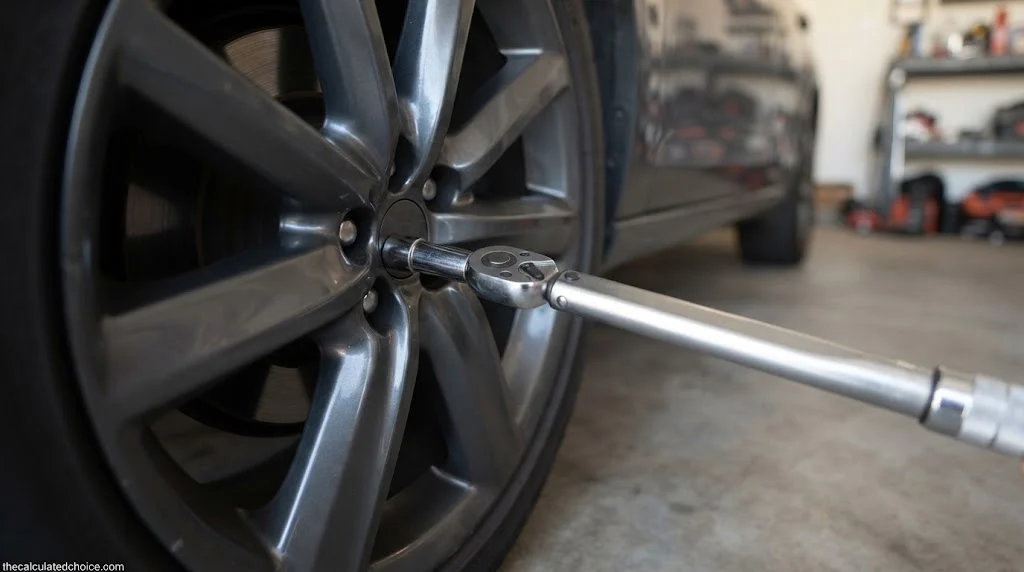
We may earn a commission when you buy through links on this page, at no extra cost to you. It never decides what we recommend. How we make money
Guessing with an impact gun or a short roadside lug wrench is the fastest way to leave a wheel under-tightened or over-tightened. Every automaker publishes its own wheel nut figure, and the numbers differ: Toyota’s own chart lists 76 lb-ft for a Camry, 97 lb-ft for a Tundra with alloy wheels and 154 lb-ft for the same truck with steel wheels. This lug nut torque chart by vehicle type puts those published figures side by side so you can see where your car or truck is likely to land.
We built the chart only from automaker documents we could read: a Toyota technical tip, Ford Performance’s wheel installation sheet, and Honda, Nissan and Mazda owner’s manuals. Each row names its source. Treat this lug nut torque chart by vehicle type as a guide to the range, then use the number printed in your own owner’s manual, because torque can change with the model year, the wheel and the hardware.
Quick answer
- Compact and midsize cars, crossovers and minivans (Toyota): 76 lb-ft (103 Nm) in Toyota’s chart for the Corolla, Yaris, Camry, Avalon, RAV4, Highlander, Venza, Sienna and Prius.
- Honda, Nissan and Mazda cars: 80 lb-ft (108 to 110 Nm) in the Honda and Nissan Leaf manuals we checked; the Mazda manual lists 80 to 108 lb-ft (108 to 147 Nm).
- Ford applications in Ford Performance’s wheel sheet: 100 lb-ft (135 Nm).
- Midsize trucks and body-on-frame SUVs (Toyota): 83 lb-ft (113 Nm) for the Tacoma, 82 lb-ft (112 Nm) for the 4Runner and FJ Cruiser, and 97 lb-ft (131 Nm) for the Land Cruiser.
- Full-size trucks and SUVs (Toyota Tundra and Sequoia): 97 lb-ft (131 Nm) with alloy wheels and 154 lb-ft (209 Nm) with steel wheels, which is above the limit of a 150 ft-lb wrench.
Lug nut torque chart by vehicle type
When you tighten a wheel nut to its published torque, you stretch the stud slightly so the wheel clamps flat against the hub. Heavier vehicles generally use bigger hardware and higher figures, which is why the chart below is grouped by vehicle class. The numbers come from Toyota Tech Tip T-TT-0124-11, which lists lug nut size and torque for 2005 to 2013 Toyota models.
| Vehicle class | Toyota models and years in the chart | Lug nut size | Torque (lb-ft) | Torque (Nm) | Wrench range that covers it |
|---|---|---|---|---|---|
| Compact cars and hatchbacks | Corolla 2009–2013, Yaris 2006–2013, Matrix 2009–2013, Prius 2010–2013 | 21 mm | 76 | 103 | 10–150 ft-lb |
| Midsize and full-size sedans | Camry 2007–2013, Avalon 2005–2013 | 21 mm | 76 | 103 | 10–150 ft-lb |
| Crossovers and minivans | RAV4 2006–2013, Highlander 2008–2013, Venza 2009–2013, Sienna 2005–2013 | 21 mm | 76 | 103 | 10–150 ft-lb |
| Midsize pickups | Tacoma 2005–2013 | 21 mm | 83 | 113 | 10–150 ft-lb |
| Body-on-frame SUVs | 4Runner 2010–2013, FJ Cruiser 2007–2013 | 21 mm | 82 | 112 | 10–150 ft-lb |
| Large SUVs | Land Cruiser 2008–2013 | 22 mm | 97 | 131 | 10–150 ft-lb |
| Full-size trucks and SUVs, alloy wheels | Tundra 2008–2013, Sequoia 2008–2013 | 22 mm | 97 | 131 | 10–150 ft-lb |
| Full-size trucks and SUVs, steel wheels | Tundra 2008–2013, Sequoia 2008–2013 | 22 mm | 154 | 209 | 25–250 or 30–250 ft-lb |
Torque figures from other manufacturers
Toyota is one automaker. These documents show how other manufacturers publish their wheel nut torque. They cover different vehicles and years, so read them as examples of the range, not as one number for every car.
| Manufacturer document | What it covers | Torque (lb-ft) | Torque (Nm) |
|---|---|---|---|
| Ford Performance instruction sheet M-20045-MSVT | Wheel installation step for the five-nut Ford application in that kit | 100 | 135 |
| Honda owner’s manual CV9393 | Changing a flat tire, wheel nut torque | 80 | 110 |
| Nissan Leaf owner’s manual | Installing the spare tire, wheel nut tightening torque | 80 | 108 |
| Mazda3 owner’s manual | Mounting the spare tire, nut tightening torque | 80 to 108 | 108 to 147 |
The Mazda manual gives a range rather than a single figure, which is a reminder to read the exact line in your own manual. The Ford sheet adds that its torque specification is for clean, dry wheel stud and wheel nut threads.
How to find your exact torque
The most reliable number is the one in your owner’s manual, ahead of any lug nut torque chart by vehicle type, including this one. The Honda, Nissan and Mazda manuals above print the wheel nut torque in the section about changing a flat tire or mounting the spare, so start there.
- Open the owner’s manual to the tire change or wheel nut section and write down the figure in lb-ft and Nm.
- Match your model year, wheel type and hardware. Toyota’s chart shows that one model can have two figures depending on whether it wears alloy or steel wheels.
- If the manual does not list a number, ask the dealer for the figure for your exact vehicle before you tighten anything.
How to match your torque value to a wrench scale
Finding your number on a lug nut torque chart by vehicle type is only half the job. You also need a wrench that can reach it with room to spare. A 10 to 150 ft-lb wrench covers every figure in the Toyota chart except the 154 lb-ft steel-wheel Tundra and Sequoia, which needs a 25 to 250 ft-lb or 30 to 250 ft-lb wrench. Our guide to the best torque wrench for lug nuts compares both sizes.
- LEXIVON states ±4% clockwise accuracy on the LX-183 (10–150 ft-lb) and the LX-184 (25–250 ft-lb).
- GEARWRENCH publishes ±3% clockwise accuracy for 20% to 100% of full range on the 85066 (30–250 ft-lb), so its stated accuracy window starts at 50 ft-lb.
- Example A, 76 lb-ft on a ±4% wrench: 76 × 0.04 = 3.04, so the click lands between about 72.96 and 79.04 lb-ft, and 76 is about half of a 150 ft-lb scale.
- Example B, 100 lb-ft on a ±4% wrench: 100 × 0.04 = 4, so the click lands between 96 and 104 lb-ft.
- Example C, 154 lb-ft on a ±3% wrench: 154 × 0.03 = 4.62, so the click lands between about 149.38 and 158.62 lb-ft. A 150 ft-lb wrench cannot be set to 154.
How to tighten lug nuts step by step
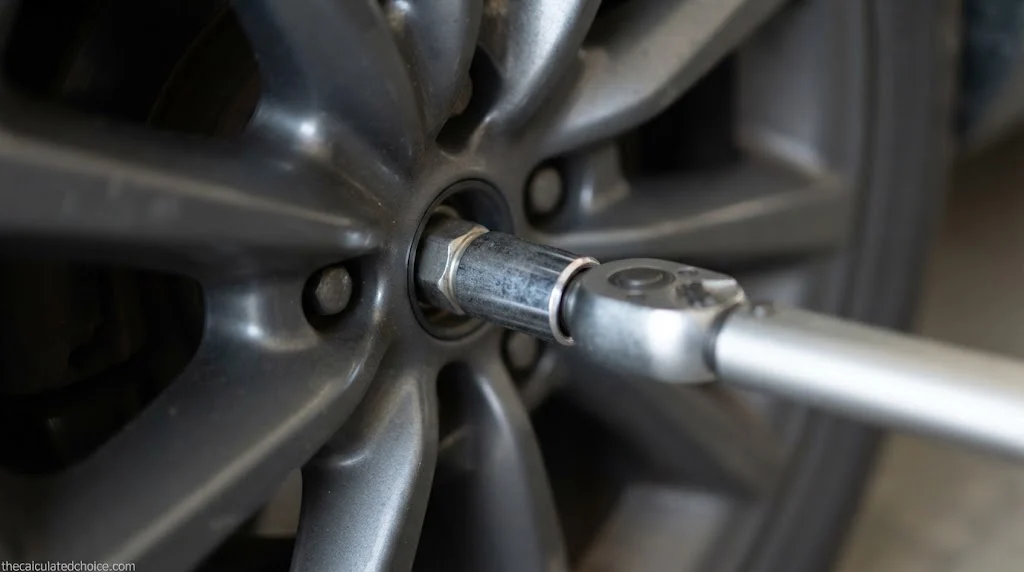
The torque number only works if the wheel seats properly. Ford Performance’s sheet warns that failing to tighten the wheel nuts in a star/cross pattern can cause high brake disc runout, which speeds up brake roughness, shudder and vibration. Toyota’s tech tip adds that final tightening should be done with a manual torque wrench, not an impact tool. Follow this sequence every time:
- Loosen the nuts on the ground. Break each wheel nut loose about half a turn while the tire still touches the ground, using a breaker bar or lug wrench. LEXIVON’s LX-183 page says not to use its torque wrench to break loose stuck fasteners.
- Lift and support the vehicle. Use a floor jack and jack stands; our best floor jack for a home garage guide covers the options.
- Clean the mounting surfaces. Ford’s warning says to remove corrosion, dirt or foreign material from the wheel and hub mounting surfaces, because skipping this can let the wheel nuts loosen and the wheel come off.
- Start the nuts by hand. Toyota recommends reinstalling the wheel nuts by hand first.
- Snug them in a crisscross pattern. Tighten until the wheel sits firmly against the hub, but do not fully tighten while the vehicle is in the air. Honda’s manual says the same.
- Lower the vehicle and torque. Set the wrench to your figure and tighten each nut in a star/cross pattern.
- Retighten after driving. Ford’s sheet says to retighten the wheel nuts within 160 km (100 miles) after a wheel is reinstalled, because wheels can loosen after the first tightening.
Star pattern for 4, 5, 6 and 8 lugs
A lug nut torque chart by vehicle type only works if you tighten in a star pattern. That means you tighten the nut across from the one you just finished instead of the one next to it. That pulls the wheel flat against the hub rather than tilting one edge first.
- 4 lugs: work in opposite pairs, such as top, bottom, left, right.
- 5 lugs: skip one nut each time, drawing a five-point star.
- 6 lugs: tighten a nut, then the one directly across the hub, and repeat around the wheel.
- 8 lugs: use opposite pairs again, moving around the wheel so no two neighbors are tightened in a row.
Go around once to snug and again to the final figure.
Why the spec assumes clean, dry threads
Any figure from a lug nut torque chart by vehicle type assumes clean, dry threads, and Ford’s sheet states exactly that: its wheel nut torque specification is for clean, dry wheel stud and wheel nut threads. A wrench measures the effort you apply, not the clamping force on the stud, so oil, grease or anti-seize on the threads can change how much force the stud sees at the same click. That is why you should not lubricate studs or nuts unless your manual says to.
What to buy for home wheel changes
To put a lug nut torque chart by vehicle type to work at home, two tools do the job: a torque wrench whose range covers your number, and a jack with jack stands. In our guide to the best torque wrench for lug nuts, we compare 1/2-inch drive click wrenches from 10 to 150 ft-lb up to 30 to 250 ft-lb. For lifting, see the best floor jack for a home garage picks, which are chosen by saddle height and lift range.
Loosening lug nuts is only half of a wheel job. Before you lift the car, read how to use a floor jack safely so the car sits securely on stands while the wheel is off.
How we researched this guide
We read the automaker documents behind every figure in this lug nut torque chart by vehicle type and linked each one so you can check it yourself.
Sources: Toyota Tech Tip T-TT-0124-11, Ford Performance M-20045-MSVT, Honda owner’s manual CV9393, Nissan Leaf owner’s manual, Mazda3 owner’s manual, LEXIVON LX-183, GEARWRENCH 85066
Bottom line: Keep this lug nut torque chart by vehicle type handy when you rotate tires, swap seasonal wheels or check a wheel after a shop visit, but tighten to the number in your own manual. Clean mounting surfaces, a star pattern, a torque wrench instead of an impact tool, and a recheck within 100 miles protect your brakes and keep the wheel secure.
Pair this chart with the basic car tools every driver should own, including a breaker bar and torque wrench.
Frequently asked questions
Can I use the same lug nut torque on every car?
Should I put anti-seize or oil on wheel studs before torquing lug nuts?
Do the wheels need to be on the ground when torquing lug nuts?
When should I recheck lug nut torque after a wheel change?
What size torque wrench do I need for car and truck lug nuts?
Can I use an impact wrench to tighten lug nuts?

Researched by Shahzad
Amazon seller who researches products using sales-rank history, price tracking and owner reviews before recommending anything. Read our disclosure.