
We may earn a commission when you buy through links on this page, at no extra cost to you. It never decides what we recommend. How we make money
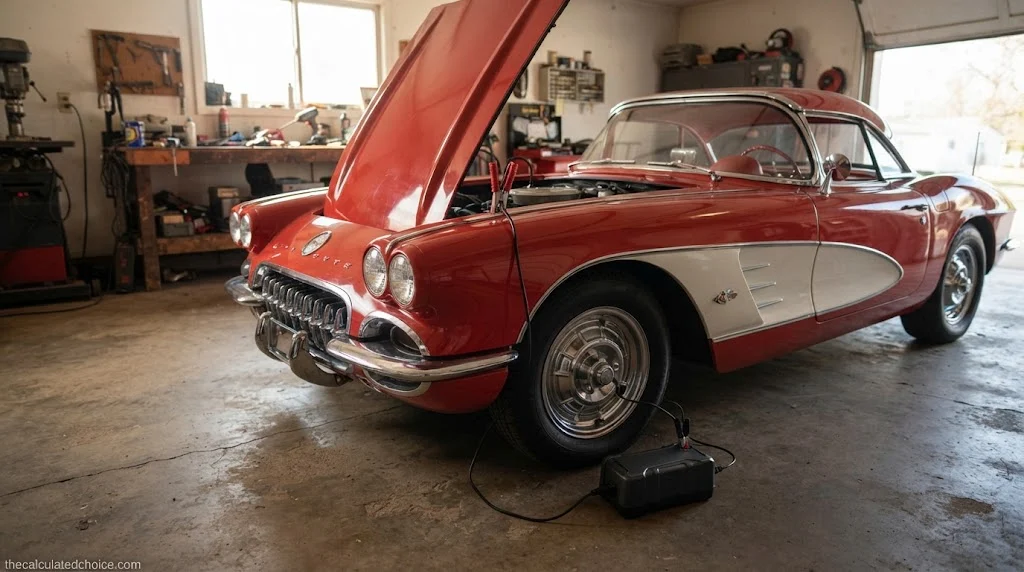
Choosing the best battery maintainer for classic cars prevents two expensive garage mistakes: letting a stored lead-acid battery sit discharged until hard lead sulfate crystals permanently ruin the plates, or hooking an unregulated trickle charger to a vintage electrical system that boils out electrolyte. Classic cruisers, muscle cars, and early six-volt collector vehicles spend weeks or months parked between drives, and even a clean electrical system loses charge through natural self-discharge.
A true smart maintainer monitors voltage continuously, tapers current during absorption, and drops into a regulated float or pulse maintenance stage so the battery stays at full capacity without overcharging. If your garage includes early six-volt vehicles, modern twelve-volt restorations, or absorbed glass mat (AGM) spiral-cell batteries, matching the charger’s voltage modes and amperage rating to your battery’s amp-hour (Ah) capacity is critical.
For a 6V classic, note that only one of the two best-known 5-amp maintainers supports 6V; our NOCO Genius5 vs CTEK MXS 5.0 comparison explains the difference.
We reviewed manufacturer manuals, published charging tables, warranty terms, and 12-month Keepa sales-rank and review histories across 12 candidates from five brands. Only five chargers passed every check for seller reliability, stable demand, and verified specifications.
Quick answer
- Best overall (6V & 12V)The NOCO GENIUS5 is the best battery maintainer for classic cars up to 120 Ah, pairing 5A charging for 6V and 12V batteries with temperature compensation and a dedicated 12V Repair Mode.Check price →See review ↓
- Best 12V set-and-forgetThe Battery Tender Plus 12V 1.25A (021-0128) covers 12V flooded, AGM, and gel batteries from 14 Ah to 80 Ah with a 4-stage float routine and a 10-year limited warranty.Check price →
- Best budget 6V & 12VThe NOCO GENIUS1 delivers 1A maintenance for topped-off 6V and 12V batteries (charging up to 30 Ah, maintaining all sizes) in a 0.77 lb plug-in body.Check price →
- Best for large batteriesThe NOCO GENIUS10 supplies 10A for 6V and 12V batteries up to 230 Ah, adds a dedicated 6V AGM mode, and includes a 13.6V 10A DC Supply Mode.Check price →
- Best for 2-car garagesThe NOCO GENIUS2X2 provides two independent 2A banks (4A total) so you can maintain a 6V classic and a 12V cruiser simultaneously from one wall outlet.Check price →
Our picks at a glance
Every model in the table below passed our Keepa stability check for consistent sales rank, strong owner ratings, and direct fulfillment by Amazon, with specifications verified directly on NOCO and Battery Tender support pages.
| Model | Best for | Output & Voltages | Rated Capacity | IP Rating | Warranty | Price Band |
|---|---|---|---|---|---|---|
| NOCO GENIUS5 | Most 6V & 12V classic cars | 5A DC (6V / 12V) | Charges up to 120 Ah; maintains all sizes | IP65 | 3 years | $$ |
| Battery Tender Plus 021-0128 | Set-and-forget 12V storage | 1.25A DC (12V only) | 14 Ah to 80 Ah (12V lead-acid) | Not published | 10 years | $$ |
| NOCO GENIUS1 | Budget upkeep of topped-off cars | 1A DC (6V / 12V) | Charges up to 30 Ah; maintains all sizes | IP60 | 3 years | $ |
| NOCO GENIUS10 | Large batteries & faster recovery | 10A DC (6V / 12V) | Charges up to 230 Ah; maintains all sizes | IP65 | 3 years | $$$ |
| NOCO GENIUS2X2 | Two classic cars side by side | 2A DC x 2 banks (6V / 12V) | Charges up to 40 Ah/bank; maintains all sizes | IP60 | 3 years | $$$ |
Best battery maintainer for classic cars: our 5 picks
NOCO GENIUS5
Best for: Most classic cars with 6V or 12V batteries up to 120 Ah that need both seasonal maintenance and overnight recharging
The NOCO GENIUS5 is our top choice for most collector garages because its 5 Amp DC output is strong enough to recharge a depleted full-size car battery in a single day while remaining gentle enough for year-round float maintenance. According to the NOCO GENIUS5 product page and NOCO Genius support specifications, the unit supports both 6-volt and 12-volt batteries across wet cell, gel, maintenance-free, calcium, EFB, AGM, and lithium (LiFePO4 with BMS) chemistries. It is rated to charge batteries up to 120 Ah and maintain all battery sizes, with an integrated thermal sensor that adjusts the charging profile from -4°F to 104°F and a 3-year limited warranty explained on the NOCO Genius support page.
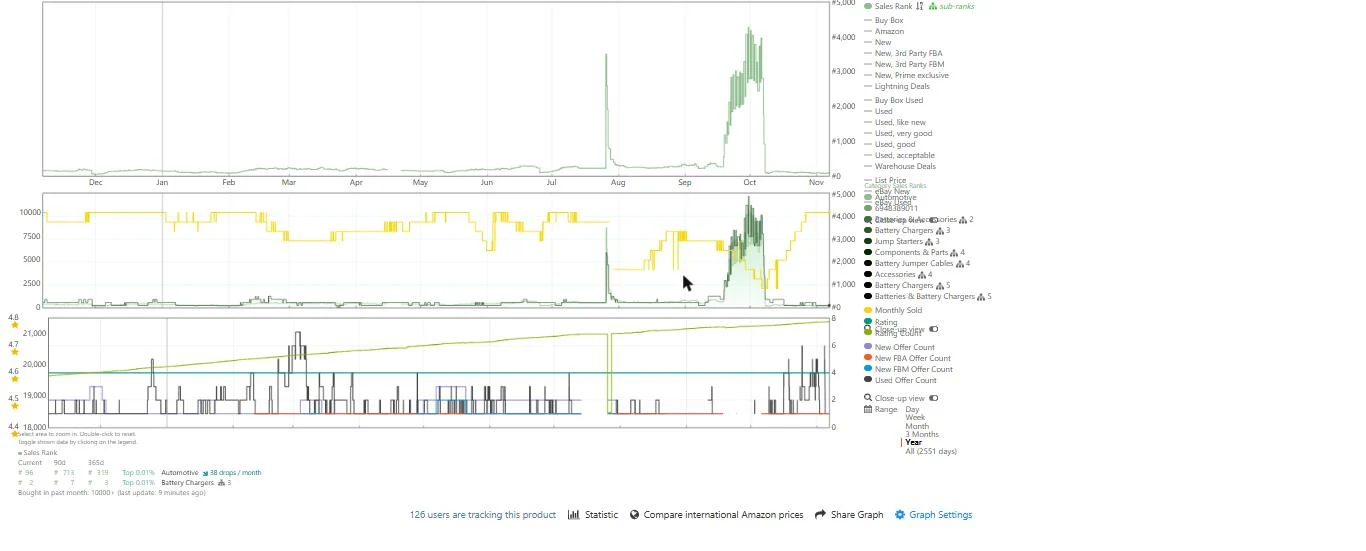
On Keepa, its sales rank stays consistently in the top 0.01% of Automotive and near the top of Battery Chargers across the 12-month tracking window, supported by a 4.6-star rating across 21,399 steadily growing reviews and inventory sold by Amazon.
Fine print: NOCO’s support documentation notes that the dedicated 12V Repair Mode (which runs for up to 4 hours to address sulfation and acid stratification) is strictly for 12-volt lead-acid batteries, uses a high charging voltage that can cause water loss in flooded wet cells, and requires disconnecting the battery from the vehicle first to protect sensitive electronics.
What we like
- Charges an 80 Ah car battery from 50% discharge in 12 hours (versus 60 hours on a 1A unit)
- Supports both 6V and 12V systems plus dedicated 12V AGM and 12V Repair modes
- IP65 splash- and dust-resistant enclosure weighs 1.50 lbs and includes needle-nose clamps with integrated eyelets
- Detects dead batteries down to 1V and includes manual Force Mode down to 0V
Watch out for
- Does not have a separate 6V AGM or 6V Repair mode (6V mode is for wet, gel, EFB, MF, and calcium)
Verdict: If you want one charger that handles both 6V and 12V classics, recharges a low 80 Ah battery overnight, and stays connected safely in an unheated garage, get the NOCO GENIUS5. Skip it if you only maintain 12V vehicles and want a 10-year warranty, or if you need a dedicated 6V AGM profile.
Battery Tender Plus 12V 1.25A (021-0128)
Best for: Stored 12V classic cars and muscle cars (14 Ah to 80 Ah) where a 10-year warranty and simple plug-and-forget float maintenance matter most
For collectors whose classic cars all run 12-volt electrical systems, the Deltran Battery Tender Plus (model 021-0128) eliminates mode-button guesswork entirely. As detailed on the Battery Tender Plus 021-0128 page, it delivers 1.25 Amps through a 4-stage Infinite Sequential Monitoring (ISM) cycle—Initialization, Bulk Charge, Absorption, and Float Maintenance—for 12V flooded, AGM, gel cell, and sealed maintenance-free batteries from 14 Ah to 80 Ah. It carries ETL and cETL safety certifications, temperature compensation, 12 feet of combined AC and DC cord reach, and a 10-year limited warranty detailed on the Battery Tender warranty policy page.
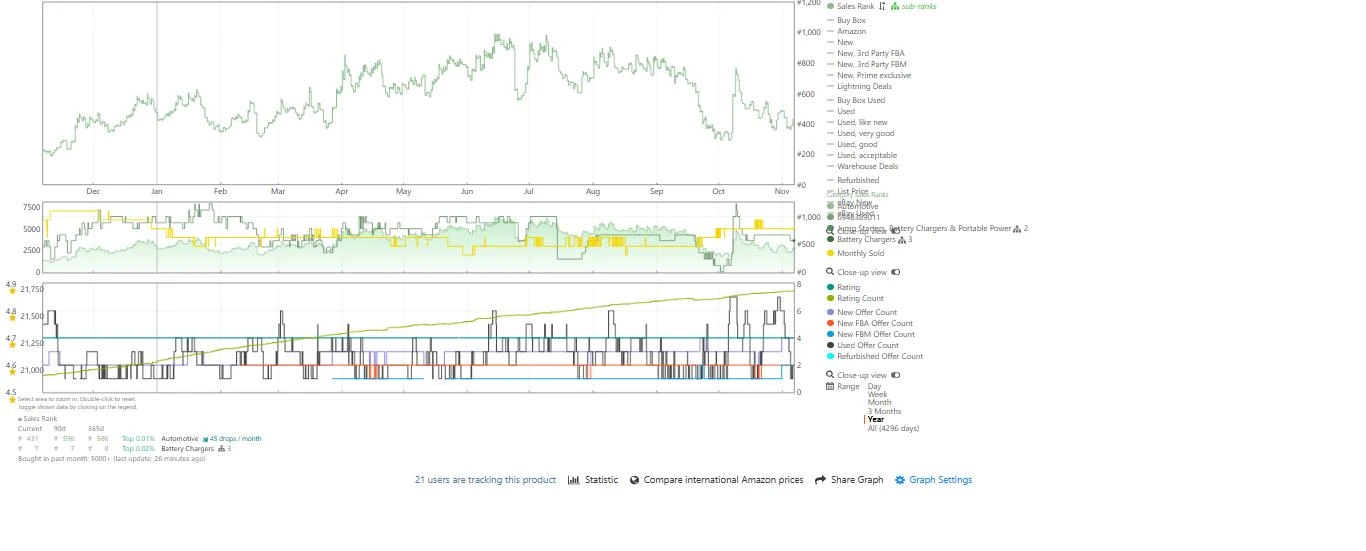
On Keepa, its Automotive sales rank remains steady across the 12-month history, backed by a 4.7-star rating across 21,732 steadily growing reviews and inventory sold by Amazon.
Fine print: According to Battery Tender’s technical FAQ, the charger holds absorption at a constant 14.4V until the current drops to 0.1A or a time limit passes, then drops its output to a 13.2V float maintenance stage, and even a momentary AC power outage causes the charger to reset its cycle. Under the warranty terms, Deltran supplies a prepaid return label for days 1 through 90 after purchase; from day 91 until the warranty ends, the purchaser pays shipping to Deltran, and a faulty unit is repaired or replaced and returned at no charge.
What we like
- Backed by a 10-year limited warranty, which Battery Tender says is longer than the 1 to 5 years most competitors offer
- ETL and cETL safety certified, with spark-proof connection and reverse-polarity protection
- 12-foot total reach (6 ft AC cord plus 4.5 ft DC cord and 1.5 ft accessory harness)
- No mode buttons to misconfigure; plugs in and runs automatically on 12V lead-acid and AGM batteries
Watch out for
- 12V lead-acid only; incompatible with 6V classic cars and lithium (LiFePO4) batteries
- Minimum battery voltage needed to start charging is not published
- IP rating not published, so keep it in a dry indoor garage
Verdict: The Battery Tender Plus 021-0128 is the most dependable set-and-forget maintainer for 12V classic cars stored indoors. Skip it if you own a 6V vintage car, run a lithium battery, or need a charger with a published deep-discharge recovery mode.
NOCO GENIUS1
Best for: Budget-friendly storage maintenance of a classic car battery that is already topped off before parking
If your classic car goes into the garage with a healthy, fully charged battery and you simply want to prevent sulfation during storage, the NOCO GENIUS1 gives you NOCO’s multi-voltage smart platform at an entry-level price band ($). Per the NOCO GENIUS1 product page and NOCO support specifications, it delivers 1 Amp DC (15 Watts max power consumption) for 6V and 12V wet, gel, MF, calcium, EFB, AGM, and lithium batteries. While NOCO rates its active charging capacity up to 30 Ah, its comparison spec table confirms it maintains all battery sizes, backed by a 3-year limited warranty (NOCO Genius support page).
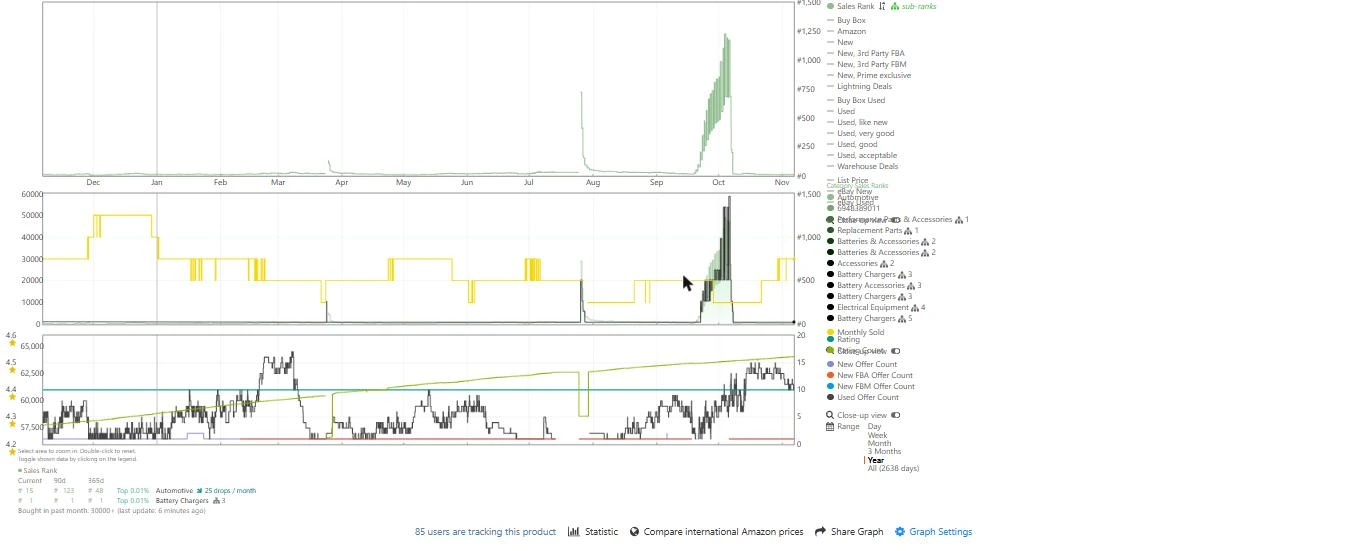
On Keepa, it sits at the top of the Battery Chargers category with a strong 12-month sales-rank average, a 4.4-star rating across 64,057 steadily growing reviews, and fulfillment sold by Amazon.
Fine print: Unlike the IP65-rated GENIUS5 and GENIUS10, the GENIUS1 carries an IP60 rating, meaning it is dust-tight but has zero liquid ingress protection—keep it off damp garage floors. Also note that recharging a half-depleted 80 Ah car battery at 1 Amp takes roughly 60 hours.
What we like
- Maintains both 6V and 12V classic car batteries of any amp-hour size once charged
- Includes thermal compensation (-4°F to 104°F) and low-voltage detection down to 1V (plus Force Mode to 0V)
- Ultra-light 0.77 lb unit with needle-nose clamps and detachable M6 eyelets (2A Mini blade fuse)
Watch out for
- 1A output is too slow for bulk recharging large automotive batteries (60 hours for 80 Ah at 50% discharge)
- IP60 enclosure is not water-resistant
- Lacks the dedicated 12V Repair Mode found on the GENIUS5 and GENIUS10
Verdict: For keeping a charged 6V or 12V battery healthy in a dry garage at the lowest cost, the NOCO GENIUS1 is a smart buy. Skip it if you frequently need to recharge a low full-size car battery or work in a damp area.
NOCO GENIUS10
Best for: Big-block classics, 6V AGM batteries, high-capacity batteries up to 230 Ah, and garage wrenching that needs a 13.6V DC power supply
Older American luxury cruisers, diesel conversions, and high-compression muscle cars often run heavy-duty batteries where a 1A or 5A maintainer takes too long after repeated cranking. According to the NOCO Genius comparison page and NOCO GENIUS10 support documentation, the GENIUS10 outputs 10 Amps DC (150 Watts max) to charge 6V and 12V batteries up to 230 Ah and maintain all sizes. It is the only pick in our lineup that adds both a dedicated 6V AGM mode and a 13.6V 10A DC Supply Mode alongside 12V Repair Mode, all covered by NOCO’s 3-year limited warranty (NOCO Genius support page).
On Keepa, its Automotive sales rank stays consistently strong across the 12-month tracking period, with a 4.5-star rating across 21,466 steadily growing reviews and inventory sold by Amazon.
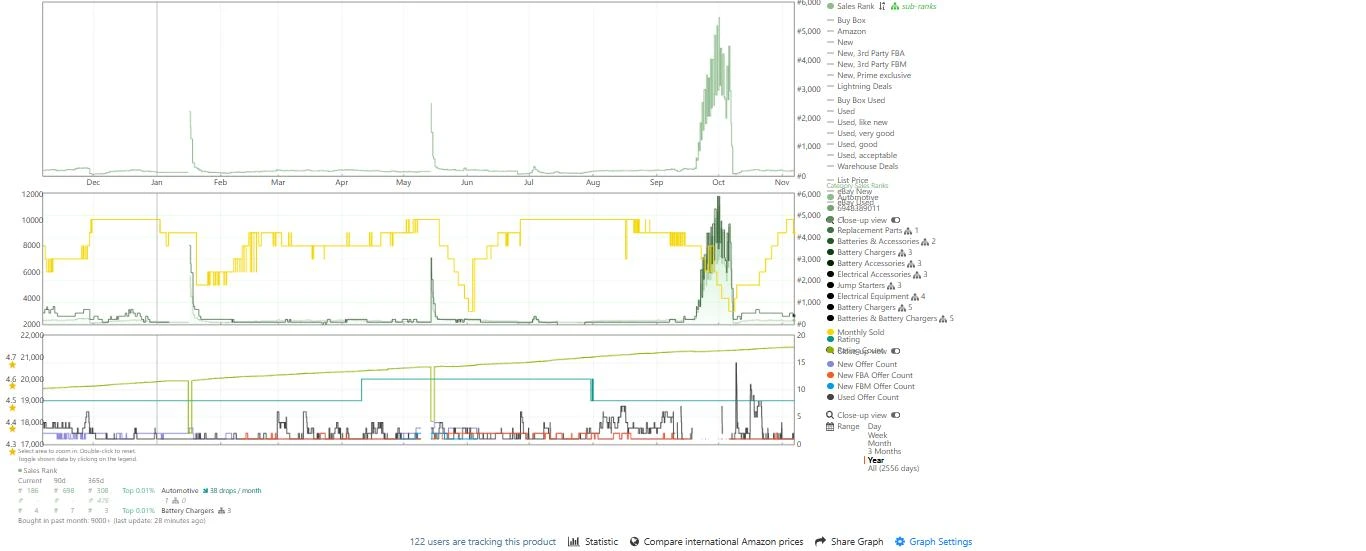
Fine print: NOCO’s support guide warns that enabling 13.6V Supply Mode (10A continuous, 12A max overload protection) disables spark-proof and reverse-polarity safety features, placing live DC power at the clamps—never let the clamps touch each other in Supply Mode.
What we like
- Cuts 50%-discharge recovery time on an 80 Ah car battery to 6 hours (and 9 hours on a 120 Ah battery)
- Includes a dedicated 6V AGM mode for vintage cars upgraded to 6-volt AGM batteries
- 13.6V 10A Supply Mode holds vehicle memory during battery swaps or powers 12V garage tools
- IP65-rated housing for garage use
Watch out for
- At 3.33 lbs (charger unit) and a $$$ price band, it is heavier and pricier than a pure float maintainer
- 10A current is too aggressive for very small powersport batteries if the wrong mode is selected
Verdict: Choose the NOCO GENIUS10 if you want fast 10A recovery for high-capacity 6V or 12V classic car batteries, a dedicated 6V AGM setting, and a 13.6V bench power supply. Skip it if you only need low-current storage upkeep for a single standard battery.
NOCO GENIUS2X2
Best for: Collectors storing two classic vehicles side by side (including mixed 6V and 12V cars) on one AC outlet
When two collector cars share a garage bay, running separate wall chargers and extension cords creates clutter. The NOCO GENIUS2X2 houses two completely independent 2 Amp DC charging banks (4 Amps total, 30 Watts max per bank) inside a single wall-mountable unit. Per the NOCO GENIUS2X2 support page, each bank has its own mode button and can be set independently to 12V, 12V AGM, 12V Lithium, 6V, or Force Mode, allowing one bank to maintain a 6V vintage roadster while the second bank tends a 12V AGM muscle car. It is backed by a 3-year limited warranty (NOCO Genius support page).
On Keepa, its Automotive sales rank stays steady across the 12-month history, paired with a 4.6-star rating across 4,710 steadily growing reviews and inventory sold by Amazon.
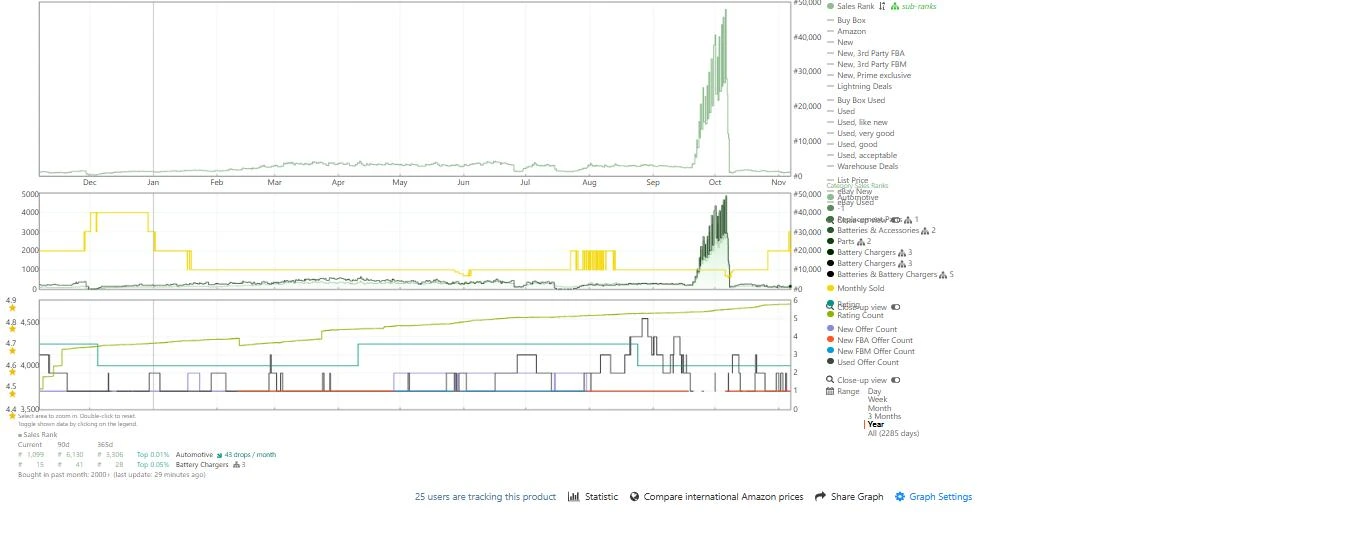
Fine print: Each bank is rated for active charging up to 40 Ah (while maintaining all battery sizes), so it suits upkeep and light top-ups rather than recharging a large, deeply discharged battery. Like the GENIUS1, the GENIUS2X2 housing is rated IP60 rather than IP65.
What we like
- Two independent banks let you mix 6V and 12V batteries or flooded and AGM chemistries simultaneously
- Includes two sets of needle-nose clamps with integrated eyelets plus two charging extension cables
- Thermal compensation and Force Mode (down to 0V) work independently on each channel
Watch out for
- 2A per bank is geared toward maintenance and light top-ups (each bank is rated to charge batteries up to 40 Ah)
- IP60 rating means the charger body must stay in a dry indoor location
Verdict: The NOCO GENIUS2X2 is the cleanest two-car maintenance station for collectors who park two classics side by side. Skip it if your cars are parked far apart in separate bays or if you need fast 5A–10A bulk recovery on each vehicle.
Sizing math: matching charger amps to classic battery capacity
Selecting the best battery maintainer for classic cars starts with checking the amp-hour (Ah) rating printed on your battery label (usually listed at the 20-hour rate, such as 60 Ah or 80 Ah). Any smart float maintainer in our lineup can hold a fully charged car battery at 100% during storage, because maintenance current only offsets a tiny natural self-discharge rate. The amperage rating matters when your battery is partially depleted from cranking a carbureted engine or sitting uncharged for several weeks.
How to estimate bulk + absorption recharge time
Step 1: Find the amp-hours needed = Battery Capacity (Ah) × Depth of Discharge (0.50 for a half-drained battery).Step 2: Account for absorption taper (charging slows during the final 20% of capacity, multiplying raw amp-hour time by roughly 1.5).Example (80 Ah classic car battery at 50% discharge): 80 Ah × 0.50 = 40 Ah needed. With taper (× 1.5): at 1A (GENIUS1) = 60 hours; at 2A (NOCO lists this for the GENIUS2 and says the GENIUS2X2 is similar) = 30 hours; at 5A (GENIUS5) = 12 hours; at 10A (GENIUS10) = 6 hours.These recharge times match the published 50% depth-of-discharge table on the NOCO Genius Support Page.
To help you compare recovery speed across battery sizes, here are the 50% depth-of-discharge charging times published by NOCO for the Genius lineup:
| Battery Size (at 50% Discharge) | NOCO GENIUS1 (1A) | NOCO GENIUS2 (2A; NOCO says the GENIUS2X2 is similar) | NOCO GENIUS5 (5A) | NOCO GENIUS10 (10A) |
|---|---|---|---|---|
| 20 Ah (Small / Aux Battery) | 15 hours | 7.5 hours | 3 hours | 1.5 hours |
| 40 Ah (Compact Classic Car) | 30 hours | 15 hours | 6 hours | 3 hours |
| 80 Ah (Full-Size Classic Car) | 60 hours | 30 hours | 12 hours | 6 hours |
| 100 Ah (Large Cruiser / Pickup) | 75 hours | 37.5 hours | 15 hours | 6 hours |
| 120 Ah (Heavy-Duty Battery) | 90 hours | 45 hours | 18 hours | 9 hours |
| Price | Check price | Check price | Check price | Check price |
How to choose the best battery maintainer for classic cars
Even the best battery maintainer for classic cars cannot protect your battery if its voltage profile or connection sequence conflicts with your vehicle’s electrical architecture. Before clipping a charger onto a collector vehicle, verify these four technical checks.
1. Six-volt (6V) vs. twelve-volt (12V) systems
Many American and European classics built before the mid-fifties run 3-cell, 6-volt lead-acid batteries, while later classics and converted restomods run 6-cell, 12-volt batteries. Connecting a 12V-only charger to a 6V battery applies double the voltage the cells are built to handle, causing rapid gassing and plate damage. If you own a 6V vehicle, choose a multi-voltage unit like the NOCO GENIUS1, GENIUS5, GENIUS10, or GENIUS2X2 and confirm that the 6V mode LED is illuminated after connection. The Battery Tender Plus 021-0128 is strictly for 12V systems.
2. Positive-ground vs. negative-ground chassis wiring
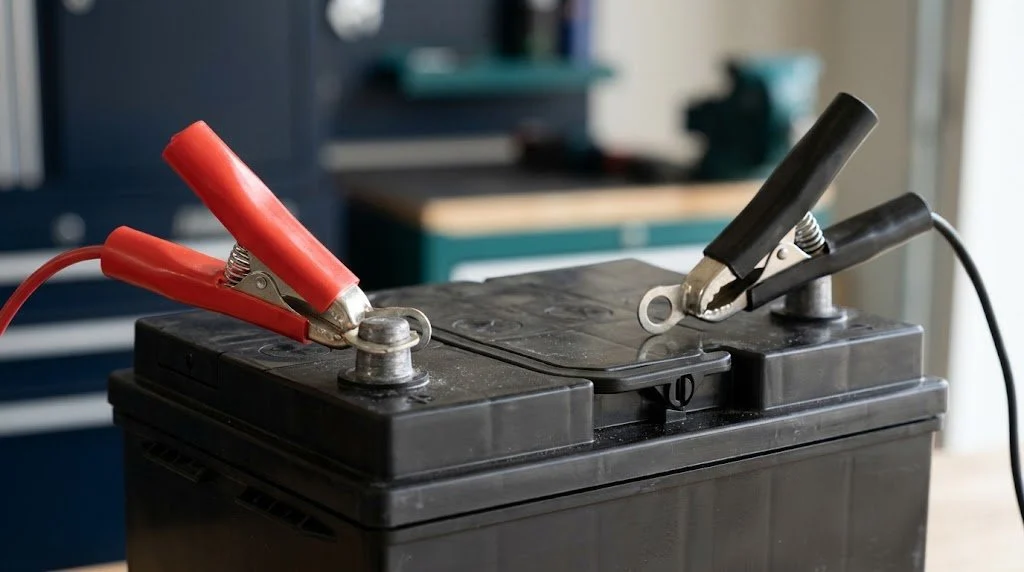
While modern vehicles ground the negative (-) battery post to the chassis, many vintage British, European, and early American automobiles use a positive-ground electrical system where the positive (+) battery post is bolted to the frame. Regardless of whether your car is positive-ground or negative-ground, charger polarity at the battery posts never changes: red (+) always goes to the positive (+, POS, P) post and black (-) always goes to the negative (-, NEG, N) post. However, as the Clore PRO-LOGIX operator’s manual explains for in-vehicle charging, the order in which you connect to the battery post versus the chassis frame changes based on which post is grounded:
- Negative-ground classic cars: Connect the red (+) charger clamp to the ungrounded positive (+) battery post first, then connect the black (-) charger clamp to a heavy-gauge metal part of the frame or engine block away from the battery, carburetor, and fuel lines.
- Positive-ground classic cars: Connect the black (-) charger clamp to the ungrounded negative (-) battery post first, then connect the red (+) charger clamp to a heavy-gauge metal part of the chassis frame or engine block away from the battery and fuel system.
- Disconnecting sequence: Always turn off or unplug the AC power cord from the wall outlet first, remove the clip from the vehicle chassis second, and remove the clip from the battery terminal last.
3. Flooded wet-cell vs. AGM and spiral-wound batteries
Many classic car owners replace traditional flooded lead-acid batteries with sealed AGM or spiral-wound batteries to prevent acid leaks on painted battery trays. Both NOCO (via its dedicated 12V AGM mode, plus 6V AGM on the GENIUS10) and Battery Tender (via its 4-stage ISM profile holding 14.4V absorption and 13.2V float) support sealed AGM batteries safely. If your classic uses a traditional flooded battery with removable filler caps, check electrolyte levels periodically and follow the battery maker’s instructions for topping up cells with distilled water.
4. Manual fine print: power outages, low-voltage cutoffs, and parasitic draws
- Auto-memory vs. power-outage resets: NOCO advertises an “Auto Memory” feature on the NOCO GENIUS5 page but does not spell out what it restores after a power cut, so check the manual if your garage circuit trips often. The Battery Tender technical FAQ notes that a momentary AC power outage causes the Battery Tender Plus to reset and restart its 4-stage cycle.
- Dead-battery voltage thresholds: Battery Tender does not publish a minimum battery voltage for the Plus 021-0128. NOCO Genius units detect batteries down to 1V automatically and offer a 5-minute manual Force Mode to push current into a 0V battery.
- High-voltage repair modes: Never run NOCO’s 12V Repair Mode on an AGM battery or while the battery cables are still connected to a classic car’s wiring harness, as the elevated recovery voltage can stress vintage gauges or aftermarket electronic ignitions.
Popular picks we rejected
We evaluated seven additional maintainers from NOCO, CTEK, Battery Tender, Clore Automotive, and Schumacher Electric. While several have solid technical specs on paper, we excluded them after checking their Keepa sales-rank stability, seller ratings, and lineup overlap:
| Model & ASIN | Key Maker Spec | Why We Rejected It |
|---|---|---|
| NOCO GENIUS2 (B07W6B987F) | 2A DC, 6V/12V, charges up to 40 Ah, IP65, 3-year warranty | Passes Keepa checks, but overlaps directly with the lower-cost 1A GENIUS1 for pure maintenance and the 5A GENIUS5 for full-size classic car charging. |
| CTEK MXS 5.0 40-206 (B00CD44RQO) | 4.3A DC, 12V only, 8-step charging up to 110 Ah (160 Ah maintenance), 5-year warranty | Weak seller reliability on the listing: fulfillment is mostly handled by a third-party seller with a 65% rating rather than Amazon or CTEK directly. |
| CTEK US 0.8 56-865 (B006CQ9BMO) | 0.8A DC, 12V only, 6-step charging up to 32 Ah (100 Ah maintenance), 5-year warranty | Erratic and weak sales-rank history on Keepa compared with the NOCO GENIUS1 and Battery Tender Plus. |
| Battery Tender Plus 6V/12V Selectable 022-0211-DL-WH (B01L0HTX72) | 1.25A DC, manual 6V/12V switch, 14–80 Ah, IP65, 5-year warranty | Volatile, weak sales-rank trend on Keepa, and the manufacturer’s own product page notes this model is being transitioned to a newer version. |
| Battery Tender 4 Amp 6V/12V 022-0209-BT-WH (B07XMJDJX7) | 4A DC, switchable 6V/12V and Lead-Acid/Lithium, 14–100 Ah, IP65 | Volatile sales-rank history and inconsistent direct-from-Amazon seller share compared with the NOCO GENIUS5 and Battery Tender Plus 12V. |
| Clore PRO-LOGIX PL2140 (B00U3ZBU2E) | 4.0A DC, 6V/12V, 7 charging phases, 1-year warranty | Very weak, erratic sales-rank demand on Keepa and only a 1-year limited warranty. |
| Schumacher SC1320 / SC1320L (B0789694GG) | 2A/6A DC, 6V/12V automatic charger and maintainer, 1-year warranty | Weak, erratic sales-rank history on Keepa and a 1-year warranty compared with 3 to 10 years on our top picks. |
How we chose these picks
To identify the best battery maintainer for classic cars, we did not lab-test units; instead, we checked 12-month Keepa sales-rank and review data, manufacturer specification tables, and electrical safety standards across 12 candidate models from five brands.
Sources: NOCO Genius Support Specs, Battery Tender Plus Specifications, OSHA Battery Charging Safety, Clore Operator’s Manual (Ground Polarity)
Bottom line: Choosing the best battery maintainer for classic cars comes down to matching your battery’s voltage (6V or 12V) and amp-hour capacity to a smart charger with verified float regulation. For most collector garages, the NOCO GENIUS5 is the best battery maintainer for classic cars because it handles both 6V and 12V systems up to 120 Ah, while the 10-year-warranted Battery Tender Plus 021-0128 is the top plug-and-forget option for 12V-only classics.
New to the difference between the two charger types? Read battery maintainer vs trickle charger first. If the car sits through cold months, our winter storage maintainer picks cover unheated garages, and the car battery care guide walks through the wider maintenance routine. Collectors who also park a camper can check the best battery maintainer for RVs. Pair your charger with our guide on how to store a car battery over winter to prevent plate sulfation.
Frequently asked questions
What is the difference between a trickle charger and a battery maintainer for a classic car?
Can I use a 12-volt battery maintainer on a 6-volt classic car?
How do I connect a battery maintainer to a positive-ground classic car?
How many amps should a battery maintainer have for a classic car?
Can I leave a smart battery maintainer connected to my classic car indefinitely?
Do I need to disconnect my classic car battery cables before using a battery maintainer?

Researched by Shahzad
Amazon seller who researches products using sales-rank history, price tracking and owner reviews before recommending anything. Read our disclosure.