
We may earn a commission when you buy through links on this page, at no extra cost to you. It never decides what we recommend. How we make money
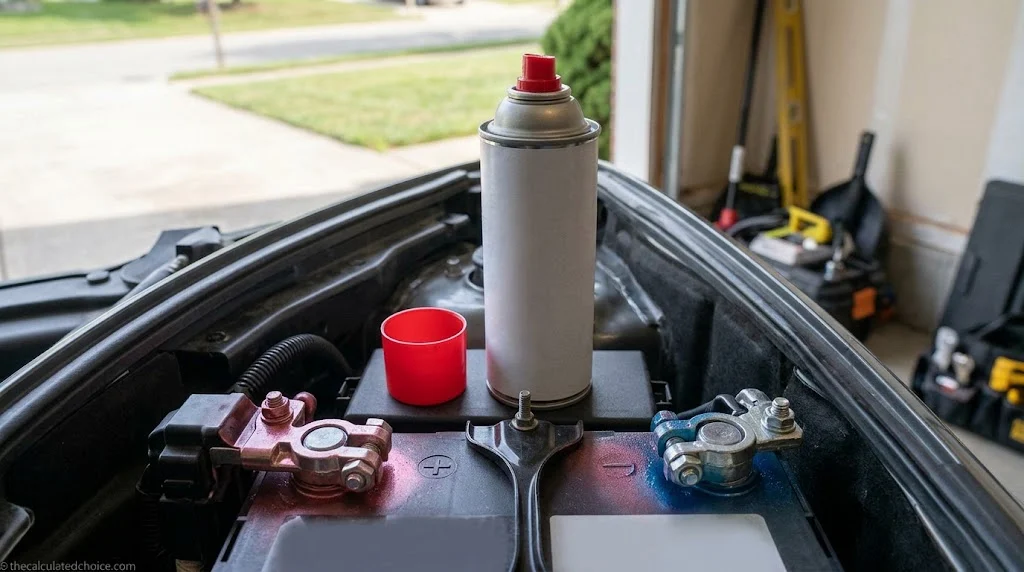
Choosing the best battery terminal cleaner and protector is not about picking a single miracle can—because neutralizing sulfuric acid salt and sealing bare lead against future acid vapor require two completely different chemical jobs. If you only wire-brush the white or blue-green crust off your clamps, unseen acid film left on the battery case keeps reacting with the metal, while micro-gaps at the base of the lead post keep venting corrosive fumes.
Grabbing the wrong product creates headaches of its own. Spraying a thick, viscous terminal protector onto a bare battery post before clamping the cable down puts an insulating film right between the mating surfaces, raising electrical contact resistance and starving your starter motor of voltage. Conversely, using an alkaline foaming cleaner without following up with an oil- or resin-based moisture barrier leaves freshly stripped lead and copper exposed to under-hood heat and humidity.
We analyzed manufacturer technical data sheets, Safety Data Sheets, and Keepa sales-rank and review history to put together a complete four-part toolkit that covers every step of terminal care. If you want a step-by-step walkthrough of the disconnect and wash procedure before you shop, read our guide on how to clean car battery terminals.
Quick answer
- Best foaming cleaner & leak detectorCRC 05023 Battery Cleaner with Acid Indicator (11 wt oz) sprays on as a pH 8.5 yellow foam that turns pink on contact with battery acid, neutralizing hidden leaks across terminals, hold-downs, and trays.Check price →See review ↓
- Best spray-on barrier coatCRC 05046 Battery Terminal Protector (7.5 wt oz) leaves a soft, visible dark-red viscous film over assembled top-post or side-post connections to block moisture and acid vapor.Check price →
- Best under-clamp felt ringsNOCO NCP2 B603 Oil-Based Battery Terminal Protectors (50-Pack) use non-woven felt washers saturated in non-drying NCP2 oil compound to seal the base of top-post and side-post terminals where acid fumes escape.Check price →
- Best mechanical post & clamp brushLisle 11120 Battery Brush pairs an internal post brush with a tapered external clamp brush inside a chemical-resistant high-impact plastic shell to strip thick crust before chemical treatment.Check price →
Our picks at a glance
Battery terminal maintenance works in three distinct stages: mechanical scraping to break through crusty deposits, alkaline washing to neutralize acidic residue, and barrier sealing to block oxygen and venting acid gas. Because no single aerosol or brush does all three jobs, the table below shows how each pick fits into the workflow.
| Product | Role in workflow | Format & net fill | Key maker spec | Flammability |
|---|---|---|---|---|
| CRC 05023 Battery Cleaner | Acid neutralizer & leak detector | Aerosol yellow foam (11 wt oz) | pH 8.5; foam turns pink on acid contact | Non-flammable (no flash point) |
| CRC 05046 Terminal Protector | External spray barrier film | Aerosol dark red liquid (7.5 wt oz) | Soft viscous film; 86.3% VOC | Extremely flammable (0 °F flash point) |
| NOCO NCP2 B603 Protectors | Base-of-post vapor seal | 50 saturated non-woven felt rings | Oil-based NCP2 compound; removable inner ring | Non-aerosol oil-saturated felt |
| Lisle 11120 Battery Brush | Mechanical post & clamp scraper | Dual internal/external wire brush (0.13 lb) | High-impact chemical-resistant plastic case | Not applicable (hand tool) |
The best battery terminal cleaners and protectors
Every product below passed our Keepa history checks for consistent sales rank, stable review patterns, and reliable stock availability, and the specs we quote come from the makers’ own product pages, labels, and data sheets.
CRC 05023 Battery Cleaner with Acid Indicator (11 wt oz)
Best for: Neutralizing sulfuric acid residue and pinpointing hidden case or post leaks
Standard baking-soda-and-water mixes run right off vertical battery cases before they can soak through thick sulfate deposits. The CRC 05023 Battery Cleaner with Acid Indicator solves both dwell time and leak detection at once. It sprays out of a 12-ounce aerosol can (11 wt oz net fill) as a slow-evaporating, pH 8.5 yellow foam that clings to battery posts, cable clamps, hold-down brackets, and plastic battery trays. Everywhere the yellow foam touches sulfuric acid, it turns pink—showing you where acid residue sits around the posts, tray, and vent caps before you rinse the residue away.
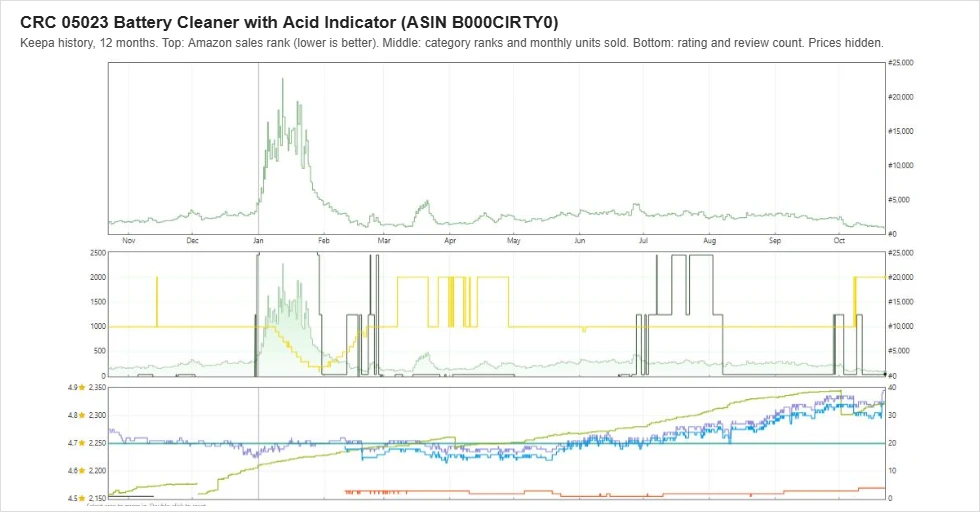
On Keepa, CRC 05023 is sold and shipped by Amazon, sits around the top 1,000 to 2,500 in Automotive, shows 2,000+ units bought in the past month, and has years of steady demand with a review count that rises smoothly rather than in sudden bursts.
Fine print: CRC confirms on the specification sheet that 05023 is plastic-safe, non-flammable (CPSC Flammability Class: None, with no flash point), and carries a 7.9% VOC rating (82.16 g/L). However, it is strictly a water-rinsable cleaner—it leaves zero protective barrier behind once rinsed, so bare metal will corrode again if you do not follow up with a dedicated terminal protector.
What we like
- Yellow foam turns pink on contact with acid, making invisible electrolyte seepage along the case top easy to spot
- Non-flammable aerosol formulation with no flash point and a low 7.9% VOC content
- Plastic-safe pH 8.5 chemistry cleans battery casings, trays, and hold-downs safely
Watch out for
- Requires a water rinse after application to flush away dissolved corrosion by-products
- Provides no ongoing anti-corrosion film after rinsing—must be paired with a separate protectant
Verdict: If you want to know whether terminal fuzz is coming from normal venting or a cracked post seal, CRC 05023 shows you where the acid is before you rinse. Skip it if you work in an enclosed parking spot where rinsing battery trays with water is impractical.
CRC 05046 Battery Terminal Protector (7.5 wt oz)
Best for: Sealing assembled top-post clamps, side-post bolts, and metal hold-down brackets
Felt washers cannot cover the top of a battery clamp, exposed copper cable strands, or steel hold-down J-bolts. That is where the CRC 05046 Battery Terminal Protector earns its spot. Packaged as a 7.5 wt oz net fill inside a 12-ounce aerosol can, it sprays a fast-evaporating carrier solvent that leaves behind a soft, dark-red viscous film over terminals, posts, hold-downs, and casings on automotive, marine, and backup-power batteries. Because the coating is tinted dark red, you can see at a glance whether you achieved complete coverage around bolt heads and clamp ears, and CRC’s label says to reapply when the red film turns clear.
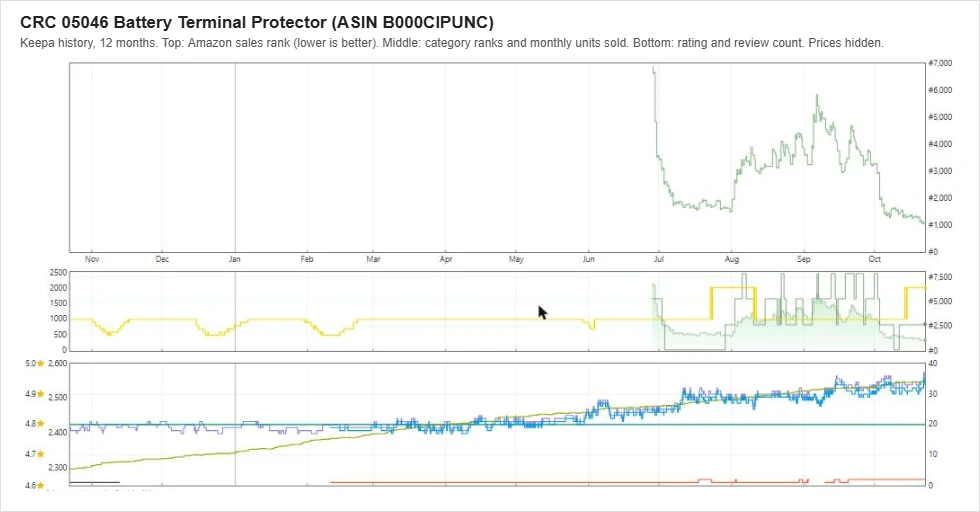
On Keepa, CRC 05046 is sold and shipped by Amazon, ranks around the top 1,100 to 2,900 in Automotive, and shows 2,000+ units bought in the past month. Keepa has a gap in its rank data for several months, but monthly sales and reviews kept climbing through that gap.
Fine print: Unlike the non-flammable 05023 cleaner, CRC 05046 is rated Extremely Flammable by CPSC standards, with a flash point of 0 °F (-18 °C) and an 86.3% VOC content (627.4 g/L consumer definition). CRC’s application directions state that you must connect and tighten the battery cables before spraying the protector over the exterior, and when you need to strip old buildup later, CRC specifies removing it with a degreaser or brake cleaner product. Also remember to invert the can and spray until only clear propellant escapes after each use so the viscous film does not clog the nozzle valve.
What we like
- Dark-red tint makes missed spots obvious and shows when the protective coat has worn thin
- Coats irregular shapes—including cable crimps, side-post bolts, and steel hold-down brackets—that flat washers cannot reach
- Soft viscous film does not dry into a brittle shell that cracks under engine vibration
Watch out for
- Extremely flammable aerosol (0 °F flash point) that must never be sprayed near sparks or with the ignition on
- Tacky red overspray requires brake cleaner or degreaser to wipe off painted fenders or valve covers
Verdict: For sealing the outside of tightened clamps and metal hold-down hardware against salt air and acid mist, CRC 05046 is fast and thorough. Skip it if you want a mess-free installation with zero solvent fumes or overspray masking.
NOCO NCP2 B603 Oil-Based Battery Terminal Protectors (50-Pack)
Best for: Sealing the post-to-case seam on multiple family cars, trucks, boats, or lawn equipment
Most battery terminal corrosion starts right where the lead post exits the plastic battery cover: heating and cooling cycles flex that plastic-to-lead seal, letting sulfuric acid fumes seep upward straight into the underside of your cable clamp. The NOCO NCP2 B603 Battery Terminal Protectors sit flat against the battery top right under the clamp, intercepting those fumes at the source. Each tub holds 50 organic non-woven felt washers saturated with NOCO’s oil-based NCP2 corrosion preventative compound, which the maker states will not dry out or evaporate. NOCO says NCP2 protection is guaranteed for the life of your battery, with support claims handled through NOCO Warranty & Returns.
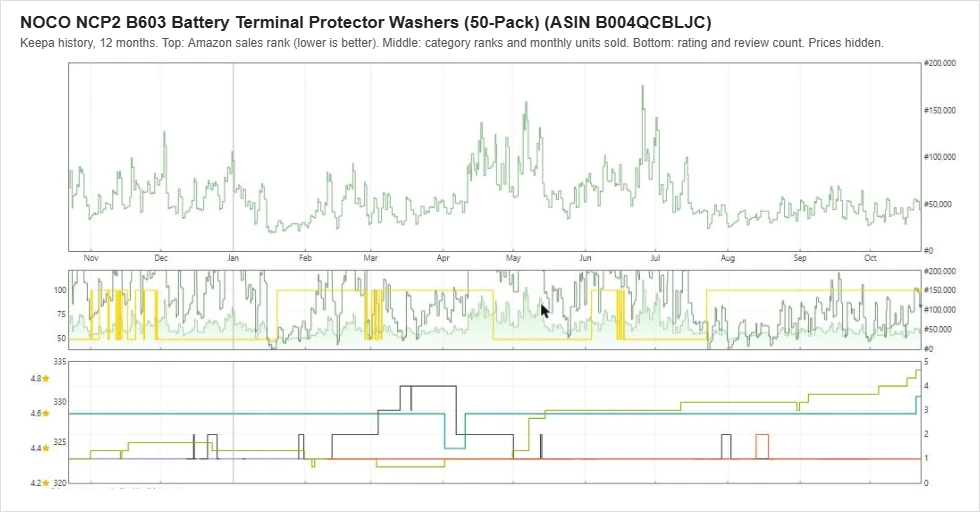
On Keepa, the NOCO B603 50-pack is sold and shipped by Amazon and has held a steady Automotive rank of around 44,000 for about ten years, with 100+ units bought in the past month and no suspicious review bursts.
Fine print: Every B603 washer has a die-cut removable inner ring so it can fit smaller negative posts, larger positive posts, or side-post battery bolts. Because the washers are heavily saturated in oil-based NCP2 grease inside the tub, wear nitrile gloves when pulling one out, and wipe any excess grease off the tapered contact surface of the lead post before sliding the cable clamp down so you keep clean metal-to-metal clamping contact.
What we like
- Seals the exact base-of-post gap where acid vapors escape, without spraying flammable solvents under the hood
- Removable inner center ring adapts each washer to standard top posts or side-post battery bolts
- One 50-washer tub services up to 25 dual-post batteries across cars, tractors, ATVs, and marine banks
Watch out for
- Requires disconnecting and lifting the battery cable clamps off the posts to install
- A thick felt washer can prevent a worn clamp from seating all the way down on a short battery post
- Protects the base of the post, not exposed copper wire strands or upper hold-down brackets
Verdict: If you maintain more than two vehicles or hate aerosol overspray, the NOCO B603 tub gives you a permanent supply of oil-saturated vapor barriers. Skip it if you only own one car and have no use for 48 leftover washers.
Lisle 11120 Battery Brush
Best for: Scrubbing dark lead oxide film and crusty sulfate off top-post terminals and cable clamps
Chemical foam dissolves loose white acid salt, but it will not strip the hard, dark gray lead-oxide glaze that forms between the inside of a cable clamp and the outside of a battery post. That dark oxide layer acts as an electrical resistor even when a terminal looks clean from above. The Lisle 11120 Battery Brush packs two specialized wire brushes into a single 0.13-pound hand tool: twist the open cylindrical base over a battery post to scour the outer wall with the internal bristles, then pop off the cap to twist the tapered external cone brush inside the disconnected cable clamp.
On Keepa, the Lisle 11120 is sold and shipped by Amazon, ranks around 55,000 in Automotive, shows 100+ units bought in the past month, and its reviews grow steadily over time.

Fine print: Lisle specifies that the outer housing is molded from high-impact plastic that will not weaken when exposed to battery cleaning solutions. Note that Lisle does not publish the specific metal alloy of the internal or external wire bristles on its specification sheet, so always rinse and dry the bristles after using them around battery acid.
What we like
- High-impact plastic body resists battery cleaning solutions and that Lisle says will not weaken in cleaning solutions
- Tapered cone brush matches the internal bevel of top-post battery cable clamps for uniform contact cleaning
- Compact 0.13-pound enclosed shell keeps sharp wire bristles covered in your glovebox or tool drawer
Watch out for
- Designed for standard top-post terminals and ring clamps—the internal cylinder cannot clean flat side-post pads
- Aggressive twisting on thin stamped-sheet-metal clamps can score soft lead plating if overdone
Verdict: Every top-post battery service needs mechanical scrubbing before you tighten the clamp, and the solvent-resistant plastic housing is the main reason we picked the Lisle 11120. Skip it if your vehicles exclusively use GM-style threaded side-post batteries.
How terminal resistance steals cranking voltage
Why does a thin layer of terminal corrosion stop an engine from starting even when the battery tests full on a voltmeter? Because an unloaded voltmeter draws almost zero current, hiding the contact resistance between a dirty post and clamp until the moment you turn the key.
Under Ohm’s Law (V = I × R), voltage drop across a connection equals the electrical current in amps multiplied by the resistance in ohms. When a starter motor demands high cranking current, even a tiny fraction of an ohm of lead sulfate or oxide buildup drops terminal voltage below what the starter solenoid and engine computer need to fire.
Starter cranking voltage drop across a corroded terminal
Step 1 (Ohm’s Law): Voltage Drop (V_drop) = Cranking Current (I) × Terminal Contact Resistance (R)Step 2 (Clean connection): 250 A starter draw × 0.0004 Ω clean clamp resistance = 0.10 V lostExample (Corroded connection): 250 A starter draw × 0.015 Ω oxidized clamp resistance = 3.75 V lostIf a 12.6 V battery drops to 10.5 V under a 250 A cranking load and loses another 3.75 V across a crusty terminal clamp, only 6.75 V reaches the starter motor—causing a rapid clicking solenoid instead of a start.
Battery post geometry also explains why you need a tapered brush like the Lisle 11120 and why you should never coat the mating surfaces before tightening the clamp. SAE-style top posts are tapered, and the positive post is slightly thicker than the negative so the clamps are hard to swap by mistake. The ODYSSEY owner’s manual lists these dimensions for its SAE top posts and side terminals:
| Terminal type | Positive (+) | Negative (-) | Why it matters for cleaning & protection |
|---|---|---|---|
| SAE tapered top post | 17.3 mm (0.682 in) top / 19.3 mm (0.759 in) base | 15.7 mm (0.619 in) top / 17.7 mm (0.696 in) base | The taper means a cone-shaped post brush cleans the full contact surface; a flat brush misses the sides. |
| Side terminal | 3/8″-16 threaded receptacle | 3/8″-16 threaded receptacle | The flat mating pad needs a flat brush, not a post cylinder; remove the inner ring on NOCO B603 washers. |
What to check on the label before you buy
Walk down an auto parts aisle and half the cans look identical, yet their chemical formulas behave completely differently on a battery. Before you put a cleaner or protector in your cart, verify these four details on the manufacturer sheet:
- Acid-indicator color change on cleaners: Plain foaming degreasers clean oil and road grit, but they do not tell you whether sulfuric acid is actively leaking out of a cracked post seal. CRC 05023 sprays out as a pH 8.5 yellow foam that turns pink where acid is present, letting you spot a failing battery case before it rots the steel battery tray underneath.
- Post-assembly vs. pre-assembly application: Aerosol film sprays such as CRC 05046 deposit a soft viscous barrier coat that blocks air and moisture, not an electrically conductive paste. Always bolt the clean, dry metal clamp onto the clean, dry post first, and then spray the red film over the outside of the assembled joint. By contrast, NOCO B603 felt washers go onto the base of the post before you slip the cable clamp down.
- Flammability and flash point differences: Do not assume two cans from the same brand share the same hazard rating. CRC 05023 Battery Cleaner is a water-based non-flammable aerosol with no flash point and 7.9% VOCs, whereas CRC 05046 Battery Terminal Protector is rated Extremely Flammable with a 0 °F (-18 °C) flash point and 86.3% VOCs.
- Brush housing material: Bare metal brush housings can rust after repeated contact with cleaning solution and acid runoff. Look for a high-impact plastic housing like the Lisle 11120 that will not soften in chemical cleaners or corrode in your toolbox.
Popular approaches and products we skipped
Not every popular battery maintenance shortcut or competing spray earns a recommendation. Here is why we passed on several common alternatives during our spec and market review.
| Product or method | Category | Why we skipped it |
|---|---|---|
| Permatex 80369 cleaner and 80370 protector | Cleaner & sealer sprays | Both failed our Keepa check: no reliable Buy Box offer, a slipping or weak sales rank, and listing details that did not match the product. |
| Two-pack retail felt washer cards | Felt terminal rings | Single-battery blister packs use the exact same felt washer concept as the NOCO B603 tub but usually cost more per ring if you maintain more than one battery. |
| Unpainted sheet-metal post brushes | Mechanical brushes | Cheap stamped-metal brushes can rust inside the cap if they are stored wet after scrubbing acid-damp terminals. |
| Household petroleum jelly (Vaseline) | DIY grease substitute | Low melting point allows under-hood engine bay heat to liquefy the jelly, letting it run off the clamp and collect road grit across the battery top. |
How we chose these picks
We did not lab-test these cleaners, protectors, or brushes; instead, we evaluated Keepa sales and review data alongside manufacturer specification sheets, Safety Data Sheets, and federal workplace safety rules.
Sources: CRC Industries (05023), CRC Industries (05046), NOCO Support (B603), Lisle Corporation (11120), OSHA Battery Safety eTool
Frequently asked questions
Do I need both a battery terminal cleaner and a battery terminal protector?
Should I spray battery terminal protector before or after connecting the cables?
What color does CRC 05023 Battery Cleaner turn when it touches battery acid?
Can I use NOCO NCP2 B603 felt washers on side-post batteries?
How do you remove old CRC 05046 Battery Terminal Protector spray before servicing a battery?
Why do battery terminals corrode even when the battery is sealed?

Researched by Shahzad
Amazon seller who researches products using sales-rank history, price tracking and owner reviews before recommending anything. Read our disclosure.