
We may earn a commission when you buy through links on this page, at no extra cost to you. It never decides what we recommend. How we make money
Following a consistent car maintenance schedule prevents roadside breakdowns, cuts fuel bills, and protects your engine, transmission, and brakes from expensive wear. Most drivers wait for a dashboard warning light before opening the hood, yet National Highway Traffic Safety Administration (NHTSA) TireWise data shows that only 19 percent of consumers properly inflate their tires. Sticking to a 15-minute monthly car maintenance schedule in your driveway catches low tire pressure, fluid leaks, and corroded battery terminals before they turn into repair shop bills.
Skipping basic checks penalizes your gas tank on every commute. According to the Federal Trade Commission (FTC), keeping your engine tuned per your owner’s manual increases gas mileage by an average of 4 percent, while keeping tires properly inflated and aligned increases mileage by up to 3 percent. By contrast, carrying an extra 100 pounds of unnecessary weight in the trunk reduces a typical car’s fuel economy by up to 2 percent, and hauling cargo on a loaded roof rack lowers fuel economy by 5 percent (FTC).
Quick answer
- Monthly cold tire checkCheck the pressure of all tires, including your spare, at least once a month when cold (not driven for at least 3 hours), and verify tread depth is above 2/32 of an inch (NHTSA TireWise).
- Monthly under-hood fluidsAs part of your monthly car maintenance schedule, inspect engine oil and coolant levels while the engine is cool (Bridgestone), and check brake, automatic transmission or clutch, power steering, and windshield washer fluid levels (NHTSA).
- Monthly belts, hoses, wipers, and lightsInspect rubber belts and hoses for bulges, blisters, cracks, or cuts; check both sides of wiper blades for wear and deformation; check headlights, brake lights, and turn signals against a garage door; and secure floor mats with retention clips (NHTSA; Bridgestone).
- Tire rotation & EV checksIf recommended by the vehicle manufacturer, rotate tires every 5,000 to 8,000 miles or sooner if uneven wear appears (NHTSA); on EVs, Toyota recommends tire inspection every 5,000 miles due to high torque and regenerative braking.
- Oil change intervalsDepending on your car and oil type, manuals call for oil and filter changes every 3 months or 3,000 miles on some vehicles, or between 5,000 and 10,000 miles on many newer models–with more frequent service needed under extreme conditions like towing, rough or dirt roads, or cold-climate short trips (Bridgestone; Toyota Newsroom).
The 15-minute monthly car maintenance schedule checklist
A practical car maintenance schedule separates driveway checks you can perform in 15 minutes from mileage-based shop service. Combining the monthly inspection guidance from NHTSA, Toyota Newsroom, and Bridgestone’s maintenance checklist, here are the seven systems to inspect every month:
| Component / System | When to Check | Required Condition / Spec | What to Do If Out of Spec |
|---|---|---|---|
| Cold tire inflation pressure (all 4 + spare) | At least once a month (parked 3+ hours) | Matches driver’s door-jamb Tire and Loading Information Label PSI (NHTSA) | Add air to match door-jamb PSI; never inflate to the tire sidewall number, which shows maximum pressure (FTC) |
| Tire tread depth & sidewall condition | At least once a month | Tread depth above 2/32 inch; no cuts, cracks, or bulges (NHTSA) | Replace tires if tread is level with the treadwear indicators or shows the top of Lincoln’s head on a penny |
| Engine oil & engine coolant levels | Every month or every few gas fill-ups | Inspect both levels while the engine is cool (Bridgestone) | Top off with manufacturer-recommended oil grade or a 50/50 antifreeze-to-water mix; inspect for leaks |
| Brake, transmission, power steering & washer fluids | Periodically / monthly and before trips | Reservoirs full with no signs of fluid leakage (NHTSA) | Refill windshield washer fluid; take the vehicle in for service if you see any signs of fluid leakage |
| Under-hood rubber belts & radiator hoses | Monthly and before road trips | Rubber free of bulges, blisters, cracks, or cuts; hose connections secure (NHTSA) | Have belts or hoses checked and replaced if they show signs of wear |
| Battery terminals & cable clamps | Monthly visual check (clean every 6 months) | Terminals free of white, green, blue, or brown corrosion (Toyota; Interstate) | Clean with a 1-part baking soda to 5-parts water mixture (Interstate FAQs) |
| Exterior lights, wiper blades & floor mats | Monthly | Headlights, brake lights, turn signals, and flashers work; wiper blades intact; mat clipped (NHTSA; Bridgestone) | Replace burned-out bulbs; replace wipers once every year or when effectiveness drops; secure mat retention clips |
Step 1: Check cold tire pressure, tread depth, and tire age
Tires sit at the top of every monthly car maintenance schedule because tire pressure changes with outdoor temperatures. According to Bridgestone’s maintenance checklist, tire pressure drops about 1 pound (1 psi) for every 10 degrees the temperature falls. NHTSA TireWise reports that properly inflating your tires saves you as much as 11 cents per gallon on fuel and extends the average life of a tire by 4,700 miles.
- Measure pressure when tires are cold (parked at least 3 hours): NHTSA instructs drivers to check the pressure of all tires, including the spare, at least once a month when the tires are “cold,” meaning the car has not been driven for at least three hours. Use the recommended PSI listed by the vehicle manufacturer on the Tire and Loading Information Label on the driver’s side door edge or B-pillar (or in your owner’s manual) rather than what is listed on the tire itself (NHTSA), because as the FTC notes, the number on the tire itself shows the maximum pressure.
- Check treadwear indicators and the 2/32-inch penny depth: Under NHTSA guidelines, tires are not safe and should be replaced when the tread is worn down to 2/32 of an inch. Check tread at least once a month when checking pressure: look for the built-in raised “treadwear indicators” running between the tread grooves (replace the tire when tread wears level with the indicator), or place a penny in the tread–if you can see the top of Lincoln’s head, replace your tires.
- Inspect the 4-digit DOT Tire Identification Number (TIN) for tire age: Even if a low-mileage car or spare tire has deep tread, tire age still matters. NHTSA states that some vehicle and tire manufacturers recommend replacing tires that are six to 10 years old, regardless of treadwear. Find the DOT TIN on the sidewall (check both sides of the tire); the last four digits indicate the week and year the tire was made (for example,
0308means the third week of the year ending in 08). NHTSA also advises never using a full-size spare tire as a regular replacement for worn tires except in flat-tire emergencies.
Step 2: Inspect engine oil, coolant, brake, and washer fluids
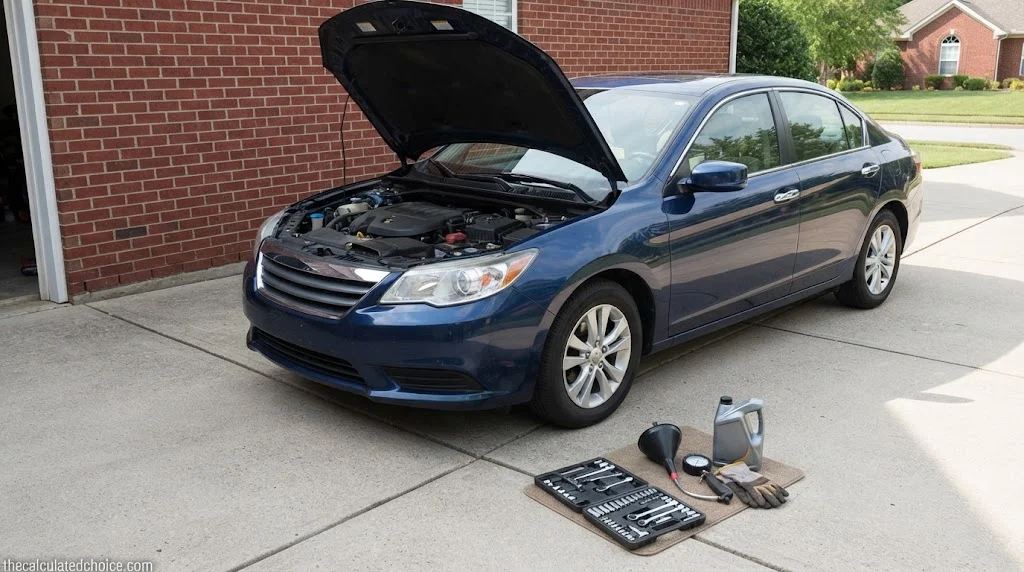
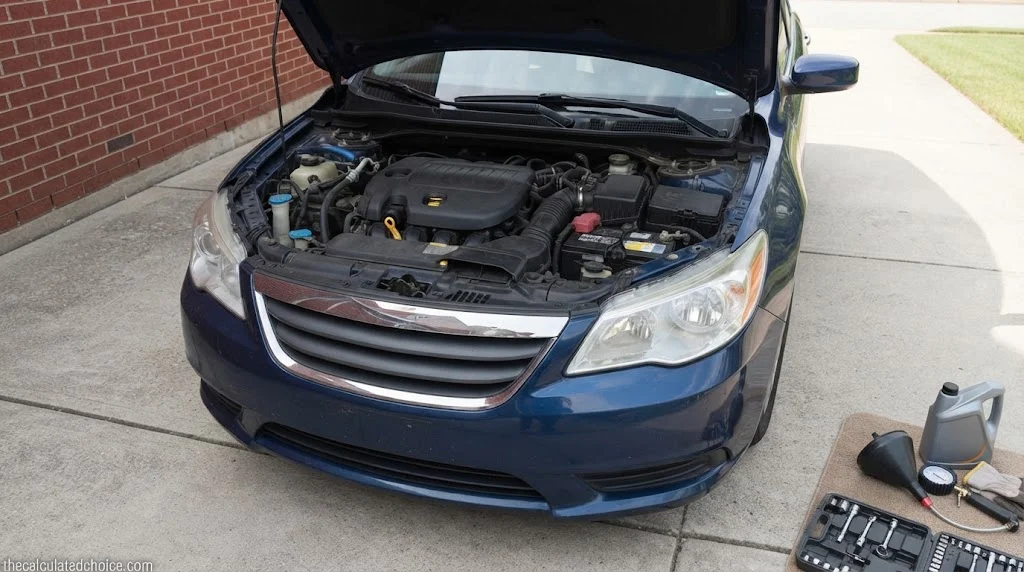
Opening the hood every month as part of your car maintenance schedule–or every few gas fill-ups and before any long road trip–lets you catch low fluid levels before they cause overheating or mechanical failure (Bridgestone; NHTSA):
- Engine oil level and recommended grade: Bridgestone advises checking your engine oil level under the hood every month or every few gas fill-ups while the engine is cool. Wipe the dipstick on a clean cloth or paper towel, reinsert it, and verify the oil film sits at the proper mark. According to the FTC (citing the U.S. Department of Energy and EPA), using the manufacturer’s recommended grade of motor oil improves gas mileage, and choosing oil with the “Energy Conserving” label on the American Petroleum Institute (API) performance symbol ensures it contains friction-reducing additives.
- Engine coolant (antifreeze) level: Check the coolant level while the engine is cool (Bridgestone). Bridgestone notes that a 50/50 mix of antifreeze to water is generally recommended to keep the radiator and engine components from freezing or overheating, while NHTSA recommends checking the cooling system for leaks and draining or replacing old coolant per your owner’s manual.
- Brake, transmission, power steering, and windshield washer fluids: NHTSA’s vehicle check guide lists four additional fluid reservoirs to inspect: brake fluid, automatic transmission (or clutch) fluid, hydraulic power steering fluid, and windshield washer fluid. Make sure each reservoir is full, and if you spot any signs of fluid leakage–such as a small puddle in your parking spot (Toyota Newsroom)–take your vehicle in to be serviced immediately.
Step 3: Check belts, hoses, wiper blades, lights, and floor mats
Complete your monthly car maintenance schedule walk-around by inspecting the rubber, electrical, and cabin components specified by NHTSA, Toyota, and Bridgestone:
- Belts and hoses: Look under the hood and inspect all serpentine belts and hoses for bulges, blisters, cracks, or cuts in the rubber, and make sure all hose connections are secure (NHTSA; Bridgestone).
- Battery terminals and corrosion: Toyota’s maintenance list includes checking for battery corrosion (Toyota Newsroom). Interstate Batteries explains that green or blue corrosion comes from hydrogen gas reacting with copper clamps or wiring, while white corrosion comes from lead, zinc, or aluminum posts. Interstate recommends checking and cleaning corrosion every six months using a solution of 1 part baking soda to 5 parts water (Interstate FAQs).
- Windshield wiper blades: NHTSA advises inspecting both sides of your wiper blades for signs of wear and tear, as blades can deform and fail to wipe cleanly in both directions. Bridgestone notes that wiper blades need to be replaced about once every year, or sooner whenever wiping effectiveness is compromised.
- Headlights, brake lights, and turn signals: Each month, turn on your headlights while parked facing a flat wall or garage door to confirm they are working and aimed properly (Bridgestone). Walk around the vehicle to check turn signals, emergency flashers, interior lights, and brake lights–including trailer lights if towing (NHTSA).
- Floor mat installation and clips: NHTSA warns drivers to check for improperly installed floor mats that may interfere with the accelerator or brake pedals, increasing crash risk. Always use mats sized for your specific vehicle and lock them into the manufacturer’s retention clips.
Fuel-saving math: How routine maintenance pays you back
You can see how a regular car maintenance schedule lowers your annual fuel bill by combining the published efficiency figures from NHTSA TireWise, the Federal Trade Commission (FTC), and Toyota:
Published fuel-economy gains and penalties
Proper tire inflation (NHTSA): Saves as much as $0.11 per gallon on fuel and extends average tire life by 4,700 milesProper tire inflation & alignment (FTC / Toyota): Increases gas mileage by up to 3% (FTC), and up to 6% from keeping tires properly inflated (Toyota citing U.S. DOE); a 10% reduction in tire rolling resistance yields a 1% to 2% fuel economy improvement (NHTSA)Engine tune-up per owner’s manual (FTC): Increases gas mileage by an average of 4%Trunk weight, roof cargo & cold short trips (FTC): Every extra 100 lbs in the trunk reduces fuel economy by up to 2%; a loaded roof rack lowers fuel economy by 5%; and several short trips from a cold start can use twice as much fuel as one warm-engine trip covering the same distanceExample on 1,000 gallons of annual fuel: Saving up to $0.11 per gallon from proper tire inflation (NHTSA) returns up to $110 per year in fuel alone while delaying tire replacement by an average of 4,700 miles. Federal Trade Commission; Toyota USA Newsroom
Long-term car maintenance schedule by mileage and time
Your monthly driveway checks work alongside the long-term part of your car maintenance schedule, which follows mileage and time intervals. Below are the recurring service milestones published by NHTSA, Bridgestone, Toyota, and Interstate Batteries:
| Mileage / Time Interval | Scheduled Maintenance Tasks | Official Source & Qualifier |
|---|---|---|
| Every 3 months / 3,000 miles to 5,000-10,000 miles | Change engine oil and oil filter according to your vehicle owner’s manual and oil type | Bridgestone (3 months/3,000 miles on some cars; 5,000 to 10,000 miles in many newer manuals) |
| Every 5,000 miles (EV tire inspection) | Inspect tires on EVs, which may wear tires faster due to high torque and heavy regenerative braking | Toyota USA Newsroom |
| Every 5,000 to 8,000 miles (if recommended by manufacturer) | Rotate tires if recommended by the vehicle manufacturer (or sooner if uneven tread wear appears); check wheel balance and alignment if pulling or vibration occurs | NHTSA TireWise (only if recommended by the vehicle manufacturer; staggered front/rear sizes may not rotate) |
| Every 6 months (semiannual) | Have the 12V battery and charging system checked (or at every oil change); clean battery terminal corrosion; wax vehicle after washing to protect paint and reduce rust risk | Interstate Batteries FAQs & Bridgestone |
| Every 12 months (annually) | Replace windshield wiper blades about once every year, or whenever wiping effectiveness is compromised | Bridgestone |
| Every 50,000 miles (and per manual intervals) | Have a professional inspect shocks and struts; service air filter, coolant exchange, spark plugs, serpentine belt, and transmission, transfer-case, and differential fluids per manual | Bridgestone Long-Term Checklist |
| Every 6 to 10 years (tire age limit) | Replace aging tires (including spares) when recommended by the vehicle or tire manufacturer at 6 to 10 years old based on the 4-digit DOT TIN code, regardless of treadwear | NHTSA TireWise & NHTSA |
Oil change intervals and extreme driving conditions
How often your car maintenance schedule calls for an oil and filter change depends on both your engine’s factory specification and how you drive. As Bridgestone explains, older or conventional schedules may call for an oil and filter change every 3 months or 3,000 miles, whereas many newer vehicle owner’s manuals recommend oil change intervals between 5,000 and 10,000 miles.
However, you should not stretch oil changes to the maximum normal-duty mileage if your vehicle operates under severe or extreme conditions. According to Toyota Newsroom, Toyota advises checking the vehicle manual’s excessive use section, and it lists these among extreme driving conditions:
- Frequent trailer towing: Towing is listed as an extreme driving condition (Toyota Newsroom).
- Driving on rough, unpaved, or dirt roads: Rough or dirt roads are also listed as extreme driving conditions (Toyota Newsroom).
- Short trips in a cold climate: As Toyota explains, repeated short errands in cold weather prevent the engine from reaching full operating temperature, which can cause motor oil to thicken and perform ineffectively. Furthermore, the FTC notes that several short trips taken from a cold engine start can use twice as much fuel as a single warm-engine trip of the same distance. (Exact model-by-model severe-duty mileage cutoffs are not published on a single universal chart and must be checked in your specific vehicle’s owner’s manual.)
How we researched this guide
We did not run shop lab checks for this car maintenance schedule guide; instead, we verified every monthly check, tire rule, and fuel-economy figure directly against plain-text U.S. government safety and consumer agencies and manufacturer maintenance guides.
Sources: NHTSA TireWise, NHTSA Vehicle Checks, Federal Trade Commission, Toyota USA Newsroom, Bridgestone
Bottom line
A reliable car maintenance schedule takes 15 minutes once a month on a level driveway: check cold tire pressure against the door-jamb label after the car has been parked for three hours, confirm tread depth is above 2/32 of an inch with a penny, inspect engine oil and coolant while the engine is cool, and check brake, transmission, power steering, and washer fluids along with belts, hoses, wipers, floor mat clips, and exterior lights.
Pair those monthly checks with manufacturer-recommended 5,000-to-8,000-mile tire rotations and on-time oil changes, and your car maintenance schedule will protect both your safety and your resale value.
For the parts of your car maintenance schedule that fail most often, see our guides to car battery care, jump-starting a car, digital tire pressure gauges and portable tire inflators, or browse tool gifts for DIY mechanics.
Frequently asked questions
What should I check on my car every month?
How often should I rotate my tires and change my engine oil?
How much fuel and tire life does proper monthly tire inflation save?
Why shouldn’t I inflate my tires to the PSI printed on the tire sidewall?
What does it mean if my dashboard TPMS tire warning light flashes for 60 to 90 seconds?

Researched by Shahzad
Amazon seller who researches products using sales-rank history, price tracking and owner reviews before recommending anything. Read our disclosure.