
We may earn a commission when you buy through links on this page, at no extra cost to you. It never decides what we recommend. How we make money
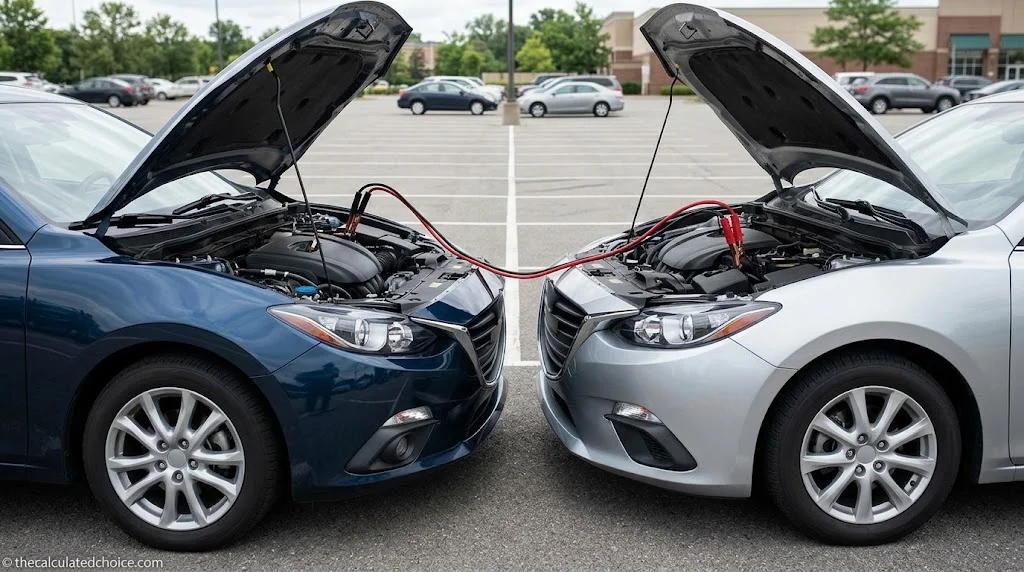
Knowing how to jump start a car with another car in the right connection sequence protects you from battery sparks, overheated jumper cables, and voltage spikes. When a 12-volt lead-acid battery drops too low to crank the starter motor, a second running vehicle with a healthy 12-volt battery can supply enough current to get you moving – provided you connect the clamps the way the guides below describe: positive clamps first, and the last negative clamp on a ground point away from the battery. That is the sequence laid out by Ford’s Transit owner’s guide, NOCO, and OPTIMA Batteries.
Skipping a single step in how to jump start a car with another car carries real mechanical and safety risks. First, the last connection can throw a spark: OPTIMA says to make it on a ground point away from the battery, and the U.S. Navy manual NAVEDTRA 14264A warns that hydrogen gas can collect at the top of a battery and explode if exposed to a flame or spark. Second, NOCO says that 10 AWG and 8 AWG jumper cables cannot transfer enough power, and that copper-clad aluminum cable differs from pure copper by about 40 percent in conductivity.
Quick answer
- 1 to 4 clamp connection orderTo execute how to jump start a car with another car safely, turn both vehicles off, then connect: (1) red (+) clamp to the dead battery’s positive (+) post, (2) red (+) clamp to the booster battery’s positive (+) post, (3) black (-) clamp to the booster battery’s negative (-) post, and (4) black (-) clamp to an unpainted metal ground point on the dead vehicle, away from the battery (Ford; OPTIMA). OPTIMA and NOCO begin at the booster’s positive post instead; either way, the positive clamps go on first and the ground connection goes on last.
- Start and 3-minute run windowStart the booster vehicle and hold engine speed between 2,000 and 3,000 RPM (Ford) or wait about a minute (OPTIMA), start the disabled car, and run both engines for 3 minutes before disconnecting in reverse order (4 → 3 → 2 → 1).
- Cable gauge and length rulePer NOCO, skip 10 AWG and 8 AWG cables. Use 100% pure copper cables (about 40% more conductive than copper-clad aluminum) in 6 AWG or 4 AWG for gas engines of 3.0 liters or smaller, and consider 2 AWG or 1 AWG for gas engines over 4.0 liters or any diesel. NOCO recommends not going past 12 feet.
- Post-jump charging ruleOPTIMA warns that alternators maintain charged batteries rather than recover deeply discharged ones; run the car 20 to 30 minutes (NOCO), then recharge fully with a dedicated battery charger.
Pre-jump safety checks: when never to jump-start a battery
Before connecting cables, confirm that your no-start symptom comes from a discharged 12-volt battery and that the case is safe to boost, because how to jump start a car with another car only helps when a discharged battery is the cause. As OPTIMA Batteries notes, a deeply discharged battery often makes a clicking sound when you attempt to start the car and shows dim headlights.
- Match nominal voltage: Ford’s Transit guide says to connect batteries of the same nominal voltage only, and to use adequately sized cables with insulated clamps.
- Do not charge a frozen battery: The U.S. Navy manual NAVEDTRA 14264A says charging a frozen battery can rupture the case and cause an explosion, so let it thaw first.
- Park close without touching: NOCO says to face the vehicles toward each other, as close as possible without touching, put both in park (neutral for manual transmissions), and suggests setting the parking brakes. OPTIMA also says the vehicles should never touch.
- Switch off ignitions and accessories: Ford says to switch the ignition and any electrical equipment off before connecting, and NOCO says both vehicles should be off. Ford also notes not to disconnect the disabled vehicle’s battery, which could damage its electrical system.
How to jump start a car with another car in 6 steps
When following how to jump start a car with another car, Ford says to connect the positive cable between the two batteries first, then use the ground point on your vehicle for the final negative connection instead of any other part of it. If the battery is not under the hood, look for the jump points: OPTIMA says many vehicles have easily identifiable points for attaching jumper cables, and Ford’s guide tells you to lift the battery positive connection point cover first.
| Attach order | Remove order | Clamp polarity | Exact attachment location | Why this order |
|---|---|---|---|---|
| Clamp 1 (First) | Clamp 4 (Last) | Red (+) Positive | Positive (+) post on the discharged (dead) vehicle | Where Ford starts; OPTIMA and NOCO begin at the booster’s positive post instead. |
| Clamp 2 (Second) | Clamp 3 (Third) | Red (+) Positive | Positive (+) post on the booster vehicle | Completes the positive link between the two batteries (Ford). |
| Clamp 3 (Third) | Clamp 2 (Second) | Black (-) Negative | Negative (-) post on the booster vehicle | Ford allows the booster’s negative terminal or a suitable ground point; keep the clamps apart (OPTIMA). |
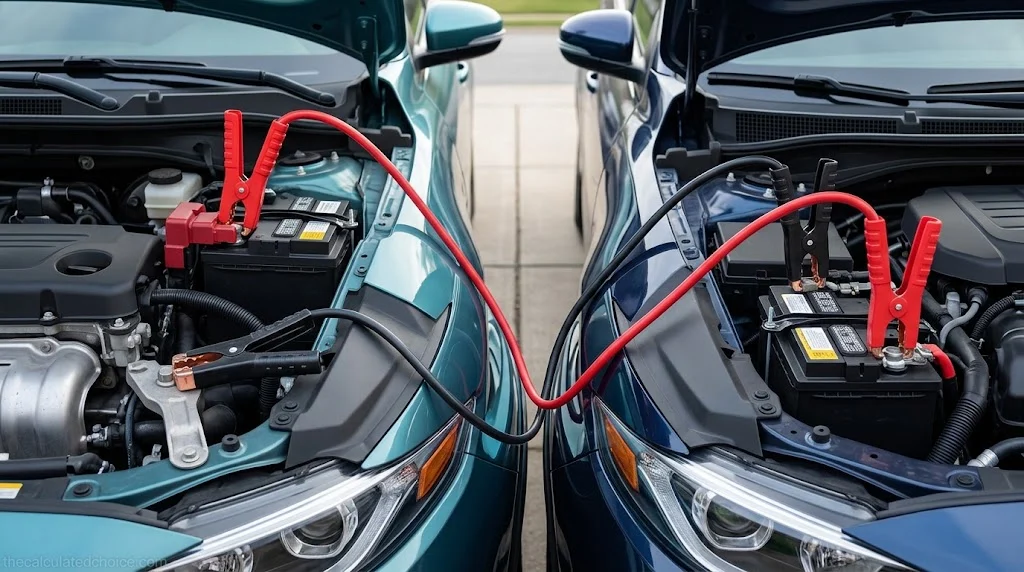
| Clamp 4 (Last) | Clamp 1 (First) | Black (-) Negative | Unpainted metal ground point on the discharged vehicle, away from its battery | The final connection can spark, so OPTIMA says to make it away from the battery; NOCO says to use the chassis ground, not the negative battery post. |
- Step 1 – Turn off both vehicles and identify polarity: Confirm both vehicles and all electrical equipment are off (NOCO; Ford). Identify the red positive (+ or POS) and black negative (– or NEG) posts and untangle the cables so the clamps never touch each other (OPTIMA).
- Step 2 – Connect the red positive (+) clamps (Clamps 1 & 2): Open the positive terminal cover, attach one red (+) clamp to the dead battery’s positive (+) post, and attach the other red (+) clamp to the booster battery’s positive (+) post (Ford). OPTIMA and NOCO start at the booster’s positive post and then connect the dead battery’s; both orders put the positive clamps on before any negative clamp.
- Step 3 – Connect the black negative (-) clamps (Clamps 3 & 4): Attach one black (-) clamp to the booster battery’s negative (-) post. Attach the final black (-) clamp to a ground point on the disabled car, not to its battery: Ford says to use the ground point and keep the cables clear of moving parts and fuel delivery parts, NOCO says the vehicle’s chassis ground, and OPTIMA says a shiny unpainted bolt on the engine, away from a fan blade or belt.
- Step 4 – Start the booster car: Start the booster engine and hold speed between 2,000 and 3,000 RPM (Ford), or just above idle for about a minute (OPTIMA).
- Step 5 – Start the disabled car and run for 3 minutes: Start the disabled car; if it does not start right away, NOCO says to wait a couple of minutes so current can flow into the battery. Run both engines for 3 minutes before disconnecting, and do not switch the headlamps on before you disconnect the cables, because the peak voltage could cause the bulbs to fail (Ford).
- Step 6 – Disconnect in reverse order (4 → 3 → 2 → 1): Remove the black (-) clamp from the disabled car’s ground point first, then the black (-) clamp from the booster battery, then the red (+) clamp from the booster battery, and last the red (+) clamp from the started car (Ford).
Why positive clamps go first and the final black clamp goes to bare metal
As NOCO and OPTIMA explain, two electrical principles govern how to jump start a car with another car safely:
- Why positive goes first: Because a vehicle’s metal chassis is grounded to the negative (-) post, NOCO notes that leaving negative clamps dangling while attaching the positive clamps cannot cause a short circuit if a negative jaw touches the fender. Connecting negative first makes the loose positive clamp a live short-circuit hazard against any grounded metal part.
- Why chassis ground beats the negative post: Completing the fourth connection can spark (OPTIMA), so grounding away from the battery keeps the spark away from the hydrogen gas that the Navy manual warns can collect at the top of a battery. NOCO also notes that chassis ground provides a more direct return path to the booster battery.
How to jump start a car with another car using the right cable AWG
Even when you know how to jump start a car with another car, thin cables can block current flow. NOCO’s jumper cable guide compares standard store wire sizes (10 AWG, 8 AWG, 6 AWG, and 4 AWG) with heavy 2 AWG and 1 AWG cables:
| Wire gauge (AWG) | Engine size (NOCO) | Current transfer verdict | Max length | Conductor material |
|---|---|---|---|---|
| 10 AWG or 8 AWG | Not recommended | Cannot transfer enough cranking power | Avoid | Often copper-clad aluminum |
| 6 AWG or 4 AWG | 3.0L gas engines or smaller | Sufficient (wait a few minutes before cranking) | 12 ft max | 100% pure copper (40% more conductive) |
| 2 AWG or 1 AWG | Over 4.0L gas or any diesel | High current delivery for V-8s and diesels | 12 ft max | 100% pure copper |
If your battery needs replacement after you learn how to jump start a car with another car, read how many cold cranking amps do I need to size your next battery, and keep a light from our best rechargeable work light for the garage picks in your trunk for nighttime roadside emergencies.
The math: copper vs CCA conductivity, C-rates, and voltage limits
How conductor material, C-rates, and run times affect a jump start
Formula 1 (Copper vs Copper-Clad Aluminum Conductivity): NOCO puts the conductivity difference between pure copper and copper-clad aluminum cable at about 40 percent, which is why it recommends 100% pure copper cables.Formula 2 (Lead-Acid vs Lithium Discharge Current): Peak Current (A) = Capacity (Ah) x Discharge Rate (C).Example (200-Amp Booster Comparison per NOCO): A 10 Ah lead-acid pack rated at 20C delivers 10 Ah x 20C = 200 A. A 1 Ah lithium-ion pack rated at 200C delivers 1 Ah x 200C = 200 A from one tenth of the amp-hour capacity.Formula 3 (Booster Speed and Run Times): Booster speed = 2,000 to 3,000 RPM, then run both engines for 3 minutes (Ford). After the jump, run the jumped vehicle for 20 to 30 minutes (NOCO).Sources: NOCO Support, Ford’s Transit owner’s guide.
What to do immediately after the engine starts
After you finish how to jump start a car with another car, OPTIMA Batteries emphasizes that jumper cables act like a 1-gallon emergency gas can, not a battery charger:
- Run the vehicle for 20 to 30 minutes: NOCO recommends running the car for 20 to 30 minutes after a jump. OPTIMA warns that idling can discharge a battery faster than letting it sit if the engine speed is too low to replace the energy that was used.
- Recharge fully on a dedicated smart charger: OPTIMA explains that most alternators are designed to maintain batteries that are near a full state of charge, not to recharge deeply discharged ones, and that asking an alternator to do it can strain it. See can you overcharge a car battery and car battery won’t charge.
- Check voltage first and watch the starter circuit: OPTIMA notes that a charger may shut off if the battery is below its minimum operating voltage, so measure voltage before and after charging (OPTIMA says its chargers can charge batteries discharged down to 1.25 volts). The U.S. Navy manual NAVEDTRA 14264A says the starter-circuit voltage drop while cranking should not be over 0.5 volts; a higher reading points to excess resistance, and cables should be cleaned, tightened or replaced as needed.
What to buy for roadside battery emergencies
- To check battery health after recharging: Pick a digital analyzer from best car battery tester.
- If your battery fails a load test: See our Keepa-verified picks in best car battery for cold weather.
- For terminal wrenches and roadside gear: Read basic car tools every driver should own and best mechanic tool set for beginners.
To keep a battery from going flat while a car is parked, see how to store a car battery over winter.
How we researched this guide
To document how to jump start a car with another car accurately, we cross-checked an automaker owner’s guide, cable and battery maker guides, and a U.S. Navy electrical manual. We reviewed these sources rather than running our own jump-start trials.
Sources: Ford’s Transit owner’s guide, NOCO Support, OPTIMA Batteries (jumper cables), OPTIMA Batteries (dead battery), U.S. Navy NAVEDTRA 14264A
Bottom line: Mastering how to jump start a car with another car comes down to four rules: use 100% pure copper cables no longer than 12 feet (4 AWG or 6 AWG for up to 3.0L gas engines; 1 AWG or 2 AWG for over 4.0L gas or diesel), connect the red positive clamps first, attach the final black negative clamp to an unpainted engine or chassis ground bolt away from the dead battery, and disconnect in exact reverse order after running both engines for 3 minutes. Once you finish how to jump start a car with another car and drive 20 to 30 minutes home, put the battery on a dedicated 12-volt smart charger so your alternator is never forced to recover a deeply discharged battery alone.
Frequently asked questions
What is the exact clamp order when jump-starting a car with another car?
Why shouldn’t I connect the last black negative clamp to the dead battery’s negative terminal?
What gauge jumper cables do I need to jump-start a car or truck?
How long should I let the cars run before and after jump-starting?
Will driving after a jump start fully recharge a deeply discharged battery?
Why does Ford warn not to turn on headlights before disconnecting jumper cables?

Researched by Shahzad
Amazon seller who researches products using sales-rank history, price tracking and owner reviews before recommending anything. Read our disclosure.