
We may earn a commission when you buy through links on this page, at no extra cost to you. It never decides what we recommend. How we make money
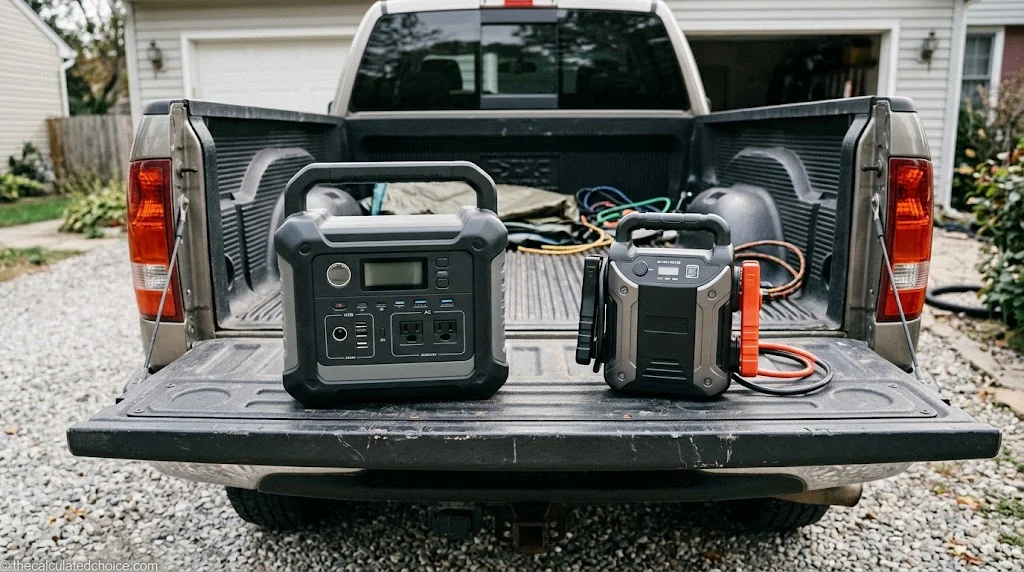
When you compare a portable power station vs jump starter, it is easy to assume the larger, heavier battery box can do everything the smaller one does. Both store energy in lithium cells, both include USB ports for phones, and both are sold as emergency gear for road trips and blackouts. That overlap traps drivers into buying one box expecting it to handle both roadside dead batteries and overnight campsite appliances.
Picking the wrong tool has immediate consequences. Connect a standard portable power station to a dead starter battery and turn the key, and the station’s 10-amp overload protection will trip almost immediately—leaving you stranded in a parking lot. Conversely, bring a pocket jump starter on a camping trip expecting to run a 12V fridge or a CPAP machine, and its 24Wh to 56Wh battery will drain flat in under an hour.
We checked the engineering manuals, discharge-rate specs, and safety standards from NOCO, Jackery, BLUETTI, EcoFlow, and UL Solutions to show how each device works, where their circuits differ, and how to pair them in your vehicle.
Table of Contents
Quick answer
- Core jobA jump starter dumps a 1,000A+ current burst for 1 to 3 seconds to crank an engine; a portable power station supplies steady 120V AC and regulated 12V DC power for hours.
- Battery sizePocket jump starters hold 24Wh to 88Wh of energy, while car-camping power stations hold 288Wh to 1,152Wh+ (roughly 12 to 48 times the storage of a 24Wh pocket pack).
- 12V port limitStandard power stations cap their 12V car outlet at 10A (120W to 126W), which is less than one-fifteenth of the 150A to 500A+ draw of a starter motor.
- Emergency workaroundA power station cannot crank an engine directly, but it can slow-charge a lightly depleted 12V lead-acid battery in 15 to 40 minutes via a dedicated 12V/10A alligator-clip cable.
- What to carryKeep a dedicated lithium jump starter ($ band) in your glovebox year-round, and pack a LiFePO4 portable power station ($$–$$$ band) for camping, tailgating, or home outages.
Side-by-side spec comparison
Although both tools fall under UL 2743, the Standard for Portable Power Packs, they are engineered for opposite electrical tasks. A jump starter is built for peak current (amps), while a portable power station is built for energy capacity (watt-hours) and continuous AC/DC wattage.
| Specification | Portable Jump Starter (e.g., NOCO Boost GB40 / GBX45) | Portable Power Station (e.g., BLUETTI AC180 / Jackery 1000 v2) |
|---|---|---|
| Primary job | Instant 12V engine cranking (1–3 second bursts) | Continuous off-grid AC & DC appliance power (hours to days) |
| Energy capacity (Wh) | 24Wh to 88Wh (NOCO Boost lineup) | 288Wh to 1,152Wh+ (BLUETTI AC180 / Jackery 1000 v2) |
| Cell chemistry | High-discharge lithium-ion pouch cells | Deep-cycle LiFePO4 (LFP) rated for 3,000–4,000+ cycles |
| 12V output limit | 1,000A to 1,250A+ peak via heavy-duty battery clamps | Regulated 12V/10A (120W–126W max) cigarette-lighter port |
| 120V AC outlets | None | 1 to 6 pure sine wave outlets (300W to 1,800W continuous) |
| USB output | 10.5W USB-A (GB40) up to 60W USB-C PD (GBX45) | Dual 100W USB-C PD + multiple USB-A ports |
| Solar recharging | Not supported (recharges via USB) | Built-in MPPT controller (100W to 600W solar input) |
| Weight & storage | 1.3 to 2.4 lbs; fits in a glovebox | 8.3 to 35.3 lbs; rides in the trunk or cargo area |
| Price band | $ | $$ to $$$ |
Why a big power station cannot crank a car
It feels counterintuitive that a 24-pound power station holding over 1,000 watt-hours cannot start a car, while a 1.65-pound jump pack holding just 24 watt-hours starts a 6.0-liter V8 engine in two seconds. The difference is instantaneous current draw versus regulated port protection.
When you turn the key, your starter motor pulls a massive surge of direct current at 12 volts. Under the SAE J537 Cold Cranking Amps (CCA) standard, a 12V starter battery is rated by the current it can sustain for 30 seconds at 0°F (-18°C) without dropping below 7.2 volts. In modern vehicles, starter motors draw between 150 amps on a four-cylinder engine and 500+ amps on a full-size truck or diesel engine, per Battery Tender’s sizing guidelines.
A portable power station never exposes its raw internal battery terminals. Every front-panel port passes through a DC-DC regulator and a Battery Management System (BMS). On mainstream stations like the BLUETTI AC180, Jackery Explorer 1000 v2, and Anker SOLIX C1000, the 12V car outlet is strictly capped at 10 amps (120W to 126W).
Cranking burst vs. 12V port limit math
Step 1 (Starter motor demand): Current (150A to 500A) × Nominal Voltage (12V) = 1,800W to 6,000W of instantaneous DC draw (or 1,080W to 3,600W at the 7.2V SAE J537 cold-crank floor).Step 2 (Power station 12V port cap): Regulated Voltage (12V to 12.6V) × Max Current (10A) = 120W to 126W continuous DC output.Example: Cranking a mid-size SUV starter motor drawing 250A asks for 25 times the 10A ceiling of a power station’s 12V socket (250A ÷ 10A = 25×).Because a starter motor demands 15 to 50 times more current than a 10A socket can pass, the power station’s BMS overcurrent protection trips immediately. Sources: Battery Tender, SAE J537 Standard, Jackery Explorer 1000 v2 Manual
Battery chemistry and internal design
Beyond the 12V port limit, the cells inside each tool are formulated for very different discharge rates (the C-rate).
How a lithium jump starter delivers 1,000+ amps
Compact jump starters like the NOCO Boost Plus GB40 (24Wh, 1,000A peak) and NOCO Boost X GBX45 (31Wh, 1,250A peak) use high-rate lithium-ion pouch cells with ultra-low internal resistance wired directly to heavy-duty clamps. Because dumping hundreds of amps generates intense heat inside a 1.3-to-2.4-pound case, jump starters enforce strict thermal timers: on the NOCO GBX45 data sheet, a 60-second automatic timeout cuts off boost output if you do not crank the engine within 60 seconds.
Why portable power stations use LiFePO4 cells and inverters
Car-camping power stations prioritize cycle life, thermal stability, and continuous AC power over short-circuit burst current. Models like the BLUETTI AC180 (1,152Wh), Jackery Explorer 1000 v2 (1,070Wh), and EcoFlow RIVER 2 Pro (768Wh) use Lithium Iron Phosphate (LiFePO4) cells rated for 3,000 to 4,000+ cycles before dropping to 70%–80% capacity.
Inside the enclosure, a power station pairs that LFP battery bank with a pure sine wave AC inverter (converting DC battery power to 120V AC household electricity at around 85% efficiency) and an MPPT solar charge controller. If you only need to power small devices from your car’s 12V socket while driving, see our breakdown of what a 300W power inverter can run to compare a plug-in inverter against a standalone battery station. For waveform details, read pure sine vs modified sine wave inverter, and for wiring and sizing see what size power inverter you need.
Appliance runtime math: 24Wh jump starter vs. 1,152Wh power station
Step 1 (BLUETTI runtime formula): Usable Runtime (hrs) = Capacity (Wh) × Depth of Discharge (90%) × Efficiency (85%) ÷ (Load Watts + 15W self-consumption).Step 2 (Power station running a 45W 12V camping fridge): 1,152Wh × 0.90 × 0.85 ÷ (45W + 15W) = 881.28Wh ÷ 60W = 14.7 hours of continuous compressor run (or 35+ hours with compressor cycling).Example (Jump starter USB capacity): A 24Wh jump starter (NOCO GB40) has no 12V socket or AC outlet; its 5V/2.1A (10.5W) USB-A port delivers up to 4 smartphone charges and cannot run camp appliances.Use watt-hours (Wh) to size runtime for camping and blackouts, and peak amps / engine-liter rating to size a jump starter. Sources: BLUETTI AC180 FAQ, NOCO GB40 Data Sheet
How to charge a dead car battery with a power station
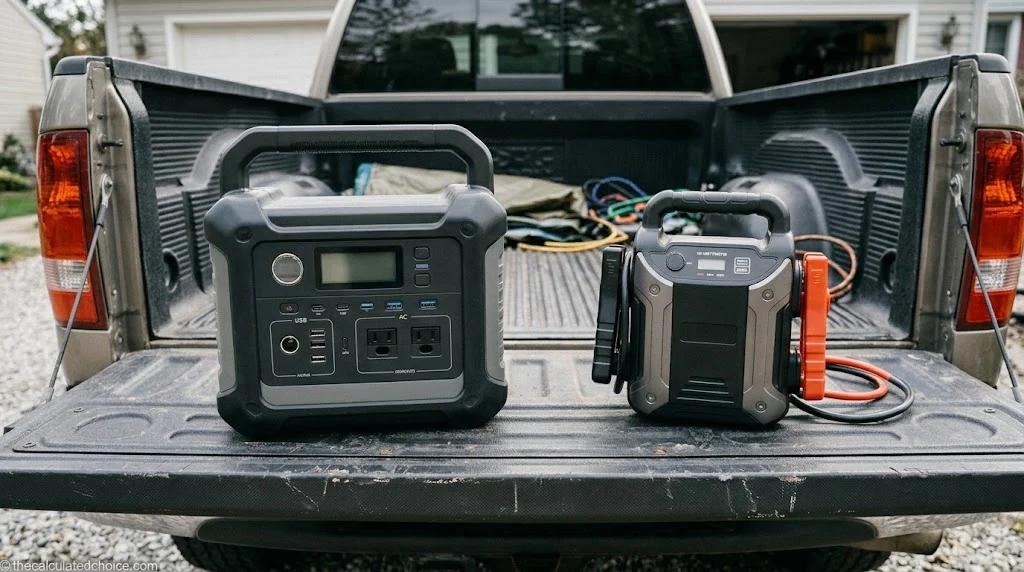
While a portable power station cannot jump-start an engine instantaneously, it can recharge a depleted 12V lead-acid starter battery if you have 15 to 40 minutes to wait and carry the right cable or charger.
Method 1: Use an official 12V/10A automotive battery charging cable
According to Jackery’s official 12V Automobile Battery Charging Cable guide, a dedicated 16 AWG copper alligator-clip cable feeds a steady 12V at 10A from the power station’s car socket into a 12V lead-acid battery:
- Connect the 12V plug: Insert the male cigarette-lighter plug into the power station’s 12V car port with the output turned off.
- Clamp the battery posts: Attach the red/orange clip to the positive (+) battery post and the black clip to the negative (-) post.
- Turn on DC output and wait: Press the 12V DC button. Jackery specifies waiting 15 to 20 minutes for a 40Ah–60Ah battery or 30 to 40 minutes for a 60Ah–100Ah battery.
- Disconnect before starting: Turn off the 12V output and remove both alligator clips from the battery terminals before cranking the engine.
Method 2: Plug a 120V smart battery charger into the AC outlet
If your car uses an AGM or lithium starter battery that requires multi-stage voltage regulation, plug a 120V AC smart charger—such as the NOCO Genius10 (10A smart charger)—into the power station’s AC outlet. The Genius10 draws a maximum of 150 watts AC at 87% efficiency to deliver a 10A DC charge. Neither slow-charge method will rescue a frozen or internally shorted battery that needs immediate cranking amps.
Are 2-in-1 jump starter power stations worth it?
Some brands market hybrid power stations with jumper clamps or bulky lead-acid jump boxes with an AC outlet. Combining both tools creates three practical compromises:
- Trunk temperature limits: A jump starter must stay in the car year-round. Dedicated jump packs like the NOCO GB40 fit in the glovebox and operate from -4°F to +122°F (-20°C to +50°C). Large LiFePO4 power stations weigh 18 to 35+ pounds and cannot be recharged below 32°F (0°C) per BLUETTI and Jackery manuals.
- Short jumper cable reach: Jumper clamps use 15 to 24-inch cables to minimize voltage drop, forcing you to balance a heavy power station on top of the engine bay.
- Shared battery drain: Draining a hybrid unit overnight on a camp fridge leaves zero reserve power to start your vehicle the next morning.
Portable power station vs jump starter: which one do you need?
Match your primary use case below to choose the right unit—or see why most road-trippers carry both.
| Scenario or Task | Portable Jump Starter | Portable Power Station | Why |
|---|---|---|---|
| Dead car battery at work or trailhead (need to leave now) | Yes (Best choice) | No (15–40 min slow charge only) | Starter motors need 150A–500A+ immediately; a power station’s 10A port trips on cranking loads. |
| Running a 12V compressor car fridge (40W–60W) all weekend | No | Yes (768Wh–1,152Wh+) | A 24Wh–56Wh jump pack lacks a 12V socket and holds less than 1 hour of fridge energy. |
| Powering a CPAP machine overnight while camping | No | Yes (288Wh–768Wh+) | CPAPs require 120V AC or regulated 12V/24V DC for 8 hours; jump starters shut off or drain fast. |
| Making camp coffee or running a 1,000W electric kettle | No | Yes (1,000W–1,800W AC output) | Heating appliances require a high-wattage 120V pure sine wave inverter. |
| Charging phones and a tablet during a flight or commute | Yes (10.5W–60W USB) | Too heavy for carry-on | Jump starters under 100Wh fit in a small bag and double as rugged USB power banks. |
| Home blackout backup for Wi-Fi router, lamps, and refrigerator | No (phones + flashlight only) | Yes (1,000Wh+ with <20ms UPS) | Power stations include 120V AC outlets and 20ms–30ms UPS auto-switchover. |
What to buy for your vehicle and campsite
If your main goal is never getting stranded by an aging starter battery or a dome light left on overnight, buy a dedicated UL 2743 lithium jump starter rated for 1,000A peak current (for gas engines up to 6.0L) or 1,250A to 2,000A (for larger trucks and diesels). Store it in your glovebox and top it up every six months.
If you want to run a 12V portable cooler, brew coffee at the tailgate, power a CPAP in a tent, or keep household essentials running during an outage, see our Keepa-verified guide to the best portable power station for car camping. And if you only need up to 300 watts of AC power while driving, read our breakdown of what a 300W power inverter can run before buying a standalone battery station.
How we researched this guide
We did not lab-test these units; we analyzed manufacturer wiring specifications, battery datasheets, and electrical safety standards to compare the portable power station vs jump starter question under real vehicle and campsite loads.
Sources: UL Solutions (UL 2743), NOCO GB40 Datasheet, Jackery 12V Battery Charging Guide, BLUETTI AC180 Specs
Bottom line: in the portable power station vs jump starter decision, buy the jump starter for roadside emergencies and the power station for camping and outages. If you can only afford one, the portable power station vs jump starter rule is simple: pick the tool that matches the problem you are most likely to face.
If a dedicated starter turns out to be the better fit, our guides on how to choose a jump starter and the jump starter size calculator cover sizing, jump starter vs. jumper cables compares it with the classic option, and how long a jump starter holds a charge explains standby care. To top up a dead battery at home instead, see how to charge a car battery at home.
Frequently asked questions
Can a portable power station jump-start a dead car battery?
Can I use a car jump starter as a portable power bank?
Why does a jump starter have 1,000 amps but fewer watt-hours than a power station?
What happens if you try to crank an engine while a portable power station is connected?
Can a portable power station recharge my lithium jump starter?
Is it safe to leave a portable power station or jump starter in a hot or freezing car?

Researched by Shahzad
Amazon seller who researches products using sales-rank history, price tracking and owner reviews before recommending anything. Read our disclosure.