
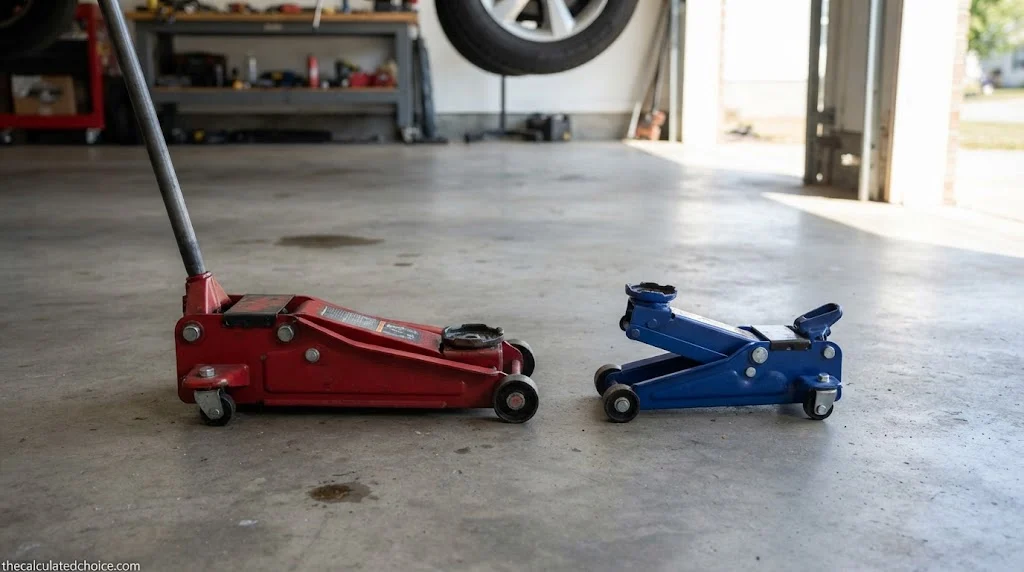
We may earn a commission when you buy through links on this page, at no extra cost to you. It never decides what we recommend. How we make money
Asking what size floor jack do I need before buying garage equipment prevents two costly mistakes: bringing home a hydraulic jack that cannot reach your vehicle’s factory frame points, or overloading an undersized cylinder under a heavy truck. Whether you service a compact sedan, a low-slung coupe, or a four-wheel-drive pickup, floor jack sizing comes down to three published numbers on the maker’s spec sheet: rated weight capacity in tons, minimum saddle height in inches, and maximum lifting height in inches.
Getting any of those three dimensions wrong creates real hazards. A saddle taller than your rocker panel clearance can crush plastic underbody shields, while a compact trolley jack with a 13.4-inch maximum lift height cannot raise a vehicle high enough to fit 15.5-inch 6-ton jack stands underneath. Exceeding a jack’s stamped capacity also goes against the marked-capacity rule in OSHA 29 CFR 1926.305(a)(1) and risks overload valve bypass or seal failure.
We reviewed federal vehicle weight classes from the U.S. Department of Energy Alternative Fuels Data Center, federal weight rules from the National Highway Traffic Safety Administration (NHTSA), and published manuals from Harbor Freight, Arcan, BIG RED (Torin) and ESCO to match each floor jack size to your vehicle and stands.
Quick answer
- Compact & midsize carsIf you are asking what size floor jack do I need for a car under 6,000 lbs GVWR (FHWA Class 1), choose a 2-ton (4,000 to 4,400 lb) or 2.5-ton (5,500 lb) low-profile jack with a 2.75-in. to 3.5-in. minimum saddle height, then check that its maximum lift clears your jack stands (13.4 to 24 in. across the maker pages below).
- SUVs, minivans & half-ton trucksPick a 3-ton (6,000 lb) or 3.5-ton (7,000 lb) floor jack with a 19-7/8-in. to 21.75-in. maximum lift height so the saddle clears taller 3-ton and 6-ton jack stands (11.625 in. to 15.5 in. starting height).
- Heavy-duty pickups & vansFor vehicles from 8,501 to 14,000 lbs GVWR (EPA heavy-duty 2b and FHWA Class 3), step up to a 5-ton (11,000 lb) long-reach floor jack with a 22-in. maximum lift height.
- Lowered sports carsPrioritize a 2.75-in. to 3.5-in. entry profile and a 32-in. extended chassis to reach recessed front crossmembers without scraping splitters.
What size floor jack do I need by vehicle weight class?
When drivers ask what size floor jack do I need, the fastest filter is the vehicle weight classification on the driver’s door-jamb label. The Federal Highway Administration (FHWA) and U.S. Environmental Protection Agency (EPA) group vehicles by Gross Vehicle Weight Rating (GVWR), which DOE Alternative Fuels Data Center data defines as the maximum weight of the vehicle specified by the manufacturer, including total vehicle weight plus fluids, passengers, and cargo.
Under FHWA and EPA weight categories, Class 1 covers vehicles under 6,000 pounds GVWR and Class 2 spans 6,001 to 10,000 pounds GVWR. EPA also lists a heavy-duty 2b group at 8,501 to 10,000 pounds, and Class 3 covers 10,001 to 14,000 pounds.
| Floor Jack Size & Model | Rated Capacity | Min / Max Height | Tool Weight | Best Vehicle Fit (FHWA / EPA GVWR Class) |
|---|---|---|---|---|
| 2-Ton Trolley (BIG RED 2-ton kit) | 2 Ton (4,400 lbs) | 5.3 in. / 13.4 in. | Not published | Standard-clearance small sedans (< 6,000 lbs GVWR) |
| 2-Ton Low-Profile (Harbor Freight 70485) | 2 Tons (4,000 lbs) | 3-1/2 in. / 16-7/8 in. | Not published | Low-clearance sedans & coupes (< 6,000 lbs GVWR) |
| 2-Ton Extended (Arcan A20016) | 2 Ton (4,000 lbs) | 2.75 in. / 24 in. | 92.59 lbs | Lowered cars needing 2.75-in. entry & 32-in. reach |
| 2.5-Ton Low-Profile (BIG RED AT825010B) | 2.5 Ton (5,500 lbs) | 3.5 in. / 14.1 in. | Not published | Midsize sedans & small crossovers |
| 3-Ton Low-Profile (Harbor Freight 70482) | 3 Tons (6,000 lbs) | 3-1/8 in. / 19-7/8 in. | Not published | Cars, SUVs & Class 2 light trucks (6,001 to 8,500 lbs GVWR) |
| 3.5-Ton Low-Profile (Arcan A20012) | 3.5 Ton (7,000 lbs) | 3.75 in. / 21.75 in. | 100.8 lbs | Full-size SUVs & Pickups in the 8,501 to 10,000 lbs GVWR range (EPA 2b) |
| 5-Ton Long-Reach (BIG RED 5-ton long-reach) | 5 Ton (11,000 lbs) | 6.3 in. / 22 in. | Not published | Class 3 heavy-duty trucks (10,001 to 14,000 lbs GVWR) |
When you ask what size floor jack do I need, remember that higher tonnage does not guarantee a taller lift range. The Arcan A20016 2-ton jack lifts from 2.75 inches to 24 inches, out-reaching the Harbor Freight 70486 3-ton jack (5-1/8 inches to 18-1/4 inches) by 5.75 inches. For most home garages servicing both a car and an SUV or half-ton pickup, a 3-ton low-profile jack like the Harbor Freight 70482 balances 6,000-pound capacity with 3-1/8-inch entry clearance.
Curb weight vs GVWR: what size floor jack do I need by weight?
Under federal rules detailed in NHTSA Chief Counsel Interpretation 24115.rbm, 49 CFR 571.3 defines unloaded vehicle weight as the weight of a vehicle with maximum capacity of all fluids necessary for operation, but without cargo, occupants, or accessories ordinarily removed when not in use. By contrast, 49 CFR 571.3 defines GVWR as the value specified by the manufacturer as the loaded weight of a single vehicle.
Under 49 CFR 567.4(g)(3) on the same NHTSA page, assigned GVWR shall not be less than the sum of unloaded vehicle weight, rated cargo load, and 150 pounds (68 kilograms under FMVSS No. 110) multiplied by designated seating capacity. Workplace rules in OSHA 29 CFR 1910.244(a)(1)(i) require a jack rating sufficient to lift and sustain the load, and OSHA 29 CFR 1926.305(a)(1) forbids exceeding the marked capacity.
Floor jack capacity & GVWR check
Step 1 (49 CFR 567.4(g)(3) Minimum GVWR): Minimum GVWR = Unloaded Vehicle Weight + Rated Cargo Load + (150 lbs x Designated Seating Capacity)Step 2 (Single-End Lift Margin): Lifting one end leaves the other tires on the ground, so the jack carries only part of the vehicle. Pick a jack whose marked capacity comfortably exceeds your lifted-end load, and never exceed the marked capacity.Example (5-Seat Class 2 SUV/Pickup): Unloaded weight (example) = 4,800 lbs | Seating = 5 x 150 lbs = 750 lbs | Cargo (example) = 1,250 lbs | Minimum GVWR = 6,800 lbs (Half of GVWR = 3,400 lbs).A 2-ton (4,000 lb) jack leaves only 600 lbs of headroom above a 3,400-lb half-GVWR lift. Choosing a 3-ton (6,000 lb) or 3.5-ton (7,000 lb) floor jack provides 6,000 to 7,000 lbs of capacity, staying inside the marked capacity required by OSHA 1926.305(a)(1).
What size floor jack do I need for minimum clearance and maximum lift height?
Tonnage is only half the equation when deciding what size floor jack do I need. Even if a 2-ton jack can lift your vehicle’s weight, it will fail in practice if its saddle cannot slide under the rocker panel or if its lift arm stops short of your jack stands’ lowest locking position.
- Low-profile entry (2.75 in. to 3.75 in.): The Arcan A20016 (2-ton) starts at 2.75 inches, Arcan 3-ton at 3 inches, Harbor Freight 70482 (3-ton) at 3-1/8 inches, Harbor Freight 70485 (2-ton) and BIG RED AT825010B (2.5-ton) at 3.5 inches, and Arcan A20012 (3.5-ton) at 3.75 inches.
- Standard and heavy-duty entry (5-1/8 in. to 6.3 in.): Harbor Freight 70486 (3-ton) at 5-1/8 inches, BIG RED 2-ton kit jack at 5.3 inches, and BIG RED 5-ton long-reach jack at 6.3 inches.
Your floor jack’s maximum lift height must also clear the minimum starting height of your jack stands plus suspension droop:
| Floor Jack & Max Height | 2-Ton Stand (T42002A: 10.8 in. min) | 3-Ton Ratchet (ALJS3: 11.625 in. min) | 3-Ton Flat-Top (ESCO 10498: 13.2 in. min) | 6-Ton Stand (Arcan ALJS6: 15.5 in. min) |
|---|---|---|---|---|
| BIG RED 2-ton kit (13.4 in.) | Fits (+2.6 in.) | Tight (+1.775 in.) | Barely clears (+0.2 in.) | Fails (-2.1 in. short) |
| BIG RED AT825010B (14.1 in.) | Fits (+3.3 in.) | Fits (+2.475 in.) | Tight (+0.9 in.) | Fails (-1.4 in. short) |
| Harbor Freight 70485 (16.875 in.) | Full range | Fits (+5.25 in.) | Fits (+3.675 in.) | Barely clears (+1.375 in.) |
| Harbor Freight 70482 (19.875 in.) | Full range | Full range | Fits (+6.675 in.) | Fits (+4.375 in.) |
| Arcan A20012 (21.75 in.) | Full range | Full range | Full range | Fits (+6.25 in.) |
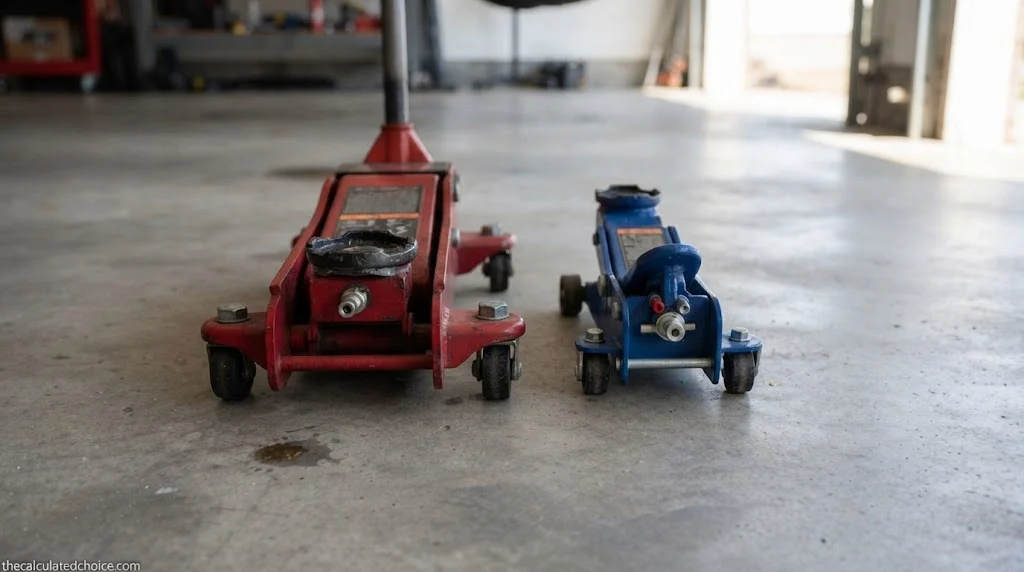
Chassis reach, tool weight, and manual checks before you buy
- Tool weight: The Arcan 3-ton low-profile jack page lists 76.8 pounds, the Arcan A20016 (2-ton extended) lists 92.59 pounds, and the Arcan A20012 (3.5-ton) lists 100.8 pounds. The BIG RED and Harbor Freight pages we checked do not publish a jack weight.
- Chassis length and valves: Reaching a central front crossmember takes a long frame so the handle clears the bumper (Arcan A20016 lists a 32-inch extended chassis). The Arcan A20012 page lists bypass and overload valves and compliance with ASME PASE, and BIG RED lists its AT825010B as complying with ASME PASE.
If your jack stops short of full height, check the Harbor Freight 70485 and 70482 manuals: inspect before each use (and every 6 months under OSHA 29 CFR 1910.244(a)(2)(vi)(a)), keep oil 1/4 inch below the fill port, grease the fitting monthly, and change hydraulic fluid every three years.
| Symptom | Likely cause (per the manual) | What the maker says to do (with no load on the jack) |
|---|---|---|
| Will not lift at capacity, spongy stroke, or saddle will not lift all the way | Release valve not fully closed, air in the system, or low hydraulic fluid | Check that the release valve is fully closed, bleed the system, and check the fluid level, refilling with high-grade hydraulic fluid if needed (HF 70486 manual, pp. 5 and 8) |
| Saddle lowers under load, or handle moves up under load | Release valve not fully closed, or blocked valves | Close the valve fully; if the valves may be blocked, lower the saddle, lift it by hand, open the release valve and force the saddle down as quickly as possible to flush them (HF 70486 manual, p. 8) |
| Fluid leaking from the fill plug | Too much hydraulic fluid | Check the fluid level and adjust it; the 70482 manual sets the level at 1/4 in. below the fill port (HF 70482 manual, p. 6) |
What size floor jack do I need for a home garage?
- Primary garage floor jack: For most people asking what size floor jack do I need, a 3-ton low-profile steel floor jack with a 3-inch to 3-1/8-inch entry height and 19.72-inch to 19-7/8-inch maximum lift height covers sedans, crossovers, and light trucks. See our guide to the best floor jack for a home garage to compare vetted models.
- Vehicle support stands: Pair your jack with 3-ton jack stands for passenger cars, or 6-ton double-locking jack stands for trucks and full-size SUVs (confirming your jack lifts past the 15.5-inch minimum height of the Arcan ALJS6). Check our roundup of the best jack stands for Keepa-checked sets.
- Wheel installation after lowering: Once the vehicle is back on the ground, look up your fastener spec in our lug nut torque chart by vehicle type and tighten every wheel nut using a calibrated pick from our guide to the best torque wrench for lug nuts.
How we researched this guide
We did not lab-check floor jacks; to answer what size floor jack do I need with verified numbers, we cross-checked federal safety standards, government vehicle weight classes, and manufacturer manuals.
Sources: OSHA 1910.244, OSHA 1926.305, U.S. DOE AFDC, NHTSA 49 CFR 571.3 / 567.4, Harbor Freight Manuals, Arcan Professional Tools
Bottom line: If you are deciding what size floor jack do I need for a passenger car under 6,000 pounds GVWR, a 2-ton or 2.5-ton low-profile jack with a 2.75-inch to 3.5-inch minimum saddle height whose maximum lift clears your jack stands handles single-end lifts safely.
If you are asking what size floor jack do I need for an SUV, minivan, or pickup truck – or want one versatile garage jack that clears 6-ton jack stands – choose a 3-ton or 3.5-ton low-profile floor jack with a 19-7/8-inch to 21.75-inch maximum lift height, or step up to a 5-ton (11,000-pound) floor jack for Class 3 heavy-duty trucks.
Once you have the jack, round out your kit with the basic car tools every driver should own.
Frequently asked questions
Can a 2-ton floor jack lift a 4,000-pound car?
Should I size a floor jack using curb weight or GVWR?
Is a 3-ton floor jack enough for a pickup truck or full-size SUV?
What minimum saddle height do I need for a low-clearance car?
Why does my floor jack stop lifting before it reaches full height?
Can I leave a vehicle supported on a floor jack while changing a tire?

Researched by Shahzad
Amazon seller who researches products using sales-rank history, price tracking and owner reviews before recommending anything. Read our disclosure.