
We may earn a commission when you buy through links on this page, at no extra cost to you. It never decides what we recommend. How we make money
The signs of a bad car battery are easy to list and surprisingly easy to misread. A slow crank, a click, dim headlights or a battery light can each come from a worn-out battery. They can also come from a loose cable, a tired alternator or a starter on its way out. Replace the wrong part and the same problem is back a week later.
This guide is for US drivers and DIYers who want to know whether the battery is really the problem before paying for a new one. We checked each warning sign against what AAA, Interstate Batteries and battery-tester maker Midtronics publish, then paired every sign with a quick check you can do with a basic multimeter, using the limits in Clore Automotive’s load tester manual and Fluke’s testing guide. You will also see how to tell a bad battery from a bad alternator or starter, and which signs mean you should not charge or jump the car at all.
Signs of a bad car battery at a glance
- Slow crank The engine turns over lazily, worst on cold mornings.
- Clicking, no crank The starter is not getting enough current: low battery, bad connection or starter.
- Dim or flickering lights Headlights dim at idle, or fade within a minute with the engine off.
- Glitchy electronics Windows hesitate, the radio forgets settings, the idle stumbles right after a start.
- Warning light or message A battery or charging light, or a low-charge message from the car’s battery monitor.
- Start-stop quits On start-stop cars, the engine stops shutting off at red lights.
- Repeat jump starts It needs another jump a day or two after a normal drive.
- Swollen case, rotten-egg smell or leak The battery is damaged. Do not charge or jump it.
- Age Past three years, AAA recommends testing it every year.
- Confirm it Below 12.4V after a full charge, or below 9.5V while cranking, points to the battery.
The 9 signs of a bad car battery
Most of these show up when you start the engine, because starting is the hardest job a battery does. Here is what each sign looks and sounds like, and what is usually happening behind it.
1. The engine cranks slowly
This is the classic sign, and one that every source we checked lists. The starter turns the engine over, but slower and longer than usual before it catches. It is usually worst on the first cold morning of the season: a battery delivers less current as it gets colder, while a cold engine with thick oil takes more effort to turn. A battery that was borderline in the fall can fail in January without anything new going wrong.
2. Clicking when you turn the key
A single click or a fast clicking with no crank means the starter is not getting enough current to turn the engine. A discharged battery is the most common reason, but AAA notes that clicking can also come from a poor connection, and a failing starter can sound the same. Sources do not agree on whether one click or rapid clicking points to the battery, so do not diagnose by sound alone. A voltage reading settles it faster, and we show how below.
3. Dim or flickering lights
Headlights that dim at idle were a common battery sign on older cars, AAA says. Interstate Batteries suggests a cleaner test for standard flooded batteries: after the car has sat for several hours, switch on the headlights with the engine off, ideally in a dark garage. If they flicker or fade within about a minute, the battery is drained or weak. Lights that brighten and dim with engine speed while you drive point more toward the alternator.
4. Electronics that glitch at startup
Modern cars run dozens of modules that need steady voltage. When the battery sags during a start, Interstate lists things like a window that hesitates, a flickering cabin light, a radio that forgets its station, or a phone that will not reconnect. A rough idle or a brief stumble in the first minute or two after starting can come from the same low voltage. One glitch means little. Weak car battery symptoms tend to come in clusters, though, and a pattern that shows up mostly on cold starts is worth a test.
5. A battery light or low-charge message
The battery or charging light means the charging system has spotted a problem. That can be the battery, but it is just as often the alternator, a loose connection or the voltage regulator. If the battery keeps going flat, our guide on why a car battery keeps dying narrows down the cause. Many newer cars also have a battery management system that tracks state of charge; Honda and Ford, for example, show a low-charge message when it drops too far. Treat either warning as a reason to test both the battery and the charging system, not as proof you need a new battery.
6. Start-stop stops working
If your car has automatic engine stop-start and it quietly stops shutting the engine off at red lights, the battery may be the reason. Midtronics, which makes battery testers for dealers and repair shops, explains that the battery management system turns start-stop off when it no longer trusts the battery to restart the engine. Short trips and heavy accessory use can keep the battery undercharged and cause the same thing. These cars use AGM or enhanced flooded (EFB) batteries, and Midtronics notes that most need a replacement battery registered with a scan tool.
7. It needs jump starts again and again
One jump after leaving the dome light on proves nothing. Needing another jump a day later, after a normal drive, is different. Interstate’s rule of thumb: if the engine still hesitates after a full recharge or a long drive, the battery is worn out. A drain that pulls the battery down overnight can look the same, which is why the checks below matter. A jump gets you home, and our guide on how to use a jump starter safely covers the steps, but no jump fixes a battery that no longer holds a charge.
8. A swollen case, a rotten-egg smell or a leak
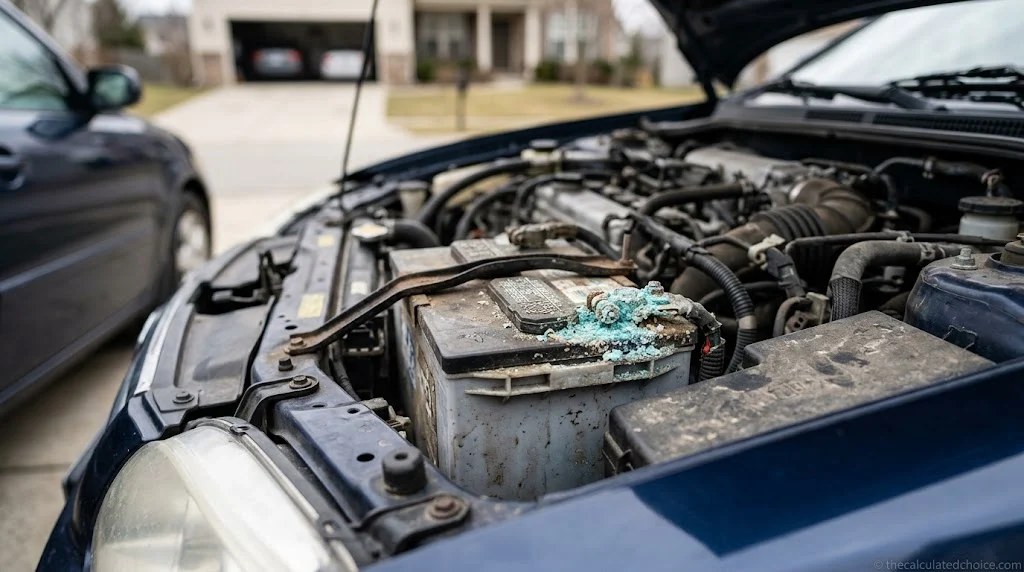
These are the signs you can see or smell. AAA links a bulging case to overcharging or overheating, and a rotten, sulfur-like smell to a damaged battery. Any one of them means the battery is finished, and none of them is a do-it-yourself charging job; see the safety section below. Crusty white or blue-green buildup on the terminals is different. It is common, it can cause hard starts by blocking current, and on its own it does not mean the battery has failed.

9. The battery is three or more years old
Age is not a symptom, but it changes how you read the others. AAA puts typical battery life at three to five years, closer to three in hot southern states and five or more in the north, and recommends a yearly test once a battery reaches its third year. A slow crank on a four-year-old battery in Phoenix means something different than the same crank on a one-year-old battery in Minnesota. Most batteries carry a date code on a sticker or stamped into the case, and our guide on how long car batteries last shows how to judge that age against your climate.
How to confirm each sign
A sign tells you where to look. A number tells you what to replace. This table pairs each sign with the quickest check and how soon to act. The voltage limits come from Clore Automotive’s 1874 load tester manual and Fluke’s battery testing guide, and our car battery voltage chart explains each reading in more detail.
| Sign | Most likely cause | Quick check | How urgent |
|---|---|---|---|
| Slow crank | Low charge or a worn battery; dirty or loose cables | Resting voltage, then the lowest reading while cranking | Test this week; it gets worse in the cold |
| Clicking, no crank | Low battery, poor connection or starter | Voltage at the battery; terminals clean and tight | Now. You are probably stuck |
| Lights fade, engine off | Drained or weak battery | Resting voltage after several hours parked | Charge and test soon |
| Lights pulse with engine speed | Alternator, belt or wiring | Voltage with the engine running | Have the charging system checked |
| Startup glitches, rough first minute | Voltage sag while cranking | Lowest reading while cranking | Test before the next cold snap |
| Battery light or low-charge message | Battery, alternator, regulator or wiring | Resting voltage and running voltage | Soon; do not ignore it |
| Start-stop quits | Undercharged or aging AGM or EFB battery | Resting voltage after a long rest; shop test | Soon |
| Repeat jumps | Worn battery or a drain while parked | Full charge, then resting voltage the next morning | Now |
| Swollen, leaking or rotten-egg smell | Damaged battery, possibly overcharging | None. Do not charge or jump it | Stop. Replace it and check the charging system |
The two-minute driveway check
Three readings with an inexpensive digital multimeter set to DC volts will sort most cases. Take the first one after the car has been parked for several hours, because a reading right after a drive runs high. Our guide on how to test a car battery with a multimeter shows where to put the probes and how to clear surface charge.
Three readings, one verdict
Reading 1, resting (engine off, parked for hours): 12.4V or more = charged enough to judge. Below 12.4V = charge it fully firstStill below 12.4V after a full charge = replace the battery (Clore)Reading 2, cranking (meter on MIN/MAX, helper starts the engine): lowest reading 9.5V or more = passes Clore’s cranking lineReading 3, running at idle, accessories off: 13.7 to 14.7V = normal range in Fluke’s guideHow to read them together: if all three pass and the car still starts poorly, look at the cable connections and the starter. If only the cranking reading fails on a fully charged battery, the battery is the prime suspect, and a load test or a digital battery tester confirms it. If the running reading is low, fix the charging system first, or a new battery will go flat too.
One piece of fine print: some newer cars use smart charging that lets running voltage swing well outside the classic range on purpose. Firestone notes that some modern alternators can read anywhere from 12.0 to 15.8 volts. If your car is newer and the running reading looks odd but nothing else is wrong, check the service information for your model before buying an alternator.
Signs of a bad car battery vs alternator vs starter
The battery starts the car. The alternator runs the electrical system and recharges the battery once the engine is running. The starter is the motor that turns the engine over. Because each one can leave you with a car that will not start, their signs overlap. These patterns help separate them:
| What you notice | Points to | Why |
|---|---|---|
| Dead or slow after sitting overnight, fine after a jump and a long drive | Battery, or a drain while parked | The alternator recharged it while driving; the battery could not hold it |
| Starts with a jump, then dies soon after the cables come off | Alternator | Firestone’s jump test: the car is running on the battery alone until it is empty |
| Lights brighten and dim with engine speed while driving | Alternator | Output changes with RPM instead of holding steady |
| Running voltage low, battery tests good after charging | Alternator, belt or wiring | The charging side is not keeping up |
| Cranking dip below 9.5V on a fully charged battery that passes a load test | Cables, connections or starter | Clore names poor connections and a failing starter as other causes of a low cranking reading |
| Clicks with bright dash lights, battery fully charged | Starter or a connection | Plenty of voltage is there, but current is not reaching or turning the starter |
| Whining or growling under the hood, burning rubber smell | Alternator or belt | Firestone lists both among bad-alternator signs |
The two parts also wear each other out. Firestone points out that a weak battery makes a healthy alternator work harder, and a failing alternator can overcharge or undercharge a good battery. So if a nearly new battery has died, test the charging system before you buy another one.
Why some batteries die with no warning
Most lists of signs imply a battery always gives notice. Interstate Batteries says the opposite: batteries usually die without warning. Modern engines start easily, and the charging system can make up for a weakening battery during daily driving. Warm weather and a healthy engine hide the weakness. Then a cold snap, a light left on, or a few days parked uses up the margin, and the car simply will not start. That is why watching for signs your car battery is dying is only half the job; a scheduled test is the other half.
Interstate adds a subtle clue: if the car feels normal only after 20 to 30 minutes of driving, the alternator may be covering for a weak battery. Its advice is to test the battery at least twice a year, before winter and before summer. AAA’s version is a yearly test once the battery reaches its third year. Either way, a test on a calm afternoon beats a surprise at 6 a.m. in a parking lot, and it catches the batteries that never show the signs of a bad car battery at all.
Signs that mean do not charge or jump it
A few signs move the problem from inconvenient to unsafe. Do not charge, jump or keep driving on a battery that shows any of these:
- A swollen or bulging case. AAA ties this to overcharging or overheating, so the charging system needs a check too.
- A rotten-egg or sulfur smell. AAA says it can mean the battery is damaged; Interstate links it to overcharging.
- Cracks, wet spots or leaking acid on the case or tray.
- A frozen battery, such as one with ice visible or bulged sides after a deep freeze. Clore’s manual says not to load test or charge a battery below 20°F at all.
What to do when you see the signs
If you notice the signs of a bad car battery and none of the stop signs above apply, work through these steps in order. They follow Clore’s charge-then-test sequence and keep you from buying a battery you do not need.
- Check the terminals. With the engine off, make sure both clamps are tight and clean. Corrosion and loose clamps cause many of the same signs as a weak battery.
- Charge it fully. A short drive rarely tops off a low battery. Use a charger that matches your battery type.
- Let it rest and measure. If it still reads below 12.4 volts after a full charge, Clore says to replace it.
- Test it under load. A load test or a digital tester checks what voltage cannot. Many parts stores test for free, or see our picks for the best car battery tester if you want your own.
- If it passes but keeps going flat, check the running voltage for a charging problem, then look for a drain while parked, such as a glove box or trunk light that stays on or an aftermarket accessory wired in wrong.
- If you replace it, match the group size and cold cranking amp rating in your owner’s manual. Start-stop cars need the AGM or EFB type they came with, and many need the new battery registered. Our picks for the best car battery for cold weather list the CCA and warranty terms of five AGM options.
Bad car battery signs: myth vs fact
| Myth | Fact |
|---|---|
| A dying battery always warns you first. | Interstate says batteries usually die without warning, because modern cars hide a weak battery until a cold snap or a few days parked. |
| If it reads 12.6V, the battery is fine. | Voltage shows charge, not capacity. A fully charged battery can still fail a load test. |
| Corrosion means the battery is bad. | Terminal buildup is a connection problem first. Clean and tighten, then test. |
| A jump fixes a dead battery. | A jump only starts the engine. Interstate notes that recharging a deeply drained battery may get it working briefly without restoring it. |
Frequently asked questions
How does a car act when the battery is going bad?
How do you know if a car battery needs replacing?
How can you tell if it’s the battery or the alternator?
Do car batteries give warning before dying?
Can a car battery be so dead it can’t be jumped?
What drains a car battery when the car is off?
Can a weak battery cause a car to run rough?
How we researched these signs
We started from the questions US drivers actually search, then checked every sign against what AAA, Interstate Batteries, Firestone and Midtronics publish. The voltage limits come from Clore Automotive’s 1874 load tester manual and Fluke’s battery testing guide, the same sources behind our voltage chart. Where sources disagree, such as what a single click means or what running voltage is normal on newer cars, we say so instead of picking one. The sign-to-check table, the driveway check and the battery, alternator or starter table are our own work built from those sources. We did not hands-on test any battery or vehicle for this article, and no brand paid for or reviewed it.
Sources: AAA battery warning signs · Interstate: signs of a dying battery · Interstate: get a battery test · Midtronics on start-stop batteries · Firestone battery vs alternator · Clore 1874 load tester manual · Fluke battery testing guide

Researched by Shahzad
Amazon seller who researches products using sales-rank history, price tracking and owner reviews before recommending anything. Read our disclosure.