
We may earn a commission when you buy through links on this page, at no extra cost to you. It never decides what we recommend. How we make money
Learning how to store a car battery over winter prevents two costly garage failures: hardened lead sulfate deposits on internal plates and frozen liquid electrolyte that splits the outer casing. Whenever a vehicle sits unused in cold weather, onboard clocks, alarms, and control modules draw a small continuous current every hour.
As a lead-acid battery loses charge, sulfuric acid leaves the liquid electrolyte and binds to the plates, turning the remaining liquid mostly into water. According to Battery Tender’s cold-weather technical guide, frozen electrolyte expands by roughly 9%, potentially cracking battery cases and damaging internal plates.
We reviewed service bulletins and operator manuals from Optima Batteries, Battery Tender, CTEK, Clore Automotive, NHTSA, and OSHA to outline the exact steps, voltage floors, and safety checks required for off-season storage.
Quick answer
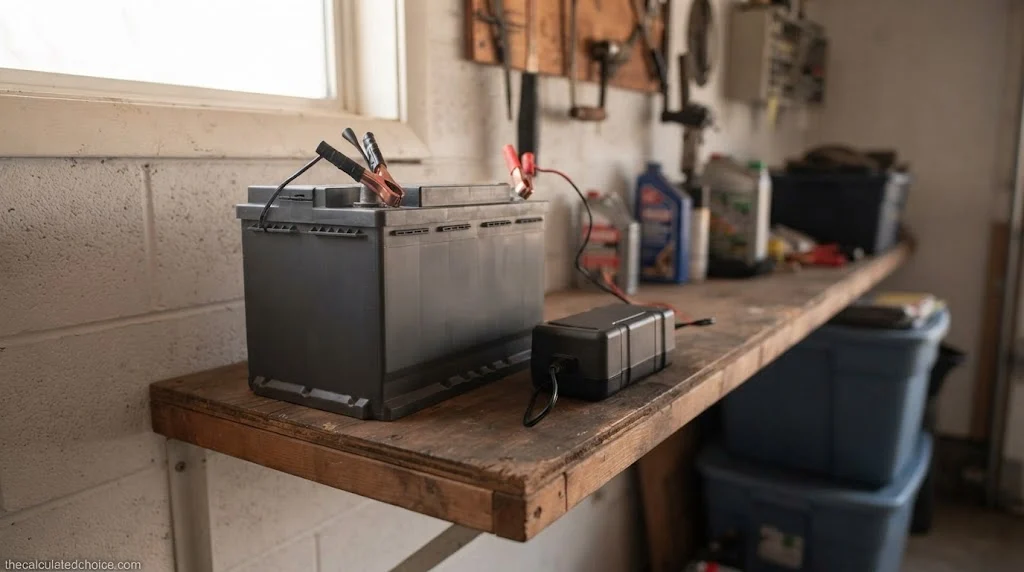
- Best storage setupThe most reliable approach for how to store a car battery over winter is to clean the posts, confirm a full charge, and keep the battery hooked to a multi-stage automatic maintainer in a ventilated garage.
- Storage without powerIf no AC wall outlet is nearby, charge the battery to 100%, remove the negative (-) cable clamp first (or move the battery to a dry indoor shelf), and test voltage every 60 to 90 days.
- Minimum voltage floorOptima says storage voltage should never drop below 12.4V, and NHTSA says to recharge a stored battery found below 12.5V.
- Concrete floor checkBattery Tender says modern battery cases prevent ground discharge, so a concrete floor is not what drains a battery.
Why cold storage ruins uncharged batteries
Cool air actually slows natural chemical self-discharge inside a disconnected battery compared with hot weather. Cold storage becomes destructive only when a battery is allowed to lose state of charge. Inside a fully charged lead-acid cell, the sulfuric acid electrolyte has a specific gravity of 1.265. As the battery discharges, acid reacts with the lead plates and lowers specific gravity toward pure water.
Figures from Battery Tender show that a 100% charged 12-volt battery (12.65V) resists freezing down to -76°F (-60°C), whereas a fully depleted battery freezes at 20°F (-7°C). Battery performance also drops with temperature: Battery Tender lists 100% at 80°F, 65% at 32°F, 40–50% at 0°F, and 25% or less at -22°F.
| State of Charge | Specific Gravity | Freezing Point | Storage Action |
|---|---|---|---|
| 100% (Full) | 1.265 | -76°F (-60°C) | Ready for cold storage; hold on float |
| 75% Charged | 1.225 | -35°F (-37°C) | Top up before parking |
| 50% Charged | 1.190 | -10°F (-23°C) | Sulfation builds; recharge right away |
| 25% Charged | 1.155 | 5°F (-15°C) | Freeze hazard in unheated spaces |
| 0% (Discharged) | 1.120 | 20°F (-7°C) | Freezes at 20°F; 9% expansion cracks case |
How to store a car battery over winter: in the car vs. on the bench
Planning how to store a car battery over winter starts with checking whether your parking spot has a live 120V AC wall outlet and how cold the storage bay gets.
When an AC outlet is available in a garage, keeping the battery bolted in the vehicle and connected to an automatic multi-stage maintainer avoids lifting a heavy case and preserves ECU settings, radio presets, and alarm memory. When storing a car in an unpowered shed or outdoor lot, disconnecting the negative cable—or bringing the battery indoors—stops continuous parasitic drain from pulling voltage below 12.4V.
Parasitic drain math: how fast a parked car drains a 70 Ah battery
Step 1: Daily drain = Continuous vehicle draw (25 mA to 75 mA, or 0.025 A to 0.075 A) × 24 hours = 0.6 Ah to 1.8 Ah per day.Step 2: Battery Tender says a healthy 70 Ah battery loses about 1.8 Ah to 5.2 Ah per month to self-discharge and parasitic draws. Worst case, a constant 75 mA draw would use about 54 Ah over 30 days by simple multiplication.Example: At the 75 mA upper bound (1.8 Ah/day), a 70 Ah battery loses half its capacity (35 Ah) in about 19.4 days (35 Ah ÷ 1.8 Ah/day), raising its freezing point from -76°F to -10°F.Parasitic draw figures (25–75 mA) and monthly discharge values from Battery Tender Cold Weather Maintenance Guide.
| Storage Environment | Best Setup | Inspection Schedule | Main Benefit & Trade-Off |
|---|---|---|---|
| Garage with AC outlet | Leave battery installed and hooked to a smart multi-stage maintainer | Continuous automatic float (glance at the charger indicator now and then) | Keeps computer memory intact and holds 100% charge; requires continuous wall power. |
| Unpowered garage (moderate cold) | Charge to 100%, then disconnect the negative (-) cable clamp in the vehicle | Check voltage with a multimeter every 60 to 90 days | Eliminates 25–75 mA vehicle drain without removing the battery; clears clock and radio presets. |
| Unheated shed or outdoor lot (severe cold) | Remove battery (for storage of 1 month or more) to a cool, dry indoor room | Check voltage every 60 days (recharge if below 12.5V) | Shields battery from extreme sub-zero cold; requires unbolting and carrying the battery. |
7 steps for how to store a car battery over winter safely
Complete these seven steps before leaving a vehicle parked for extended storage. Every voltage target, cleaning mixture, and torque value comes from manufacturer and federal service guides.
- Inspect the case and mounting hardware: Examine the plastic shell for cracks, bulging walls, or acid seepage. Verify that the hold-down bracket is secure so vibration cannot harm the plates.
- Measure rested open-circuit voltage after 2 hours: Shut off the engine and all electrical loads, wait 2 hours for surface charge to clear, and test the posts with a digital multimeter set to 20V DC. A full charge reads about 12.65V on a standard flooded battery (above 12.8V on an Optima REDTOP or BLUETOP SLI, and above 13.0V on a YELLOWTOP). Recharge any battery measuring under 12.5V before storage, and never let storage voltage fall below 12.4V.
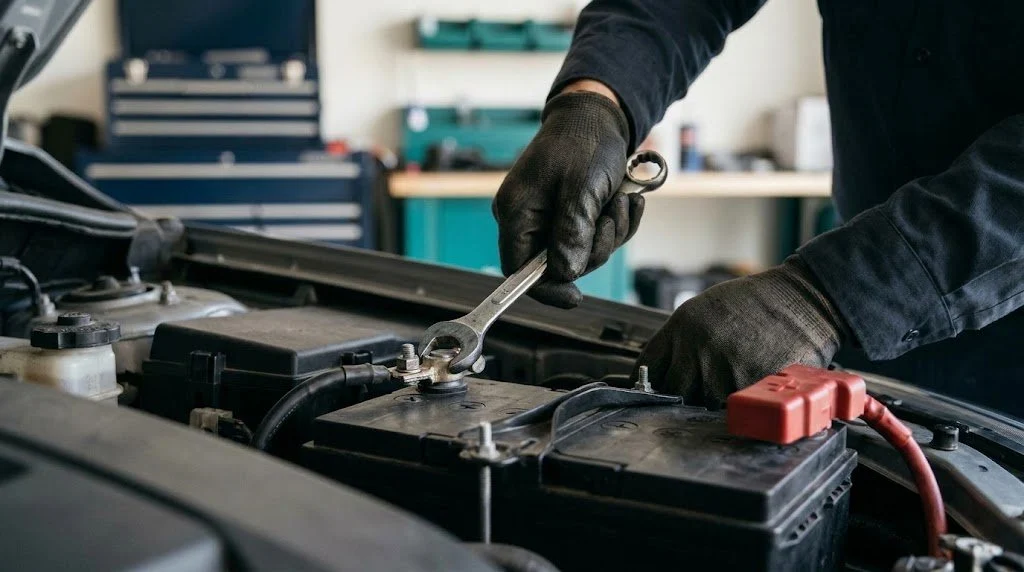
- Disconnect the negative (-) cable first when isolating or removing: Turn the ignition off, put on eye protection, and always loosen and detach the negative (-) cable clamp first, then the positive (+) clamp. Removing the grounded negative clamp first prevents short-circuit sparks if your wrench touches chassis metal.
- Scrub corrosion from terminals and case top: NHTSA Bulletin MC-10178796-0001 notes that a dirty battery case accelerates self-discharge. Clean the posts and clamps with a wire brush and a baking soda solution (1 tablespoon of baking soda mixed with 1 cup of water per NHTSA, or a 1:1 mixture for heavy buildup per Battery Tender). Rinse and dry with clean shop towels.
- Top up distilled water on non-sealed flooded cells: On conventional flooded batteries with removable caps, confirm electrolyte covers the lead plates by 1/4 to 1/2 inch (Battery Tender). Add only distilled water to low cells. Never open or add water to sealed AGM or gel batteries.
- Attach a voltage-regulated smart maintainer: Connect the positive (+) red lead first and the negative (-) black lead second (to chassis ground in the car or to the negative post on a bench battery), then plug into AC power. Optima Batteries specifies that float charging should be regulated at 13.2V to 13.8V at 1 amp maximum, while automatic multi-stage maintainers adjust voltage and current automatically.
- Check disconnected batteries every 60 to 90 days: If stored without a maintainer, check open-circuit voltage every 60 days (NHTSA, recharging below 12.5V) to 90 days (Clore Automotive), and never allow voltage to drop below 12.4V (Optima). When reconnecting cables, install the positive (+) clamp first and the negative (-) clamp last.
Cold storage myths and recovery checks
Outdated shop habits around how to store a car battery over winter frequently ruin otherwise healthy batteries. Here is what manufacturer engineering documentation states on three common storage myths.
- Myth: Concrete floors drain modern car batteries. Battery Tender states that modern battery cases prevent ground discharge. The real drains are parasitic electrical draws, battery age and temperature. Just keep the top surface clean and dry so moisture cannot conduct current between terminals.
- Myth: Idling the engine recharges a stored battery. Battery Tender notes that each cold start draws 200 to 400 amps from the battery, and CTEK says an alternator is designed to maintain a charge rather than fully recharge a depleted battery. A short idle is not a substitute for a proper charge from a maintainer.
- Myth: Charging a frozen battery warms it back to life. CTEK warns that charging a frozen battery can cause it to crack or even explode, and advises letting it thaw naturally before charging it with a smart charger.
What to buy
When planning how to store a car battery over winter, skip the unregulated trickle charger that pushes continuous current and boils out electrolyte, and choose an automatic multi-stage battery maintainer with these features:
- Multi-stage charging with regulated float (13.2V to 13.8V): Automatically tapers current during absorption and drops to a safe float or pulse stage for indefinite connection.
- Right amperage (1A to 5A): A 1A to 1.25A unit is enough to hold a topped-off battery, while a higher-output unit also recharges a depleted battery faster.
- Temperature compensation and quick-connect eyelets: Adjusts charge voltage for cold garages and lets you bolt a fused ring-terminal harness permanently to the battery posts. Compare our Keepa-checked top picks in our guides to the best battery maintainer for classic cars and the best battery maintainer for winter storage.
How we researched this guide
To write this guide on how to store a car battery over winter, we reviewed published electrochemistry data, service bulletins, and operator manuals from battery and charger makers alongside federal safety rules.
Sources: Battery Tender Cold Weather Science, Optima Storage FAQs, NHTSA Battery Maintenance Bulletin, OSHA Battery Charging Safety
Bottom line: Knowing how to store a car battery over winter comes down to keeping the battery fully charged and never letting it fall below 12.4V, so the electrolyte stays far from its freezing point. Whether you leave the battery installed on a multi-stage float maintainer or disconnect the negative cable and test voltage every 60 to 90 days on a dry shelf, following this checklist for how to store a car battery over winter ensures reliable starting power when storage ends.
Once you know how to store a car battery over winter, the next question is what to do if the battery is already weak when the season ends. Our guides on how to jump start a car with another car and how many cold cranking amps you need cover the next step, and the car battery care guide covers routine upkeep. For the charger itself, see battery maintainer vs trickle charger.
Frequently asked questions
Should I disconnect my car battery for winter storage or use a battery maintainer?
At what temperature does a car battery freeze in winter storage?
Will storing a car battery on a concrete floor drain it?
Which battery terminal do I disconnect first for storage?
How often should I charge a disconnected car battery during storage?
Can I charge a car battery if it freezes during cold storage?

Researched by Shahzad
Amazon seller who researches products using sales-rank history, price tracking and owner reviews before recommending anything. Read our disclosure.