
We may earn a commission when you buy through links on this page, at no extra cost to you. It never decides what we recommend. How we make money
Finding the best jump starter for cold weather comes down to one number most listings bury: the operating temperature. Many popular lithium packs are only rated down to 14°F, which means they are outside their own rated range on exactly the mornings you need them. We read the manufacturers’ manuals, checked months of sales-rank and price history, and kept only packs with a published low-temperature rating of 0°F or colder. Three passed — including one that has no battery inside at all.
Best jump starter for cold weather: quick picks
- Best overallClore Jump-N-Carry JNC325 — rated to operate down to −10°F, UL 2743 certified, covers gas engines up to 8.0L.Check price →See review ↓
- Best for extreme coldAutowit SuperCap 2 — supercapacitor design rated down to −40°F, with no internal battery to keep charged.Check price →See review ↓
- Best budgetClore Jump-N-Carry JNC305 — rated down to 0°F, usually under $100, sized for cars and small SUVs.Check price →See review ↓
Side-by-side comparison
| Spec | Clore JNC325 | Autowit SuperCap 2 | Clore JNC305 |
|---|---|---|---|
| Best for | Best overall Top pick | Extreme cold | Budget |
| Power source | Lithium-ion, 74 Wh | Supercapacitors (no battery) | Lithium-ion, 37 Wh |
| Lowest operating temperature | −10°F | −40°F | 0°F |
| Charging temperature | 40°F to 140°F | Charges in use from the car | 32°F to 108°F |
| Gas engine rating | Up to 8.0L | Up to 7.0L (brand site) | Up to 6.0L |
| Diesel engine rating | Up to 6.0L | Up to 4.0L | Up to 3.0L |
| UL 2743 | Yes (SGS-certified) | Not listed | Yes (per Clore) |
| Needs regular recharging | Yes | No | Yes |
| Price band | $$$ | $$ | $ |
| Price | Check price | Check price | Check price |
Specifications for every cold weather jump starter on this list come from each manufacturer’s manual or product page. Where a brand publishes conflicting figures, we use the more conservative one and say so in the review.
Why cold weather is hard on jump starters
Cold attacks from both sides at once, which is why a cold weather jump starter has a harder job than a summer one. According to AAA’s Automotive Research Center, a car battery loses about 35% of its strength at 32°F and about 60% at 0°F, while the engine needs more current to turn over thick, cold oil. So the car needs more help at the same moment the help is weakest. If your battery is near the end of its life, our guide to the best car battery for cold weather compares replacements by CCA and warranty.
The jump starter suffers too. Lithium-ion packs deliver less current when their cells are cold, and every manufacturer sets a temperature floor below which the pack is not rated to work at all. That floor is the single most useful spec when you choose a cold weather jump starter — and it varies far more than peak-amp claims suggest. Among the packs we reviewed for our best jump starter for V8 trucks guide, two popular models were only rated down to 14°F.
How we chose the best jump starter for cold weather
Not sure how much power your engine needs? The jump starter size calculator factors in your climate, and our guide to peak amps vs cranking amps explains why the biggest number on the box is not the one that matters on a frozen morning.
1. Clore Jump-N-Carry JNC325 — best overall
Clore Jump-N-Carry JNC325
Best for: most drivers with real winters, including gas V8 trucks
Clore Automotive builds its Jump-N-Carry line for repair shops and tow operators, and the JNC325 is its lithium pack. Clore’s operator’s manual lists an operating range of −10°F to 140°F, the widest of any lithium pack that passed our checks. It is rated for gasoline engines up to 8.0 liters and diesel engines up to 6.0 liters, which covers nearly every car, SUV and gas pickup.
It also has the strongest safety paperwork here: Clore states the JNC325 was certified by SGS laboratories to the UL 2743 standard for portable lithium jump starters. Long 24-inch, 6 AWG cables help when a battery sits deep in a snowy engine bay, and an override button lets it start a battery that reads completely flat.
The catch is charging. Clore’s manual says the JNC325 charges only between 40°F and 140°F, and recommends storing it above 50°F for best performance. In practice, that means bringing it inside to recharge rather than leaving it in the trunk all winter.

What we like
- Verified UL 2743 certification through SGS
- Rated to −10°F — best of the lithium packs here
- Covers gas engines up to 8.0L and diesels up to 6.0L
- Long 24 in, 6 AWG cables
- Sold by Amazon with steady sales in our tracking
Watch out for
- Will not charge below 40°F
- Costs about twice as much as the JNC305
- Far fewer reviews than mass-market brands
- Needs a top-up every few months like any lithium pack
2. Autowit SuperCap 2 — best for extreme cold
Autowit SuperCap 2
Best for: places where winter regularly drops below 0°F
The SuperCap 2 works differently from every other pack on this list. Instead of a lithium battery, it uses supercapacitors. When you connect it, it pulls the leftover energy out of your weak battery for a couple of minutes, stores it, then releases it all at once to crank the engine. Autowit rates it to work from −40°F to 158°F — a range no lithium pack we found can match.
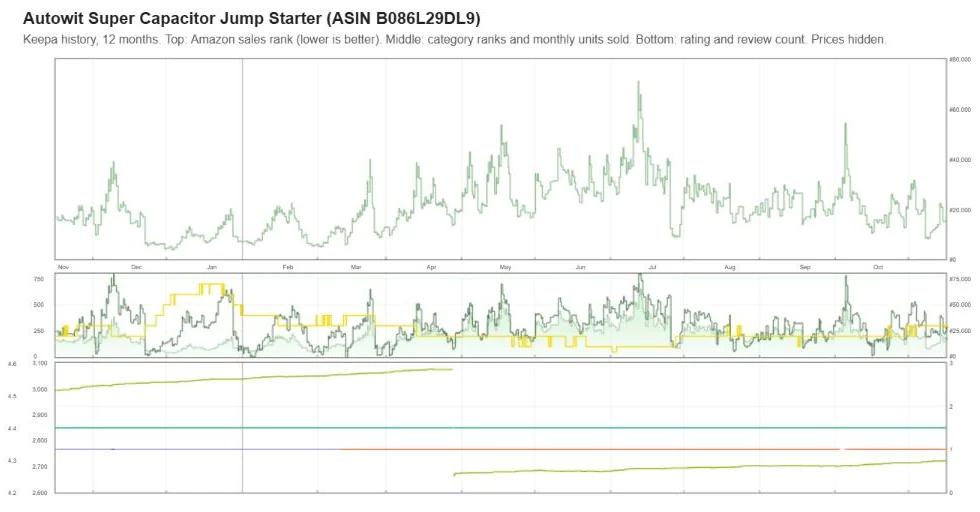
Because there is no battery inside, there is nothing to self-discharge. It can sit in a frozen car for months and still be ready, which is exactly where lithium packs struggle. In our Keepa tracking it has sold steadily for years, with a long, consistent review history, and its price moves in a regular sale cycle, so it pays to buy at the low point.
Two cautions. First, it needs some energy to work with: if your battery is completely drained, you must feed it from a USB power bank, a 12V socket or another car before it can help. Second, Autowit’s own website rates it for 7.0L gas engines, while the Amazon listing says 8.0L. We use the lower number, which still covers most cars and many V8s but leaves little margin on the biggest trucks.
What we like
- Rated to −40°F, the widest range we found
- No battery to keep charged or wear out
- Can live in the car all winter
- Long sales and review history
Watch out for
- Cannot help a fully drained battery without another power source
- Takes a few minutes to charge before each start
- Conflicting gas engine ratings between brand site and listing
- No UL 2743 certification listed; no power bank or flashlight
3. Clore Jump-N-Carry JNC305 — best budget
Clore Jump-N-Carry JNC305
Best for: cars and small SUVs in moderate winters
The JNC305 is Clore’s compact lithium pack, rated for gasoline engines up to 6.0 liters and diesels up to 3.0 liters. Its manual lists an operating range of 0°F to 108°F — 14 degrees colder than the popular packs that stop at 14°F — and Clore describes it as UL 2743 compliant.
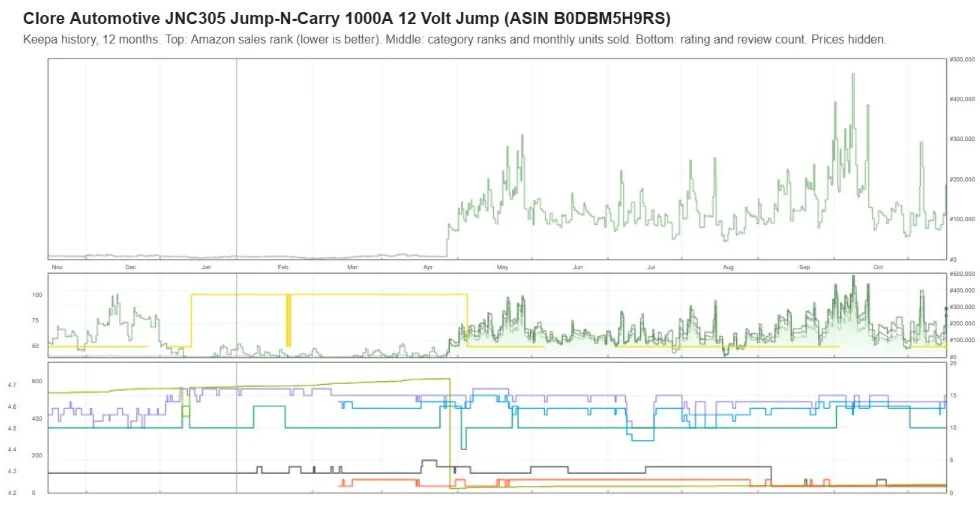
In our price tracking it has held a steady price, usually under $100, sold and shipped by Amazon. Clore’s manual adds an honest note we rarely see: in very cold conditions the unit may not start the car on the first try, and a second or third attempt warms the internal battery and improves the odds.
It is newer and far less reviewed than the other picks, with only a few dozen ratings, and its 37 Wh battery is half the size of the JNC325’s. It also stops charging below 32°F. For a sedan or small SUV in a place where winter rarely goes much below zero, it is the most sensible way to get a trusted brand at a low price.
What we like
- Trusted brand at a budget price
- Rated to 0°F, colder than many popular packs
- UL 2743 compliance stated by Clore
- Stable price, sold by Amazon
Watch out for
- Small 37 Wh battery
- Not enough for V8 trucks or larger diesels
- Only a few dozen reviews so far
- Will not charge below 32°F
The storage rule most buyers miss
Even a cold weather jump starter rated to −10°F performs best when it starts warm. Clore’s manuals recommend storing Jump-N-Carry units above 50°F for optimum performance, and all lithium packs lose charge faster when they sit in the cold. In winter, the most reliable setup is simple: keep the pack charged indoors, bring it with you when you drive, and keep it in the cabin rather than the trunk. For the year-round version of this routine, see can you leave a jump starter in your car. If a pack refuses to recharge after a cold spell, our guide to why a jump starter won’t charge walks through the fixes in order. The same cold mornings take air out of your tires too; our guide to tire pressure in cold weather shows how much to expect and how much air to add.
If you cannot do that — a work truck parked outside, or a second car that sits for weeks — that is where the Autowit SuperCap 2 earns its place as the cold weather jump starter for vehicles stored outside, because it does not rely on stored charge. And whatever you buy, never try to charge or jump a battery that is frozen solid, cracked or bulging. Our guide on how to use a jump starter safely covers the checks to do before you connect the clamps. If you are worried about modern electronics, we also explain whether a jump starter can damage your car and how to avoid it. For a car that sits for weeks in the cold, a small maintainer is cheaper insurance than any jump starter, and our battery maintainer vs trickle charger guide explains which one is safe to leave connected.
Which cold weather jump starter fits you?
| Your situation | Our pick |
|---|---|
| Car, SUV or gas pickup; you can charge the pack indoors | Clore JNC325 |
| Winters regularly below 0°F, or the pack must live in the vehicle | Autowit SuperCap 2 |
| Sedan or small SUV, moderate winters, tight budget | Clore JNC305 |
| Diesel pickup (6.6L–6.7L) | None of these — see our V8 truck picks and store the pack warm |
What we left out, and why
NOCO Boost GB40 and GB50. NOCO publishes a −4°F operating rating and the Boost line has a strong reputation. But when we researched this guide, our Keepa tracking showed no new-condition offers on Amazon — only used units. We do not recommend products you cannot buy new, and we re-check when stock returns. When we re-checked, Amazon was selling both new again; the GB40 is now the top pick in our best jump starter for small cars guide and the GB50 in our best jump starter for SUVs guide.
Schumacher DSR132. A pro-grade ultracapacitor hybrid rated from −40°F, but it was not listed on Amazon when we checked. Autowit SuperCap 2 Lite. The smaller model’s listing had no active offers. TOPDON JS2000Pro and JS3000. Good packs, but both manuals rate them only down to 14°F.
Lead-acid jump boxes. Heavy lead-acid units have a reputation as the default cold weather jump starter, yet Clore’s own manual for its lead-acid JNC660 recommends storing it above 50°F and says cold reduces its output. They are not a shortcut around the cold. Our lithium vs lead-acid jump starter comparison covers the full trade-off, and if you are weighing a pack against a set of cables, see jump starter vs jumper cables. Shopping on a tighter budget? Our best jump starter under $100 guide compares three packs that passed the same checks.
Frequently asked questions
What is the best jump starter for cold weather?
Do lithium jump starters work in freezing weather?
Can I leave a jump starter in my car in winter?
Are supercapacitor jump starters better in the cold?
How cold is too cold to use a jump starter?
Why does my car battery die in cold weather?
How we researched this guide
We started from the cold-weather specs in each manufacturer’s manual, then reviewed several months of sales-rank and price history on Keepa for every candidate. Products had to pass all six checks above and be available new on Amazon at the time of research. No brand paid to be included, and we did not receive free products.
Sources: Clore JNC325 operator’s manual · Clore JNC305 operator’s manual · Autowit SuperCap 2 · NOCO GB40 user guide · AAA on cold-weather batteries

Researched by Shahzad
Amazon seller who researches products using sales-rank history, price tracking and owner reviews before recommending anything. Read our disclosure.