
We may earn a commission when you buy through links on this page, at no extra cost to you. It never decides what we recommend. How we make money
Why does my car battery keep dying? Almost always it is one of four things: the battery is worn out, something is draining it while the car is parked, the charging system is not refilling it, or the car is not driven long enough to recharge. The trick is figuring out which one, without buying parts you do not need.
This guide is for US drivers stuck in the jump-start loop. The fastest clue is when the battery dies, so we start there. Then we show how big a drain has to be to kill a battery overnight versus in a month, how to find a drain with a multimeter, and what to check when even a brand-new battery keeps dying.
Why your car battery keeps dying: the short answer
- Dead overnight Something big is staying on: a light, a stuck relay or a module that never sleeps.
- Dead after a few days parked A moderate drain, or a battery too weak to ride out normal standby draw.
- Dead after weeks parked Often normal; Interstate says a parked battery can last about four weeks to two months.
- Dies while driving or lights dim Charging problem; Fluke’s normal running range is 13.7 to 14.7 volts.
- Normal parked draw Under 50 mA is normal and over 100 mA is suspect, per Fluke.
- Only after short trips The alternator never gets time to refill what starting took.
- New battery dying too The original cause was never fixed. Test before replacing again.
Why does my car battery keep dying? Start with when it dies
Most guides hand you a list of ten causes. That list is accurate, but it does not tell you where to look first. The timing of the failure does. Match your pattern to a row below, then jump to the check in the last column.
| What happens | Most likely cause | Check first |
|---|---|---|
| Dead the next morning, again and again | A large drain: a light, a stuck relay, an aftermarket accessory or a module that will not sleep | Parasitic draw test |
| Starts fine daily, dead after 3 to 7 days parked | A moderate drain, or a weak battery that cannot cover normal standby draw | Load test the battery, then a draw test |
| Dead only after several weeks parked | Normal standby draw doing its job | Use a battery maintainer while parked |
| Dims or dies while driving; battery light on | Charging system: alternator, drive belt or wiring | Voltage with the engine running |
| Struggles after short trips, fine after a highway drive | Undercharging | Change the driving pattern or charge weekly |
| Fails on the first cold morning | An old or weak battery losing its margin | Load test and check the battery’s age |
| Brand-new battery keeps dying | The original cause is still there | Charging system, draw test and terminals |
The usual reasons a car battery keeps dying
1. The battery is simply worn out
AAA puts a typical lead-acid battery at three to five years and an AGM at five to seven. Near the end, a battery can still read close to normal voltage yet have too little capacity left to survive a cold night or a few days of standby draw. If it also refuses to take a charge on a charger, see car battery won’t charge. A load test is what tells you. Our guide to the signs of a bad car battery walks through each symptom and how to confirm it.
2. Parasitic drain while the car is off
Every modern car draws a little current when parked to keep the clock, alarm, radio presets and computer memory alive. That is normal. The problem is when something stays awake: a glovebox or trunk light, a stuck relay, a phone charger in an always-on outlet, a dash camera, or a module that never goes to sleep. Fluke’s guidance is that under 50 milliamps (mA) is normal and over 100 mA is suspect.
3. The charging system is not keeping up
The alternator recharges the battery while the engine runs. If it is weak, the drive belt is slipping, or a cable connection is bad, the battery slowly drains even on long drives. A battery warning light on the dash or headlights that dim at idle are common clues.
4. Too many short trips
Starting the engine takes a big gulp of energy. AAA notes that on short drives the battery may not fully recharge, and both Firestone and AAA list frequent short trips as a cause of early battery failure. If your car mostly does two-mile errands, this alone can explain a battery that keeps dying. Our guide on how long to drive to charge a car battery puts numbers on it. An overnight session on a smart charger puts that energy back; see how to charge a car battery at home.
5. It sits too long between drives
Even normal standby draw empties a battery eventually. Interstate says a car battery can last about four weeks to two months parked before it dies, and AAA gives a similar month or two. A weaker battery reaches that point much sooner.
6. Loose or corroded terminals
A white or bluish crust on the terminals, or a clamp you can twist by hand, can stop the battery from charging fully and from delivering power. AAA recommends cleaning the terminals every three to six months or whenever buildup appears.
Follow our step-by-step guide on how to clean car battery terminals to neutralize crusty buildup and tighten the clamps to spec.
7. Heat and cold
Heat wears a battery out faster. Cold is when you find out, because a cold engine needs more power to start and a cold battery delivers less. That is why so many batteries die on the first cold morning after a hot summer.
8. The wrong battery for the car
If your car came with an AGM and got a cheaper flooded battery, or if a European car’s new battery was never registered, the charging system can undercharge it or the battery can fail early. Our AGM vs flooded battery guide explains which swaps are safe.
How fast a drain kills a battery: days-to-dead math
“Small drain” and “big drain” mean little until you put numbers on them. Here is the math we use to connect a draw reading to how long the car will sit before it will not start.
Days until trouble = usable amp-hours ÷ (draw in amps × 24)
Example battery: 60 amp-hours (Ah). Check your own label; many list Ah or reserve capacity.Usable before starting gets doubtful: about half, or 30 Ah (our planning rule; a rested battery near 12.2 volts is about 50% charged)25 mA draw = 0.6 Ah a day → about 50 days · 50 mA = 1.2 Ah a day → about 25 days100 mA = 2.4 Ah a day → about 12 days · 300 mA (a light left on in the glovebox or trunk) = 7.2 Ah a day → about 4 days1 amp (a stuck relay or a module that never sleeps) = 24 Ah a day → dead in about a dayOur 50 mA result, about 25 days, lines up with Interstate’s four weeks to two months for a parked car, which is a useful sanity check. If your battery is already weak or only half charged, cut every number in half. Cold weather shortens them further.
Read the table backward and it becomes a diagnosis. A battery that dies overnight needs a draw of roughly an amp or more, which is far beyond normal. A battery that lasts a week is seeing a few hundred milliamps, or it started out weak.
How to find what is draining your car battery
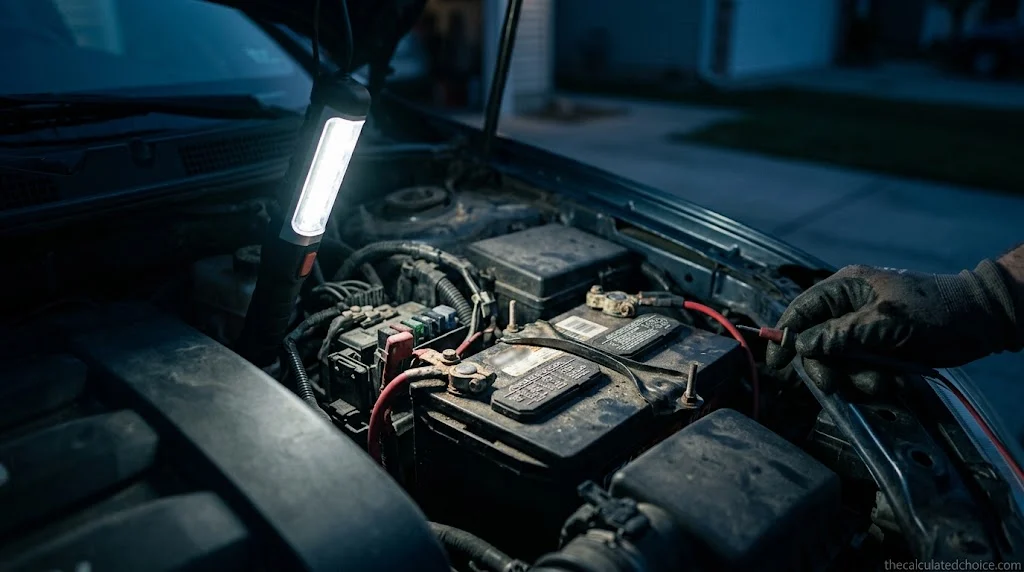
A parasitic draw test uses a digital multimeter set to measure current, wired in series with the battery. This is the method Fluke describes. Read your owner’s manual first; some cars need a security code or a relearn after the battery is disconnected.
- Prepare the car. Engine off, key out, accessories and lights off, doors closed. If you need a door open to reach the hood release, latch the door switch closed.
- Let it sleep. Wait 10 to 45 minutes so the modules shut down, per Fluke.
- Set the meter. Black lead in COM, red lead in the 10A jack, dial on DC amps.
- Connect in series. Remove the negative battery cable. Touch the red lead to the negative battery post and the black lead to the cable end, so all current flows through the meter.
- Read it. Under 50 mA is normal and over 100 mA is suspect. Fluke suggests switching to the mA jack for a finer reading once the current is below 400 mA.
- Isolate the circuit. Pull fuses one at a time. When the reading drops sharply, that fuse feeds the problem. Check its wiring, relays, switches and modules.
If you have not used a meter on a car before, our step-by-step guide on how to test a car battery with a multimeter covers the basic voltage checks first.
Check the charging system in two minutes
With the engine running, put the meter on DC volts across the battery posts. Fluke gives 13.7 to 14.7 volts as normal with the engine running. Firestone gives a slightly lower range of 13.5 to 14.5 volts, so treat anything in the high 13s or low 14s as healthy and a reading clearly below 13.5 volts as a reason to have the alternator and belt checked.
Turn on the headlights, blower and rear defroster and watch the reading. A healthy system holds steady above the battery’s resting voltage. If it sinks toward 12 volts, the battery is supplying the load instead of the alternator.
One caveat for newer cars: some use smart charging that moves running voltage outside the classic range on purpose. Firestone notes that some modern alternators can read anywhere from 12.0 to 15.8 volts. If your car is newer and the reading looks odd but nothing else is wrong, check the service information for your model before buying an alternator.
Skip the old trick of pulling a battery cable with the engine running to “test” the alternator. A voltmeter reading tells you more and puts nothing at risk.
Why a new car battery keeps dying
This is one of the most common searches on the topic, and the answer is usually frustrating: the battery was not the root problem. A new battery hides a drain or a charging fault for a while, then dies the same way. Before you buy another one, run through this list:
- Charging voltage with the engine running, as above.
- Parasitic draw after the modules sleep.
- Clean, tight terminals at both ends of each cable, including the ground to the body or engine.
- Correct battery type and size, and registration if your car requires it.
- Your driving pattern. A new battery on a short-trip car can still run down.
Also ask whether the battery was fully charged when it went in. Interstate notes that a battery dated more than six months before you bought it was likely sold drained. A battery that starts its life partly discharged and then lives on short trips may never catch up.
How to stop your car battery from dying
- Fix the cause first. Use the timing table above to pick the right test.
- Drive long enough, often enough. AAA suggests at least 20 minutes once a week; Interstate suggests at least 30 minutes at highway speeds weekly; Firestone mentions 15 minutes weekly. Longer is safer.
- Use a smart maintainer if the car sits for weeks. Our comparison of a battery maintainer vs trickle charger explains why a maintainer is the safer choice.
- Turn off what you can: USB chargers in always-on outlets, dash cams without a low-voltage cutoff, and interior lights.
- Test the battery yearly once it is three years old, as AAA recommends, and before winter.
Car battery keeps dying: myth vs fact
| Myth | Fact |
|---|---|
| “A battery that reads 12.6 volts is fine.” | Voltage shows charge, not health. A worn battery can read normal and still fail a load test. |
| “Any drain at all is a problem.” | Every modern car draws some current when parked. Fluke calls under 50 mA normal. |
| “Idling for 10 minutes recharges it.” | Idling and short trips may not refill what a start took. AAA and Interstate both recommend longer drives. |
| “A new battery will fix it.” | Only if the old battery was the cause. Test the charging system and draw first. |
| “Jump it and it is fixed.” | A jump only gets the engine running. The battery still needs a full charge and a test. |
If you would rather know than guess, a good battery load tester settles the “is it the battery?” question in under a minute. Our best car battery tester picks passed our sales-history and spec checks.
Once the terminals are clean, a protector spray or felt washer helps keep the corrosion from coming back. See our picks for the best battery terminal cleaner and protector.
Car battery keeps dying FAQ
What drains a car battery when the car is off?
How do I find out what is draining my car battery?
How do I fix a car battery that keeps dying?
How do I stop my car battery from draining?
Why does my new car battery keep dying?
How long can a car sit before the battery dies?
Why does my car battery keep dying in the cold?
How we researched dying car batteries
We took the parasitic draw limits and the test method from Fluke’s multimeter guide, parked-battery life and driving advice from Interstate Batteries, battery life, short-trip and terminal guidance from AAA, and the list of common drains and the alternator range from Firestone. Where sources give different numbers, such as running voltage and how long to drive each week, we show each one. The timing table and the days-to-dead math are our own work; the 60 Ah battery and the half-capacity point are planning assumptions, labeled as such. We did not hands-on test any vehicle for this article, and no brand paid for or reviewed it.
Sources: Fluke: finding parasitic battery drain · Interstate: sitting car batteries · AAA battery maintenance tips · Firestone: things that drain a car battery

Researched by Shahzad
Amazon seller who researches products using sales-rank history, price tracking and owner reviews before recommending anything. Read our disclosure.